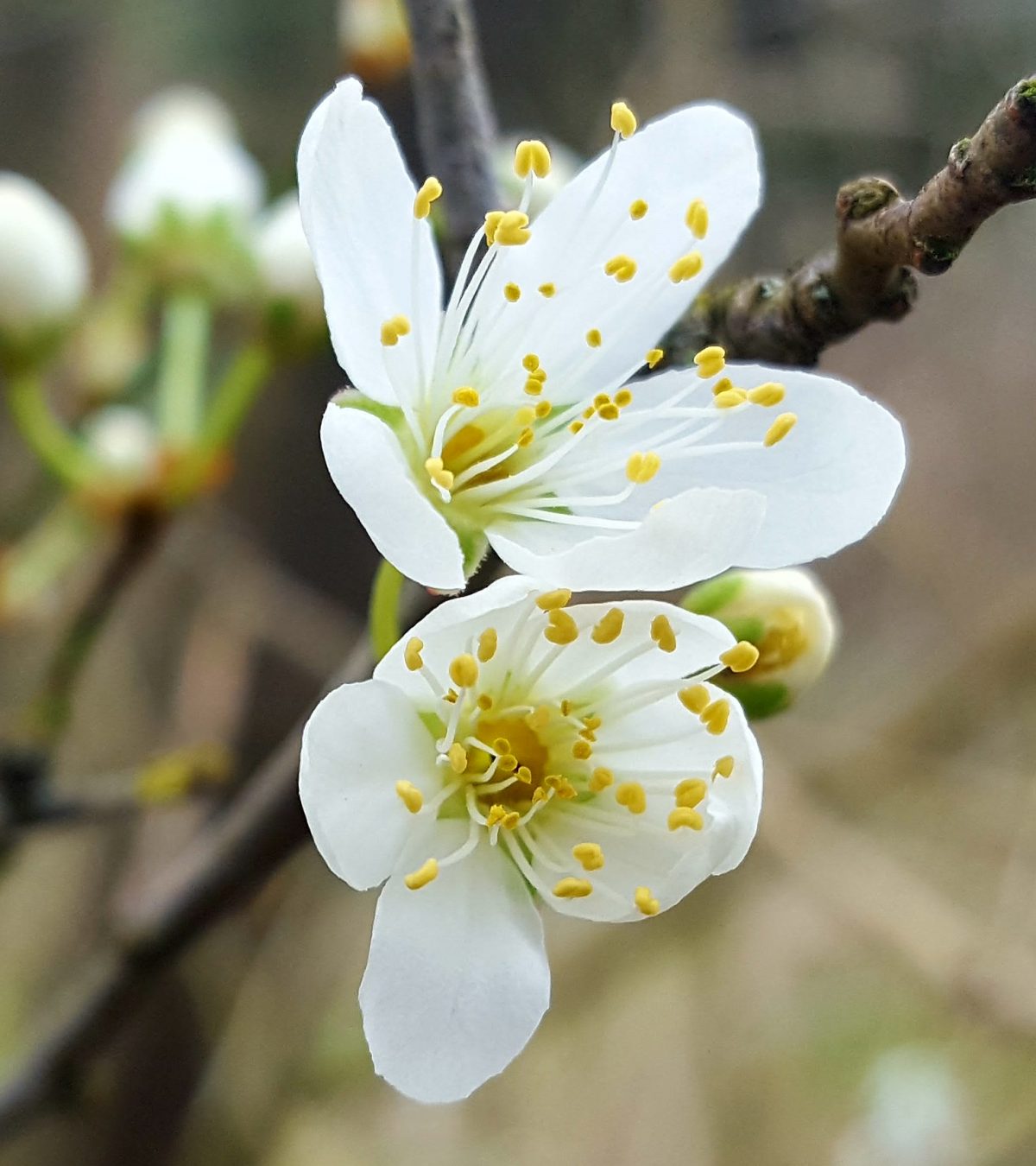
Foraging blackthorn flowers (Prunus spinosa) Rosaceae family

A guide to foraging blackthorn flowers and capturing their almond-like scent in cooking.

Our photographic guide to foraging blackthorn flowers will quickly show you how to confidently identify this almost ever-present hedgerow species, also commonly known as the tree that gives us sloe fruits.

Certain trees evoke quite strong feelings and emotions in me, catching my full attention and almost demanding I come closer, to touch, smell and taste them. I make no apologies here for repeatedly mentioning that you always need to engage each and every one of your senses when foraging!

Identifying trees in the winter can be impossible unless you know the form of the tree really well, or are prepared to start looking really closely at the minute features.

When you are starting out, study all of the plant parts. Observe the buds, and their arrangement on the stem. Are they opposite or alternately spaced? Look at the young bark and the older bark, as well as the branches. Always take note of their lenticels, including size, shape, colour, and patterning.

While its true that many other shrubs and trees in Britain have thorns, and believe me I have bled from most of them…none are quite as vicious as blackthorn can be.
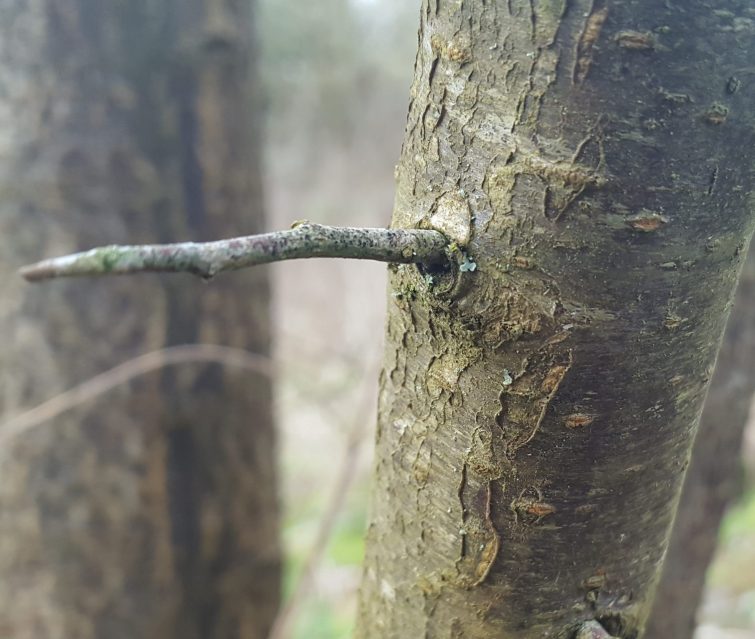
Take extra care when foraging blackthorn flowers. Its spines can be particularly nasty if you snag yourself on one!
Take care when foraging blackthorn flowers, as the spines can be extremely painful!

Warning! Although the plant is not poisonous to eat, the spines can potentially be really nasty if you accidentally puncture your skin with one. Take extra care when you are foraging blackthorn flowers, and wear strong gardening gloves for extra safety if you fancy.
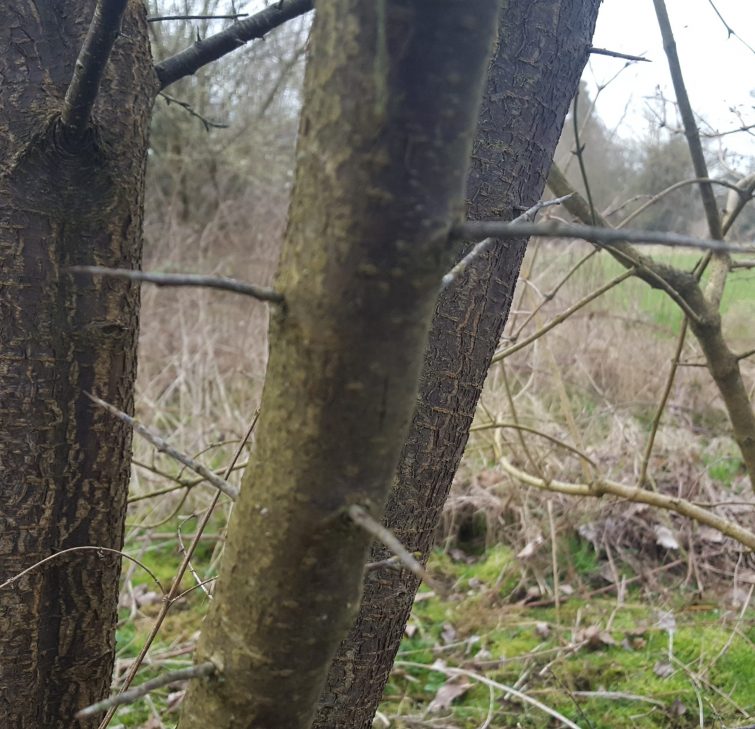
The blackthorn definitely lives up to both its scientific and English common names
Spiny by name, thorny by nature, blackthorn lives up to both its names!

Microbes living on blackthorn spines are thought to infect your blood, and if left unchecked and untreated, blackthorn punctures, esprcially where some plant material remains in the body, has in the past, led to sepsis and death.

However, these Vets and equine hospital specialists in Leicestershire, believe the pain and swelling comes from an array of alkaloid substances on the spines. Stay alert and safe!

All change in the hedgerow

In the warmer, protected regions of Britain, from late February and early March, this plant transforms itself in front of your eyes. From a hard, wiry-spiny, uninviting thing, comes a soft and fluffy-looking, sweet-smelling, late-winter wonder.
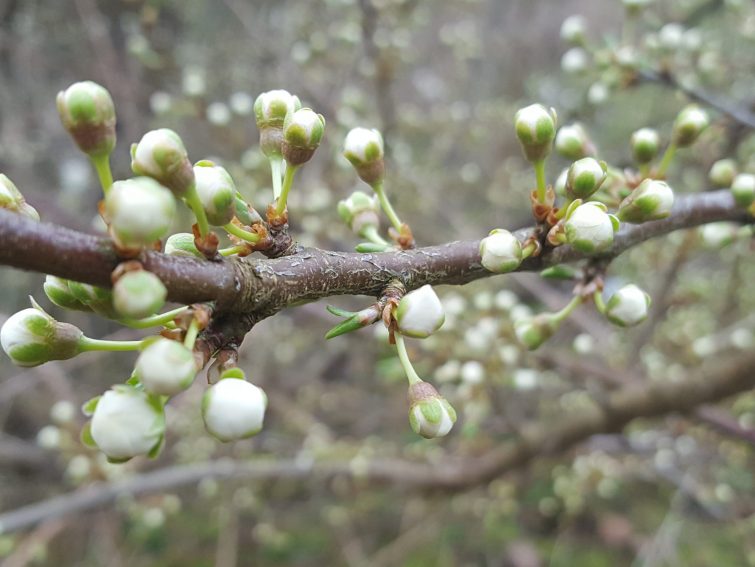
In the space of a few days, blackthorns transform from uninviting to warming the cockles of my heart.
In just a few days, blackthorn transforms from an uninviting plant to one that warms the cockles of my heart.

I absolutely adore the scent of the flowers! When wandering past a blackthorn tree on a sunny warm day in March, it makes me want to eat Bakewell tarts, and drink Amoretto and Brandy hot chocolate!
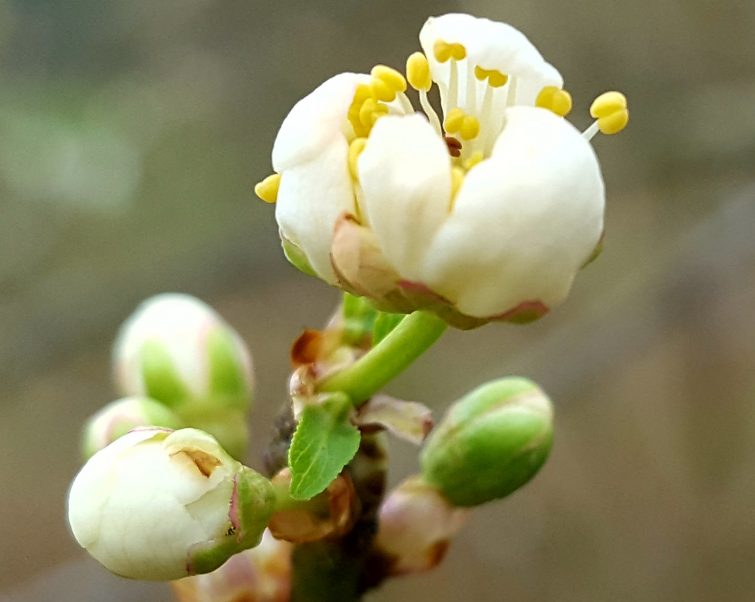
Bud burst on blackthorns tell me that spring is here
Bud burst on blackthorns gently infuse rhe air with almond scent and tell me that spring is here.

Whats in a name?

The generic part of the scientific name Prunus is the old Latin name for plums – Pruñus, which is the plural of Prune. This name is now given to a number of species producing stone fruits that are botanically classed as drupes. The name was taken from the old Greek word – Pruónē, which itself can apprantly be traced back to a borrowed word from langauges in the area of the middle East previously called Asia minor.

The speficic epithet spinosa, tells us that this plant will be covered in thorns or spines.

Its common name blackthorn also tells us about its chief defense mechanism, as well as referencing the dark colour of its branches and bark.

Blackthorn botanical description

Leaves: Obovate to laneolate-elliptic in shape and quite small (approximately 2 – 1o cm long). Typically they are rolled when emerging. Sometimes minutely hairy, the leaves have numerous small teeth (anywhere between 20 to 40) on the margins.
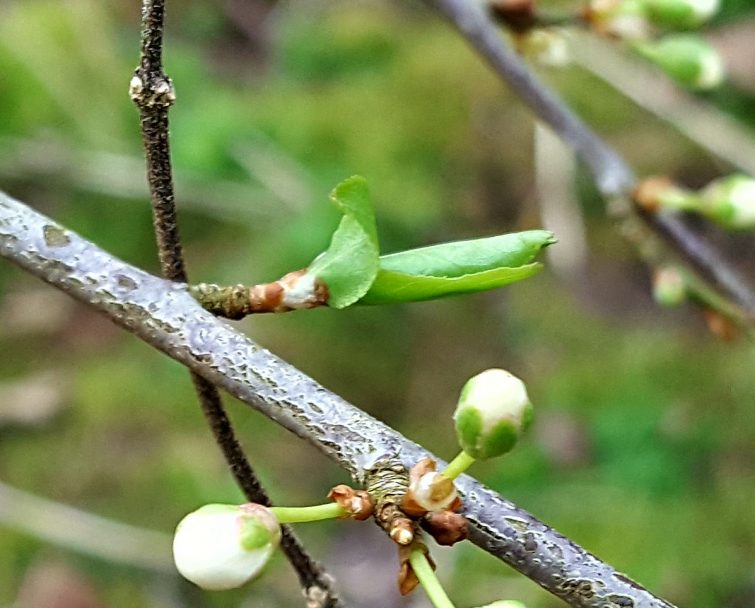
New leaves appearing on blackthorn are usually rolled when emerging.
The new blackthorn leaves are usually rolled when emerging, typically coming after the flowers.

Petioles: This is quite short on the blackthorn. Usually between 2 – 10 mm long. Look out for the linear-shaped stipules at the base.

Twigs: Dark, occasionally downy, and purple-looking when they’re found with the pruinose coating on the twigs, as seen below. This thin layer of specialist protective cells is found on many unrelated plants. Over time, it will come away. The twigs often branch at 45° and 90° angles.
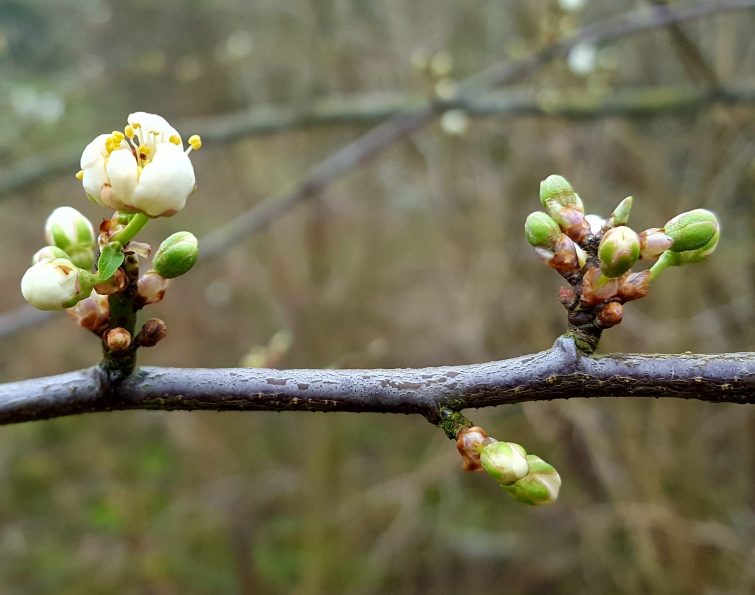
Toung blackthorn twigs will usually display a purple-coloured, pruinose coating. This will peel off in due course
Young blackthorn twigs are usually coated with a protective, purple-coloured, pruinose covering!

Buds: Oval-shaped, scaly, and brown. These soon turn into small pin-pricks of white and green as we pass imbolc in February.

Bark: On branches and trunks from about 4 or 5 years old, the bark becomes dark, rough and spotted with brown-orange lenticels.
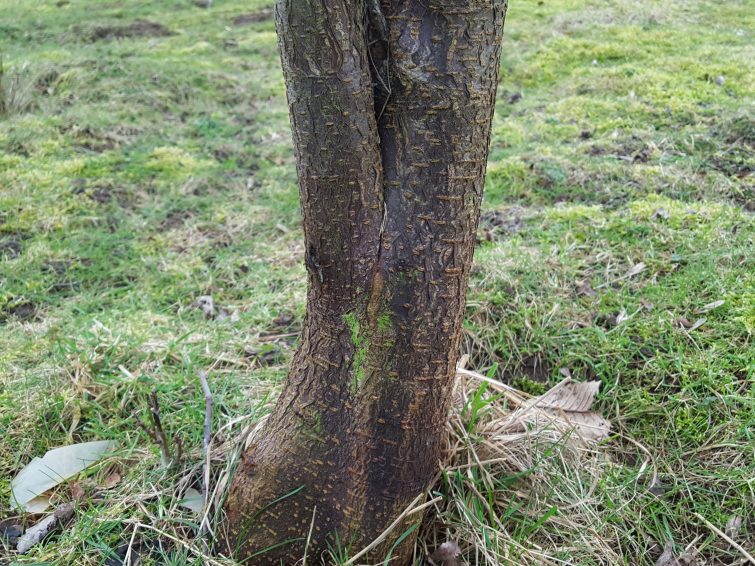
The trunks of blackthorn are sometimes multi-stemmed and often with suckers near to them.
Blackthorn trunks are sometimes multi-stemmed and often with suckers right by them.

Wavy ripples appear on older branches and the young trunk. This gives way on older trunks to the familiar dark brown bark, with numerous lentils displaying as bands of thin orange stripes.
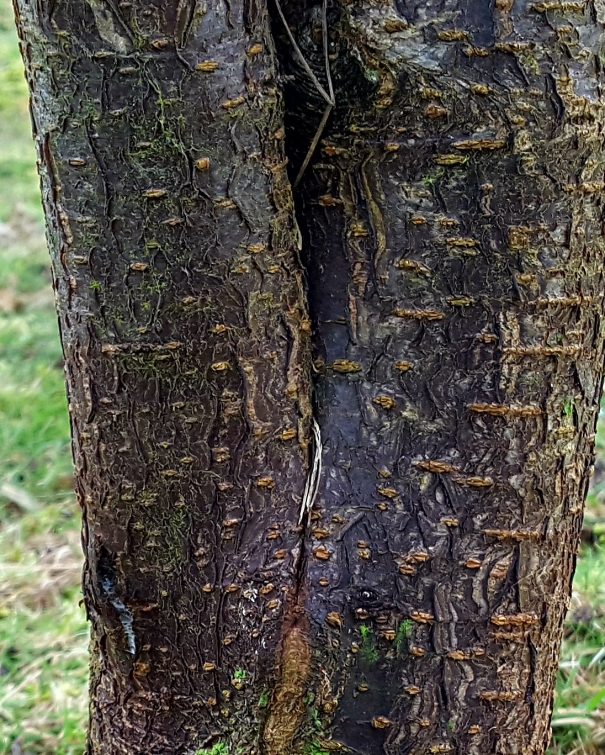
Blackthorn trunks are rough to the touch, dark coloured, with bands of orange coloured lenticels
Blackthorn trunks are dark and rough looking, with bands of orange-coloured lenticels.

Flowers: Flowers appear on long, thin, green stalks. Typically displaying five green sepals, five white petals, and a mass of yellow-tipped stamens. A single style and stigma are found in the centre of the flower. These easy-to-spot patterns of plants are described and explained in parts one and two of my article “How to identify plants in a day”.
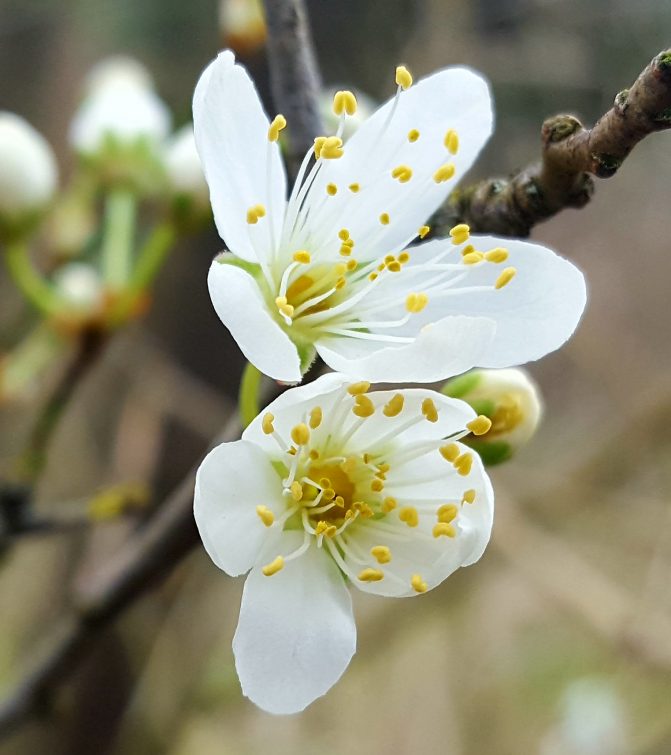
Foraging blackthorn flowers is best done just after opening when loaded with pollen.
Foraging blackthorn flowers is best done just after opening when they’re loaded with pollen.

Flowering season: I regularly see the first flowers in late February these days, but March was formerly the time of the first flush of flowers. Depending on location, you can still go out foraging blackthorn flowers well into April as well.

Fruits: Blackthorn produces the small, well-known, blue-purple stone fruits, commonly called sloes (10 – 15 mm). These astringent fruits are ready to go straight into gin from early October.
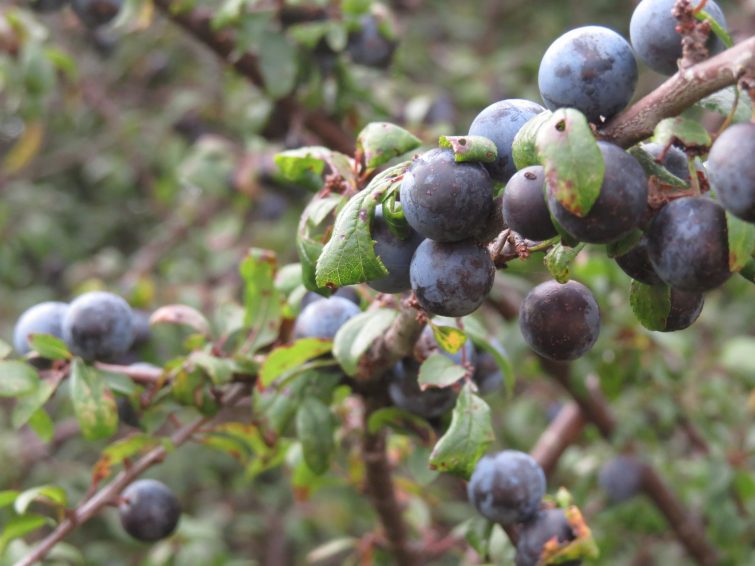
Blackthorn stone fruits are commonly known as sloes and when fully ripe in the autumn, make a cracking infused gin.
Blackthorn stone fruits are commonly known as sloes and make a cracking infused gin.

Habitats: The blackthorn is commonly found in hedgerows and woodland edges all over Britain, except for the very highest mountain peaks in Scotland.

Wherever it is found it can form dense thickets due to its habit of sending multiple suckers up from the roots.

Parts used: Only harvest the flowers when they are just opening, and while the anthers on top of the stamens are bright yellow, and loaded with pollen. The pollen soon goes and blows on the wind, and with it goes the almond flavour!
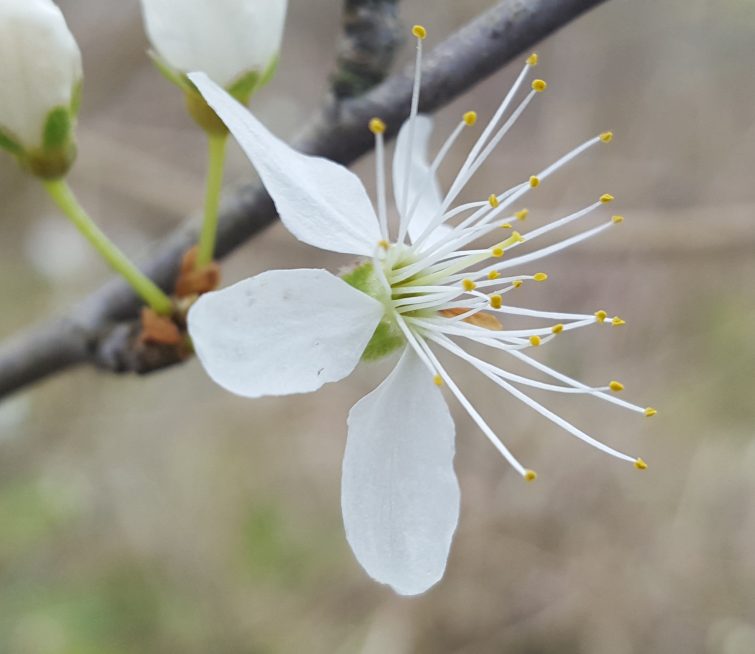
when you are foraging blackthorn flowers it is important to only harvest them with pollen-loaded stamens
When foraging blackthorn flowers it is important to only harvest the ripe and ready ones.

Harvesting: Simply pinch the whole flower off at the stalk, or select a few heavily laden twigs or young branches to judiciously prune off. Remember to check out all my other tips and tricks on harvesting wild plants.

Edible uses: What can you use this abundant flower full of almond flavour for? A lot! All maner of pastries, cakes and puddings can be enlivened with the benzaldehyde and hydrogen cyanide compounds responsible for the almond flavour.

Make blackthorn flower sugar syrup by infusing the flowers into warm water and melting sugar or honey into it. Use more sugar to make a cordial. The sugar syrup can be used in as many ways as you can think of.

Other notes: If you like me, love all the many different types of damsons, greengages, yellowgages and plums, then you can thank the blackthorn. They have all originated, or have been bred over thousands of years, from blackthorn.

Finally, and once more, please take extra care working around this plant…I want you to retun here just as you left!

Happy foraging!


Foraging Guide to Common Daisy (Bellis perennis)

Learn how to identify common daisy without flowers, and discover its traditional medicinal use

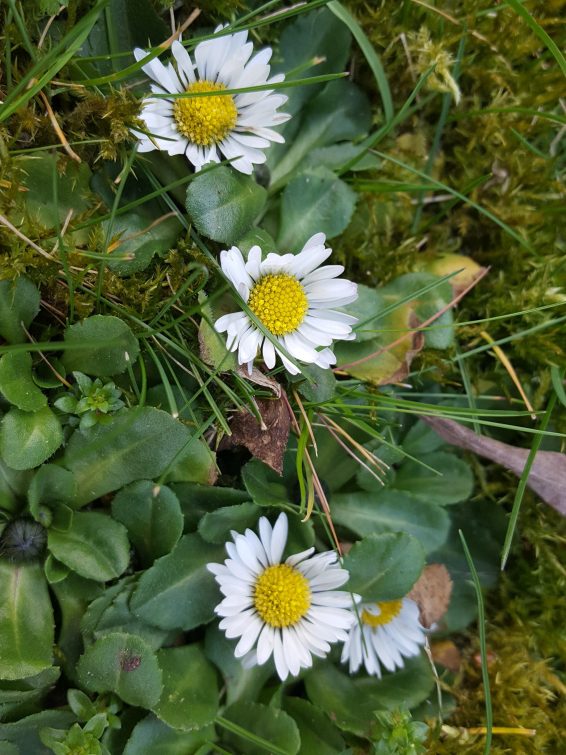
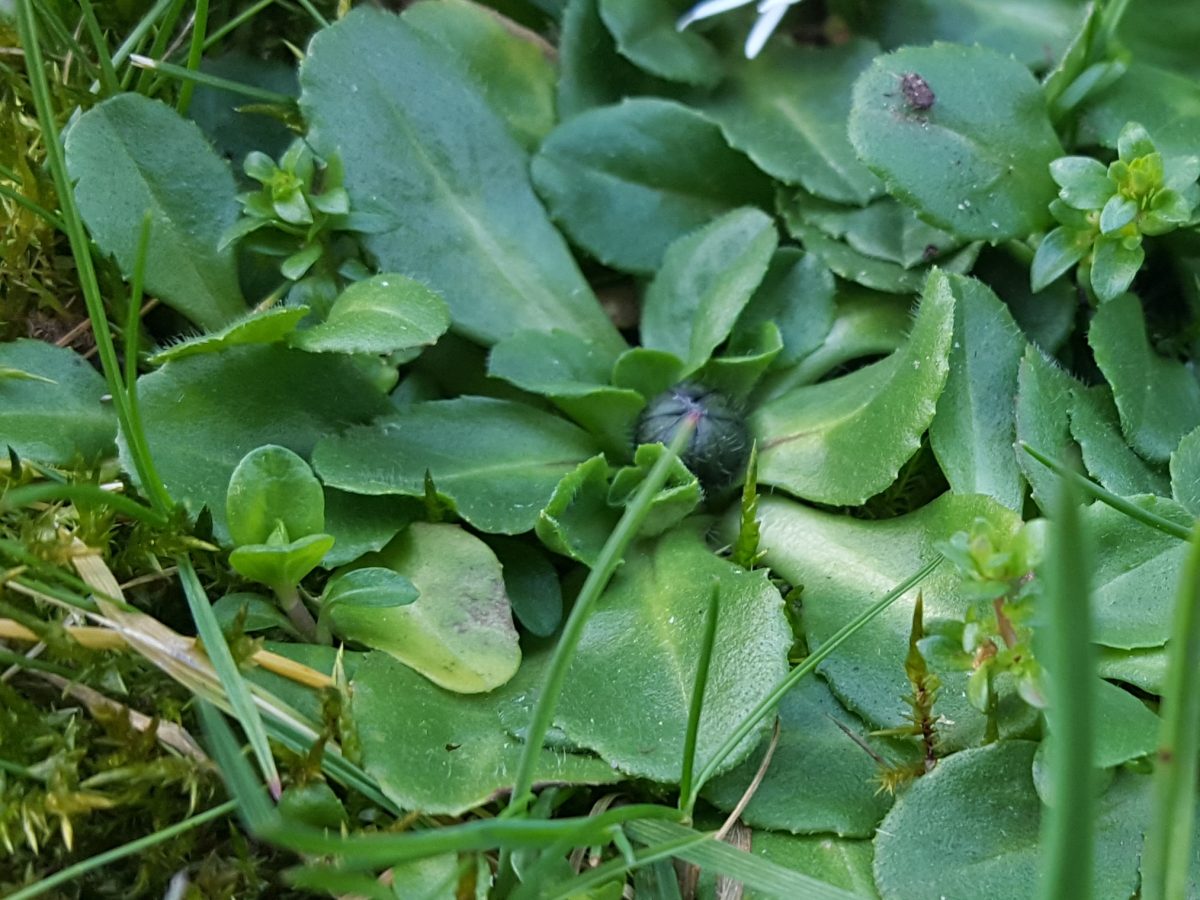
You might think that this foraging guide to the common daisy wouldn’t really require much description. Well, yes that’s true. At least it is when the plant is flowering.

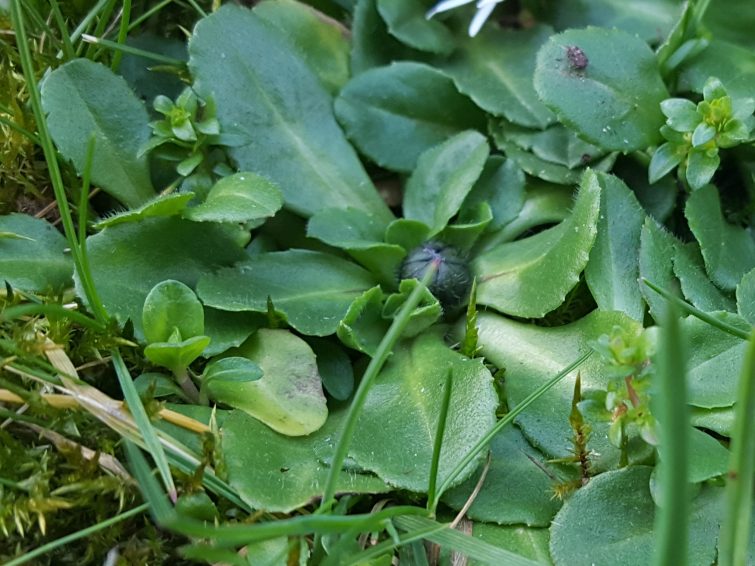
I have tested dozens of people’s knowledge of the plant, by showing them just a leaf or a leaf rosette without flowers. Less than half of them knew the plant.

These days, the daisy is generally our constant flowering plant companion.  During the spring and into early summer, you can continuallly find, and probably have found, ridiculous amounts of them on show!

As the old country saying goes, when you can take a few steps with seven daisies underfoot, spring has truly arrived!

What’s in a name?

The English common name ‘daisy’, as many people will already know, is simply a corruption of the name ‘days eye’. Prefxing  the name with ‘common’ helps distinguish it from other daisy species such as the ox-eye daisy.

Daisies are now ever-present flowers in a warmer climate. They open with the morning light and close whenever the sun goes.

The 'days eye' opens with the morning light and closes with the setting sun.
Our common ‘days eye’  tracks the sun; opening with the morning light and closing when the sun sets.

The generic part of the scientific name, Bellis, stems from the Latin word bella, meaning beautiful. Anybody who has made daisy chains knows this to be true. The specific name perennis, simply denotes the plant as a perennial species.

During the 16th and 17th centuries, herbalists knew it also as the ‘bruisewort’, testifying to one of its traditional medicinal uses.

I like the alternative common  name in Scotland, where it used to be affectionately known as ‘bairnwort’. This relates quite how captivated children are with it, and how much they love playing with this bright little herb.

Botanical description to identify the common daisy without flowers

Leaves: Spoon-shaped leaves that taper towards the base. These are typically between  5 – 8 cm long and approximately 1 – 2 cm wide.

Daisy can be identified without flowers by its dark green, spoon-shaped, hairy leaves, with a few teeth on the margins
Identify common daisy by the dark green, spoon-shaped leaves with hairs and teeth.

The dark green leaves are hairy with a few teeth (usually 4 – 7) on the margins. The central white vein widens at the base. On the undersides, the mid-rib is raised.

Daisy plant chemistry has evolved bitter and aromatic components, meaning that insects don’t like eating the leaves. In occasional and regular dietary amounts, this plant is not toxic to us. There are people with allergies to this plant family, who will not be consuming, of course.

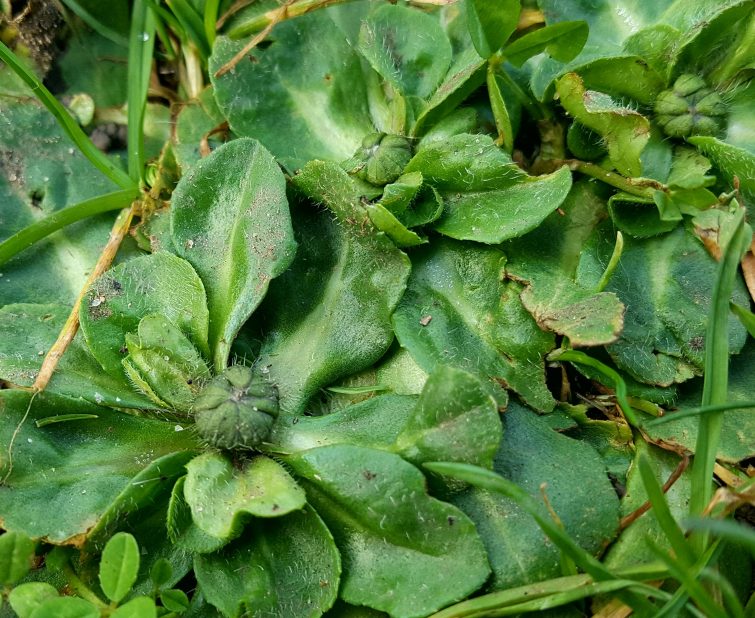
The daisy will only be seen growing leaves in rosette form. It gains a competitive advantage from its growth habit because the prostate leaves are so flat and low to the ground, nothing else can grow underneath.

Petioles: Short with a flange of leaf either side. Often purplish at the base and always with fine ciliate hairs.

Stems: Daisy flower stems are short and round. They are always without leaves, and reach between 3- 12 cm. In common with all the daisy family plants, they evolved a flower stem producing a solitary, terminal flower.

The common daisy has a single flower bud on a terminal stem
The daisy has solitary flowerbuds that appear in ridiculous numbers during spring.

Roots: This is a herb wirh rhizomes and stolons, allowing it to continually spread and colonise large areas in grassland.

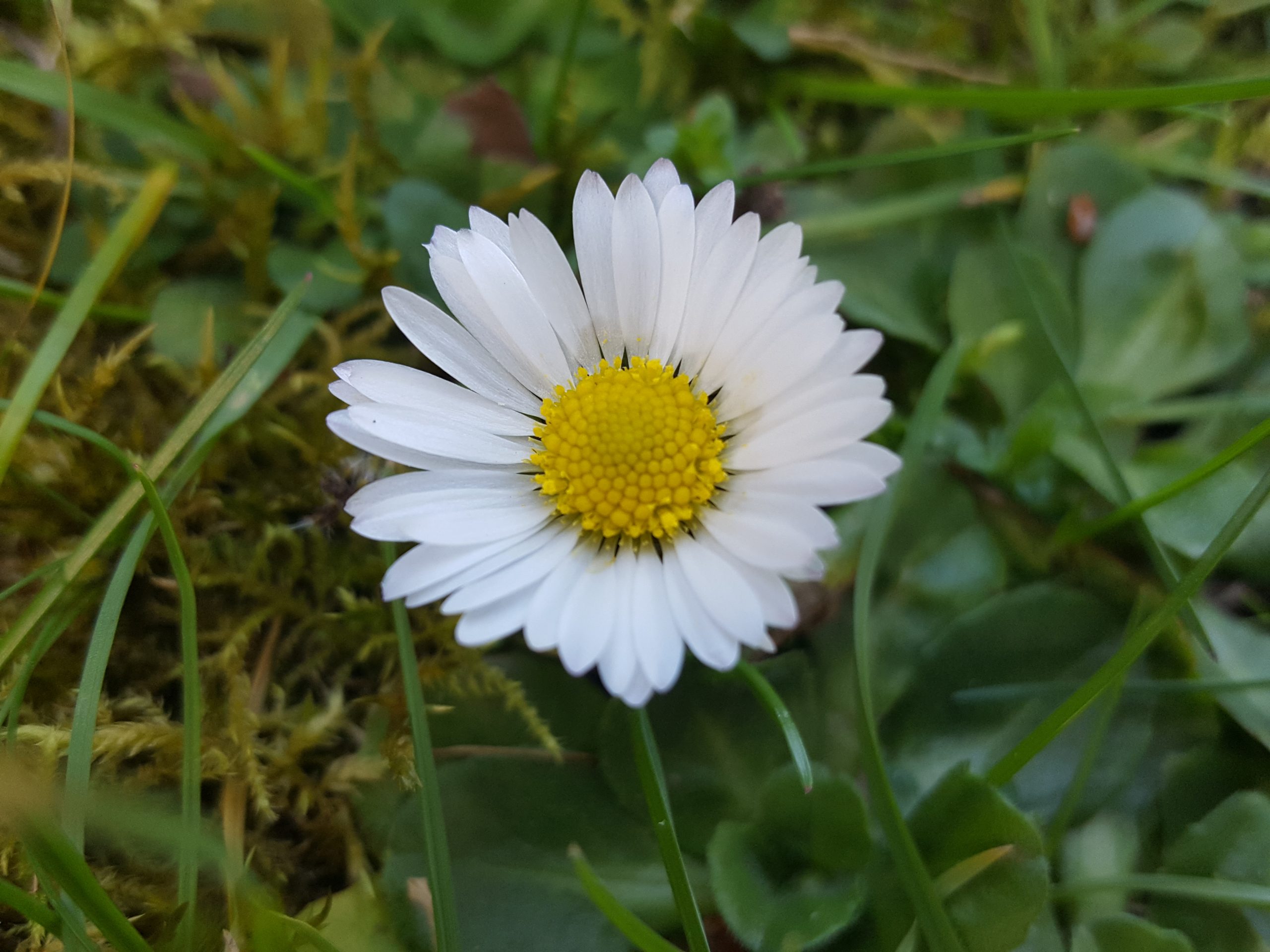
Flowers: Daisies have a composite inflorescence. The bud forms an involucre of narrow, black-tipped bracts. On opening, the white ray-florets are often beautifully crimson-tipped. These thin ray florets encircle more than a hundred yellow disc florets. The whole flowerheads are 12 – 20 cm across.

daisy flowers have hundreds of yellow disc florets surrounded by the ray florets
Daisy flowers are a composite form with more than a hundred yellow disc florets.

Fruits: After pollination the daisy eventually produces tiny dry achenes, without any white pappus hairs.

Habitats: Before humans invented lawns, the daisy evolved to populate various stream banks, edges of lakes, sand dunes, and any suitable and available setting in short grassland. In the British Isles this includes up to altitudes of 900 metres or so. These days you can find the plant in all manner of grasslands, also popping up in disturbed soils and wastegrounds.

Parts used: Leaves and flowers.

Medicinal use: Daisy has traditionally been used for wounds, fevers, numerous digestive ailments, and bruises. You can sense the aromatic medicinal qualities in its raw flavour. It is a little bitter and has astringency. Daisies can replace chamomile for topical use on young children.

Presumably we humans have been using the common daisy since those days 10,000 years ago, when ‘Cheddar Man’ was roaming around my manor in Somerset! On these islands the daisy is our native equivalent to the well-known herb Arnica montana.

Harvesting: You can collect leaves at any time of year. The leaves have a mild savory or some say, acrid taste, a little similar to the ox-eye daisy (Chrysanthemum leucanthemum). Simply pinch the petiole off at the base or snip off with small scissors. I then trim and discard the bottom 10 mm or so to reduce any stringy fibres.

Collect whole flower heads for medicinal and edible use. I sprinkle the white ray florets into salads and rice dishes. The flowerheads can be gently  decocted or infused into water, alcohols or oils, to make teas, tinctures, salves and ointments.

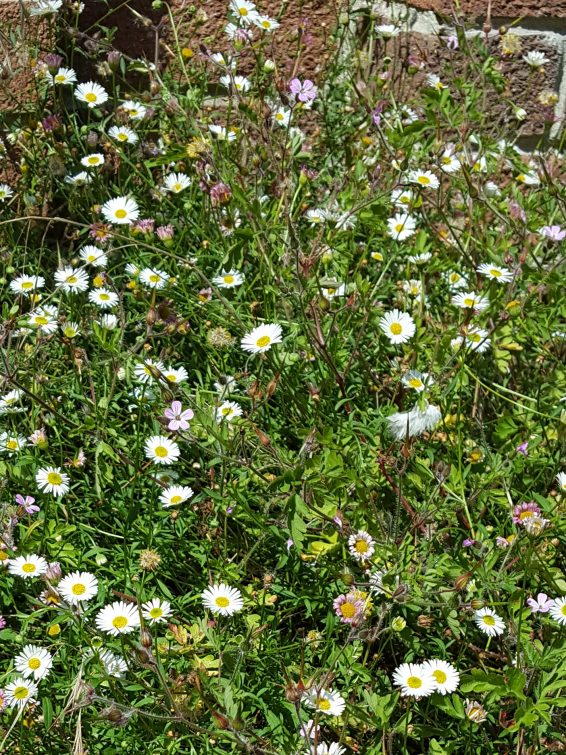
Other notes: There is another really common daisy flower you may be seeing a lot of. The Mexican fleabane’ daisy (Erigeron karvinskianus) is an imported garden plant, reportedly first cultivated here during the 1830’s. I have yet to research much about the food or medicine uses of this alien exotic.

It quickly escaped into the wild, and can now be spotted in our towns and cities all over the place, especially on different types of old stonework. It loves various rocky settings, and therefore really enjoys life by the sea.

This plant has much longer, trailing stems (to around 40 cm), and much more narrow leaves. The flowers are slightly  larger, and it grows in a somewhat sprawling mass in sunny spots.

You may come across the Mexican fleabane daisy growing in the urban environment. Knowing this plant can help you identify common daisy
Narrow leaves, trailing stems and larger flowers are hallmarks of the daisy lookalike, Mexican fleabane.

This particular plant usually appears in huge numbers growing from cracks and revices in stonework and concrete within urban areas.

More foraging guides are coming soon, on the UK’s most comprehensive foragers plant identification website.

Happy foraging!


How to Identify Red Dead Nettle (Lamium purpureum)

Read our short foraging guide and quickly learn how to identify the red dead nettle (Lamium purpureum) Lamiaceae family.

With this quick-to-read wild plant guide, you will soon be able to confidently identify red dead nettle, and then add some welcome wild greens to your diet in the winter months!

Novice foragers may be interested in our guide to starting out on your foraging adventures. I’d say it’s well worth a few minutes of your time, and might just answer a few of your most burning foraging questions.

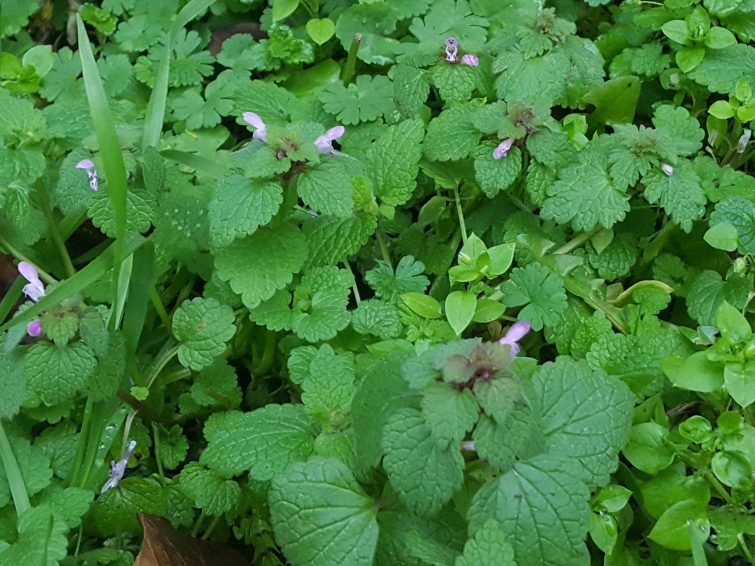
The red dead nettle is a low-growing, often sprawling annual plant. It is one of the most common species you will find here in Britain, and belongs to a large family of mainly aromatic plants, formerly known as the Labiates. More information on our aromatic, essential oil bearing plants, is available here.

What’s in a name?

The generic part of the name Lamium comes ftom the old Greek word ‘laimos’ – meaning throat. This alludes to the shape of the long corolla tube.

The specific part of the name, purpureum, tells us of its colour.

The common name that it shares with other plants in the genus – ‘dead nettle’ -points to the similarity of its foliage to stinging nettles (Urtica dioica), and also tells us it won’t sting!

Botanical description to identify red dead nettle.

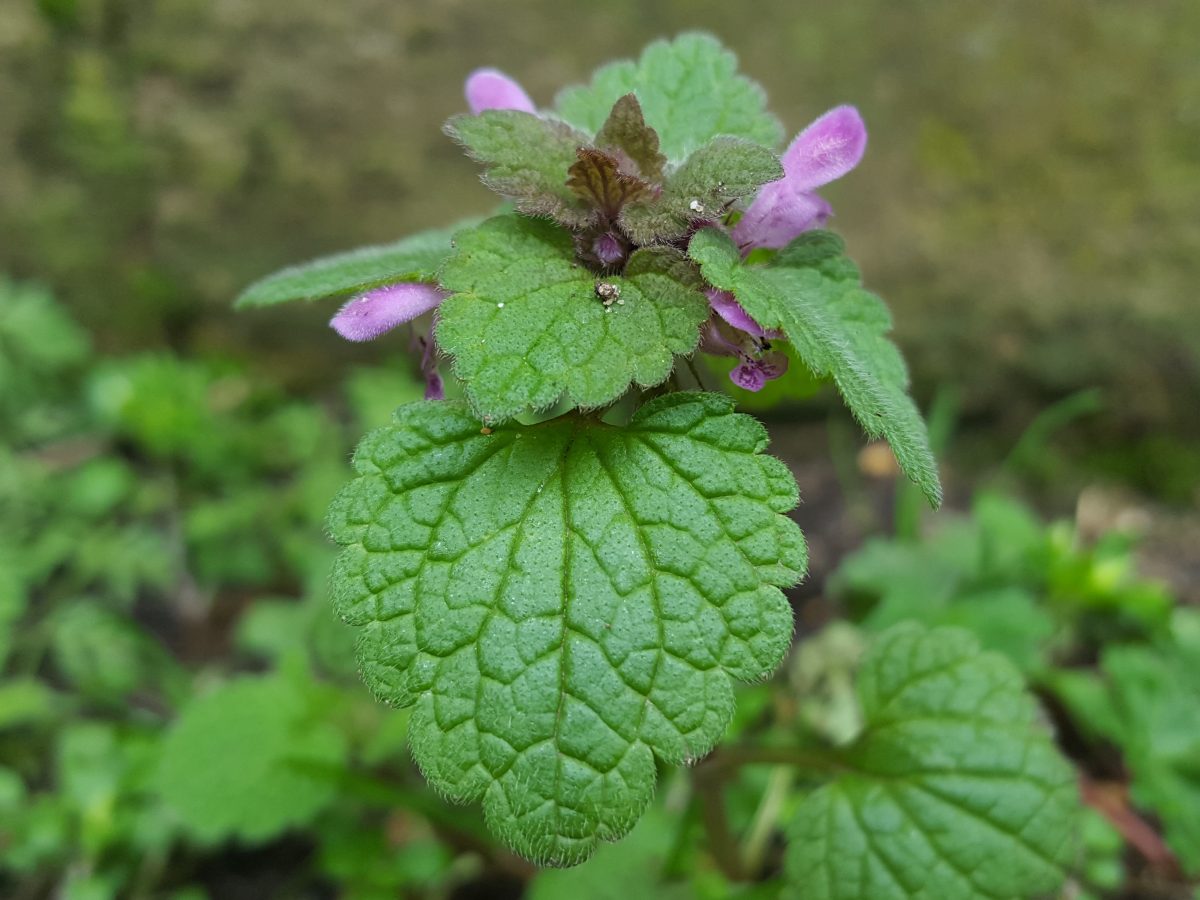
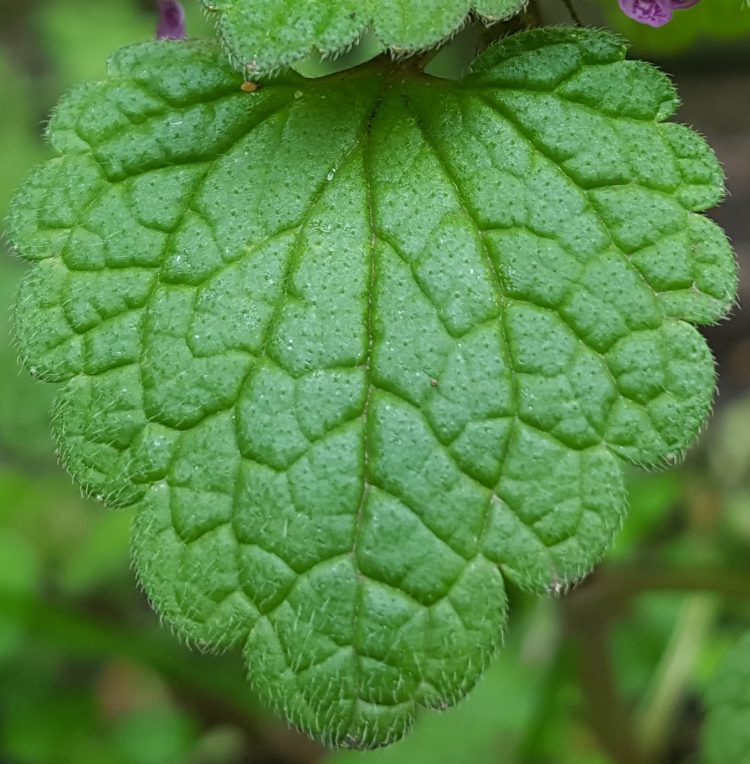
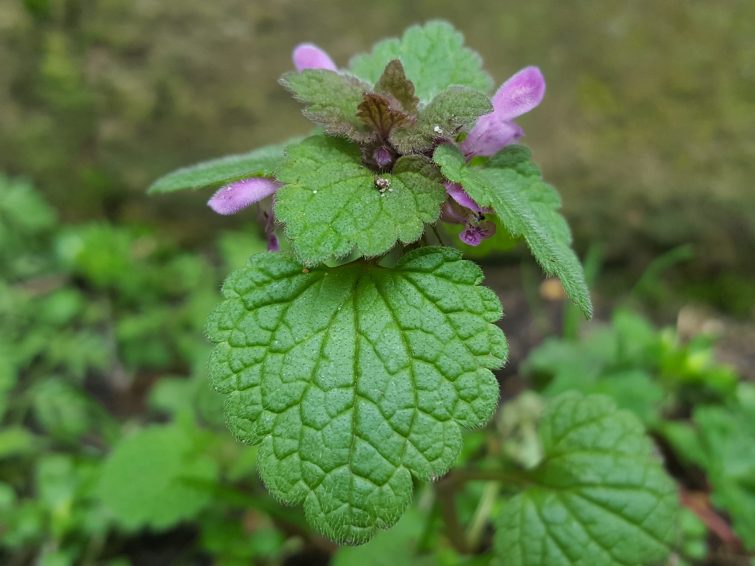
Leaves: This plant has simple, hairy, green leaves, approximately 3 cm across and 5 cm long. The leaves are basically ovate-shaped, and more often than not they are cordate at the base. The leaves are net-veined and somewhat crinkly in appearance.

The crinkly, net veined leaves are aromatic, if a little musty and earthy
The crinkly, net veined leaves of red dead nettle are aromatic, if a little musty and earthy.

The foliage is aromatic when crushed, albeit musty and earthy. Its leaf margins are crenated. Please refer to the glossary if you are bemused by the botany!

Petioles: These are quite short on the lower leaves, and are more or less absent on the stem leaves.

Roots:  The plant grows on a small tap root.

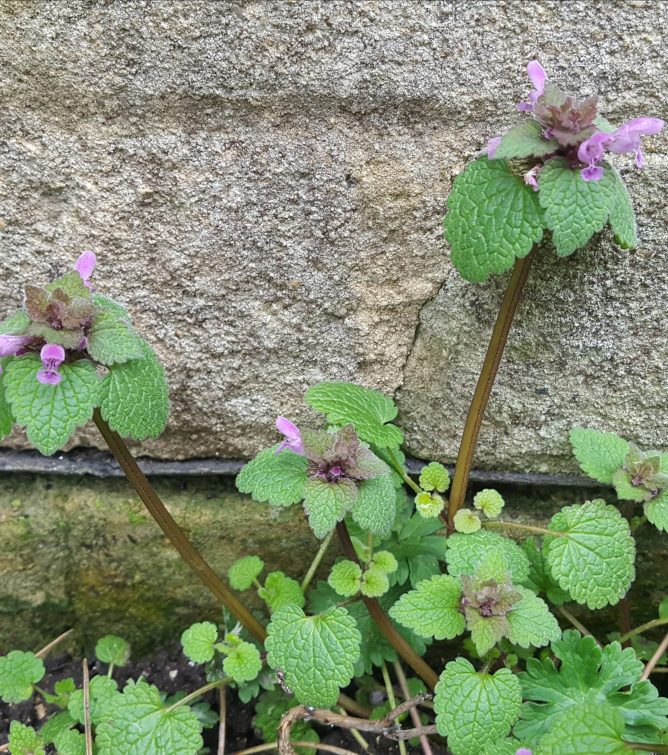
Stems: Square, hollow and  usually sparsely hairy. They will reach up to about 40 cm high in flower.

You can begin to learn how to identify red dead nettle from its square stems and their few red leaves.
Flowering stems have few leaves and reach up to 40 cm high.

Flowers: These are produced in whorls around the stem, arising from the leaf axils. The flowers are two-lipped, with a long corolla tube (10 – 20 mm).

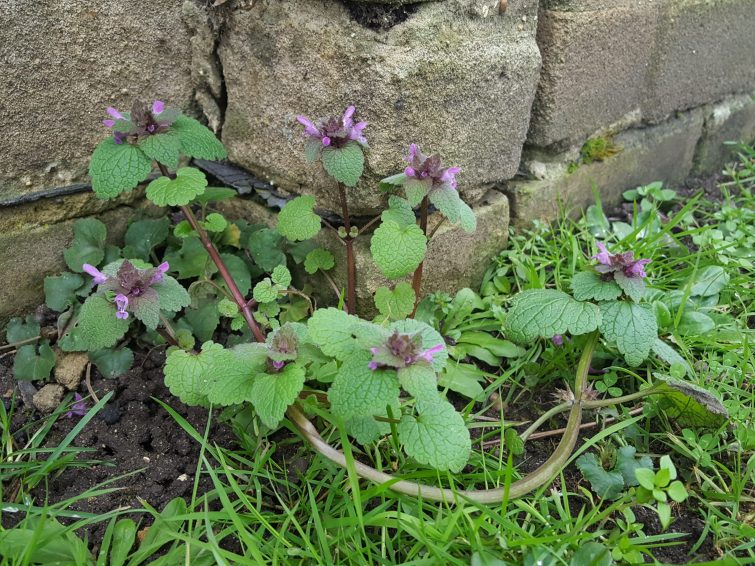
Its easy to identify red dead nettle when in flower, as it produces whorls of pink-purple, two-lipped flowers
It’s easy to identify red dead nettle in bloom, as it produces whorls of pink-purple, two-lipped flowers.

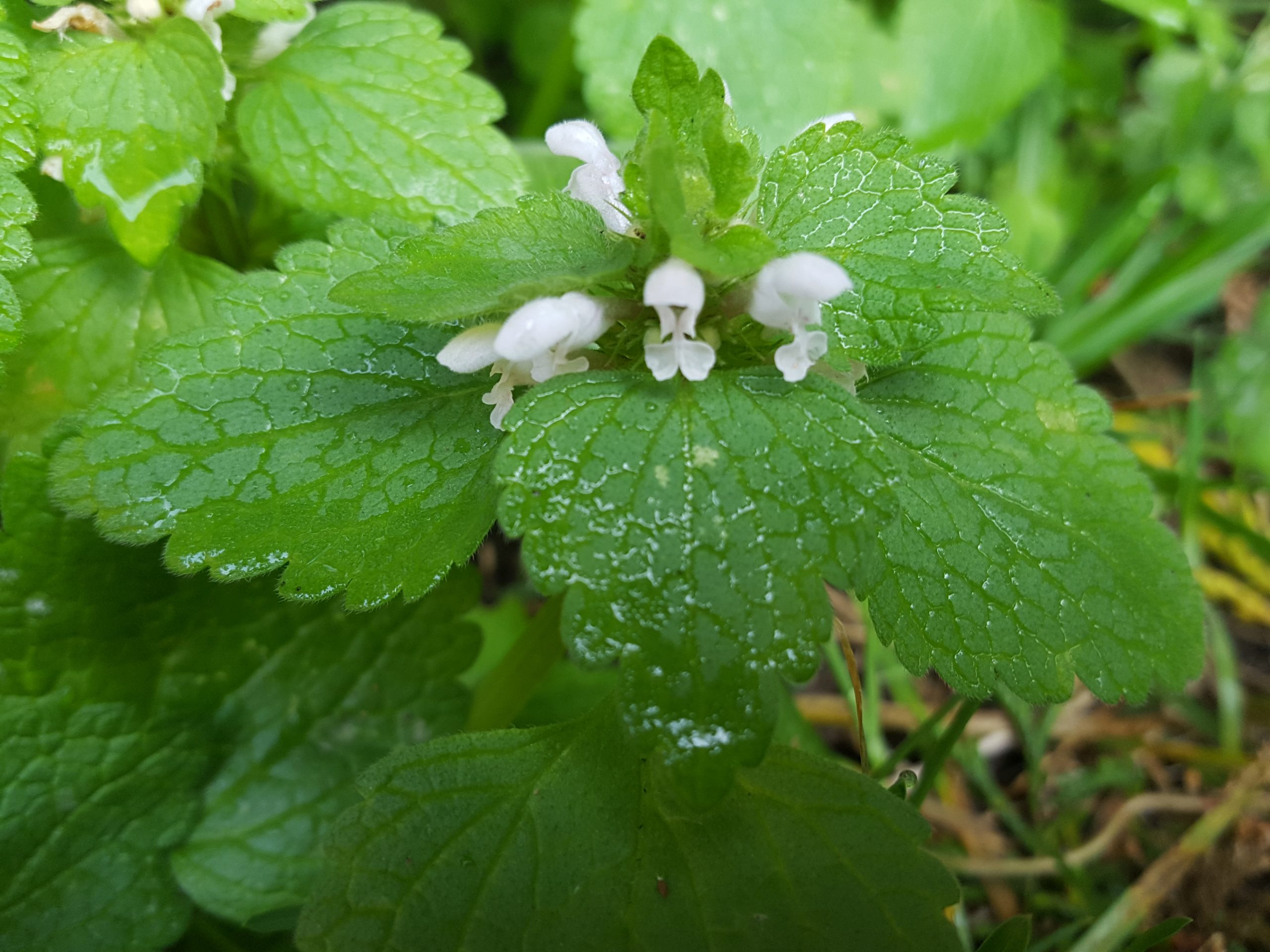
The flowers are generally a pink-purple colour, with mottled specks on the lower lip. Occasionally I see a white flowering form too.

Like many flowers, red dead nettle produces occasional white-flowered populations
Like many flowers, red dead nettle produces occasional white-flowered specimens.

The calyx from which the flower arises consists of five, green, pointed lobes. The lobes are nearly as long as the corolla tube. Inside the flower are four stamens, of which two are long and two are short.

Flowering season:  As another of our short-lived ephemeral annual plants, it will be no surprise to learn that this plant can be found in flower from January to December. I always see it flowering en masse in the run up to spring equinox.

Although red dead nettle can flower at any time, it gives off its best displays in February and March.
Although red dead nettle can flower at any time, its best displays come in February and March.

Fruits:  Like many in the dead nettle family, this plant produces four tiny nutlets.

Parts used: Leaves, flowering tops and flowers.

Harvesting: You can usually find this plant all year round, but I think the months of February and March offer the most productive harvests.

Harvesting red dead nettle is easy. Simply remove whole stems and strip off leaves or pick a few leaves from each plant.
Red dead nettle will be best harvested in early spring. Take a few leaves from each plant.

I sometimes pick a whole stem and strip the leaves off, or just pick a few leaves from each plant in a stand. Flowers are easily plucked out.

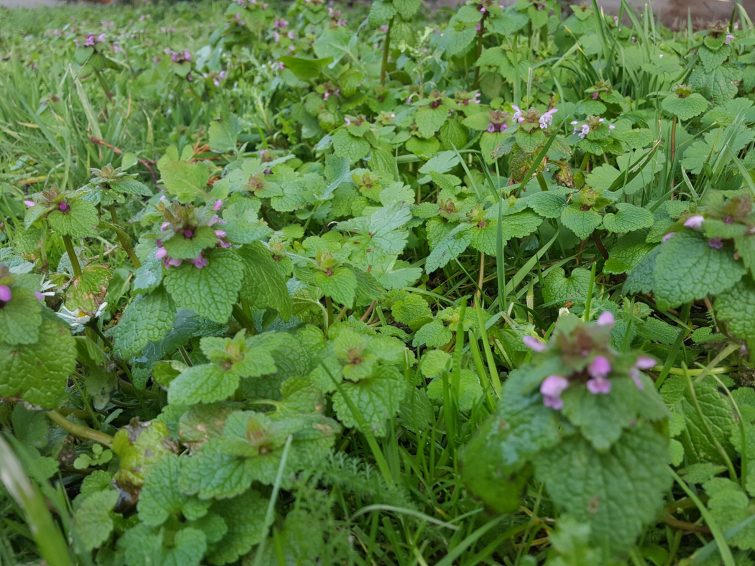
Habitats: This plant loves fertile grassy areas, cultivated ground and wastegrounds, hedge banks, and various settings in urban environments.

Knowing the habitats that the plant loves will help you identify red dead nettle. It enjoys grassy areas, as well as cultivated and wastegrounds.
Red dead nettle loves grassy areas, cultivated and waste ground as well as numerous urban settings.

This is essentially a lowland plant, and can usually be found at altitudes below 550 metres.

Other notes: With its unusual mushroom-like taste, this plant lends itself to being stuffed in ravioli or added to gnocchi. It makes a nutritious addition to soups and casseroles. In salads, you may find its best to use finely chopped, like you would other aromatic pot herbs.

A similar-looking plant, the cut-leaved dead nettle (L.hybridum), has deeper cut teeth on the leaves and a smaller corolla tube. It can be used in the same ways.

If you have any foraging or plant identification questions, please dont hesitate to contact me.

Happy foraging!


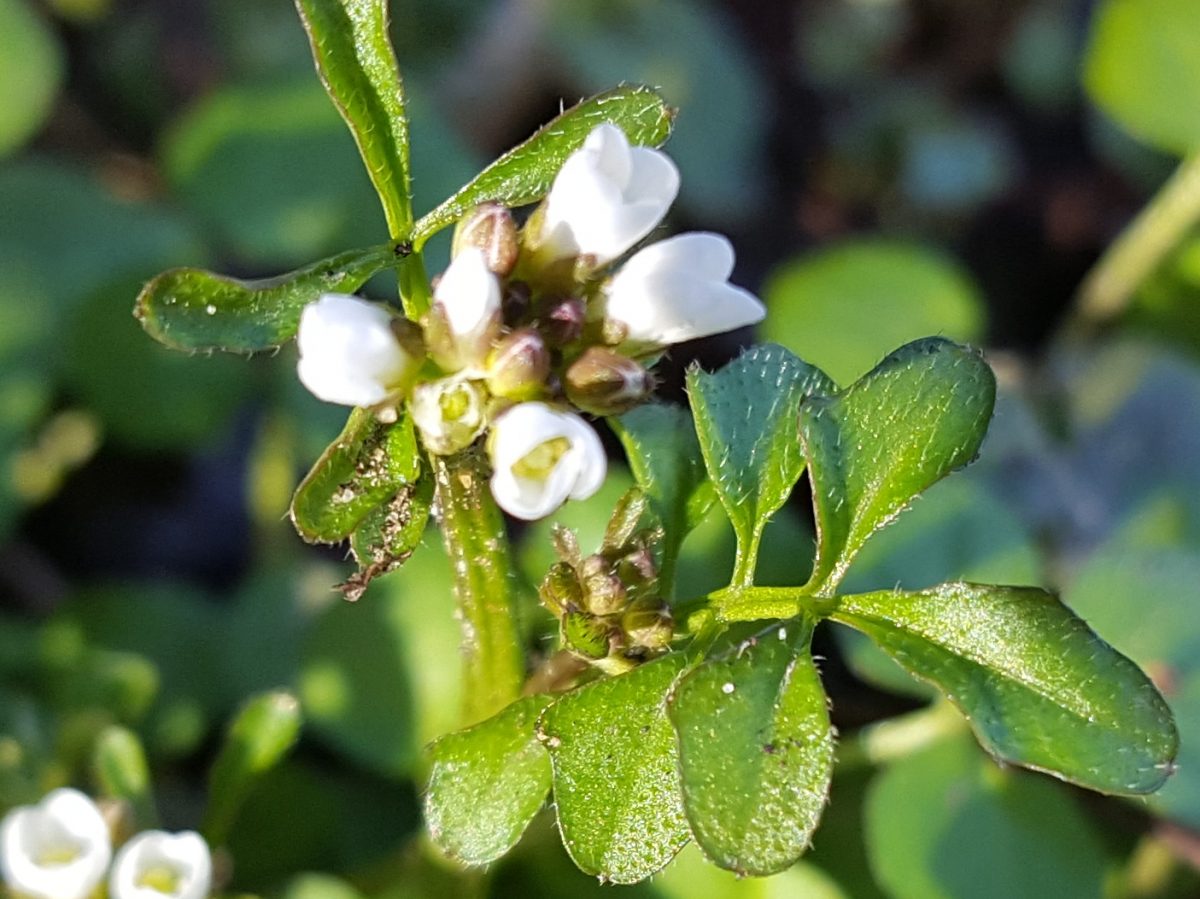
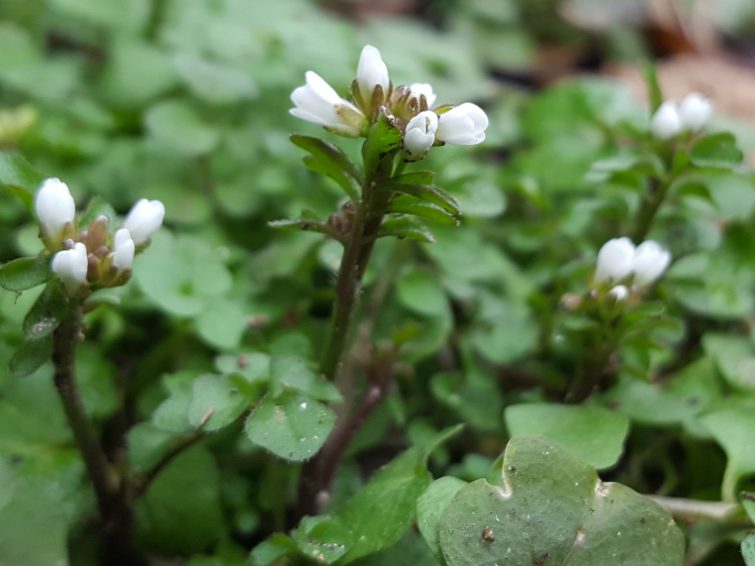
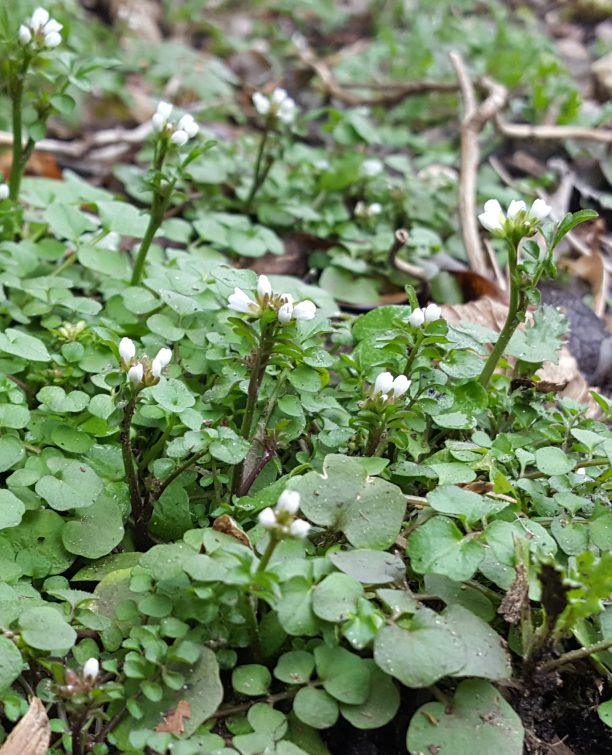
How to identify hairy bittercress (Cardamine hirsuta)

Learn how to identify hairy bittercress and add some medicinal peppery punch to your winter salads.

Read our short wild plant guide and find out how to confidently identify hairy bittercress. This is a tasty but weedy species that divides plant lovers.

For gardeners, the plant can be a bain, what with it being a seemingly persistent presence. For foragers however, they are welcome edible plants, available during the barren winter months. Not only do they add some fantastic flavour  and texture to salads, they also provide us with a welcome shot of needed and powerful brassica family medicinal constituents.

To be fair, you could skip all the following plant I/D and simply crush and sniff the plant. This will soon tell you if you have a brassica family species!

The mustard aromatics are common in this family. All mustard family plants are edible, bar the wallflower (Erysimum) species. So with all the relevant understanding about edibility, toxicity and dose, I am more than happy to know I can eat a member of this family these days without knowing the exact species.

Shock horror, Yes I eat plants without 100% positive I/D! Why? Because I can with what I know!  This has taken many years of mistakes and research. I strongly advise you DO NOT DO THIS until you have met and know nearly 500 odd plant species in these islands, and know a hundred or so more down to the genus.

Acquiring positive I/D for a genus usually satisfies me these days. My interest in wild plants currently is much more in the experimental cookery and bushcraft domains, and my interest in wild foods leads me towards fungi, sea weeds and sea foods. In these realms, I always cross reference, at least twice over.

What’s in a name?

The generic part of the name  Cardamine was apparantly first labelled by Dioscorides. The name stems from the old Greek word ‘kardamon’, meaning ‘a kind of cress’ although some reports also suggests it means a ‘spicy pepper plant’.

The specific epithet ‘hirsuta’, as any bearded man should know, means hairy.

The common name ‘bittercress’ tells you two important things about its flavour.

Botanical description to help identify hairy bittercress.

If any of the following few technical terms has you confused, dont fret; just pop over to our foragers glossary page.

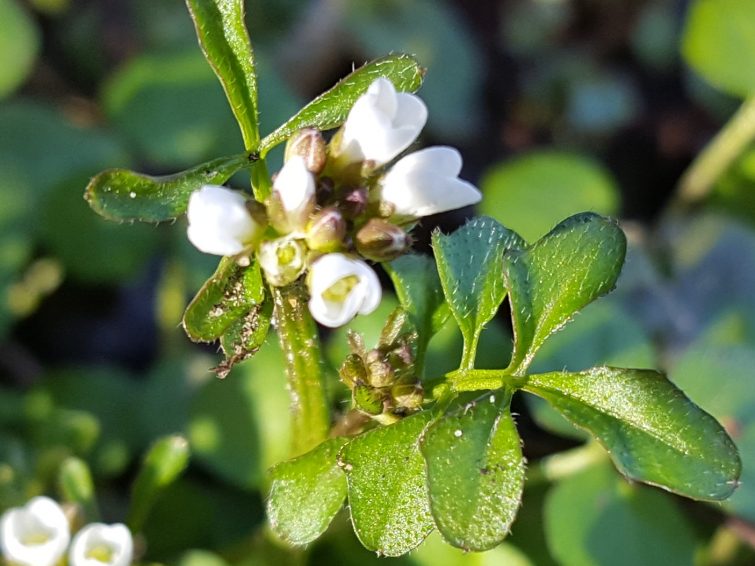
Leaves: This plant, like most of its relatives in the genus, has pinnate leaves made up of between 2-6 pairs of opposite leaflets.

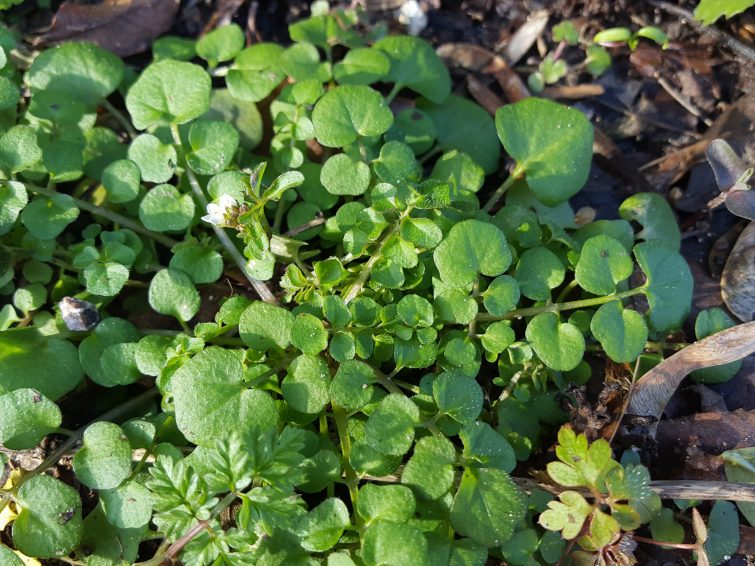
You usually find hairy bittercress with small, attractive leaf rosettes.

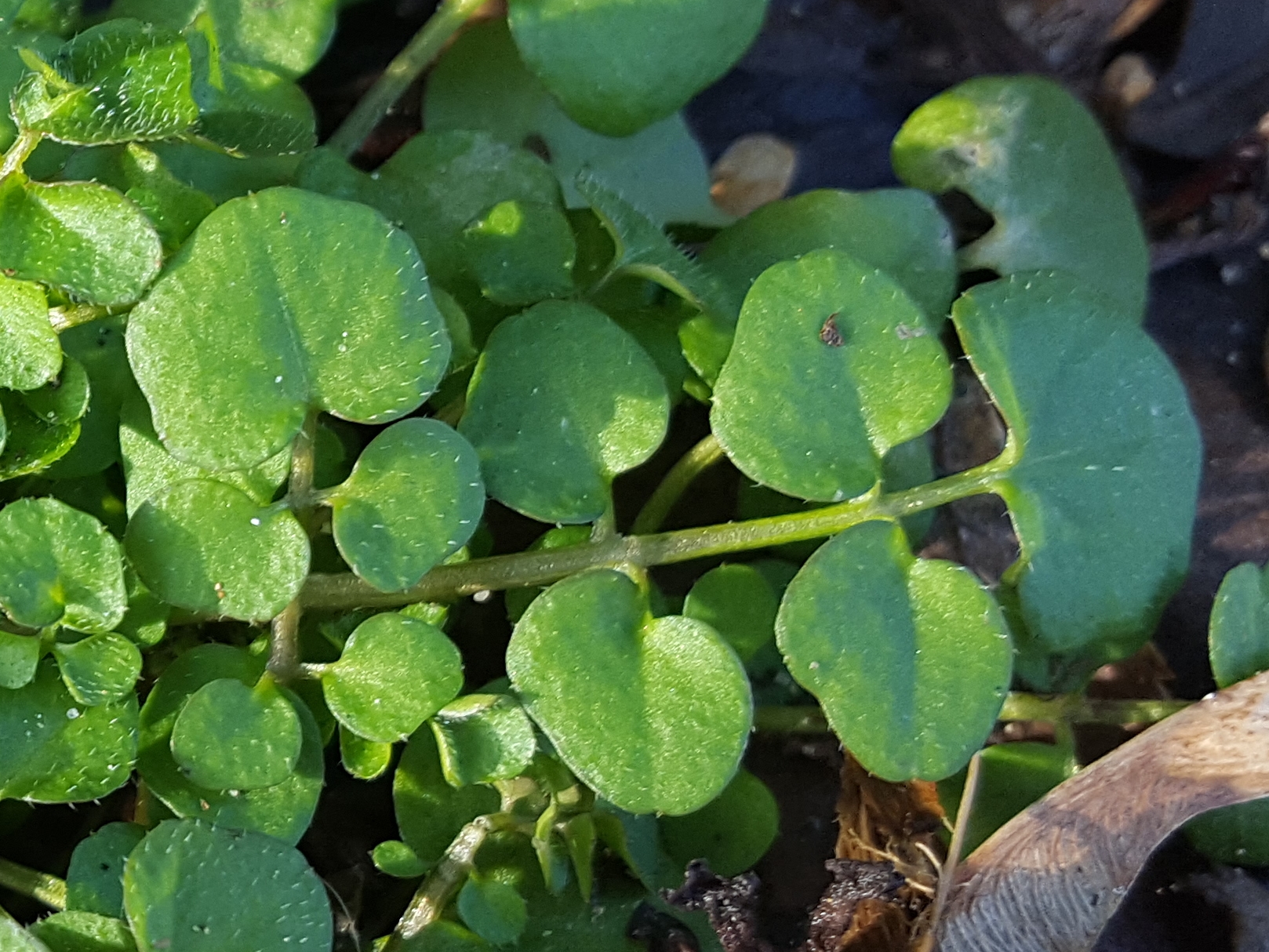
Hairy bittercress has small, hairy, oval-shaped leaflets, occasionally with mildly crenated or lobed margins. The terminal leaflet is always much larger than the others.

The pinnate leaves of hairy bittercress have between 2 and 6 pairs of leaflets.

The leaves form attractive small rosettes, and you will typically find a number of specimens growing as rosettes together.

Petioles:  Approximately 1-2 cm long.

Roots: The plant grows on a fibrous rootstock.

Stems: The small flowering stems usually reach between 8-20 cm tall. They are typically green-coloured with few branches. Their stem leaves are increasingly refined in form.

Small flowering stems are green and sparsely branched.
Hairy bittercress has small flowering stems; green-coloured and sparsely branched.

Flowers: The small inflorescence has the typical brassica family patterns. A miniscule ‘broccoli type’ raceme head forms, then stretches up and open to reveal the alternately-spaced, tiny white flowers (2-3 mm across).

To identify the species from other plants, you need to count the number of stamens inside the flower. Hairy bittercress has four stamens.
To identify hairy bittcress from others in the genus, you need to count the number of stamens in the flower.

Hairy bittercress has four stamens inside the flower. Other plants in the genus, such as wavy bittercress (Cardamine flexuosa) have six.

Flowering season: This short-lived annual plant will flower as soon as it has put on enough growth, or if it gets stressed when young. When you are out foraging during February and March you can find it in flower in abundance.

Fruits: Hairy bittercress, like many brassicas, produces dry fruits.  These are long thin pods with a flattened tip. They eventually split in two, revealing the tiny seeds.

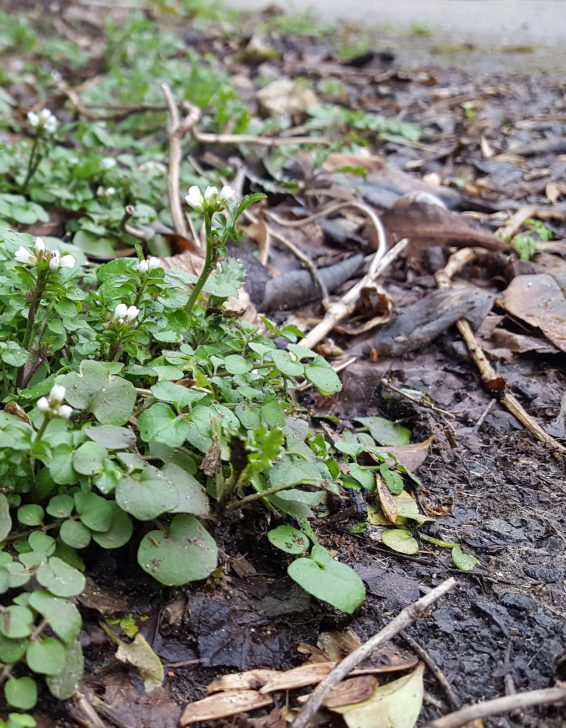
Habitats: Urban foragers will notice that this ruderal species basically finds a home anywhere it can, especially liking bare and disturbed soils. During summer you can still find the odd specimen, but only in cooler, shady spots.

Like other plants, the habitat you find it in will help you identify hairy bittercress
Like other plants, the habitat you find it in will help you identify hairy bittercress.

In the countryside, hairy bittercress particularly loves stream banks, old stone walls, and damp woodland clearances on suitable soils. It’s a hardy plant that can be found up to altitudes of around 1100 metres.

Parts used: The rosette leaves, and very young flowering tops.

Harvesting: You can potentially collect the basal rosette leaves during late winter, early spring, and autumn. I use a couple of methods to do this:

1)  Cut the plant at the top of the roots just under the leaves, removing it just like you would a whole lettuce.

2) Pick the leaves individually, by pinching the base of the petiole with your thumbnail and forefinger.

Discover lots more wild plant harvesting tips here, with our wild crafting guide.

Other notes: All the bittercresses are edible, and the larger species found by streams are available in mid to late spring. Look out also for Lady’s smock (Cardamine pratensis),  in damp meadows, and the narrowleaf bittercress (C.impatiens), with its exciting exploding seed pods!

How to Identify Groundsel (Senecio vulgaris)

Learn how to identify Groundsel, with the forager’s guide to identifying Britain’s wild plants.

Groundsel (Senecio vulgaris). Asteraceae family

It really won’t take you long to know how to identify groundsel. This weedy plant is so common that you will already know it, whether you have put a name to it or not.

Those of you in the country may already recognise this plant as a weed of cultivated and disturbed soils. Whereas foragers in urban settings will  notice it can be found all year, poking up all over the place in the concrete jungle.

So, just like many hundred of Britain’s wild plants, it will prove easier than you may have thought to identify groundsel.

What’s in a name?

The generic part of the scientific name Senecio comes from the old Latin word – senex for ‘old man’. This is in allusion to the wispy white hairs atrached to the tiny seeds of all the plants in this genus.

The specific part of the name vulgaris means ‘common’ or ‘garden’. Regular readers and plant lovers will know that many plants carry this sobriquet.

The common name groundsel is thought to be derived from the old English name ‘gundæswelgiæ‘.  The prefix ‘gund’ being an old English word for pus.

The -sel part of the name groundsel, is believed to stem from the old English word for swallow – ‘swelgen‘. Therefore the name directly translates into ‘pus swallower’.  The plant does indeed have a long history of use in herbal medicine as a poultice, to draw pus from wounds. In Scotch language it is known as ‘grundy swallow’.

Botanical description to identify groundsel.

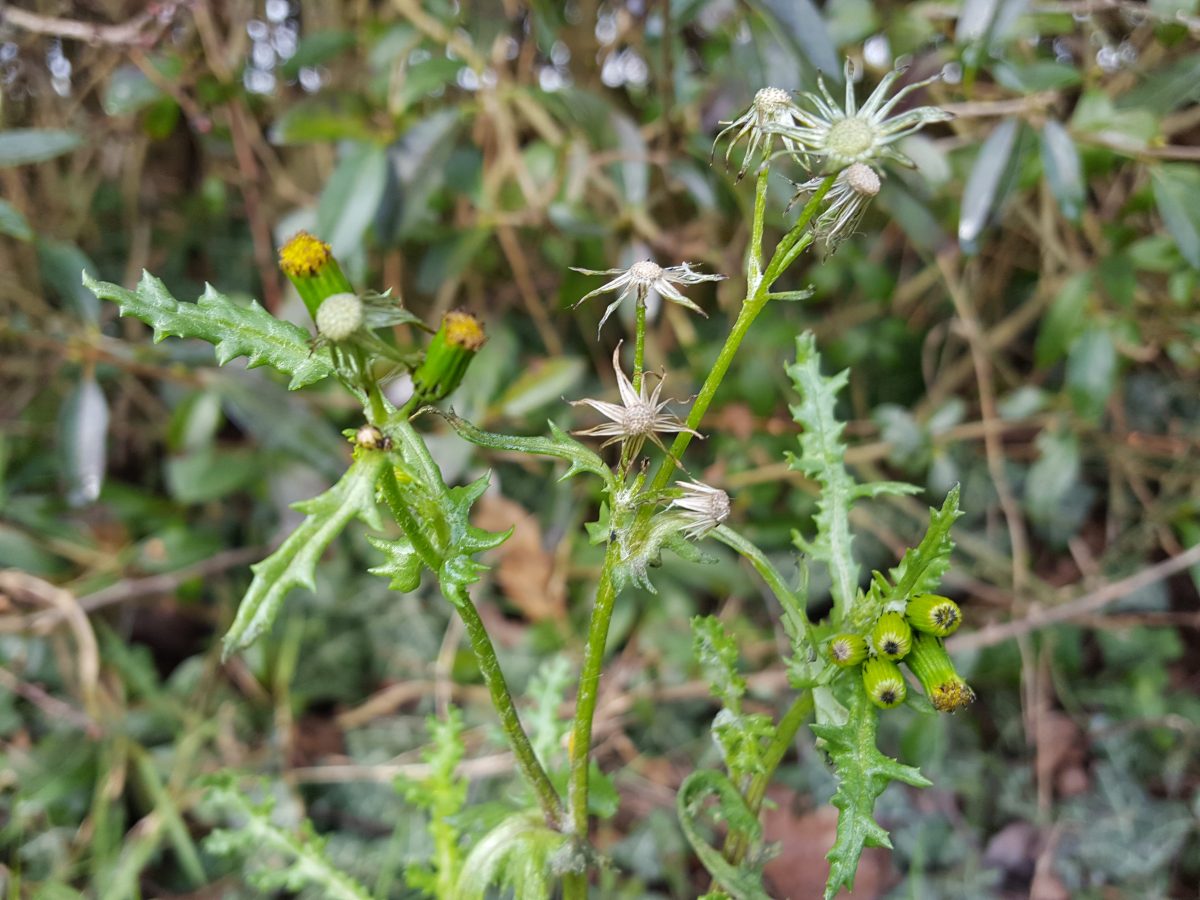
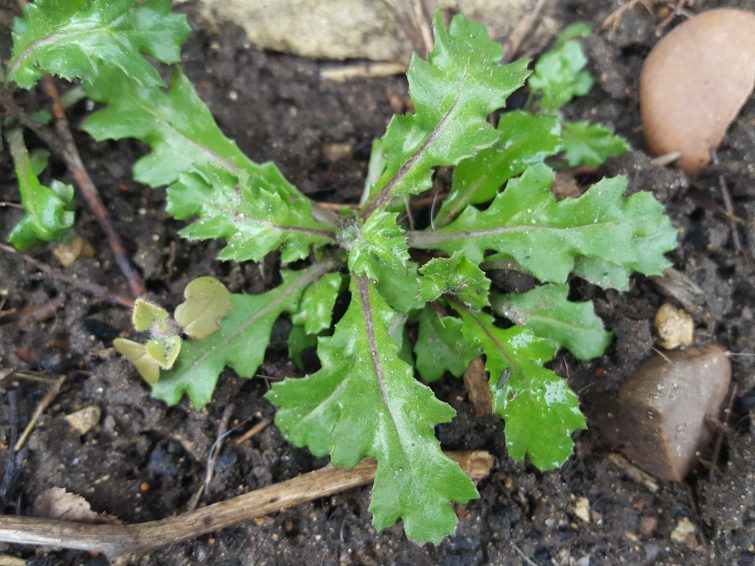
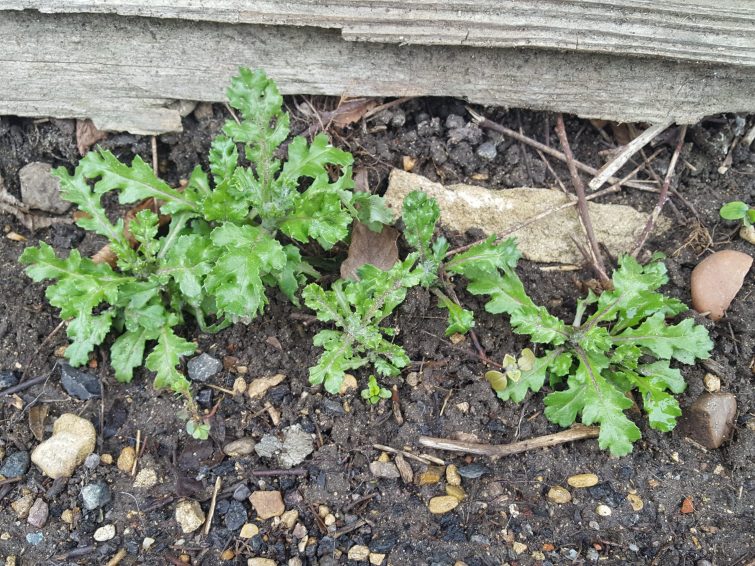
Leaves: Dark green, pinnately lobed and noticeably downy hairy when emerging. The mid ribs are typically pink or red tinged.

The small, pinnately-lobed leaves with a pink mid rib, are easy to spot features when identifying groundsel
Groundsel has small pinnately-lobed leaves with a pink mid rib and downy hairs.

You will see it growing as small rosettes, looking a lot like its close relative, ragwort (Senecio jacobea). The leaf undersides are often purplish-coloured, and taper towards the base.

Groundsel rosettes finding a home in disturbed soil in Oxford during February.

Petiole: Short or sessile. Often red-tinged.

Roots: Groundsel has a fibrous rootstock.

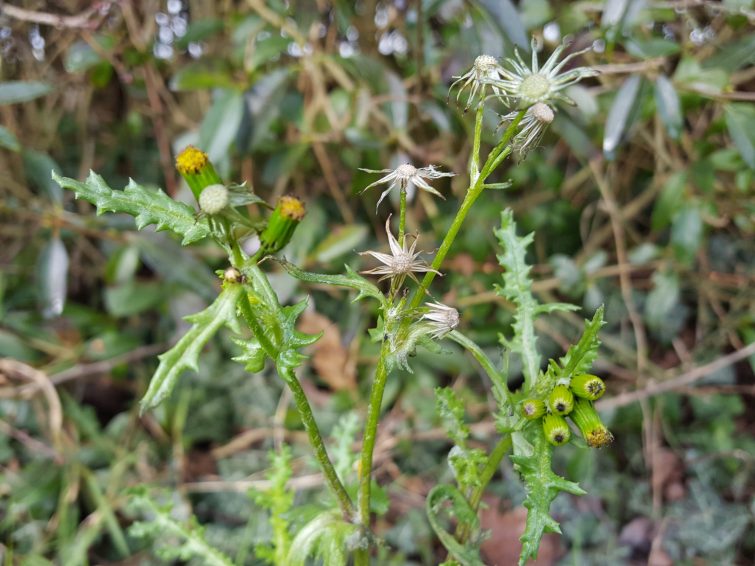
Stems: This is a small plant. Its green, downy-covered, branched stems can grow to around 40 cm high.

The branched flowering stems can reach up to around 40 cm high.

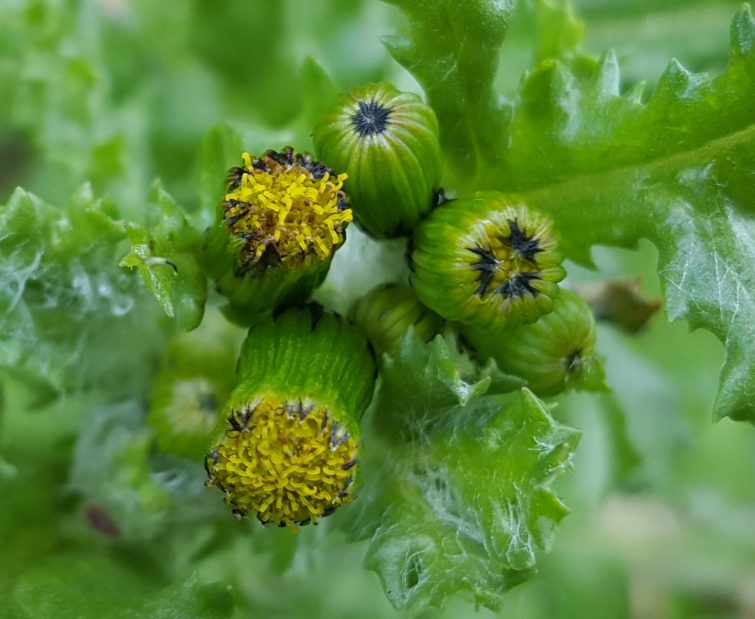
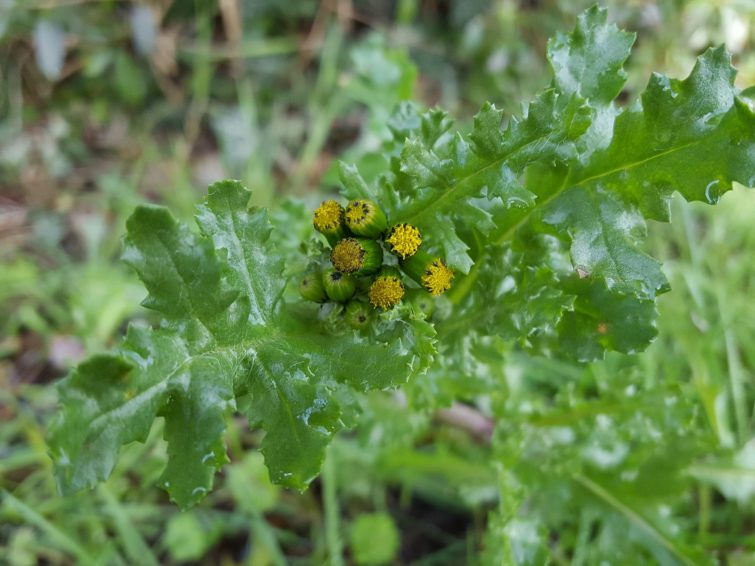
Flowers: Small yellow composite flowers with an involucre of long, narrow, and pointy green bracts. The bracts have black spots at the base and the tips. The flowers consist of disc florets only.

The yellow composite flowers are small with black spotted bracts.

Flowering season: This plant is ephemeral in nature, only taking a few weeks to grow from seed to flowering. So it will happily grow and flower whenever it can.

Fruits:  Tiny achene fruits are attached to the familiar pappus hairs. This design aids their dispersal on the wind.

Habitats: Everywhere! It especially loves any disturbed soil and open ground, hence anywhere it can find room in all the various nooks, cracks, crannies and crevices, in every UK town and city.

Parts used: All the above ground parts are used in herbal medicine.

Harvesting: Whenever you find it ready to pick…which is almost all the time! You may want to take ten minutes to read my harvesting tips, tricks, and techniques.

Medicinal use: This herb was formerly used a lot in herbal medicine as Mrs Grieves reveals . Its chief uses are as a poultice for wounds, as well as being used internally for colic and worms.

Other notes: Contains pyrolizidine alkaloids, which are known to be toxic and carcinogenic to the liver. The standard advice about plants containing them is to not use them frequently and to avoid ingestion.

If you are wondering what to harvest during the winter months, then take a look at our at-a-glance guides to the best foraging in January and February.

If you have any questions about Britain’s wild plants, please do not hesitate to contact me.

Happy foraging!


Foraging in February for Britain’s Wild Food

Some of the tastiest wild foods to find when foraging in February.

This is a small selection of the wild plants and fungi to look out for when foraging in february, with advice on harvesting, preparation and use.

We passed the ancient festival of Imbolc at the new moon in February. Now it becomes more apparent that the days are getting longer, and we can track this by watching plant life as it responds with gusto. 

After another dark winter, us foragers anticipate and keenly sense the first stirrings of re-growth. We know these will soon produce the long-awaited wild food delights of spring.

Numerous cultures stretching back thousands of years have celebrated this time of year, when life begins to stir in the belly of Mother Nature again. Soon, the plants that help our bodies adjust from winter to spring and summer, will be ready to pick. What’s not to celebrate!?

The following wild plants are just some of the species that are available to harvest this month. You might have been seeing some of these plants in January, and will continue to find some of them in March.

A couple of our most common and potentially deadly poisonous plants are included this month too, as they are plants that you will undoubtedly come across again and again if you are out foraging in late winter.

These plants are vital to learn. This summary guide to Britain’s toxic and poisonous plants can stop you making my mistakes, or worse!

Nine wild plants to know when out foraging in February

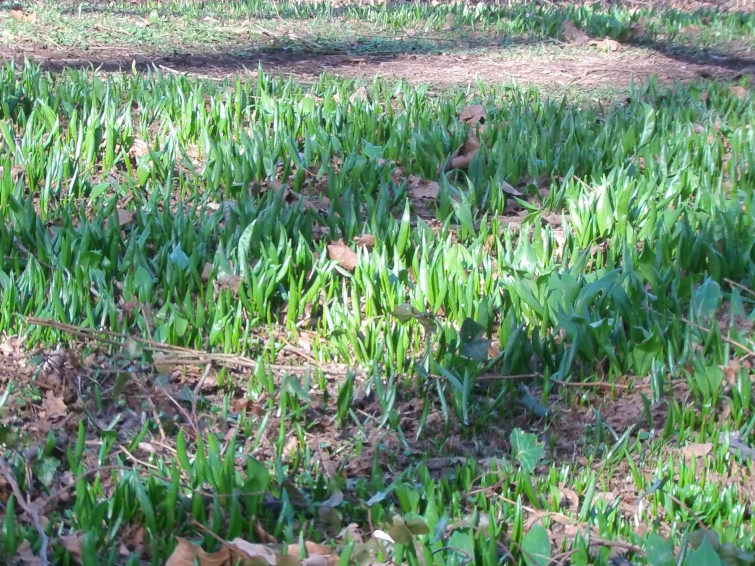
Wild garlic (Allium ursinum). Liliaceae family.

wild garlicxwill be coming up in numbers when you are put foraging in February
Wild garlic will be coming up in numbers during your foraging trips in February.

One of the yearly foraging highlights starts to appear in large numbers this month, at least for much of the western half of Britain it does. Read all about wild garlic and its edible and medicinal uses, in my full-length foraging guide.


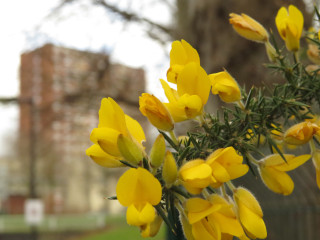
Gorse flowers (Ulex europeas). Fabaceae family.

Gorse produces tonnes of yellow flowers that you cant miss when out walking in February.
Gorse produces tonnes of yellow flowers that you can’t miss when out walking in February.

The gorse flowers begin to bloom en masse during February in the wamer parts of the UK. Also commonly called furze, these pea-like flowers smell and taste of coconut. Yes they take ages to pick, and yes you are likely to prick yourself on the spines. But, the cordial you can make from them is lovely, and reminds me of cream soda if you add fizzy water to it.


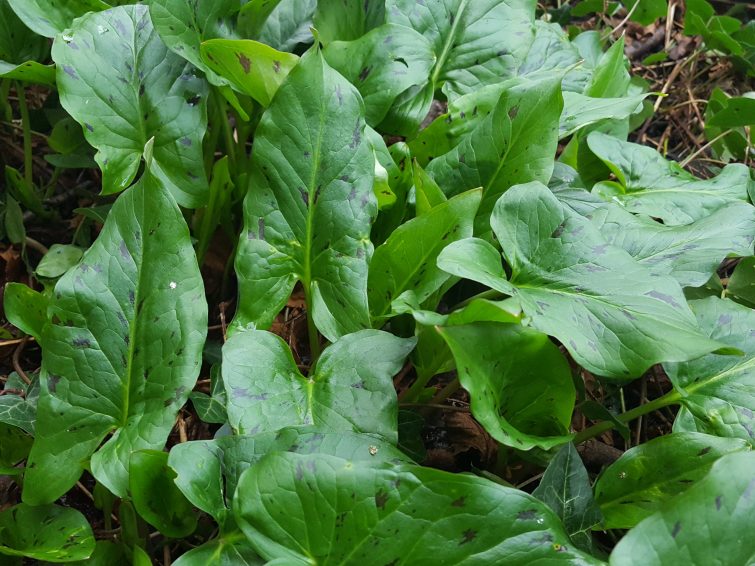
Lords and ladies (Arum maculatum). Araceae family.

Lords and ladies leaves are typically found with spotted leaves.
You cant help notice lords and ladies when foraging for woodland plants in February.

This is a poisonous plant you can’t help but notice when you are out foraging in the woodlands for wild gatlic or wild chervil.

The leaves could be mistaken for the common sorrel if you are just starting out foraging, or not paying enough attention. So it’s best to spend some time with this plant, also known as ‘cuckoo pint’, and get to know its features and characteristics.

The leaves contain microscopic, skin-piercing calcium oxalate cryatals. They can cause anaphylactic shock, restricted airways, asphyxiation, and death! Forewarned is forearmed!


Red valerian (Centranthus ruber). Valerianaceae family.

This coastal plant from the Mediterranean sea area has taken a liking to Britain. It especially loves rocky stony ground such as roadside embankments, old stone walls, and free-draining sites, anywhere sunny.

It can be found all year round but for me the leaves are best harvested as a winter spinach, when the bitterness levels are low. It has a similar succulence and texture to its relative, corn salad. 

The plant produces red, magneta, or occasionally white flowers. They are found all through the summer-time. This is not the medicinal valerian plant, (Valeriana officinalis) although it is in the valerian family.


Red dead nettle (Lamium purpureum). Lamiaceae family.

If you like earthy-tasting pot herbs, you will love this plant. At this time of year it can be flowering away in large populations in grassy areas.

I find the leaves taste a little like mushrooms. The flowering tops can be cooked also. Using them with mushrooms in gnocchi or ravioli utilises the flavour brilliantly. The pretty, purple or occasionally white flowers, can be tossed into salads. 


Darwins berberis flowers (Berberis darwinii). Berberidaceae family.

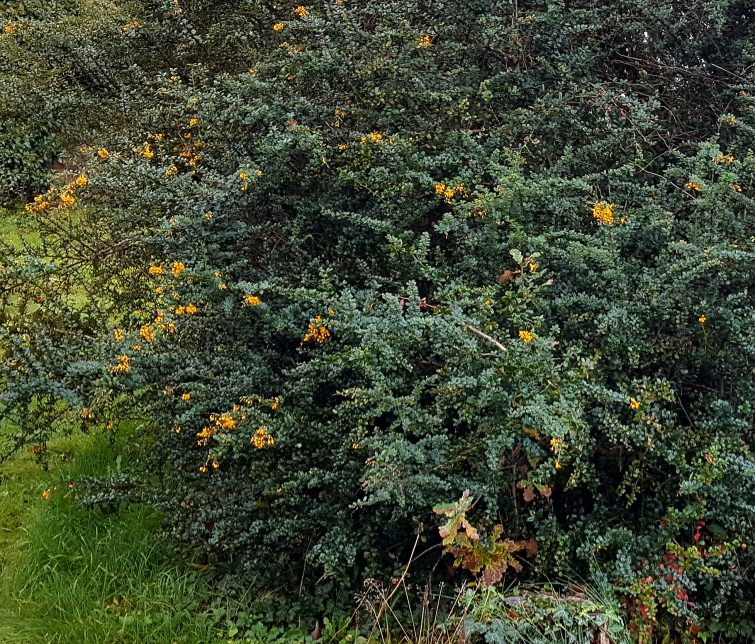
Copious amounts of sour-tasting, orange-coloured drooping flowers can be found on Darwins berberis.

This evergreen shrub is widely planted in the urban environment as an amenity plant. It is a popular plant of gardens and parks as well. The small spiny foliage looks a little like miniture holly leaves.

Masses of edible orange-coloured flowers begin to appear in late winter. These little blooms taste sour, very much like the taste of common sorrel. I throw them into salads to liven them up, and use them as a garnish. Edible dark-purple berries ripen in the early summer.


Primrose flowers (Primula vulgaris). Primulaceae family

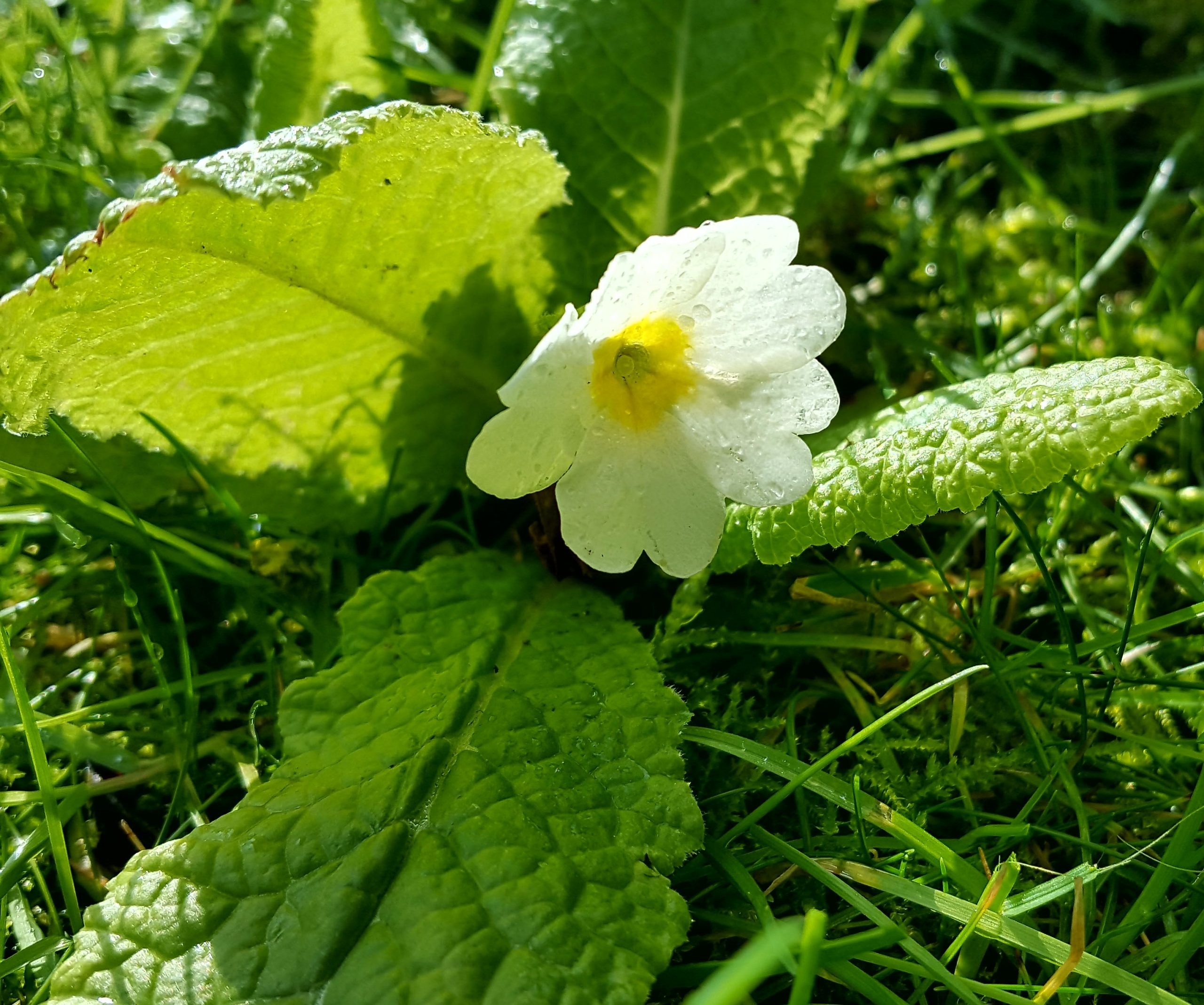
Primrose flowers are a sweet scented delight to find when you are out foraging in February
This primrose flower was open to greet me on the day of imbolc (February 2nd).

The ‘first rose’ is one of our early springtime signs. Primrose is a natural woodland plant. You can find its soft yellow fowers adorning woodland and all manner of grassy areas from February through into April.

The flowers have traditionally been preserved with a mixture of sugar and egg white. I like them in salads where they offer subtle perfume and colour. The crinkled leaves are also edible, though only the smaller baby ones are worth it, as they get tough with age.


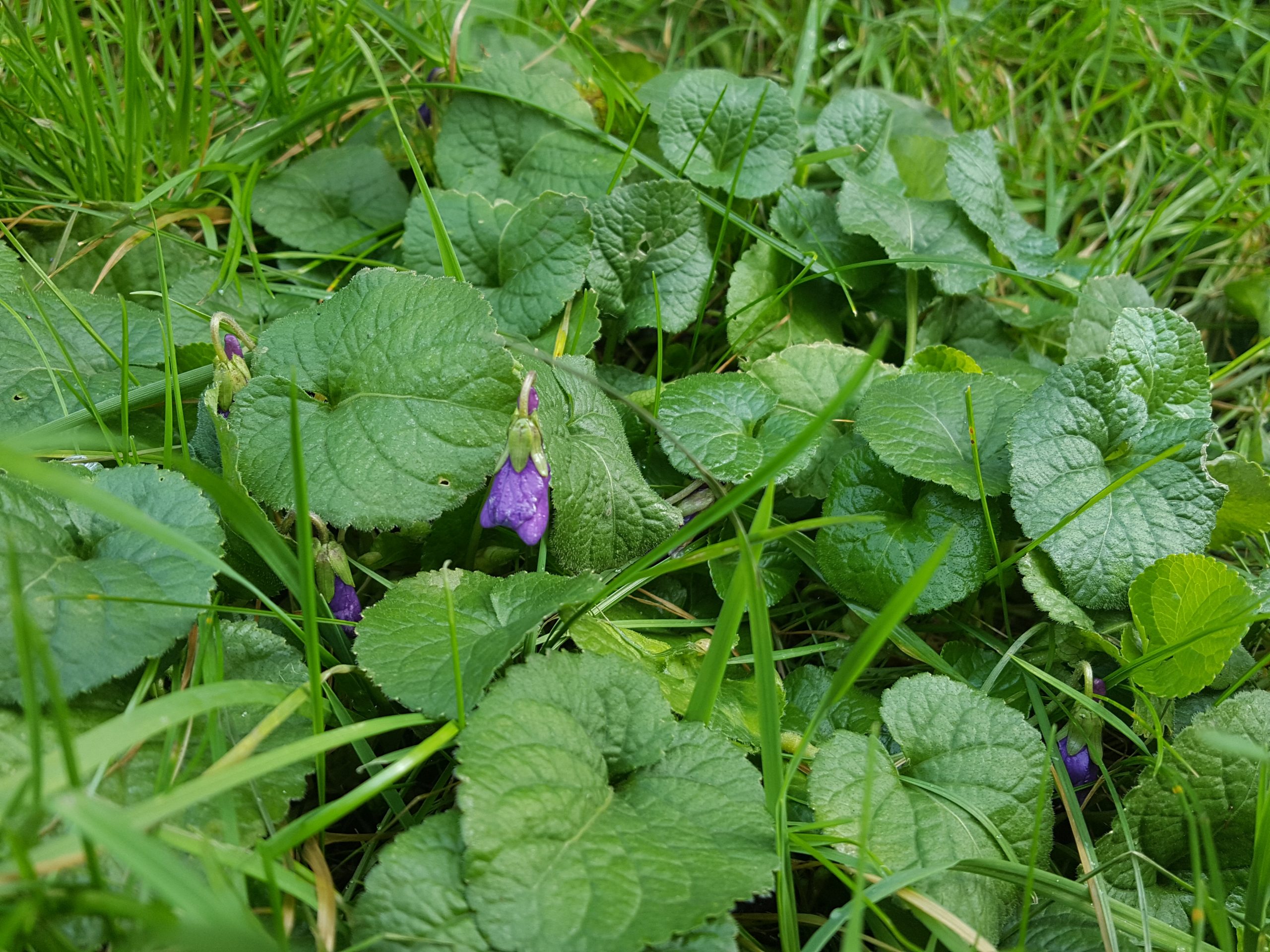
Sweet violets (Viola odorata). Violaceae family.

Sweet violet flowers beginning to appear on cue in mid February.

Another superb sweet-scented flower to experiment with. The various violets all look pretty similar, but only the sweet violets produce such stunning scent. Anyone who has had parma violet sweets will know already what they taste like. Try them in syrups, sorbets,  cordials, and vinegars.

This is another natural plant of the open woodland floor, especially on calcareous ground. Unsurprisingly therefore, I found masses of it on the rocky coastal cliffs of the Gower, South Wales, where once great forests stood.

Churchyards, cemetries and shady parks are suitable sites to look in for violets when out and about during February. The leaves persist all through the winter and are also edible. I find them coarse and a little tough, unless choosing the youngest ones. 


Fungi foraging in February.

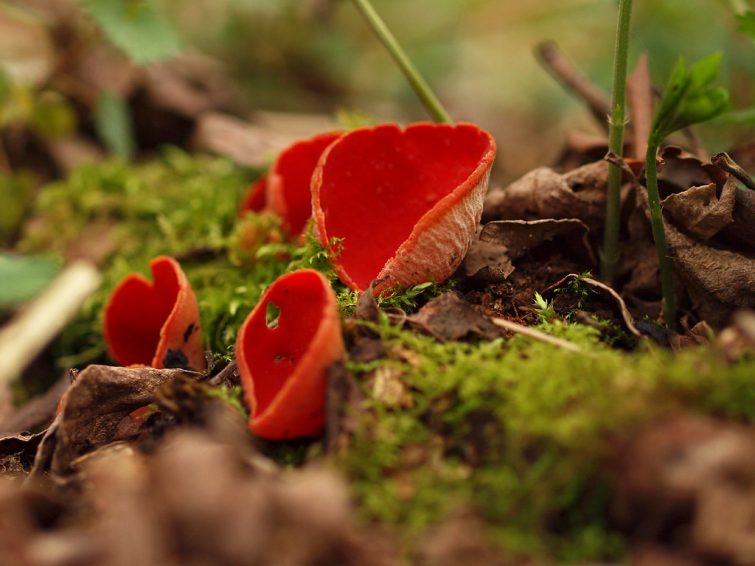
Scarlet elf cup (Sarcoscypha coccinea)

“scarlet elf cup” by Johnson Cameraface is licensed under CC BY-NC-SA 2.0

This strikingly coloured mushroom immediately became a favourite of mine following a few winter woodland trips with my arch foraging buddy Anna. Having lived in Bristol for a few years I was lucky enough to be just a short bike ride away from the ancient Leigh woods, on the far side of the Avon gorge. 

As a saprotrophic fungus, feeding on decaying cellulose, scarlet elf cup requires woodlands with fallen and decaying tree limbs. This fungus loves ancient woods, where trees have grown, died and slowly rotted for millenia, and are typically covered in thick coats of moss.

They can be found anytime from January to April, dependent on weather and location. Most specimens are typically just larger than an old 50p coin, although individuals 50-60 mm in diameter are not that  rare.

The fungus is often a little fiddly to clean, but for me they are well worth the bother. One of the things I like about this fungus is that it holds its colour and texture on cooking.

A vegetarian friend suggested it had the texture of bacon rind, and gave her teeth a similar workout to when she used to eat meat. I eat them raw, cut into thin strips, where they give a lot of colourful life to salads. I also use them in pies with other mushrooms, again because of their colour and texture.

More foraging highlights will come in March, as the foraging year really gets going.

Happy foraging!


Foraging in January for wonderful winter wild foods

Ten tasty wild foods to find when foraging in January 

Foraging in January?  Well yes of course! That is if you’re not snowed in! When it’s not sub-zero, there is a surpisingly substantial wild larder available to us here in Britain. That is, if we can wrestle ourselves away from the arm chair and go foraging in January.

We have a range of seaweeds and seasonal seafood that can be found here in Britain during the winter, as well as many plants and the occasional choice mushroom. We just have to engage all the senses, know where too look, and to look a little harder!

With surprisingly little effort, once you can identify the plants and places where they live, you can quickly gather ingredients that make your food come alive with the wild, even in the depths of winter.

Plant I/D can be fast tracked by using the ‘family patterns’ method as set out in the ‘How to identify plants in a day parts one and two.

If you are starting out on your foraging adventures, then my at-a-glance harvesting charts can help you time your forays when you are foraging in January.

The seasonal charts feature 80 or so species, and are alphabetically listed and colour-coded, for seven different plant parts. They are available as a download. Contact me for details.

Some of these plants are also used in herbal medicine. Check out our plant chemistry page for more insights into medicinal plant constituents and actions.


Nine easy-to-find wild plants to look for in January.

Wild celery. (Apium graveolens).

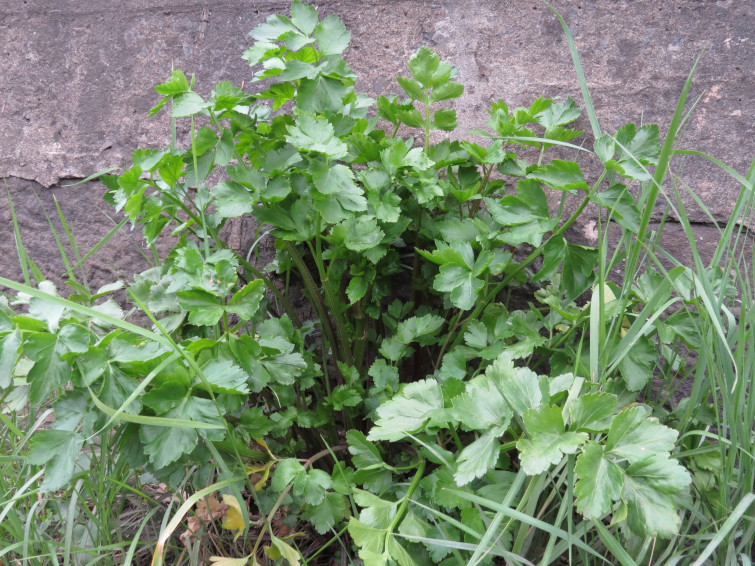
Mainly available from river and estuary habitats, plus ditches on water meadows. Get to know this plant well in my full-length, wild celery forager’s identification guide.

Wild celery on the banks of the River Avon near Bristol City Centre.

You can forage for leaves and leaf-stalks now, and may still find some of last year’s seeds available (ready for mixing with salt). 

The wild celery will taste much stronger than any blanched, shop-bought stuff. It offers fantastic flavouring for casseroles and soups. Great for a wild bloody mary cocktail!  

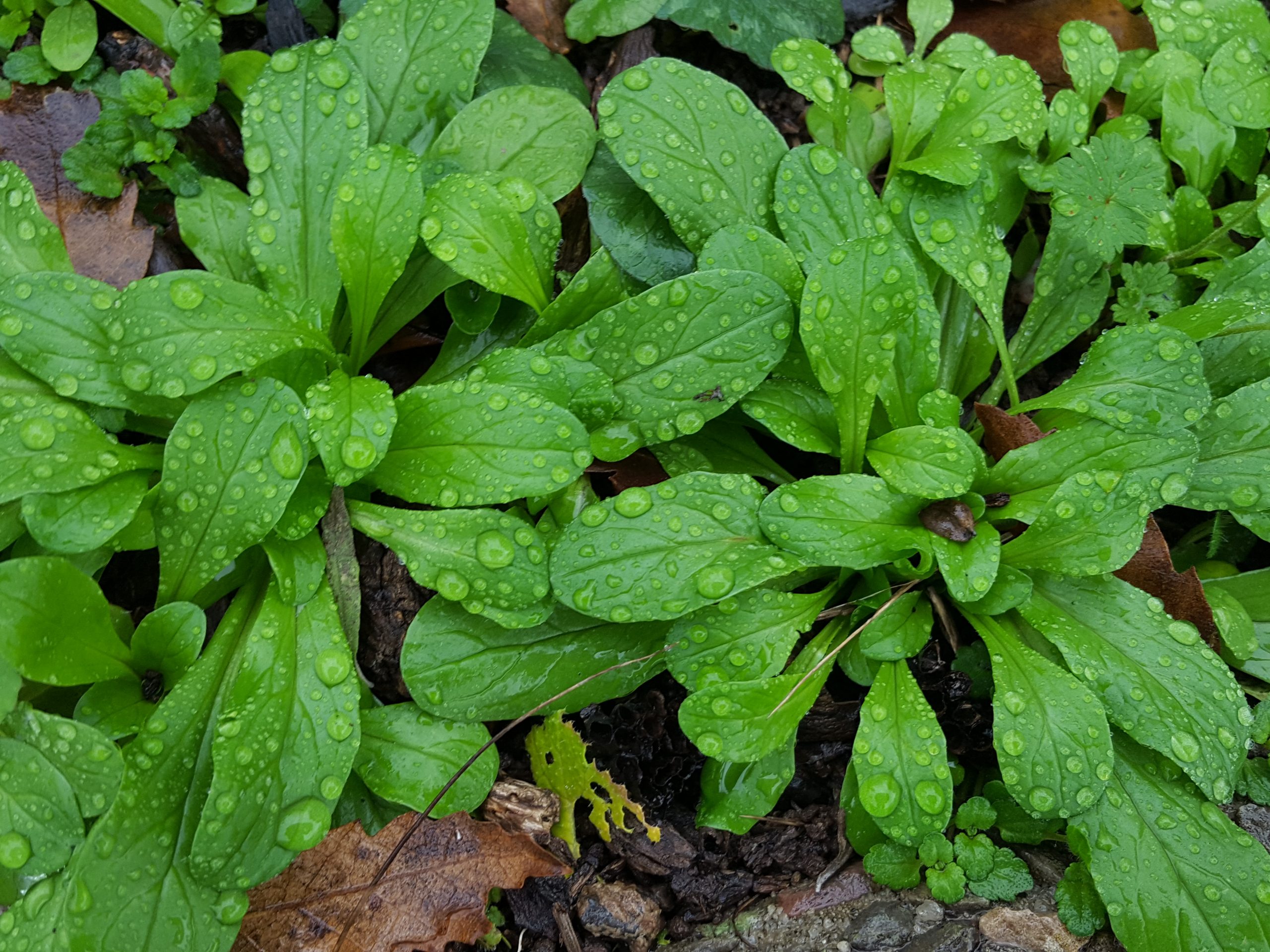
Corn salad / lambs lettuce / Mache. (Valerianella locusta).

The expensive shop bought salad leaf corn salad can be found in numbers when foraging in January.
The super expensive, Vitamin C -loaded salad plant, corn salad.

This is one of those plants that its sometimes easier to walk past than see, partly because it looks a little like the various common forget-me-not’s. I have covered corn salad at length in this previous article.


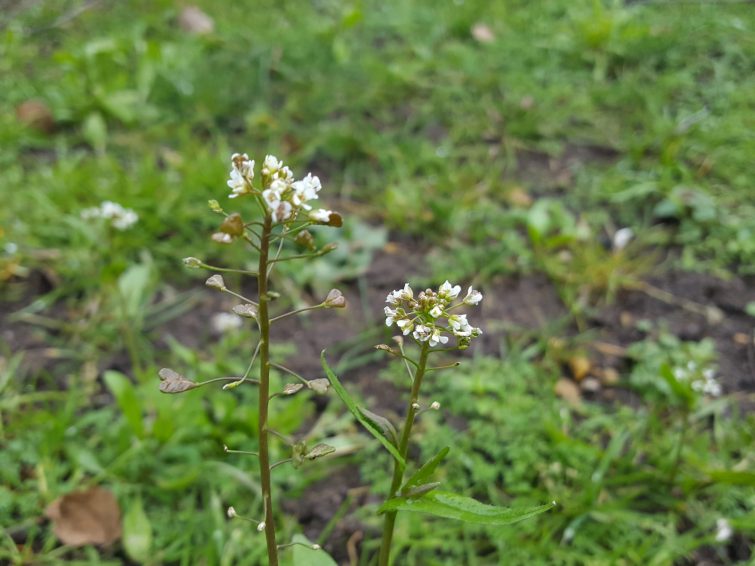
Shepherds purse (Capsella bursa-pastoris).

You can easily find shepherd’s purse when foraging in January. Here near Oxford.

One of a few different brassica family plants featured this month. This plant is a variable-looking annual species found throughout the UK. As my full-length article says, the flowering tops and leaves of shepherd’s purse are worth picking for stir fries. Sometimes the plant produces pinnately-lobed leaves, other times its leaves are almost entire.

Assistance with any confusing botanical terms can be found in the glossary for foragers.


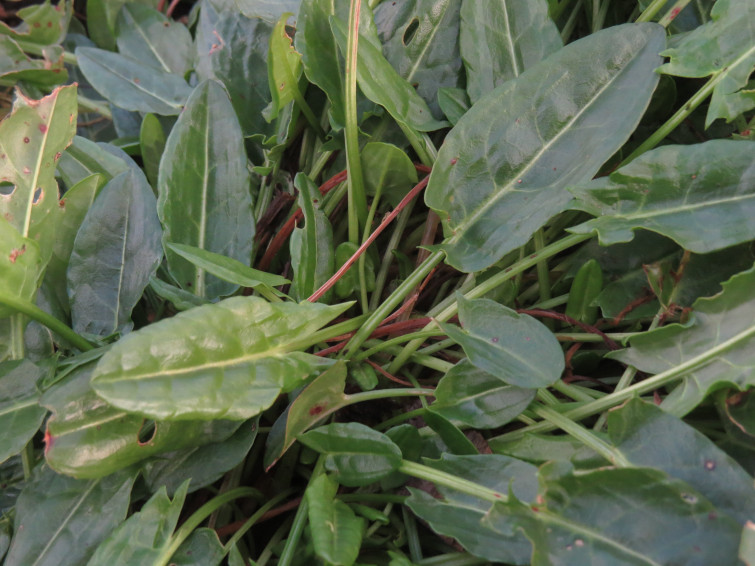
Common sorrel. (Rumex acetosa).

Sorrel is a refreshing wayside nibble when you’re out foraging in January.

A really lovely addition to any salad. A remarkably thirst-quenching and refreshing herb, great to find on warmer days when foraging in January. The sharp, tart flavour of sorrel marries exceptionally well with fish. Follow the link if you want to know more on sorrel and other edible docks!

 
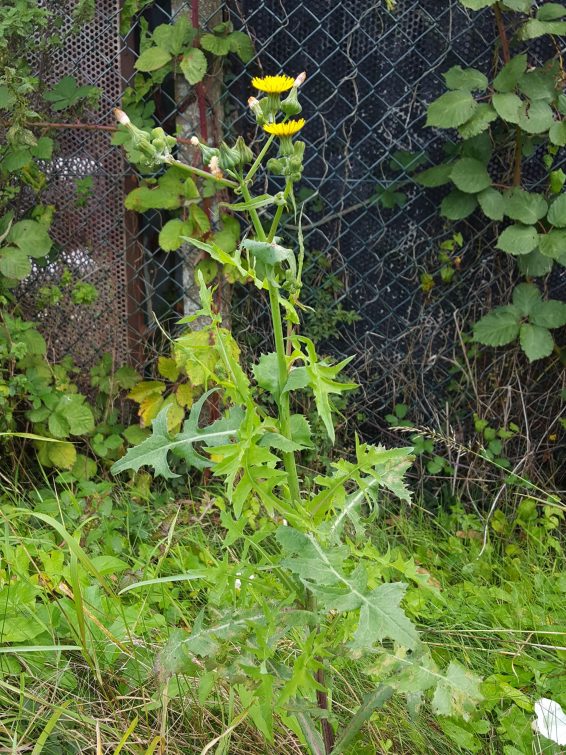
Sow thistles. (Sonchus species)

Smooth sow thistle in flower. This herb is eaten in mnay countries across the world.

The different sow thistles are plentiful plants found in numerous settings. The various species give us edible leaves, stems, flower buds, and flowers, almost all year round.

The base of the leaves on the perennial and smooth sow thistles can taste a little salty. The flower buds have a surprisingly nutty taste when young, tight and firm. The stems are great when peeled and plonked into a pickle vinegar, or served raw in salads and coated in a tangy vinaigrette. A few days continued frost will knock plants back, but until then…
 

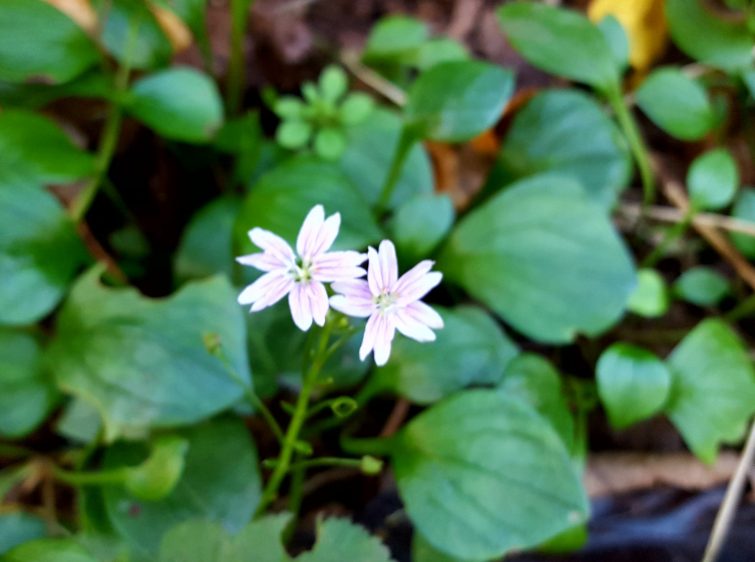
Winter purslane (Claytonia sibirica).

Winter purslane in flower by the river Dart near Totnes in early January.

Also known as pink purslane, this succulent leaf offers lovely earthy flavours to salads. The plant was previously covered in-depth here in this plant identification guide.


Jack-by-the-hedge. (Alliaria petiolata).

Jack-by-the-hedge will be found in January growing as basal rosettes.

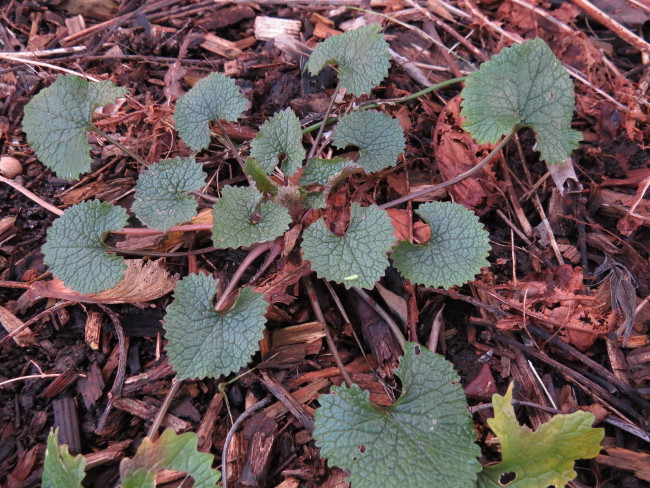
This brilliant brassica family plant will be found growing as basal rosettes when you are out foraging in January. Sometimes you will find large populations. You can learn all about the plant we also call garlic mustard, in my forager’s guide.


Magnolia flower buds (Magnolia species).

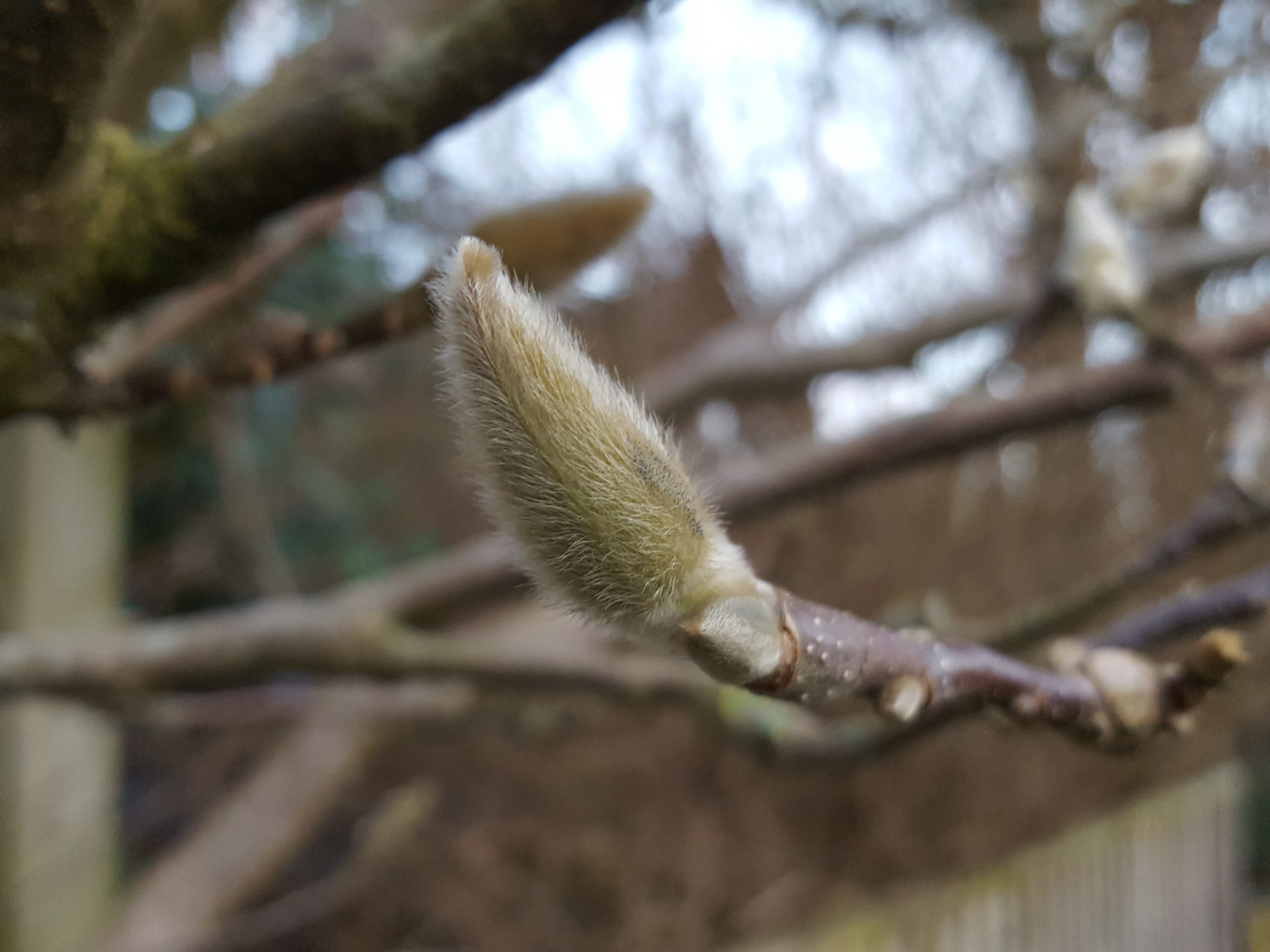
These Magnolia flower buds offer lovely zingy lemon flavours.

Various Magnolia species have documented edible use. The flower buds have a crunchy lemon flavoured zing about them and can be pickled or dried. Do your research on the species and / or follow the rules of testing your tolerance.


Lime tree buds (Tilia vulgaris et al). 

Lime tree buds are a tasty bite you can find if foraging in January.

A common tree of parks and gardens, lime tree buds are another favourite wayside nibble when I’m out foraging in January. The most commonly found species is the ‘common’ or ‘European’ lime. This particular species produces numerous suckers from the base of the trunk from which the buds can be easily picked during the winter.


Mushroom foraging in January.

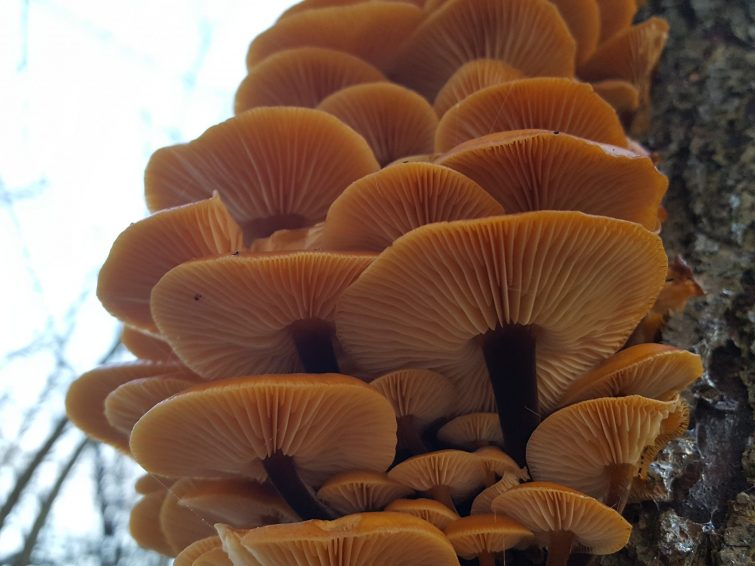
Velvet Shanks – Flammulina velutipes.

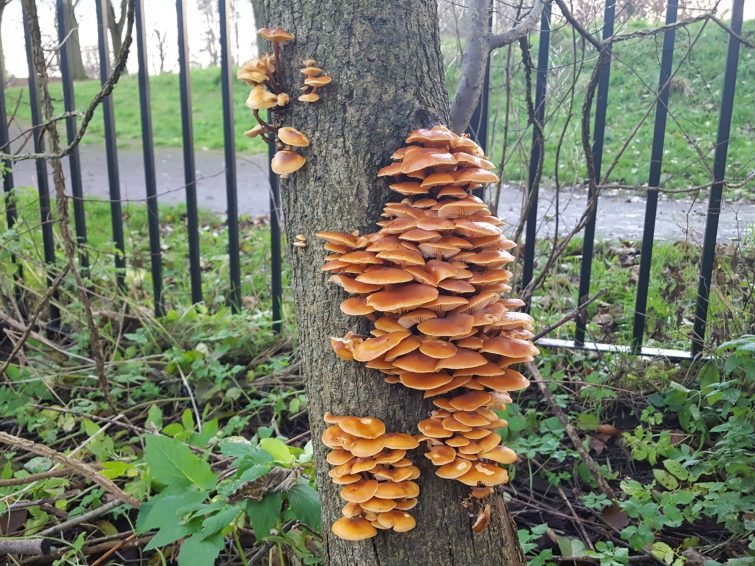
There are few mushrooms we can find in January, let alone eat. This clump-forming winter mushroom will actually be stimulated into fruiting by cold and frosty weather.

Cold frosty weather will stimulate velvet shanks into fruiting.

Its slimy, shiny-looking cap is typically a two-toned brown, lighter at the edges.

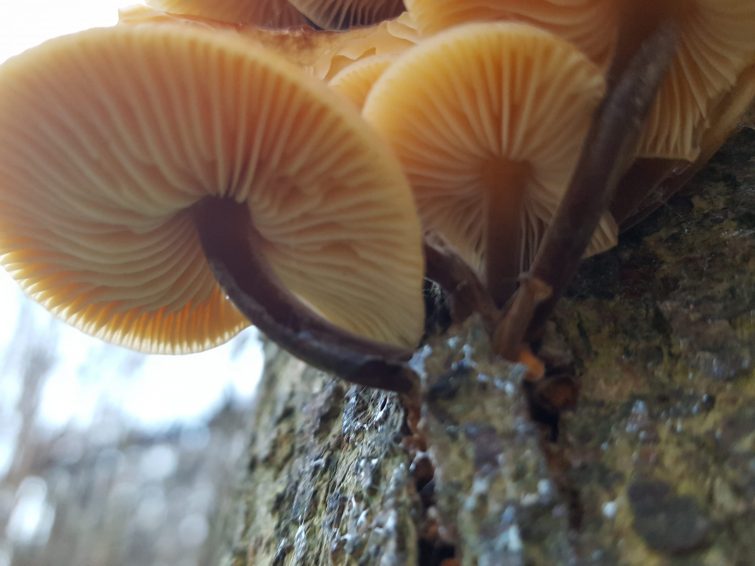
The stem (or stipe), has a soft dark brown covering, especially towards the base, and feels velvety, hence its common name.

The dark brown stipes of velvet shanks.

It has creamy white gills, that are well spaced, not crowded. The spores are white (helping to safely I/D this mushroom and distinguish it from a couple of the poisonous lookalikes). It loves to grow on cut and damaged Elm and willow. I first met it, and still mostly see it, on willow.

These mushrooms are delicious served simply on buttered toast. Its flesh is somewhat sweet, nutty and meaty.

Creamy white gills and white spores will help positively identify velvet shanks.

You may have already eaten velvet shanks under the different Japanese name of ‘enoki’. These cultivated, porcelain-white clumps of shop bought fungi are basically forced velvet shanks, grown in appropriate conditions, but no light.

More monthly wild food guides are coming. Until then, happy foraging!

Foraging for Water Pepper (Persicaria hydropiper)

Learn how to confidently identify the spicy water pepper, with the UK’s most comprehensive online foraging guide.

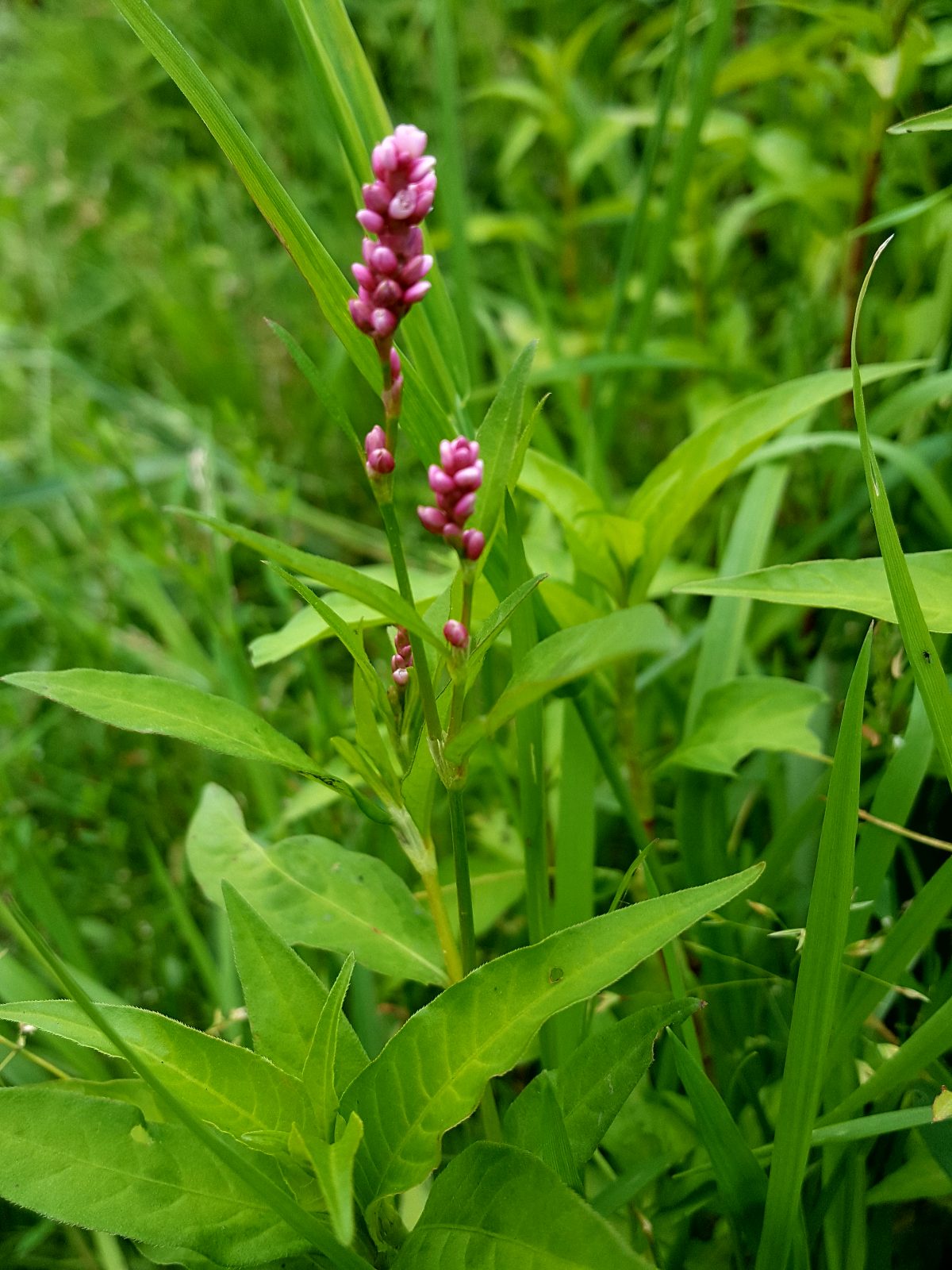
Water pepper (Persicaria hydropiper) Polygonaceae family.

When I finally got to know water pepper about 10 years ago, it was one of those great foraging moments. You know…when you discover a new edible wild plant and quickly realise it will immediately become a permanent fixture in your yearly hunting.

This fantastic peppery-tasting plant looks like a number of its relatives, such as the common weed of cultivation – red shank (Persicaria maculosa), but in its favourite habitat, water pepper will always stand out from the rest of the crowd.

What’s in a name?

The generic part of the name Persicaria – comes from the old Latin word for Peaches. This points to the similarity of the leaf shape.

Its specific name hydropiper – translates from the old Greek word for water – ‘hydro’, and the old Latin word for pepper – ‘piper’.

I love its other English common name ‘arsesmart’. Collectively, the dock family plants are known as smartweeds in North America. As my article on sorrel and other useful docks mentioned, the compound chrysophonic acid, found on the leaves, is responsible for any tingling or smarting. You can guess from its name where the tinging may arise!

If you are a student or practitioner of herbal medicine, you might want to take ten minutes to flick through this overview of other medicinal plant constituents and their actions. Moreover, all readers should get to know our common poisonous plants while you are here!

Water pepper botanical description.

If you do get stuck on any of the technical words and phrases here, then simply pop over to our glossary for foragers.

And if you are new to foraging, then you may also like to know that this quick guide is full of tips, tricks, and techniques to help you when you are starting out on your foraging adventures.

As a member of the dock family, this plant produces distinctive and easy-to-spot characteristics that help you identify them. You can now easily access the quick-to-remember plant patterns for all of Britain’s most common plant families, from my ‘how to identify plants in a day’ articles (parts one and two).

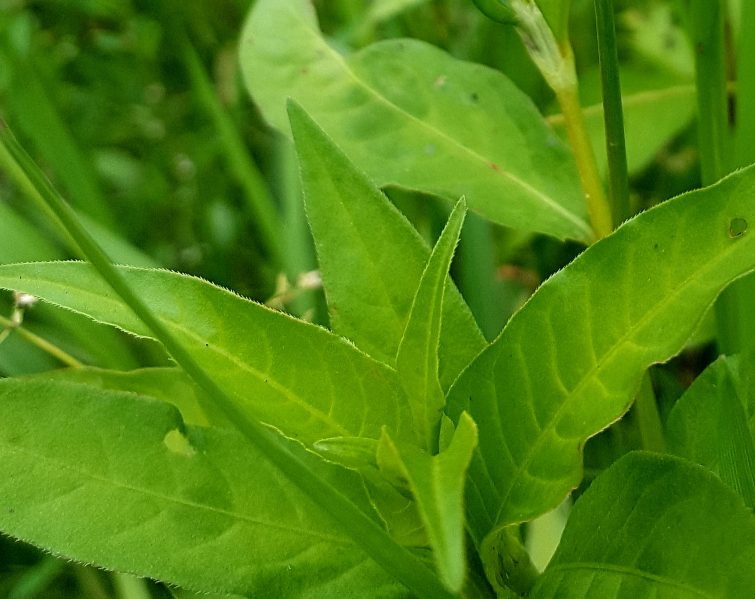
Leaves: Lanceloate-shaped leaves typically reach about 7- 15 cm long. The leaf narrowly tapers towards the base. They have slightly undulating, entire margins. The margins always have fine ciliate hairs.

When identiying water pepper, you will notice the lea ea have fine hairs running up the leaf margin
Water pepper will be found with fine hairs on the leaf margins.

Unlike its close relative redshank, (Persicaria maculosa), the waterpepper does not have any large dark smudges, or spots, on its leaves. Lovers of Latin names may have already learnt that the name ‘maculosa’ comes from the word ‘maculate’ meaning spotted or stained.

Petioles: Short. They are not usually much longer than 2-5 cm.

Roots: The plant grows on a fibrous rootstock.

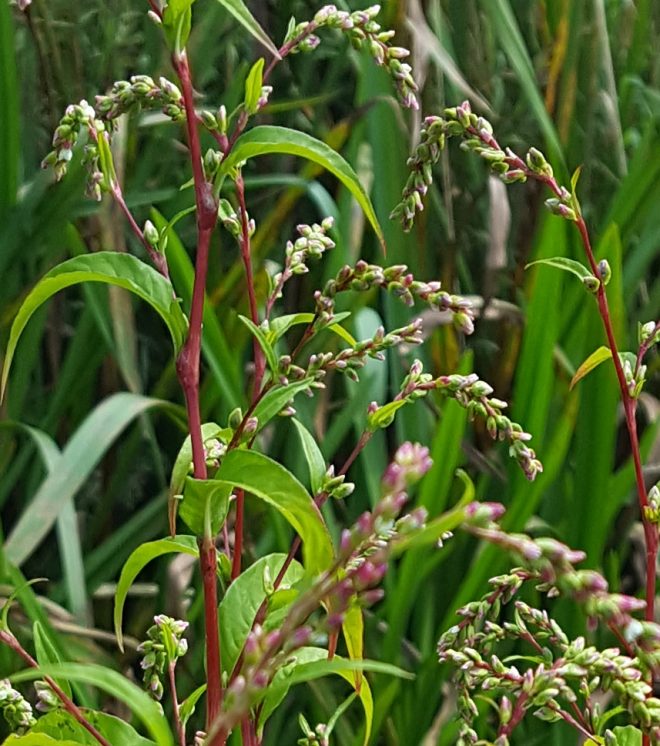
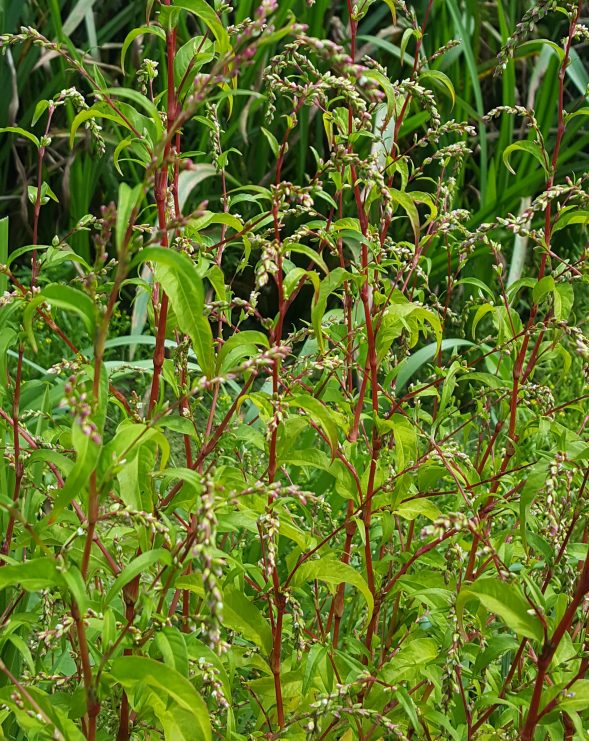
Stems: The stems can reach up to around 80 cm in flower. They can be quite red all over, or coloured just below the nodes.

Water pepper will often, but not always show, red coloured stems.
The stems of water pepper are often red coloured.

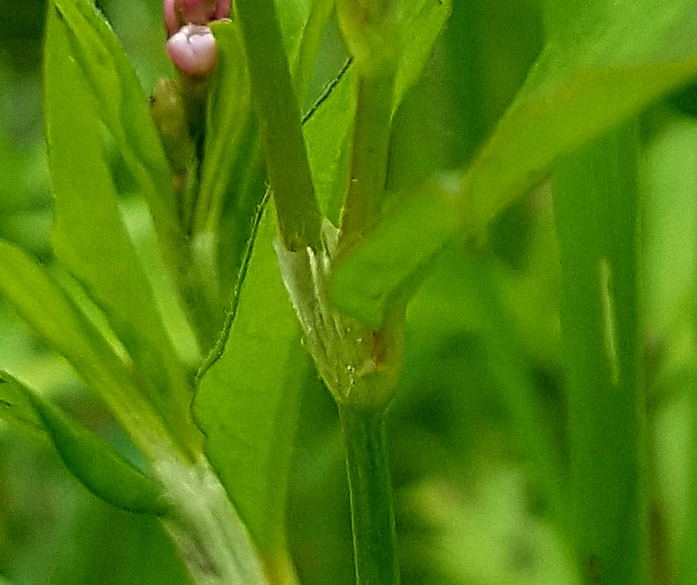
A major identifying family feature is found on the stems. If you look at the node you will find a papery sheath surrounding it. This eventually turns brown, and can wither and fall off as the plant matures.

Water pepper, like all the dock family plants will have a papery sheath on the stem nodes
Water pepper with its papery sheath surrounding the stem node.

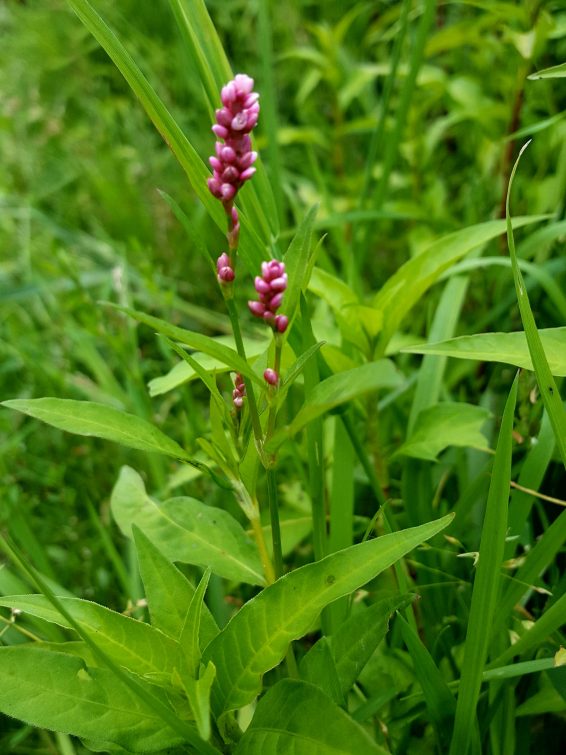
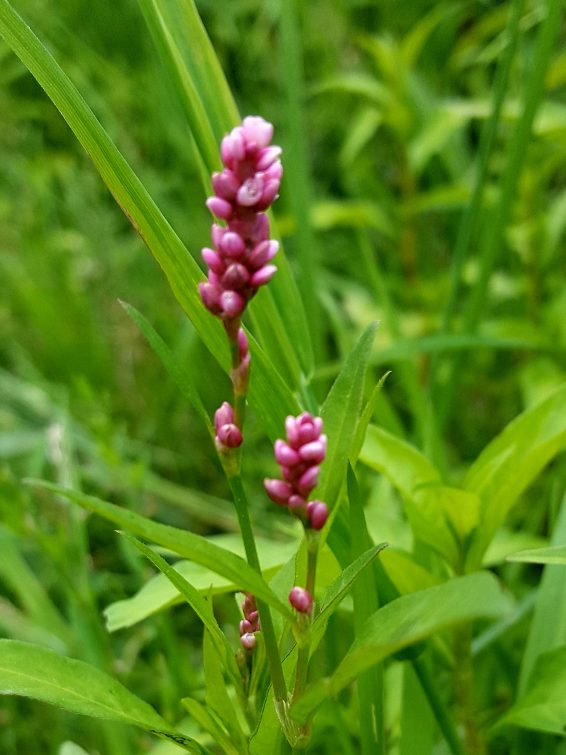
Flowers: The pretty flowers are produced on a loose, drooping raceme, that initially looks like a spike. I find the flowers generally coloured pink in this country, or occasionally white.

The flowers have no petals and 5 sepals only. Inside the centre of the flowers are 3 styles and anywhere from 4 to 6 stamens.

Flowering season: You can usually find the plant in bloom from June to September.

Fruits: The small fruits are tiny little nuts, coloured almost black, russet brown or copper. They have three-angled edges.

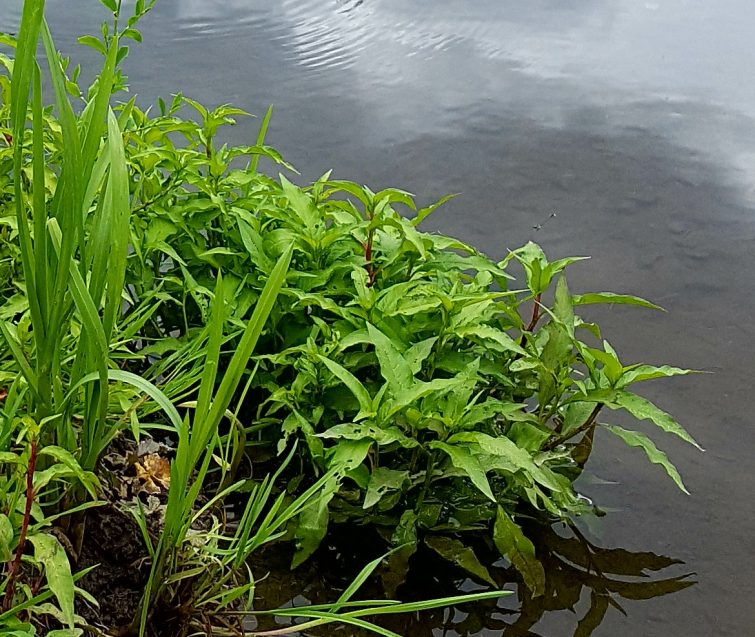
Habitats: Water pepper is a plant favouring damp muddy soils. It loves the edges of slow-moving water courses, such as streams, rivers, and ponds.

It will also be found in fields that endure quite a bit of winter flooding, as well as by wet woodland paths and streams that dry in the summer months. This is essentially a lowland plant that wont be found above altitudes of 500 metres.

Water pepper loves slow moving waterside habitats
Water pepper loves to grow in all manner of damp muddy settings like this stream edge.

Parts used: Leaves and pre-flowering tops.

Harvesting: The leaves are best in spring and early summer. You can use them fresh, or dried and powdered, as you would other spices. The flower buds and young stem tops can be harvested when they are still drooping.

Other notes: This plant is used in many different countries cuisine, especially in the Far East. Similar looking plants such as the Vietnamese coriander (Persicaria odorata) are also widely used in cooking in Asia.

Stand by for more plant identification help coming up here on Wild Plant Guides. Until then, happy foraging!


Water plantain (Alisma plantago-aquatica)

Learn how to confidently identify water plantain (Alisma plantago-aquatica) Alismataceae family.

Despite its name, water plantain is not related to the super-useful plantain herbs, previously covered here.

Unless you have a lot of running streams and drainage ditches near you, like the many rhines found near me on the Somerset levels, you may not get to meet water plantain too often.

What’s in a name?

It seems like this plant gets its common name from the similarity of the foliage to our land based plantains (Plantaginaceae family).

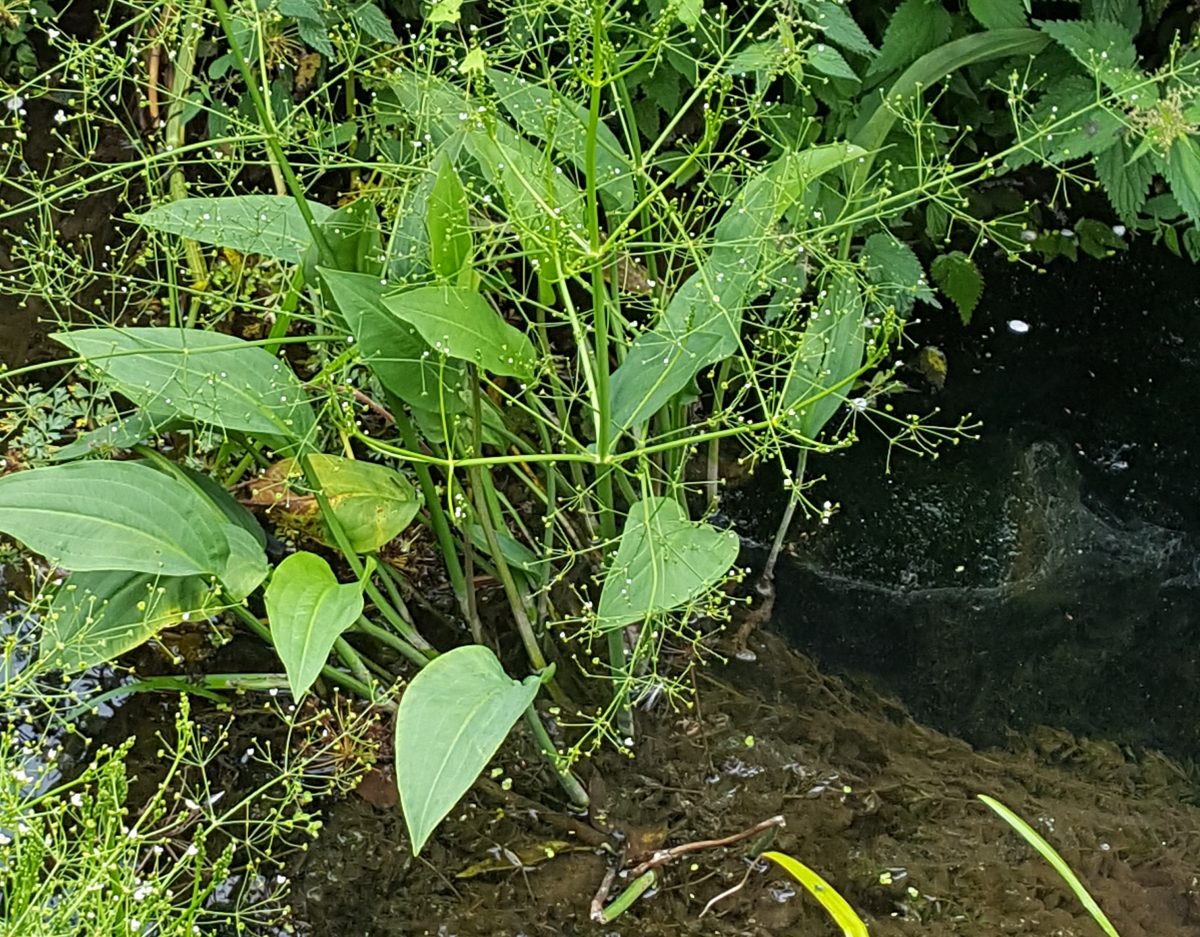
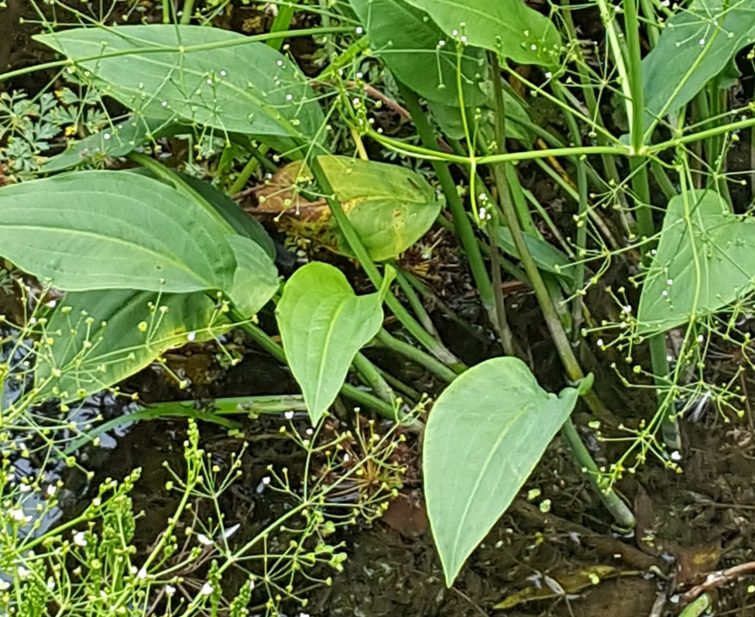
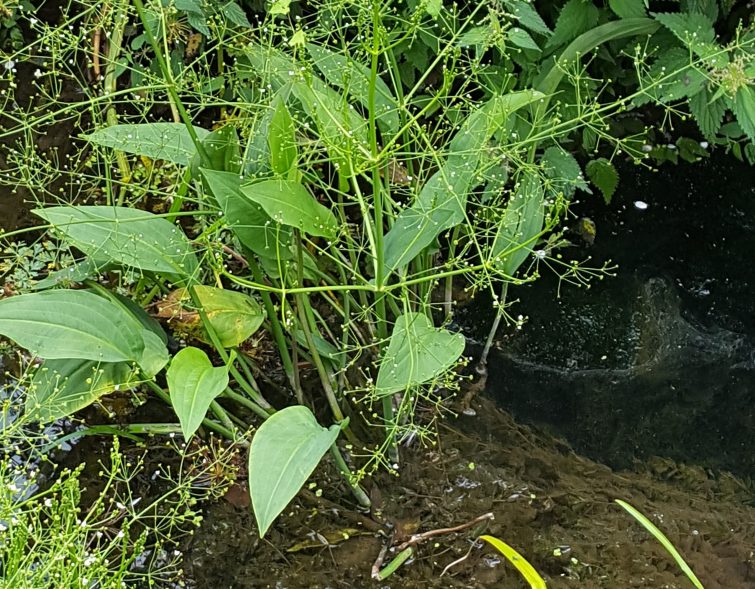
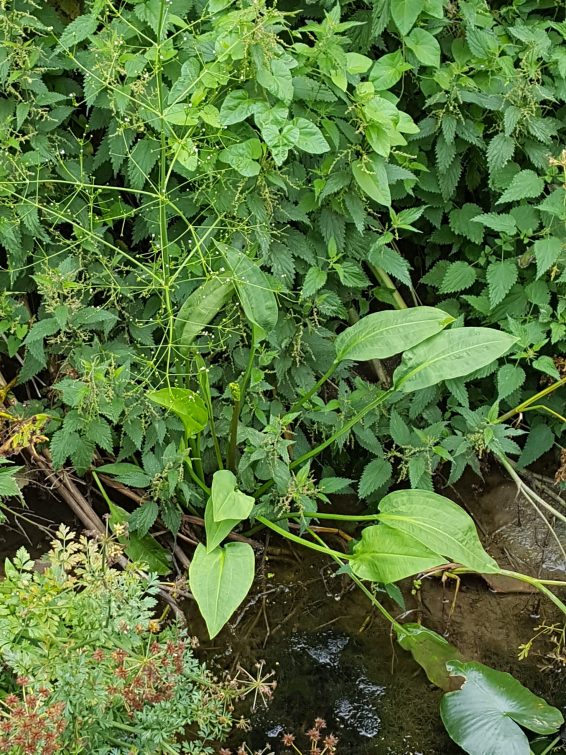
water plantain enjoys life at the edges of flowing water
Water plantain enjoying life in the medieval millstream in Glastonbury, Somerset.

The generic part of the scientific name Alisma is the old Latin name for the plant, taken from the old Greek. The plant was recorded by both the Roman writer Pliny, and the Greek physician and author of the world famous ‘De Materia Medica‘ – Dioscorides.

The specific name ‘plantago -aquatica’ is derived from the Latin word ‘planta’ – meaning ‘sole of the foot’. This alludes to the size and width of the leaf.  The word ‘aquatica’ simply reveals its chosen habitat.

Water plantain botanical description

A quick reminder that if you come across technical words that you are unfamiliar with, then this glossary for foragers will prove more than helpful.

Leaves: Long, broad, and elliptic to ovate-shaped. They appear rolled when first emerging. Each leaf can grow to around 25 – 30 cm long and between 4 – 10 cm wide.

water plantain has broad elliptical to ovage leaves with raised veins on the undersides
Water plantain has broad , hairless leaves with raised veins on the underside.

The leaves are hairless, and  typically have between 2 – 4 secondary veins. These are slightly raised on the undersides of the leaf.

Petioles: Long, semi-cylindrical petioles are filled with a spongy pith. This characteristic is found in many aquatic and marginal water plants. The leaf-stalk contains numerous air-filled cells. The petioles are sheathed at the base.

Water plantain has a spongy pith and air-filled, semi-cylindrical petioles.

Roots: This plant has a fibrous perennial rootstock.

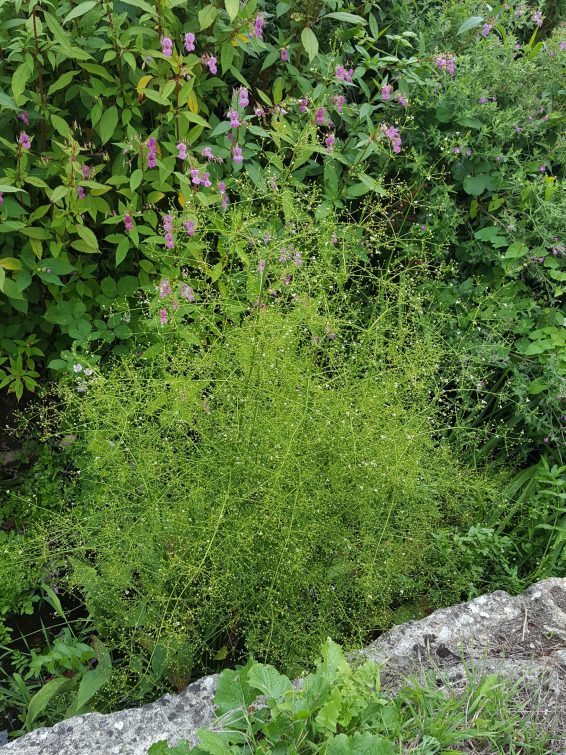
Stems: Water plantain has triangular flower stems with numerous branches. To the eye, this produces quite a messy, tangled display. No leaves appear on the flowering stems. The stems can easily reach up to around 1 metre high.

Masses of flowerering stems and stalks appear on water plantain in the summer months.

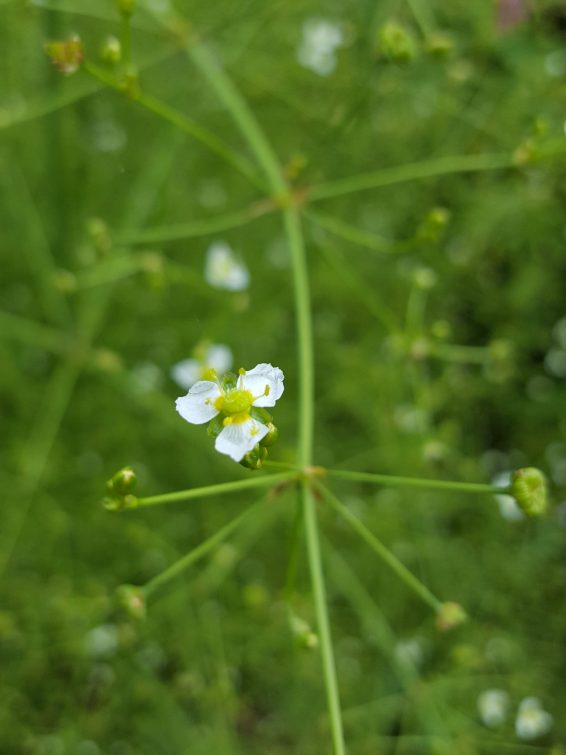
Flowers: The flowers are pretty little things. They have three triangular-shaped, green bracts, surrounding the three, round and somewhat torn-edged, white to pale lilac petals.

The edges of the petals are a little jaggex and torn
The edges of the round-ish petals are a little jagged and torn.

The petals have a little yellow spot at the base and are approximately 6 – 10 mm wide. Six yellow-tipped stamens surround the pistil.

Flowering season: Water plantain starts to flower in June, and carries on through into August.

Habitats: This plant is mostly aquatic, but loves it most where it is not totally submerged. This includes drainage ditches, shallow ponds, streams, marshes, and other damp waterside habitats. This map from the BSBI shows its geographic distribution in the UK.

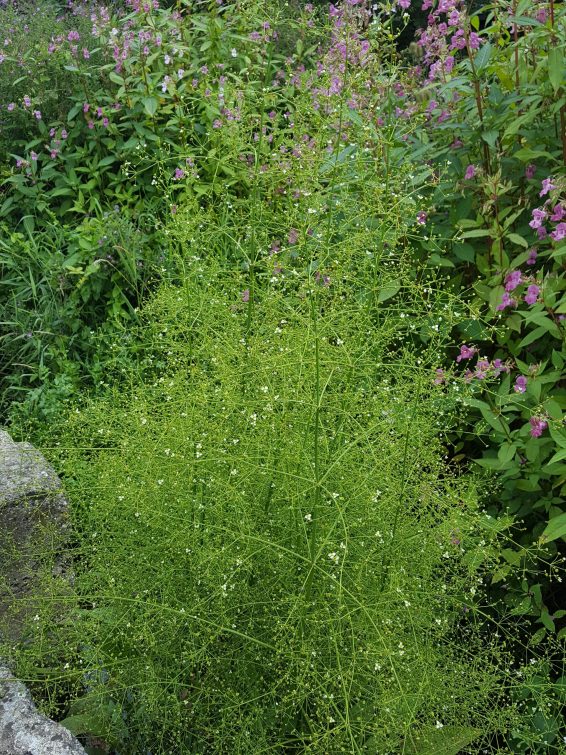
water plantain with showing its tangled, messy floweringstems
Water plantain showing off its messy, tangled looking flowering stems.

There is shed loads of this plant found in the slow-moving network of rhines on the Somerset levels. It can also be spotted throughout England, Wales, and lowland parts of southern Scotland, up to altitudes of 350 – 400 metres.

Other notes:  The excellent Cornwall-based plant research organisation ‘Plants for a Future’  mention its edible uses. I am yet to experiment with this plant.

Various species of water plantains have traditionally been used in Chinese medicine and Homeopathy.

Now then, if you are just beginning your foraging adventures then you may wish to discover just how easy it ìs to learn how to identify hundreds of plants in a day.

Another extremely important tool in your armoury is to know Britains poisonous plants. As well as this, my guide to harvesting wild plants, together with this summary of the important medicinal plant constituents and actions should give you a thorough basic understanding of how to safely collect the medicinal magic contained in our fantastic flora!

Happy foraging!


How To Identify Winter Aconite (Eranthis hyemalis)

Identifying the poisonous winter aconite (Eranthis hyemalis) Ranunculaceae.To learn them is to leave them!
In this quick to read wild plant guide, you can easily and confidently learn how to identify the beautiful winter aconite.

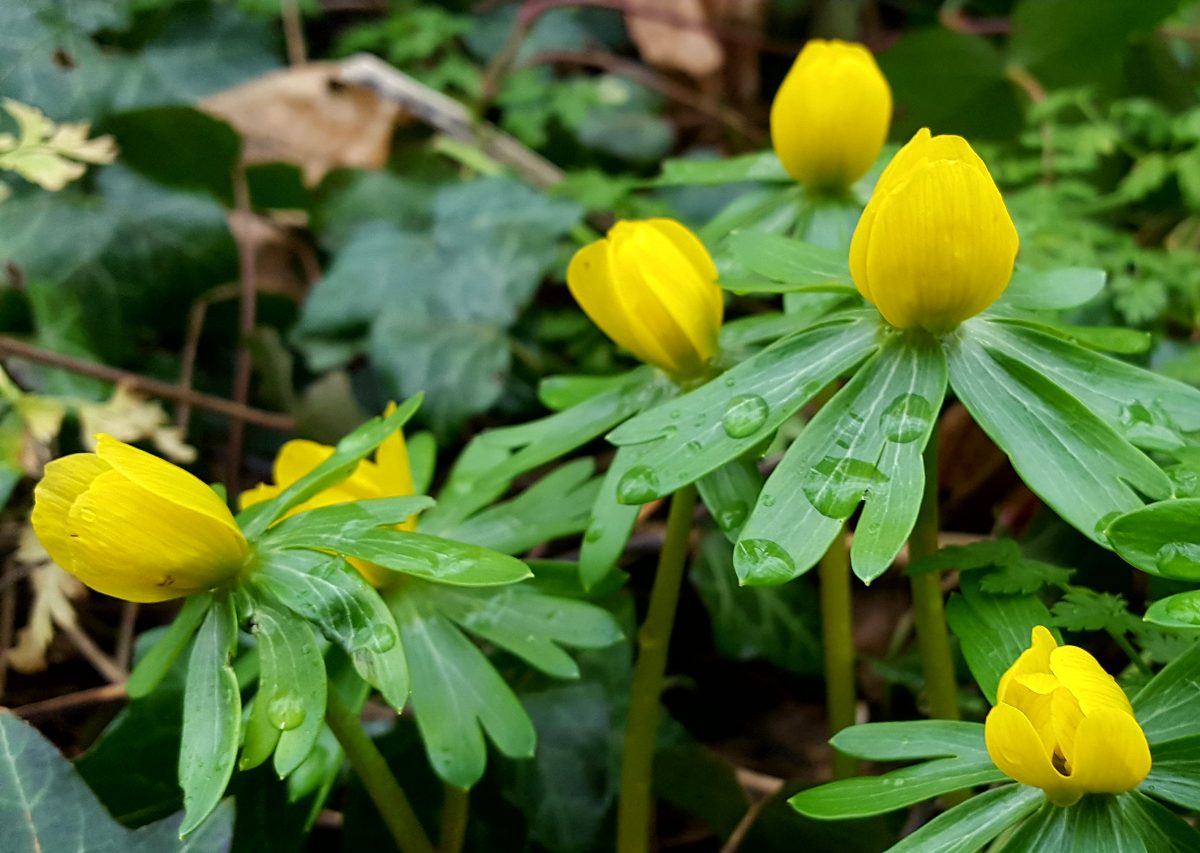
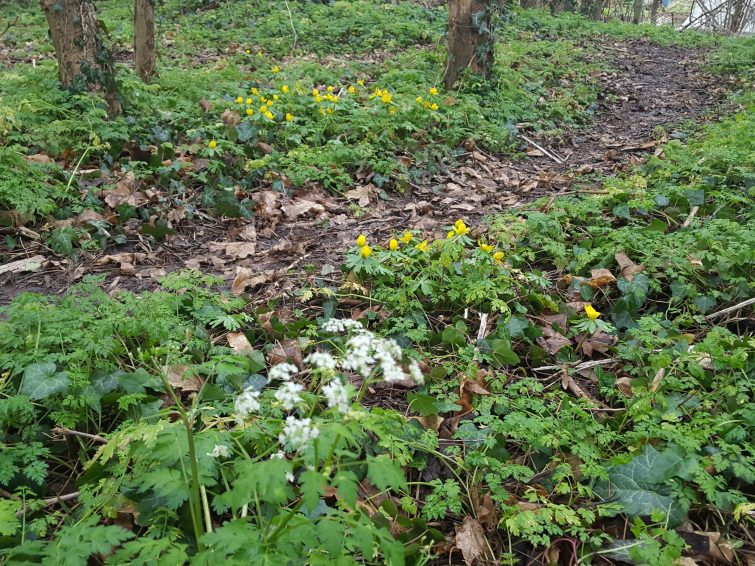
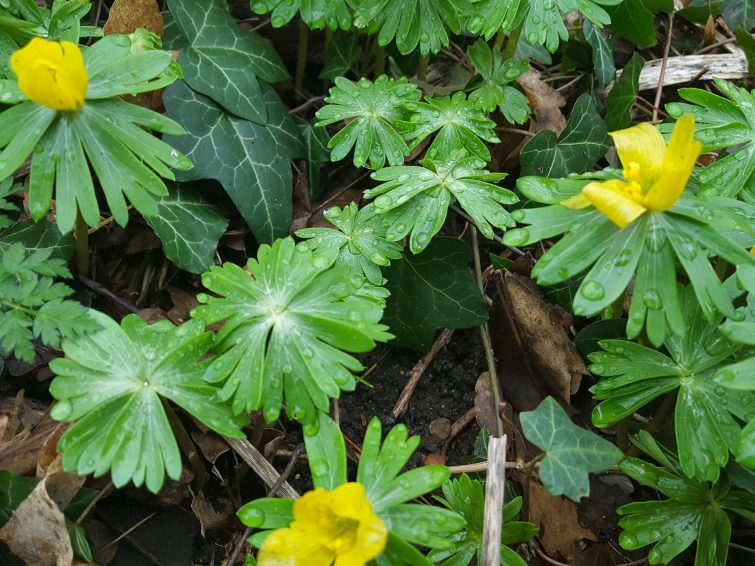
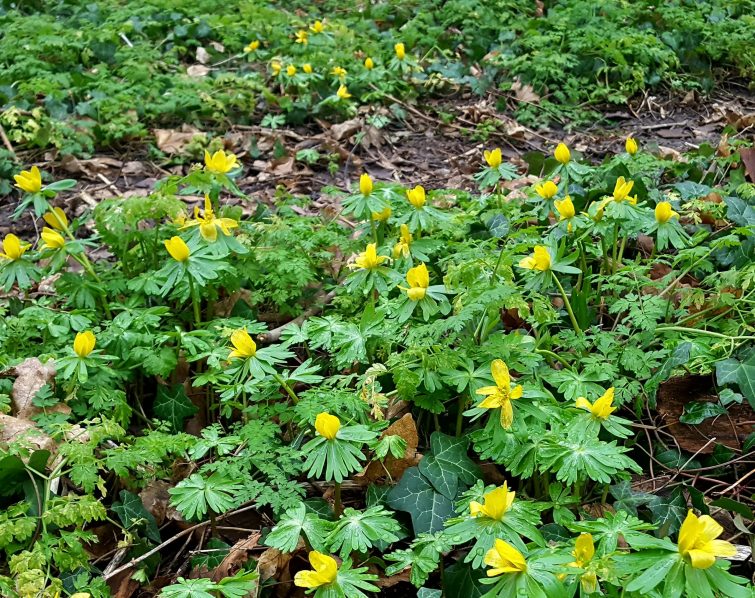
This is a delightful winter flowering plant, that brightens up woodland floors with carpets of yellow flowers in January and February. Together with its soon-to-flower close cousin, the lesser celandine, this plant is a spring messenger!

If you are new to foraging, I strongly advise the reading of my beginners guide, and this article on how you can identify plants in a day.

As I write on the eve of imbolc 2021, this plant is in flower sharing my local woodland floor with lovely white snowdrops, wild chervil and many re-emerging lords and ladies.

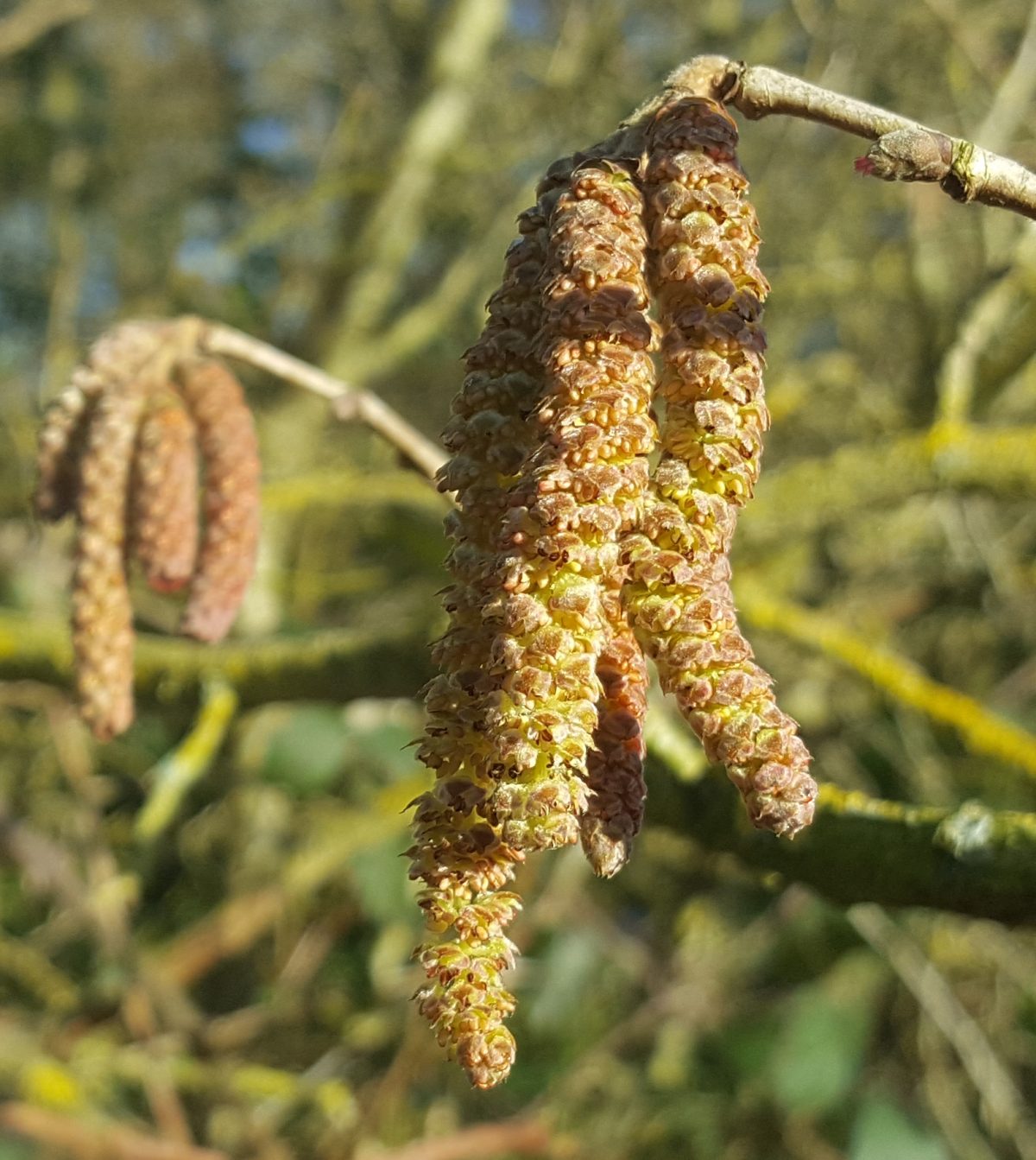
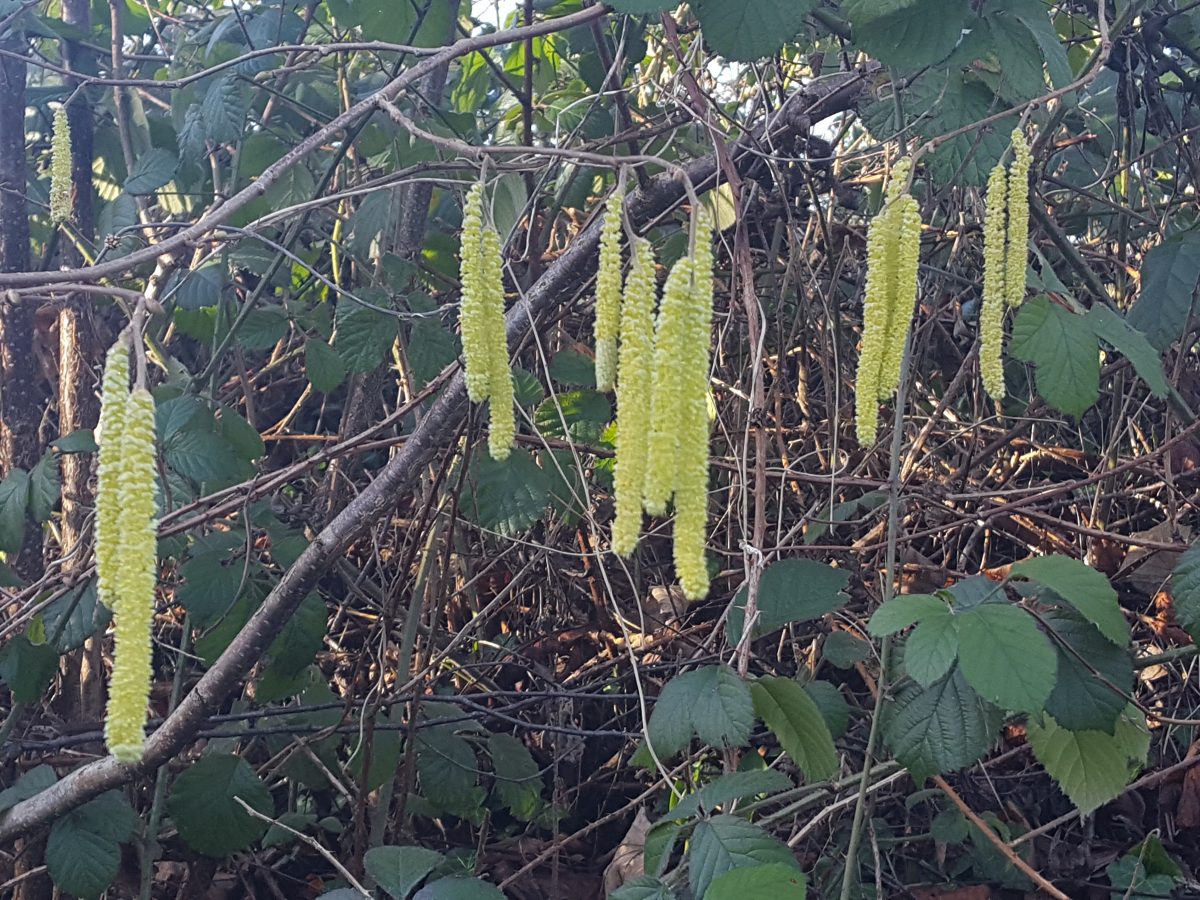
With the simple triggers of the time of year (more accurately the plant’s perception of far red light (from around 660 – 700 nanometres on the visible spectrum), alder and hazel catkins are gently stretching out to release their pollen.

Some of the young trees have the common woodbine snaking up around them, and are just beginning to poke out their new leaves, as are the elder trees. Blackthorn buds are whitening up and catching the eye.

Seeing the different plants join the new calendar’s colourful cacophony, really nourishes my soul. Their appearance finally  means we start to come out of the darkest hour of winter.

Somehow, many of the plants that we can’t eat or are best avoided, produce timely hits of colour, and with it, offer us foragers other rich rewards.

Winter aconite was reportedly brought to Britain in the 1530’s  as a garden plant. It was first recorded in the wild here in the early 19th century and it has increased its populations and geographic range since.

What’s in a name?

The scientific name Eranthis comes from two old Greek words – ‘Er’ translates to ‘spring’ and ‘anthis’ meaning flower.

The specific name hyemalis comes from a Greek word meaning ‘of winter’.

The common name winter aconite is alluding to the similar-looking, deeply divided leaf lobes of buttercup family relatives such as Aconitum nepellum.

Winter aconite botanical description.

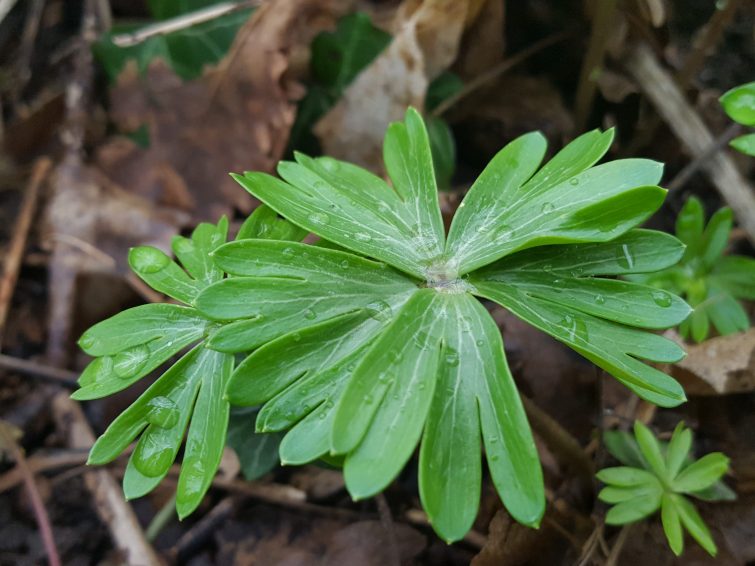
Leaves: Orbicular to palmate-lobed root leaves. These generally appear after the flowers, although on young tubers, only small basal leaves appear in the first year or two. The leaves can reach up to 13 cm across. They are glossy green, palmately-lobed and deeply divided.

White veins are easily noticable towards the base of the lobes. At the apex, the leaf lobes are rounded with a tiny white tip.

Petioles: These are long and hollow. The leaf-stalks typically reach to around 12-15 cm.

Roots: Small round perennial tubers, not knobbly like lesser celandine. The tubers are covered in a black skin.

Stems: Each flower sits on a short, hairless, unbranched terminal stem. They are hollow and grow to approximately 10 – 20 cm high.

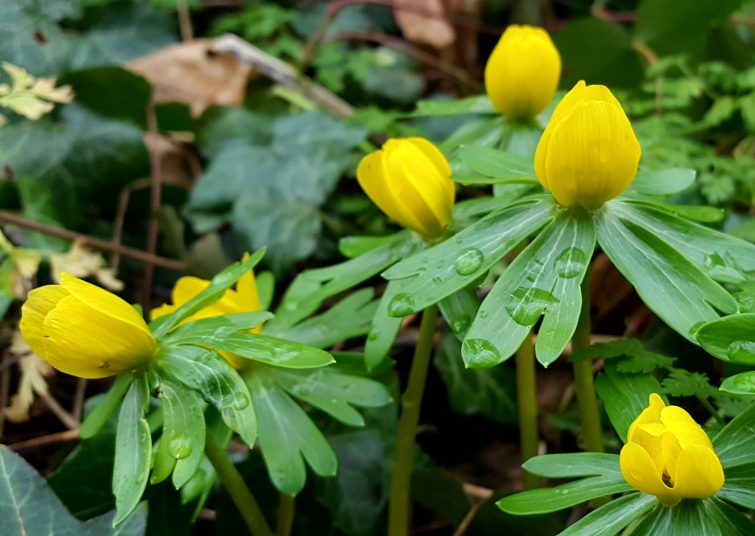
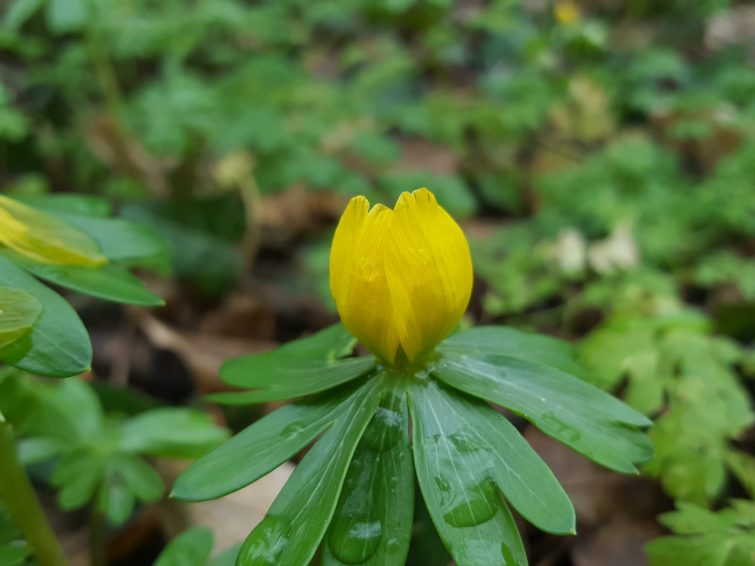
Flowers: Single yellow flowers with anywhere between 5 – 8 yellow sepals. The petals are usually absent, replaced by tubular nectaries. In the centre of the flower are fused pistils, surrounded by a mass of stamens.

Each flower sits just above a frilly, deeply-divided, leaf-like bract, looking like a collar or an Elizabethan-style ruff.

Flowering season: January to March, say the books currently.

Fruits: Oblong to oval-shaped seeds. These are formed in the nectaries and drop to the floor when mature.

Habitats: The natural home for this plant is in woodlands. Here it joins the ephemeral springtime flowering show that occurs before the tree canopy is fully out and open. This map shows its geographic distribution across the UK.

Simce its arrival in the UK as a garden plant, winter aconite has escaped and found a home in numerous shady and damp spots. Urban foragers are as likely to see this plant in parks, gardens and churchyards as we are in a more natural wooded setting.

Other notes: All parts of this plant are reportedly quite poisonous. As a whole this family are known to contain  alkaloids and other irritant compounds, and have been documented as having some of the most deadly poisons known to man. Some reports say that nausea, vomiting, colic and visual disturbances can occur if eaten.

Although the mallow family of plants are known to soothe irritation from many buttercups, if you accidentally consume this plant you should of course quickly seek professional medical attention.

As spring approaches I will be offering one-to-one mentoring and tuition, both online and in real-time, as and when current covid restrictions allow. Standby for more information on what will be available and when!

Happy foraging!