
- A Foragers Guide to Harvesting Britain’s Medicinal and Edible Wild Plants for the Kitchen and Home Apothacary
- Evaluating the plant material. Everything is ‘site specific’ when harvesting plants.
- Harvesting leaves from Britain’s medicinal and edible wild plants
- Leaf shoot / leaf stalk ‘spears’
- Harvesting Leaf buds.
- Safely harvesting stems from medicinal and edible wild plants
- Harvesting flowers for medicine and food.
- Harvesting medicinal and edible fruits from the wild
- Harvesting edible and medicinal seeds
- Harvesting Barks
- Harvesting Edible and Medicinal Roots.
A Foragers Guide to Harvesting Britain’s Medicinal and Edible Wild Plants for the Kitchen and Home Apothacary
Firstly, I have to remind you that BEFORE you even think about harvesting anything, you will of course have 100% positive identification of the species, and cross-referenced it for foolproofery..?
For foraging beginners, it canmot be stressed how important it will be to get accquainted wirh Britain’s poisonous plants.
Evaluating the plant material. Everything is ‘site specific’ when harvesting plants.
When evaluating material for harvesting, you firstly should make sure that all the leaves, flowers, roots, and seeds are healthy specimens. You also need to make sure the plant is the typical colour for the species. Either excessive nutrients or pesticides can alter the colour of leaves.
The method you employ to harvest will also be influenced by whether the plant you are after is annual or perennial, herbaceous or woody. Other factors include: which plant part you are after, the site, time of year, and the recent and current climactic conditions.
As far as the occasional insect hole or damage is concerned, its fine in my book. Primarily because untainted leaves are like true love…hard to find!
DO NOT USE any blackened, mouldy, miscoloured or otherwise damaged material. Handle plants carefully to avoid bruising and spoiling delicate leaves.
Remember that this foraging glossary will help with new technical terms.
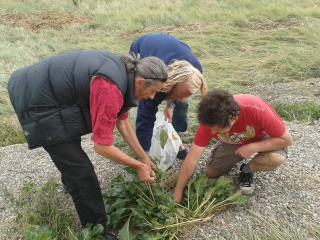
Is it the right time (of season or of year) to harvest the particular plant part you want? Say you come across a plant you know with a stem you want. Now, the stem you see may look at first like the stem you want. But if it has been growing for some time it will probably be tough.
You often get a small window of just a few days to harvest some stems, which are often best taken just a few days after they emerge, and are otherwise inedible.
So, knowing the stage of growth and also the particular life-cycle of the organism, helps hone your skills when out harvesting medicinal and edible plants.
Burdock roots are great food, but not if collected when the flowering stem grows in its second and final year! I only think of harvesting them in the late autumn of year one. Canny foragers leave markers by good specimens for winter harvesting…
The setting is also important in you choosing where to harvest. It can be summed up my all-time hero herbalist / forager/ botanist / astrologer- astronomer / physician / writer and revolutionary- Nicholas Culpeper.
He commented on it simply being best to choose plants to harvest “from where they delight to grow” (English Physician 1652).
Harvesting leaves from Britain’s medicinal and edible wild plants
Leaves can be thought of as the most renewable of our plant resources. Many of the plants listed here can be returned to on a number of occasions throughout the year in order to gather fresh new leaves in a ‘cut-and-come again’ fashion, as is often employed by gardeners.
The action of pinching out the growing tops of a plant, directly above a node, encourages it to rapidly produce more leaves from the dormant lateral buds below.
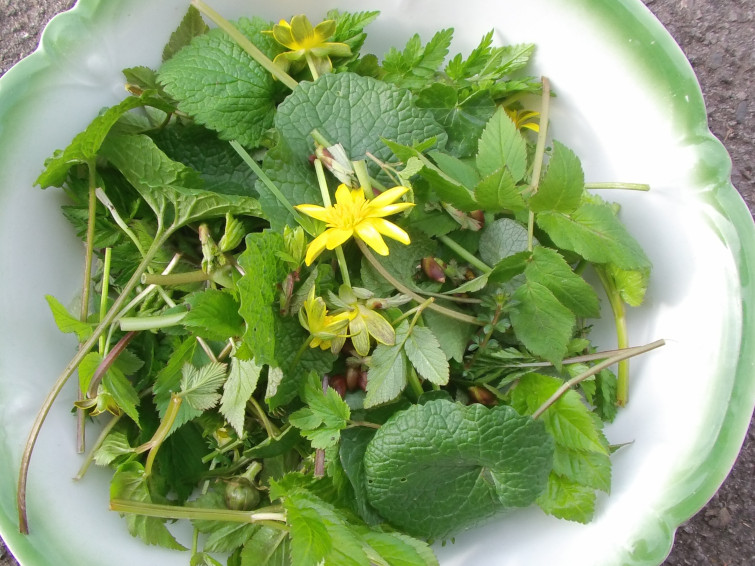
Responsible foragers tend to hold to the code of never stripping any plant of all its leaves. This will either weaken the plant through stress, enabling pests and diseases to gain a foothold, or the plant may set seed prematurely. This can serve to weaken the genetic gene pool of that particular species.
Some species do offer large amounts of leaves however, including a few abundant edible trees such as the lime (Tilia vulgaris).
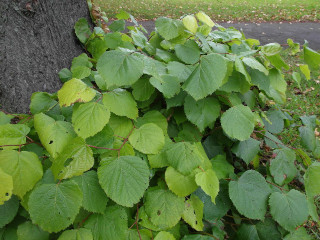
Younger leaves are best for fresh salads, as they are far more succulent, and this especially applies to our tree leaves, such as beech, hawthorn, and lime trees. All these are good in salads at certain times of the spring before the cells of the leaf toughen up for the job ahead.
Having read some of Pascal’s fantastic book, young tree leaves are more versatile than I ever knew. He uses all manner of young tree leaves to stunning effect.
Cooked wild greens feature frewuently in European cuisines. In Greece, ‘Horta greens’ accompanies many dishes. Dandelions and other common herbs are traditionally used. They are well-boiled and drained, then coated in olive oil, salt and lemon juice.
Certain edible leaves are much more bitter when eaten raw. This can also apply to many plants when found in arid conditions, growing in full sun. Many plant leaves which are considered quite unpalatable raw,suddenly become transformed when cooked.
Cooking helps to leach out different bitter substances, including various aromatic sesquiterpene bitters commonly found in the numerous daisy family plants.
Leaf shoot / leaf stalk ‘spears’
New leaves of certain herbaceous plants appear as ‘spears’. These leaf stalks / leaf shoots that we find from the wild are basically treated like plants we use regularly in the kitchen, such as celery or asparagus.
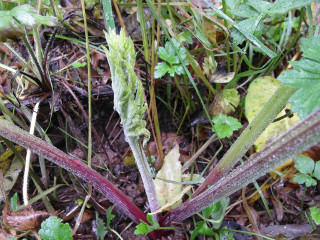
Again, I like to focus on the abundant and larger plants such as hogweed (Heracleum sphondylium), willow herbs (Epilobium species), brassicas such as sea-kale (Crambe maritima) and invasive plant japanese knotweed (Fallopia japonica).
These different spears, when picked and cooked in a number of different ways, are very succulent and tasty, and some of the best wild plant food to be had in Britain. Pre-flowering stems are similarly succulent when harvested correctly.
Harvesting Leaf buds.
These are something I haven’t fully explored by any means. A good few years ago after reading about famines in East Europe, I discovered that sycamore buds had been salt-boiled and preserved as food.
My first attempt produced horrible bitter things, even 6 months after making them. But it inspired me to pick some lime tree buds that same winter, having subsequently read about the inner bark of the tree being ground into a flour additive.
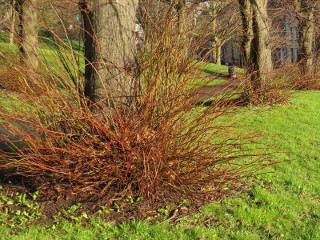
The leaf buds are great, being crunchy on the outside and soft and gooey on the inside. You can quickly pan roast them with some spice or soy sauce, as you would sunflower seeds.
Safely harvesting stems from medicinal and edible wild plants
The cutting of stems should ideally be done with sharp secateurs, a pruning saw or a knife, and just above a node if possible. This allows the dormant buds below the cut to spring forth. It also protects the plant by offering little chance of the dead stem rotting away and infecting the plant.
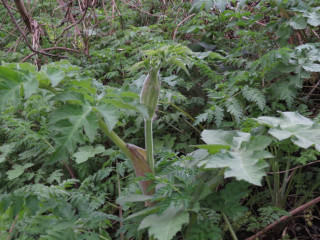
For harvesting whole plants, gather it just before flowering, cutting the plant at ground level, or gently uproot using a fork, shaking the roots gently.
On biennial and herbaceous perennial plants, take just some of the growth, thereby allowing the plant to eventually flower.
With woody perennial plant parts, its best again to take just some of the material from one specimen, leaving plenty enough for the plant to regenerate. Cut larger branches back leaving the knub a good few millimeters above flush. With a plentiful supply of vigorous multi-stemmed shrubs such as hazel, selective coppicing might be an idea.
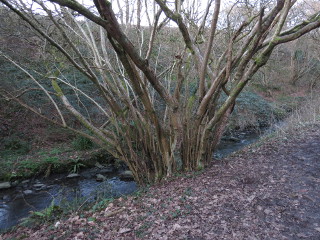
I think it is trickiest to correctly time the harvest of herbaceous pre-flowering stems.
Only direct experience of the species in question, alongside knowledge about the idiosyncrasies of a particular micro-climate, can help you get fully accustomed to making decisions about the best time to harvest.
Take cow parsley (Anthriscus sylvestris) or alexanders (Smyrnium olusatrum) pre-flowering stems as examples.
When you find them bang-on soft, tender, and young, they are a lovely. You need to peel the thin fibrous outer skin off before eating.
Plants soon develop strength and rigidity as they grow, and with it, fibrousness. Within a few days a plant part can go from tasty food to inedible!
Harvesting flowers for medicine and food.
All manner of flower buds, whole flowers, petals, stamens, pollen, and receptacles, are used as food across the world.
Flower buds are obviously the earliest part we can collect. A number of different plants can provide tight young flower buds to play with. Whether you are frying or pickling you are going to love the results. One of my favourite ‘caper’ flower buds is from the ox eye daisy.
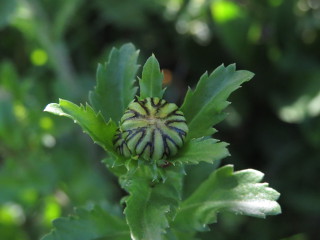
Harvest these when young, and firm-to-the-squeeze, as you are looking for tightly packed, under-developed floral parts. This is crucial for the edibility of the caper you can make from them. They are typically 3 – 7 mm diameter.
Dandelions are great to use. When young they are superb fried in batter. I also use the different sow thistles.
When you are looking to harvest essential oil-laden, aromatic flowers, these are best harvested just before they fully open on dry mornings, to ensure their maximum potency and medicinal value.
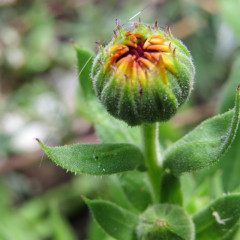
The compounds in the essential oils are mostly plant-protecting or pollinator-attracting molecules, and they will be concentrated at their peak when the flowers begin to open.
Some species can be harvested continuously over a number of days or weeks. The best results for aromatic plants are achieved from a harvest following successive warm dry days.
If the flowers are clustered on a multi-branching stem, like yarrow (Achillea millefolium) or on multi-branching forked stalks, like with elderberry, then cut the whole stem or stalk and snip off the individual flowers later. Always remove as much green material as possible from the flowers before use.
Harvesting medicinal and edible fruits from the wild
When we think of fruits we can harvest from the wild, it is worth brushing up on the botanical meaning of fruit. A forager’s definition of fruits expands beyond just dealing with our different fleshy berries.
When I’m foraging for wild fruits, I’ve also a mind to the huge amount of ‘dry’ fruits. A large number of plants eventually produce dry inedible seed pods with edible nuts or seeds inside.
Some plants start off with tender young pods we can eat. So on occasions, we can get three harvests from the fruits of certain species!€
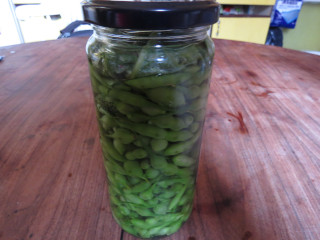
Plants as diverse as scurvy grass, three-cornered leek, or evening primrose, all offer us an opportunity to pick their juicy, crunchy, often sweet and versatile young seed pods. I often simply treat them like flower buds for pickling.
Fleshy fruits should be harvested when almost ripe. Certain products we make from wild fruits, like jams and sauces, work much better with the higher pectin content of slightly under-ripe fruit.
A few of our wild fruits have high amounts of pectin, others not so much. Hawthorn fruits are reasonably high in pectin and make a cracking jam or jelly
For plants such as rowans and elderberries, you could cut the whole stem, then strip at home leaving minimal stalk in the final material. Sea buckthorn often come away sat on a little ‘cocktail stick’ stalk. Harvest this and discard it after eating/using. Raspberries and blackberries come away in your fingers when ripe.
Hawthorns are basically mini apples and come away easily with a small twist between thumb and fingers. Don’t yank it or you will likely pull off the new growth spurs of next year’s flower buds. If you remove the spurs, there will be no flowers and no fruits. Before harvest, do a quick test to see whether they are ripe. You don’t want to see green inside.
Rowans can be treated pretty much like elderberries, as to an extent, can both the Mahonia and Berberis fruits.
Harvesting edible and medicinal seeds
Seeds can be harvested simply from many species by placing a paper or carrier bag over the ripe seed-heads. The head can be shaken immediately or left for a few days in good weather to drop naturally.
If you’re cutting the stems to take home, make sure you have the space to hang the plant upside down and leave for a few days.
Seeds will be found inside fleshy fruits as well as dry, fibrous, and woody fruits. Our method of getting to the seed will be different depending on this factor.
More detailed information on seed harvesting, winnowing, and processing, is in the pipeline. Watch this webspace!
Harvesting Barks
Barks are typically harvested in spring when the sap rises because during this period, the bark will peel away especially easily. However, certain evergreen and conifer barks could be harvested all year round.
Harvesting bark is pretty easy to do. It is a two-step process. Cut and prepare. Branches from specimens at least 3- 5 years old are suitable for many of the medicinal barks such as cramp bark (Viburnum opulus), Berberis, and oak (Quercus spp).
The age of woody branches can be deduced by tracing back the number of the visible scars on the branches a.k.a abscission points. These appear as closely bound ripples on the stem and are produced where previously buds formed and burst on the preceding year’s growth.
Generally, the inner bark will be required for medicine. Essentially, this is where the all-important, sap-pumping vascular system is found in plants. It consists of the actively dividing cambium layer of cells and is made of two distinct networks; the xylem and the phloem.
The xylem cells connect the roots to the rest of the plant, whilst the phloem connects the leaves to the rest of the plant. In any woody plant species, the cambium layer of cells in the stem, branch, or trunk, always continues to generate new cells, steadily increasing the plant’s girth.
The newest xylem cells are situated on one side of the cambium, towards the centre of the trunk or branch, whilst the phloem cells are situated just the other side, nearest to the bark, consisting of soft, corky tissue.
So with your bark, you want to be taking the softer phloem, cambium layer, and new xylem cells, as this will contain the widest array of constituents. Inner barks should easily peel away when harvested in spring.
Important! Never peel bark away in complete circles around branches or trunks, for above this point the tree will die. Never remove bark from the main trunk.
Harvesting Edible and Medicinal Roots.
Roots are mentioned in most herbal medicine books as being best to harvest either in the autumn or spring. For busy people with hectic lives, much of our choice will be pre-determined by time allowances. So when asked what the best time to harvest is… I often answer, whenever you can!
I tend to favour the autumn for harvesting biennial or perennial roots. This is the time when the plant draws down sugars and other nutrients, before returning to dormancy. At this point, the plant generally has higher concentrations of other medicinal components as well. Early in the spring, (if and when you can find it!) plants are already using up their storage reserves as they re-emerge from winter dormancy.
Spring harvested roots will likely have experienced winter frosts, that convert complex carbohydrate stores into simple sugars, so can have better flavour.
The roots of biennial plants are best harvested at the end of their first year. Tap-rooted plants will need substantial digging and coercion to remove the root intact. For fibrous-rooted plants, mark out a broad circle around the plant base, then dig out a clod on the circle line, tease out and shake loose the roots.
Specific individual plant advice related to harvesting will be found in my ever-expanding plant species articles. Meanwhile, happy foraging!