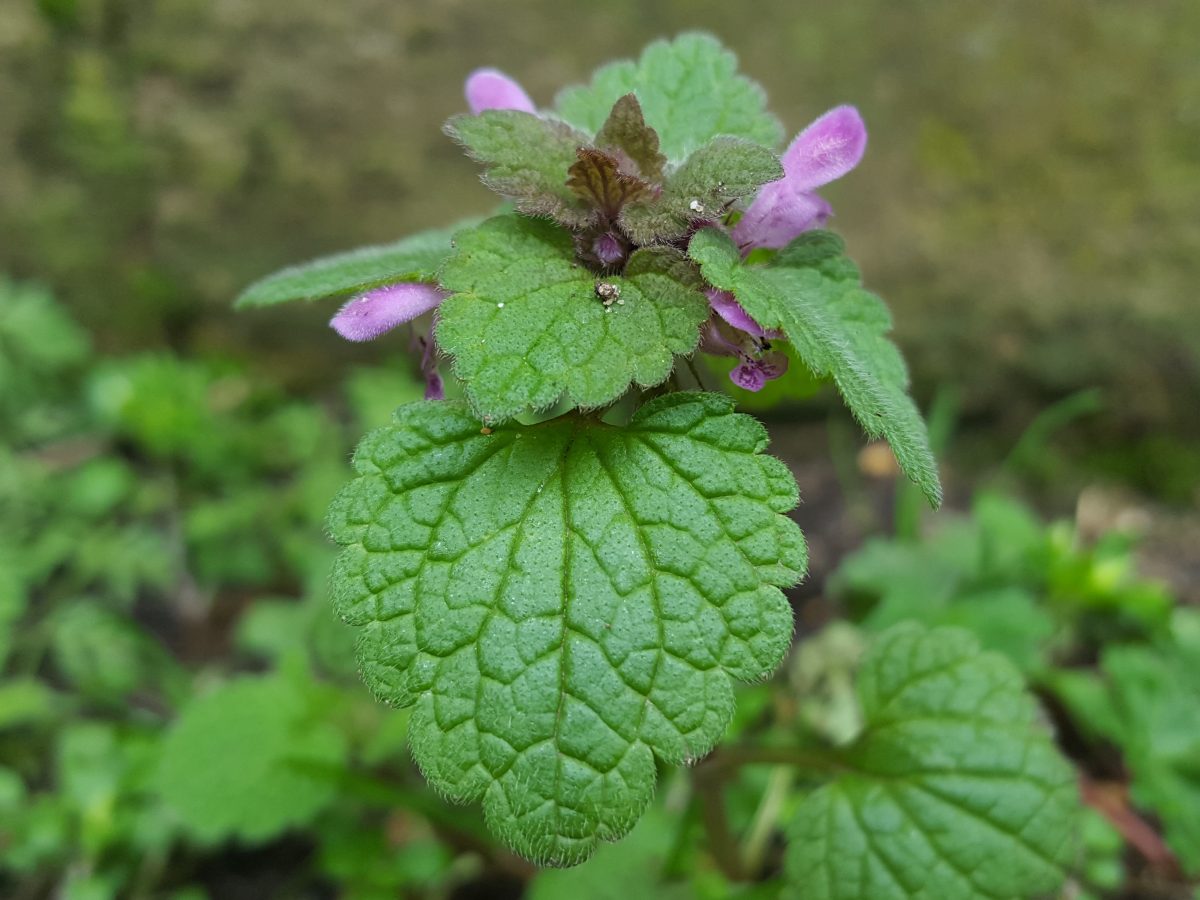
Read our short foraging guide and quickly learn how to identify the red dead nettle (Lamium purpureum) Lamiaceae family.
With this quick-to-read wild plant guide, you will soon be able to confidently identify red dead nettle, and then add some welcome wild greens to your diet in the winter months!
Novice foragers may be interested in our guide to starting out on your foraging adventures. I’d say it’s well worth a few minutes of your time, and might just answer a few of your most burning foraging questions.
The red dead nettle is a low-growing, often sprawling annual plant. It is one of the most common species you will find here in Britain, and belongs to a large family of mainly aromatic plants, formerly known as the Labiates. More information on our aromatic, essential oil bearing plants, is available here.
What’s in a name?
The generic part of the name Lamium comes ftom the old Greek word ‘laimos’ – meaning throat. This alludes to the shape of the long corolla tube.
The specific part of the name, purpureum, tells us of its colour.
The common name that it shares with other plants in the genus – ‘dead nettle’ -points to the similarity of its foliage to stinging nettles (Urtica dioica), and also tells us it won’t sting!
Botanical description to identify red dead nettle.
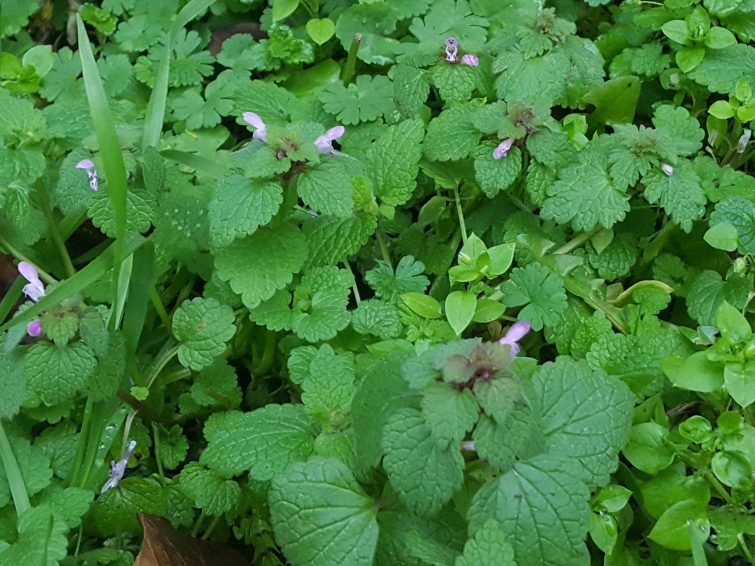
Leaves: This plant has simple, hairy, green leaves, approximately 3 cm across and 5 cm long. The leaves are basically ovate-shaped, and more often than not they are cordate at the base. The leaves are net-veined and somewhat crinkly in appearance.
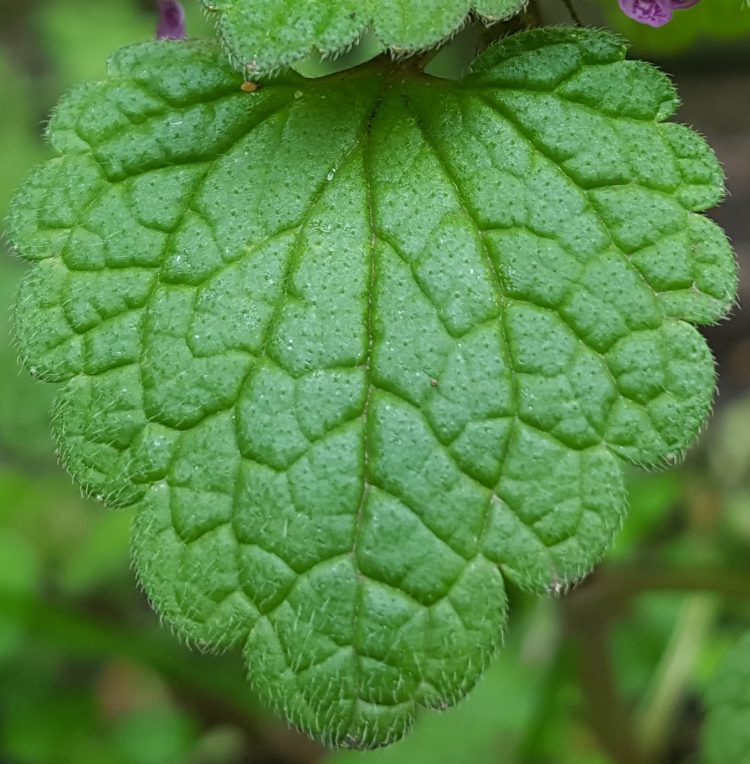
The foliage is aromatic when crushed, albeit musty and earthy. Its leaf margins are crenated. Please refer to the glossary if you are bemused by the botany!
Petioles: These are quite short on the lower leaves, and are more or less absent on the stem leaves.
Roots: The plant grows on a small tap root.
Stems: Square, hollow and usually sparsely hairy. They will reach up to about 40 cm high in flower.
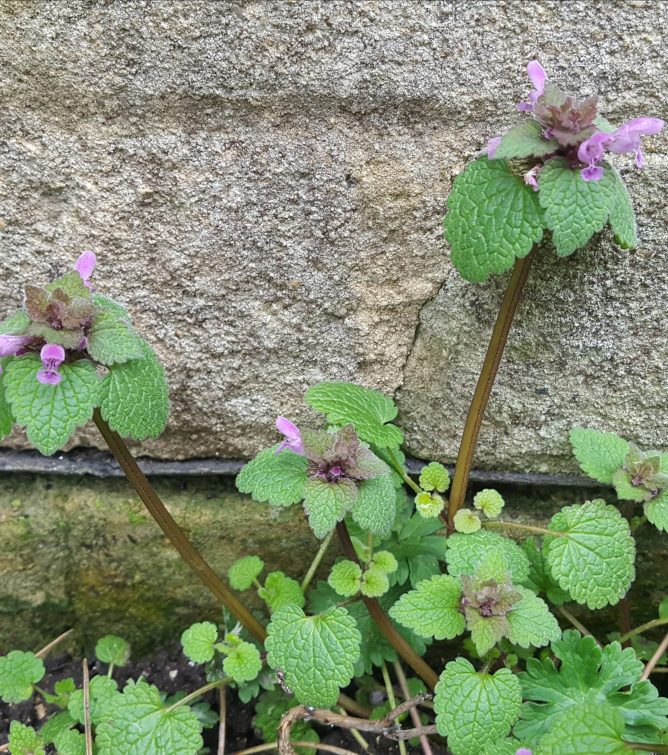
Flowers: These are produced in whorls around the stem, arising from the leaf axils. The flowers are two-lipped, with a long corolla tube (10 – 20 mm).
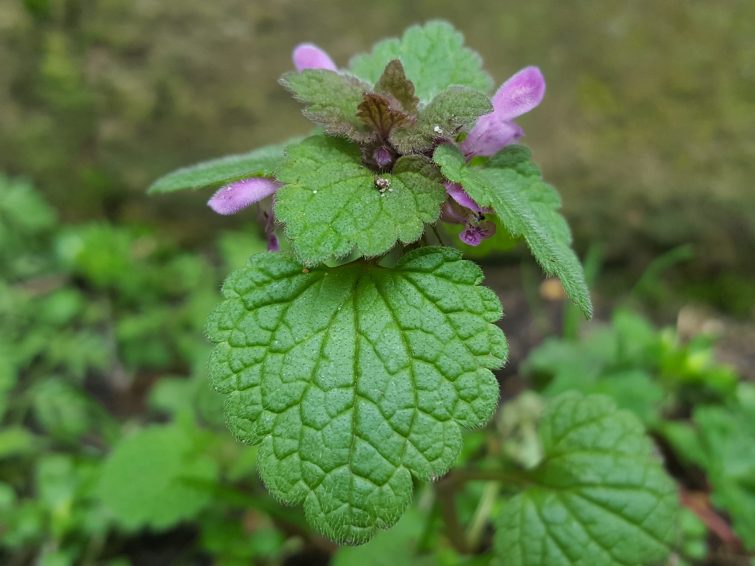
The flowers are generally a pink-purple colour, with mottled specks on the lower lip. Occasionally I see a white flowering form too.
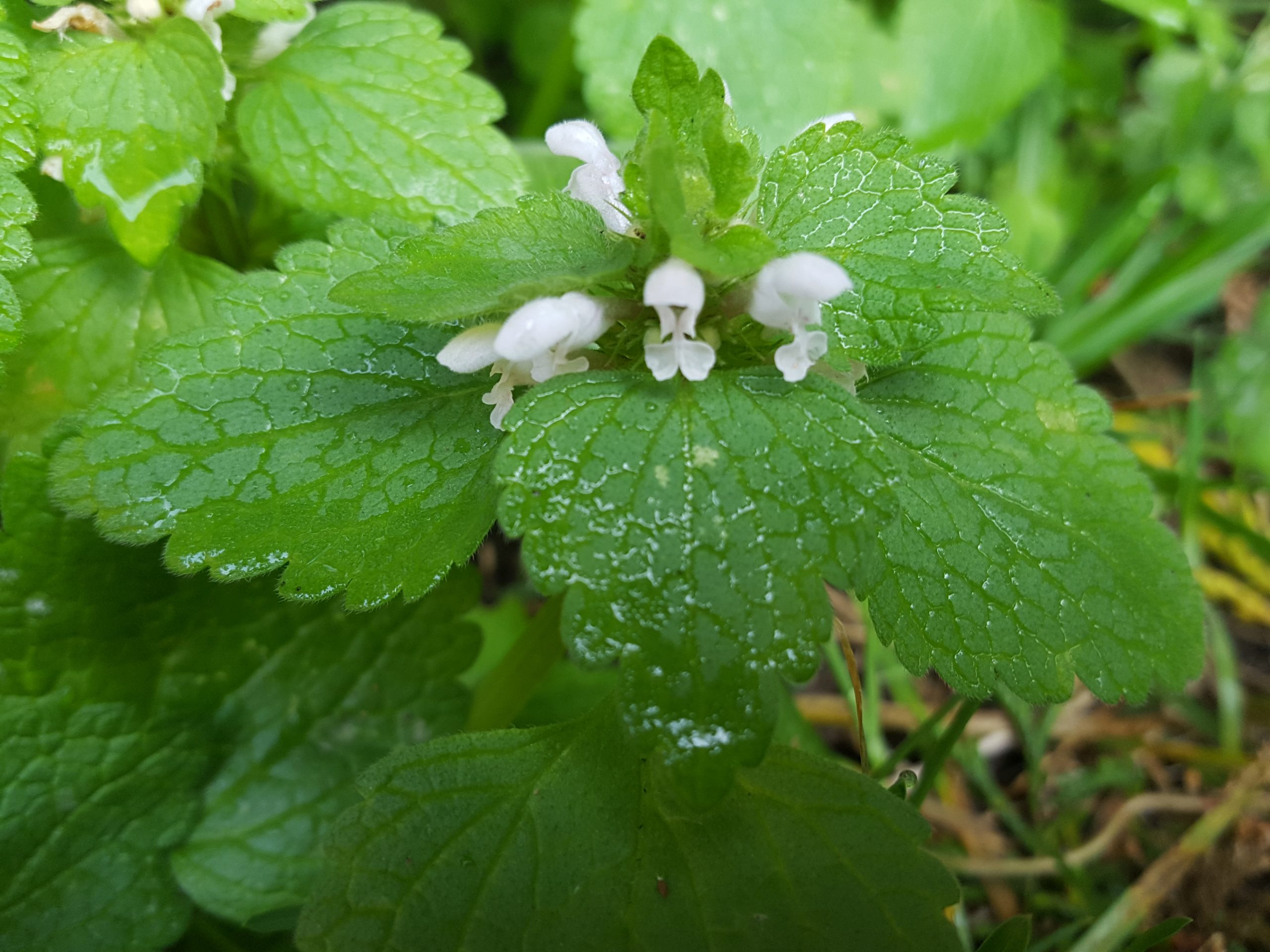
The calyx from which the flower arises consists of five, green, pointed lobes. The lobes are nearly as long as the corolla tube. Inside the flower are four stamens, of which two are long and two are short.
Flowering season: As another of our short-lived ephemeral annual plants, it will be no surprise to learn that this plant can be found in flower from January to December. I always see it flowering en masse in the run up to spring equinox.
Fruits: Like many in the dead nettle family, this plant produces four tiny nutlets.
Parts used: Leaves, flowering tops and flowers.
Harvesting: You can usually find this plant all year round, but I think the months of February and March offer the most productive harvests.
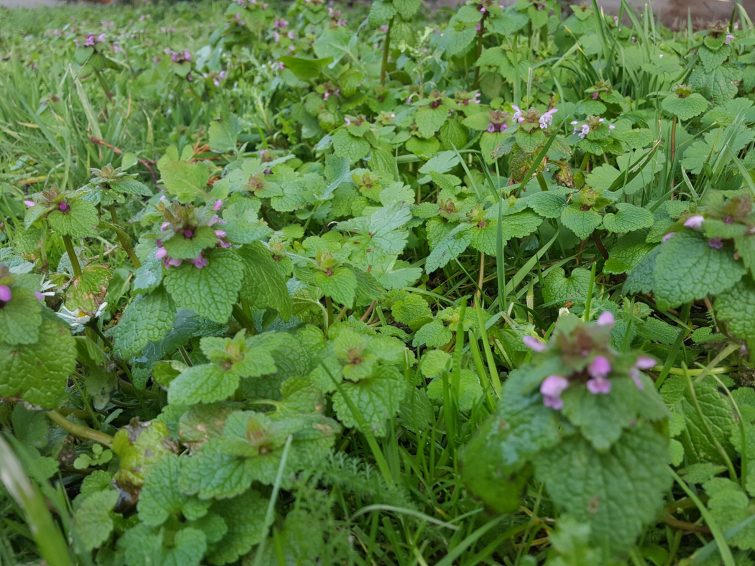
I sometimes pick a whole stem and strip the leaves off, or just pick a few leaves from each plant in a stand. Flowers are easily plucked out.
Habitats: This plant loves fertile grassy areas, cultivated ground and wastegrounds, hedge banks, and various settings in urban environments.
This is essentially a lowland plant, and can usually be found at altitudes below 550 metres.
Other notes: With its unusual mushroom-like taste, this plant lends itself to being stuffed in ravioli or added to gnocchi. It makes a nutritious addition to soups and casseroles. In salads, you may find its best to use finely chopped, like you would other aromatic pot herbs.
A similar-looking plant, the cut-leaved dead nettle (L.hybridum), has deeper cut teeth on the leaves and a smaller corolla tube. It can be used in the same ways.
If you have any foraging or plant identification questions, please dont hesitate to contact me.
Happy foraging!