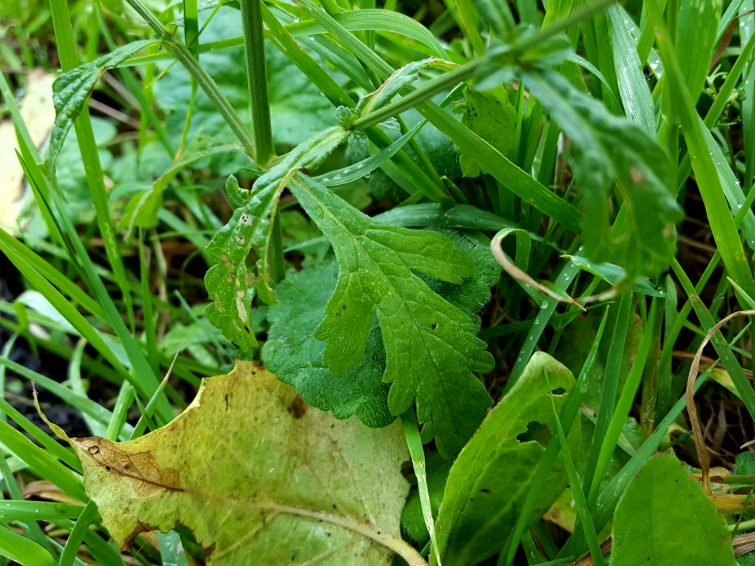
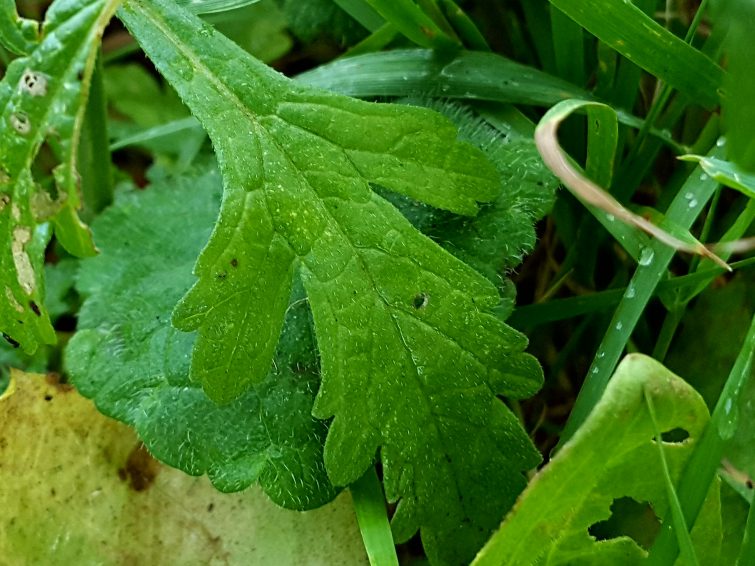
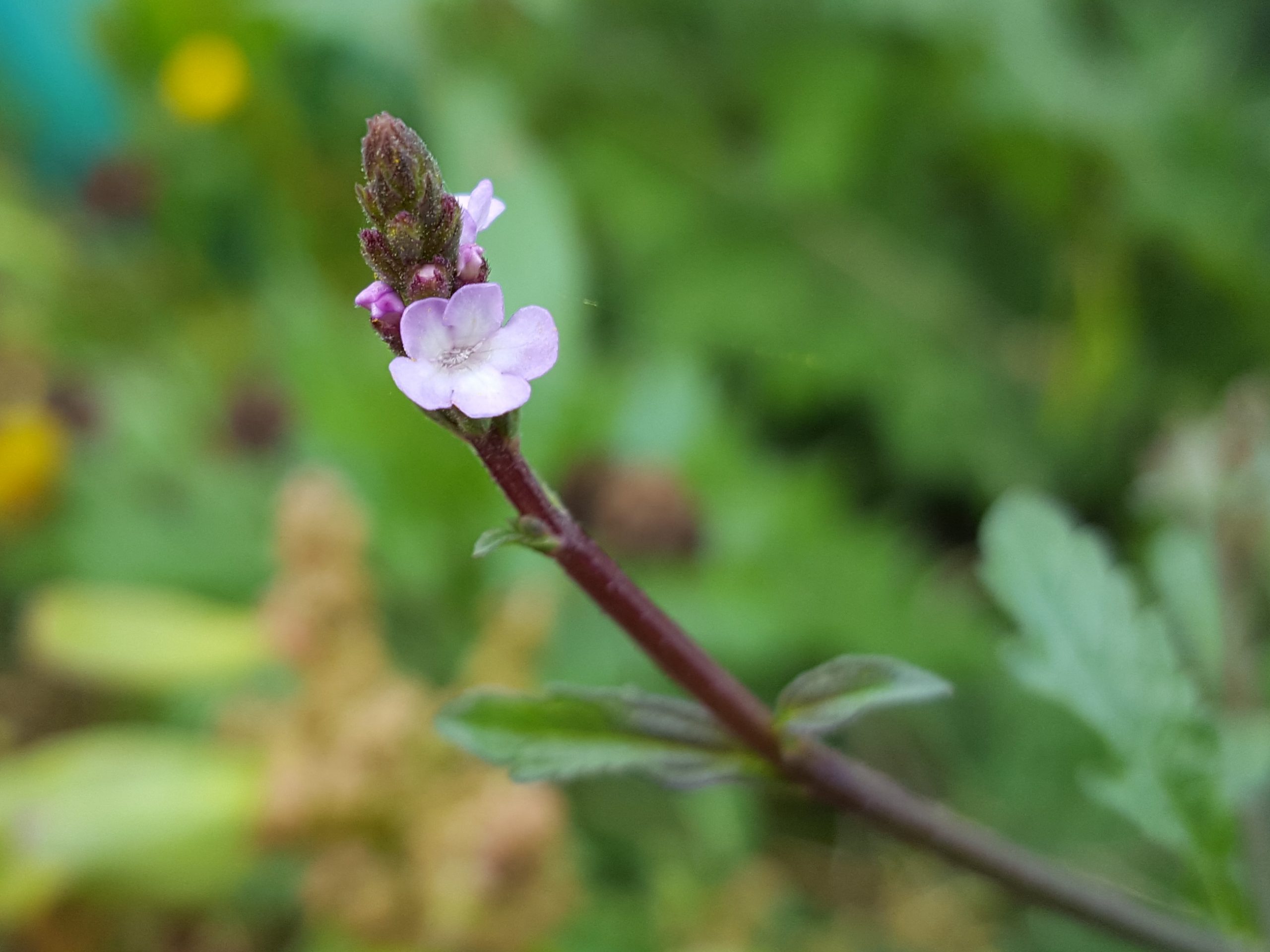
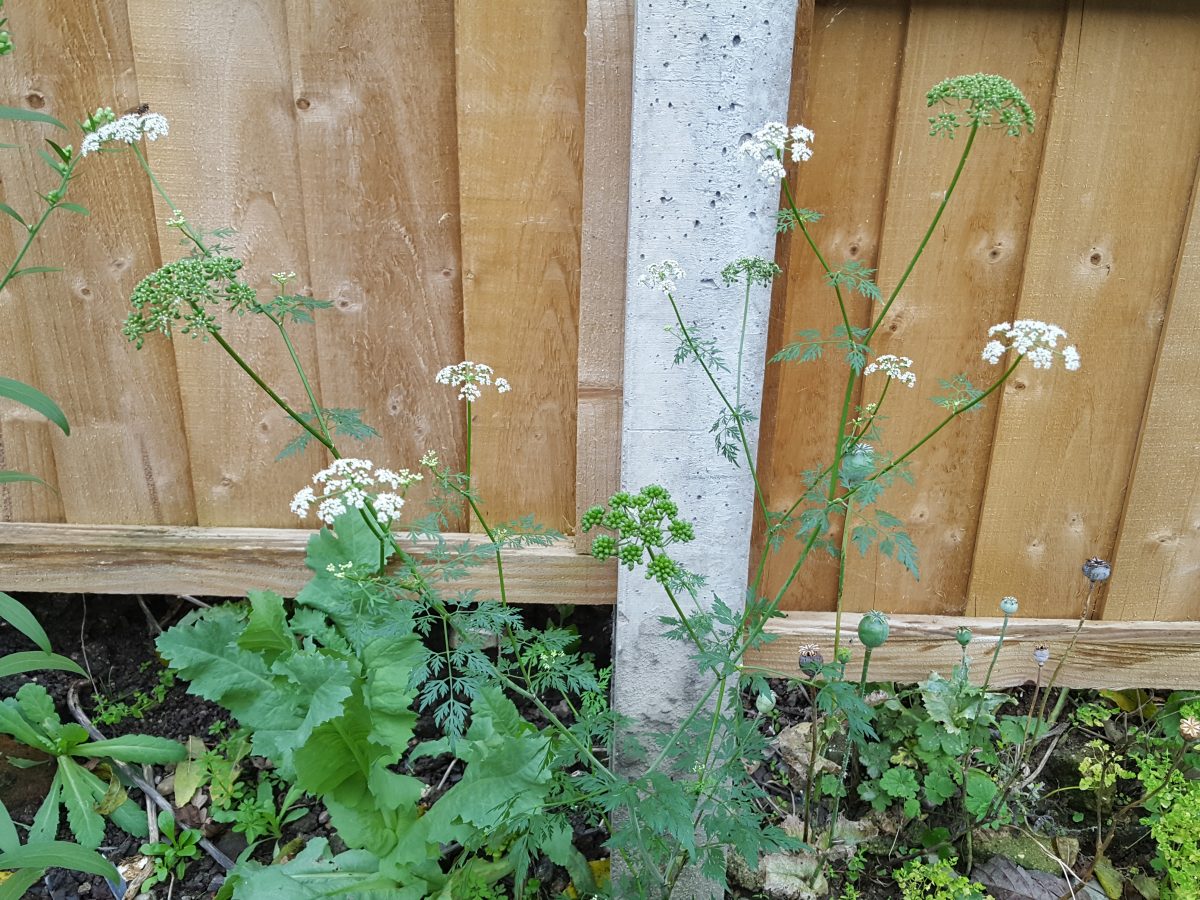
Learn how to confidently identify, and go foraging for, Japanese hedge parsley (Torilis japonica) Apiaceae.
I love meeting and identifying new plants, and the Japanese hedge parsley was a real coup. I admit to being a plant junkie, and like all junkies I get a hit of dopamine in the anticipation of reward, and then endorphins and other molecules like serotonin when I find a new plant and eventually get a positive I/D. It’s characterised often by joy, excitement, contentment and sometimes relief.
When it comes to these sometimes excruciatingly enigmatic carrot family plants, well, as my previous article on wild chervil showed, it will take close observation and patience to successfully negotiate through the lacy-flowered mists our minds make.
Hedge parsley was as tickled pink as me when I positively identified it!
So, you can appreciate the extra joy I felt on finally identifying this plant. I knew it was a plant that I had been seeing around for quite a few years but had made the mistake of ignoring, and giving cursory looks, assuming it was one of two other plants I already knew. Classic rookie error!
This website is designed to hopefully prevent you from making mymistakes, especially if you are a new visitor here, or just starting out.
The generic name Torilis reportedly gets its name from a Latin word for ‘obscure’. This plant from the Far East does not have the historical associations of the old Mediterranean civiliasations, hence its etymology being scarce.
The origins of the specific part of its botanical name – japonica, surely needs no explanation!
The name ‘parsley’ comes from the old medieval French word ‘peresil’. This was derived from the ancient Latin, Petroselinum, which was itself took straight from the ancient Greek, Petroselinon. ‘Petros’ means rock or stone, and ‘selinon’ means celery.
One of its other common names, ‘upright hedge parsley’, attempts to distinguish it from closely-related plants with similar-looking leaves, but different stems.
Japanese hedge parsley botanical description
Finding words here you don’t know? Our glossary will help untie your tongue and hold your hand, through what may seem like at first, to be a botanical word storm!
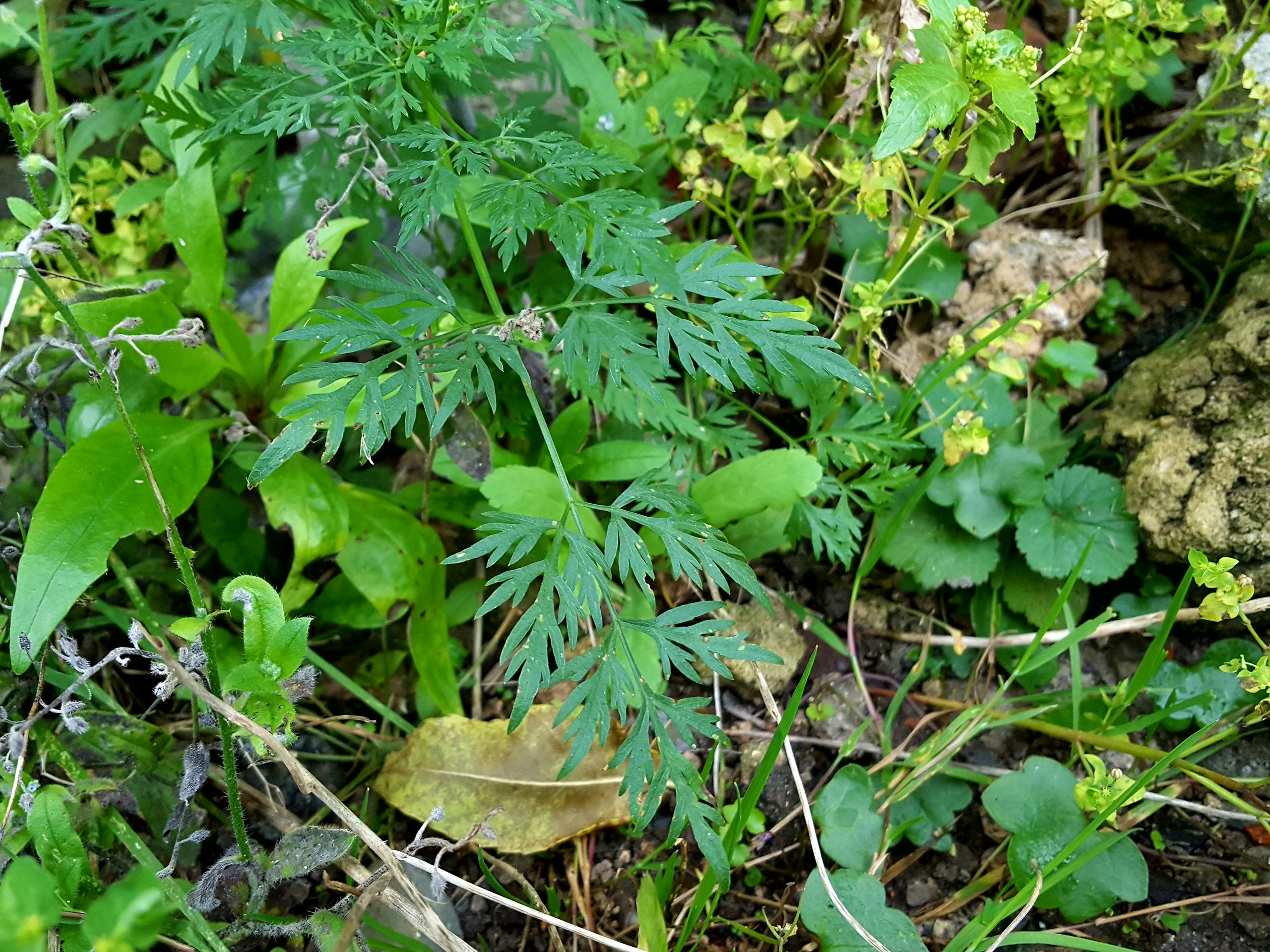
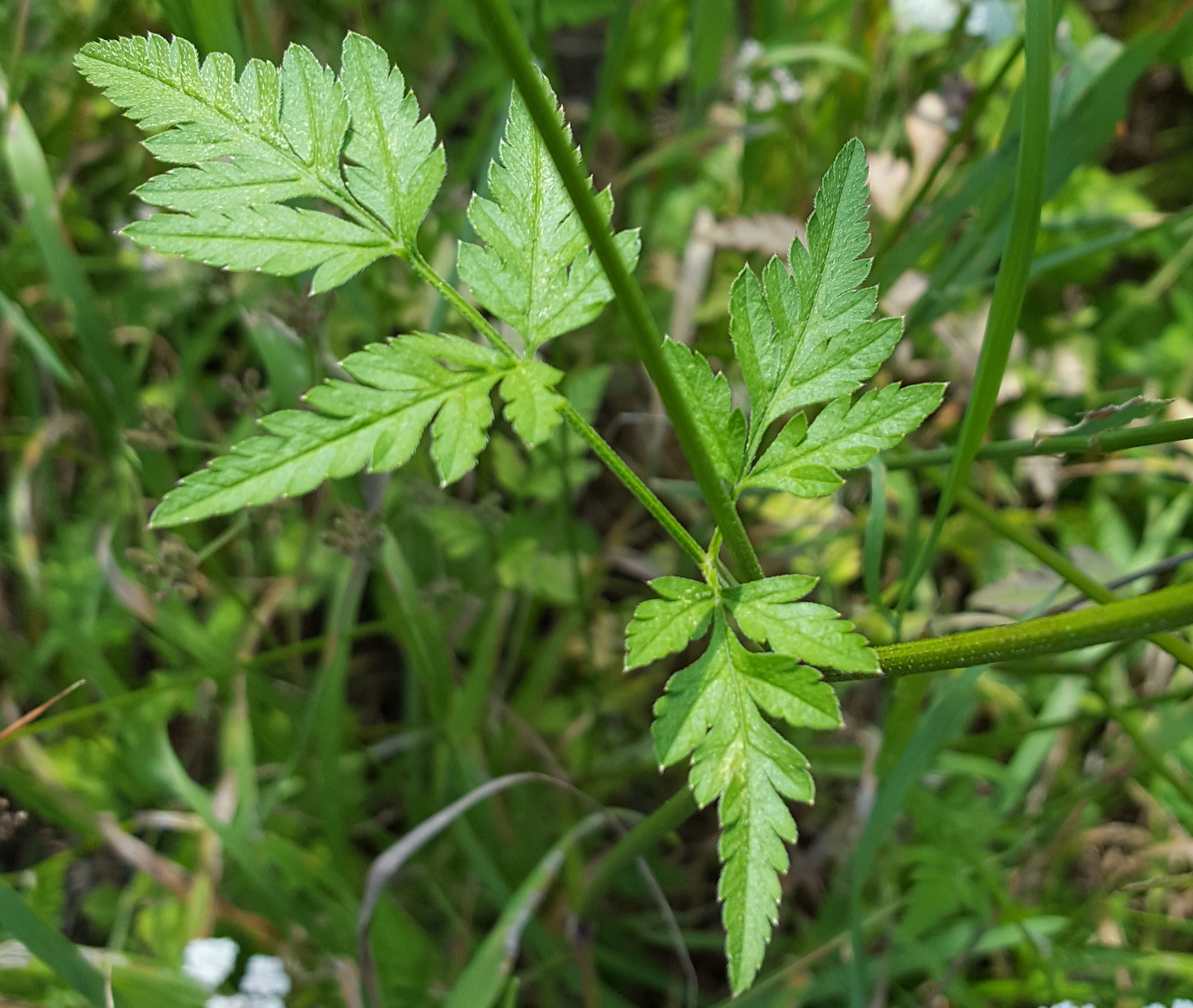
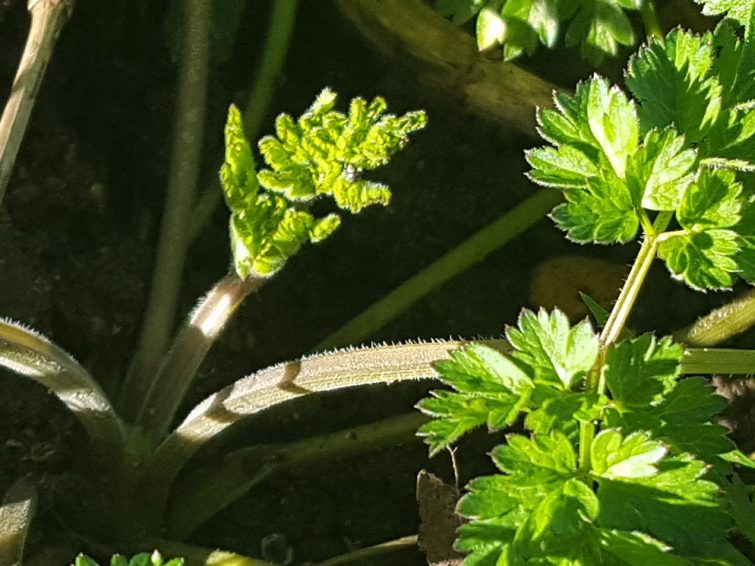
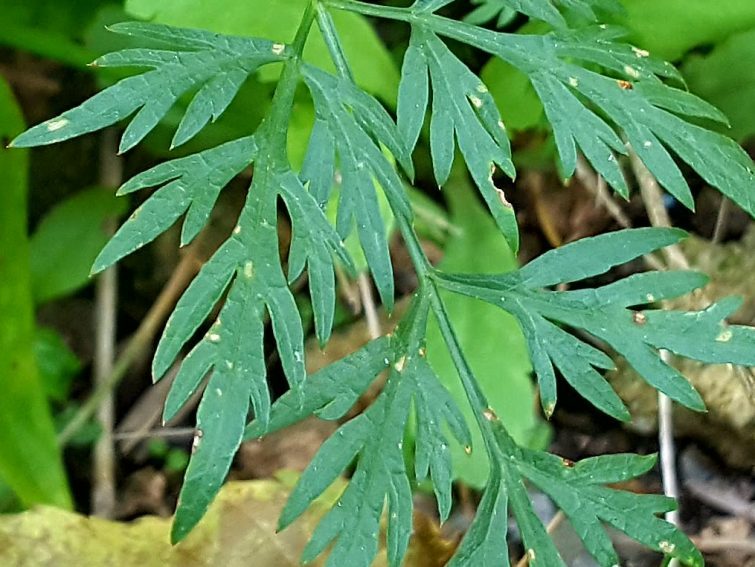
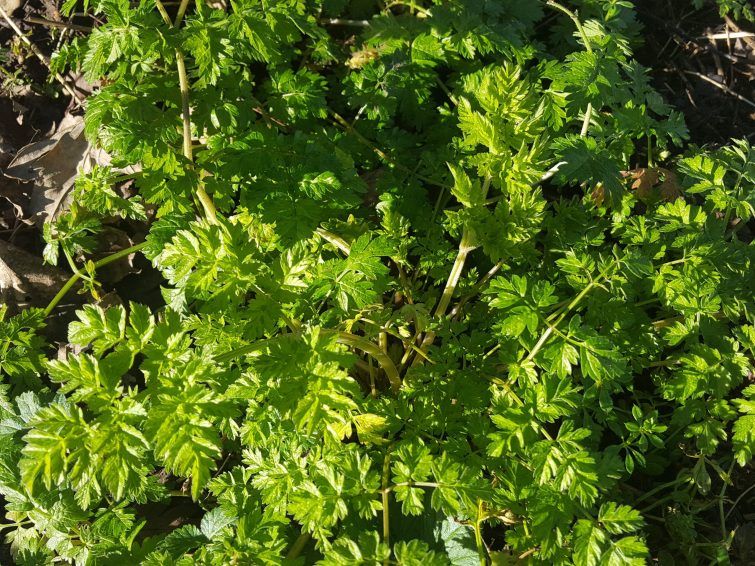
Leaves: Feathery-looking and triangular-shaped. A little rough and hairy when touched. Typically the compound-pinnate leaves at the base of the plant are bigger than 10 cm long.
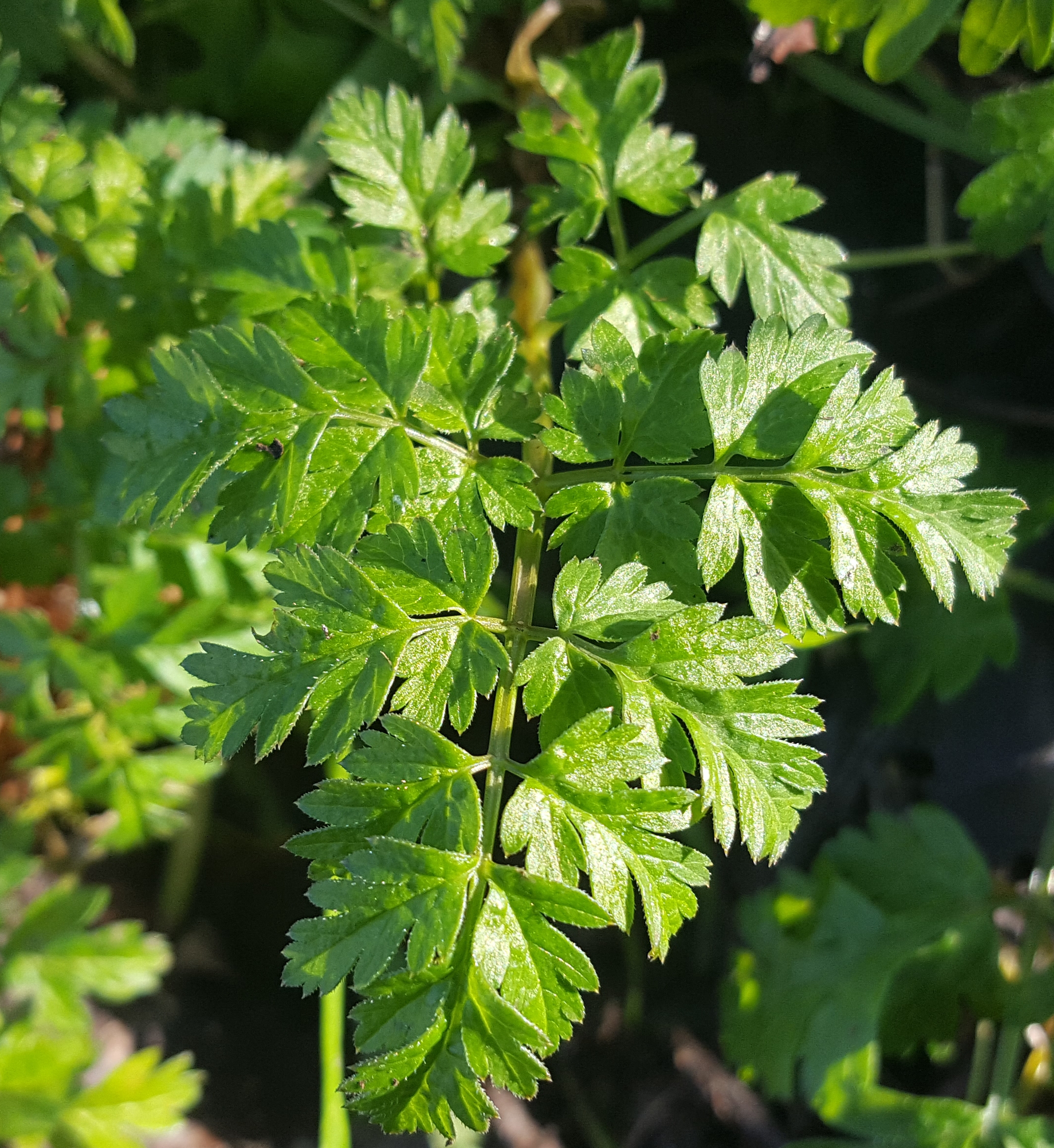
Japanese hedge parsley’s compound pinnate leaves.
The leaves are known to be anywhere from 1-3 times pinnate. Although the larger basal ones are usually 2-3 times pinnate.
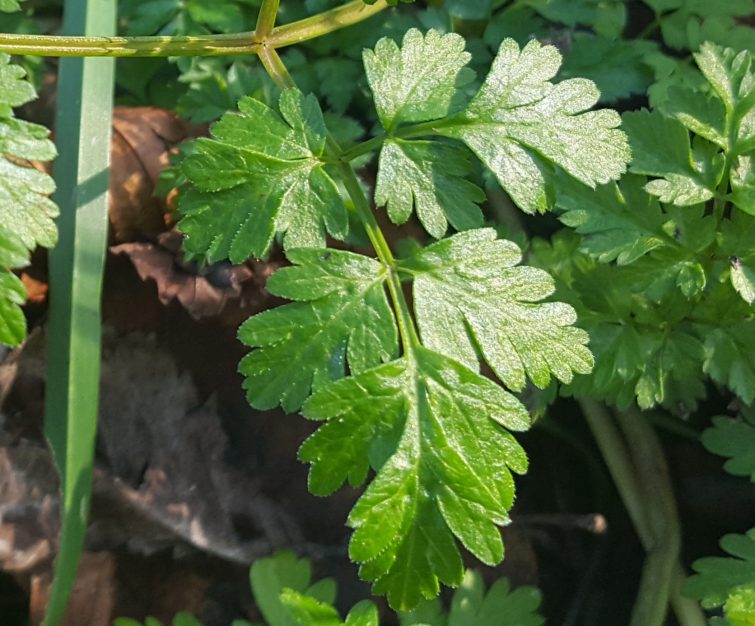
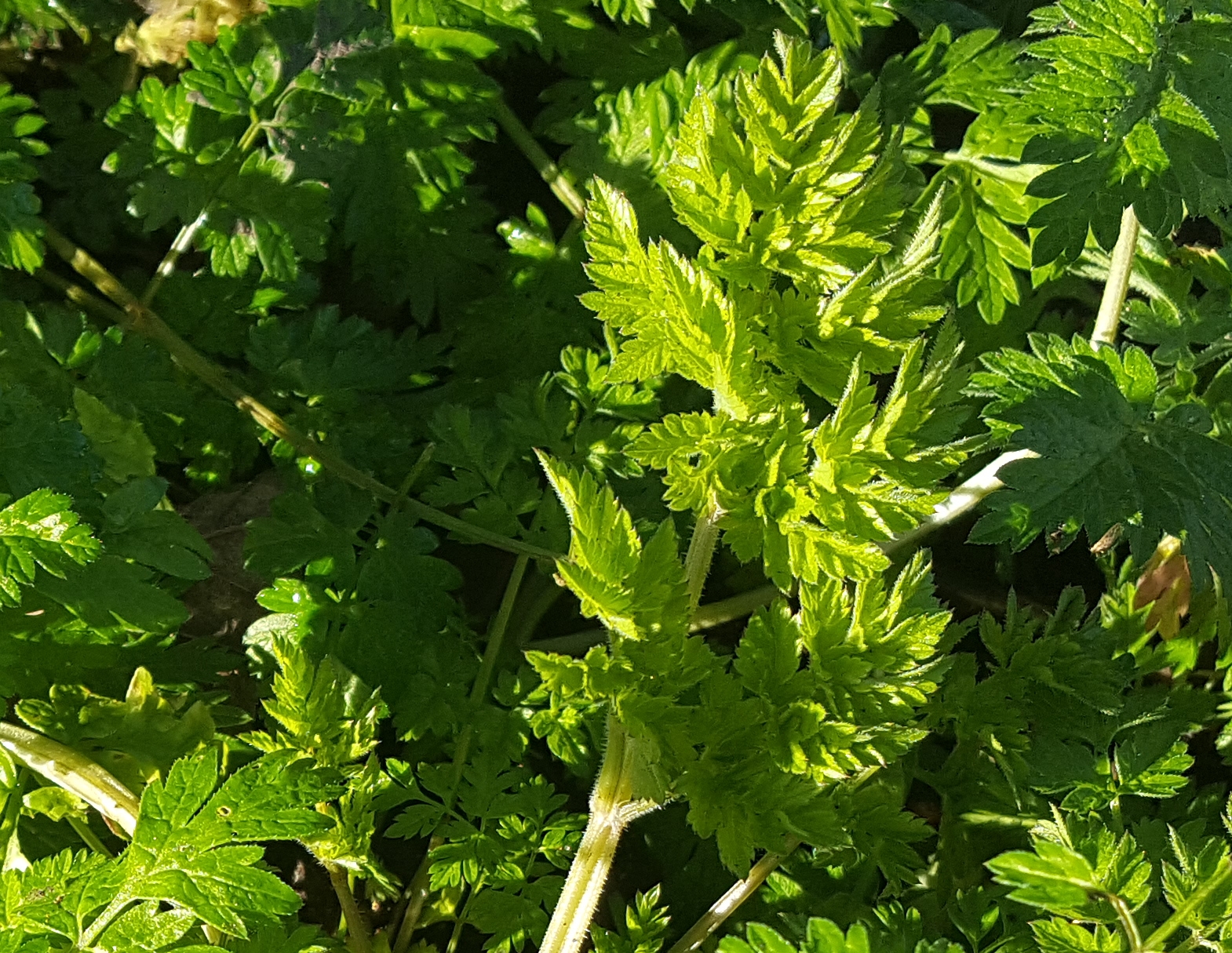
The lanceolate leaflets have a large terminal lobe.
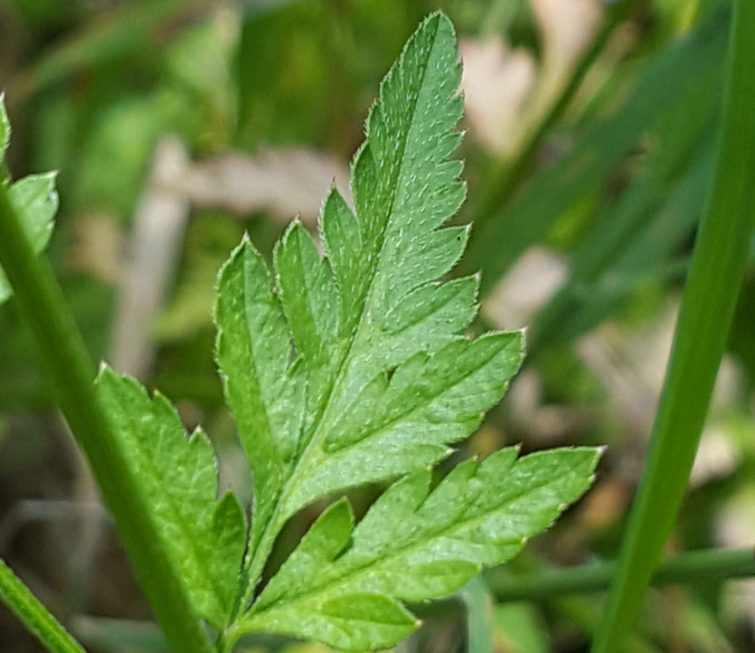
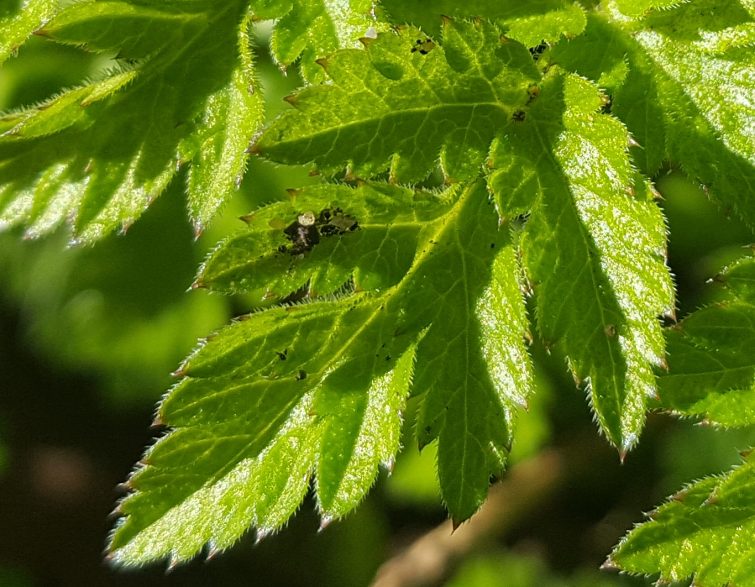
The ovate to lanceolate-shaped leaflets (1-3 cm) are hairy above; lobed, with serrate margins.
Serrated leaflet lobes with small adpressed hairs.
Petioles: Hairy, sheathed at the base. Solid. Channeled.
Roots: A long tapering tap root.
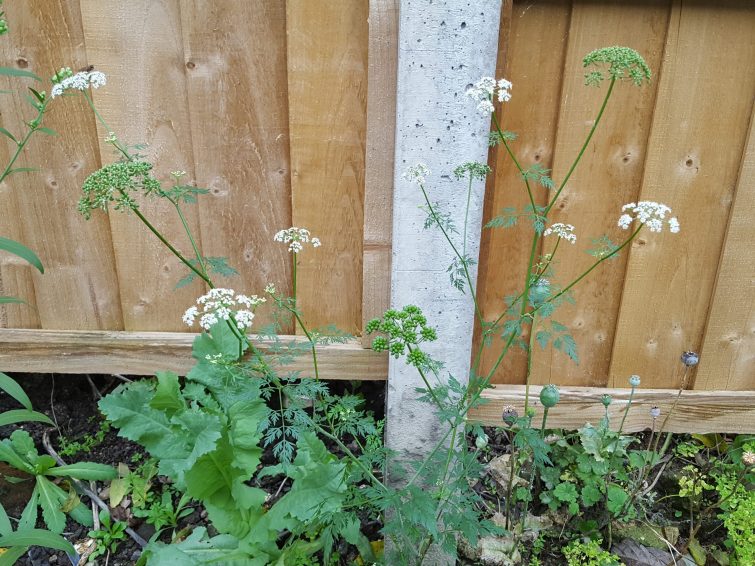
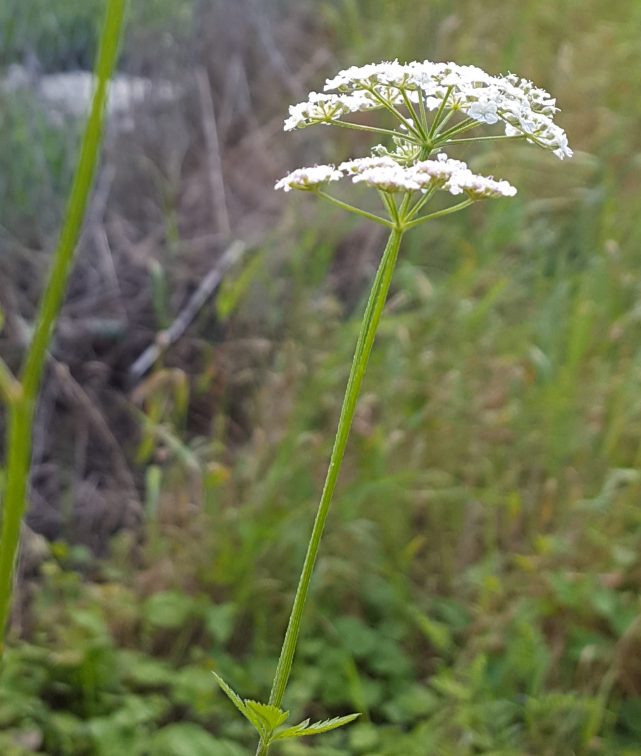
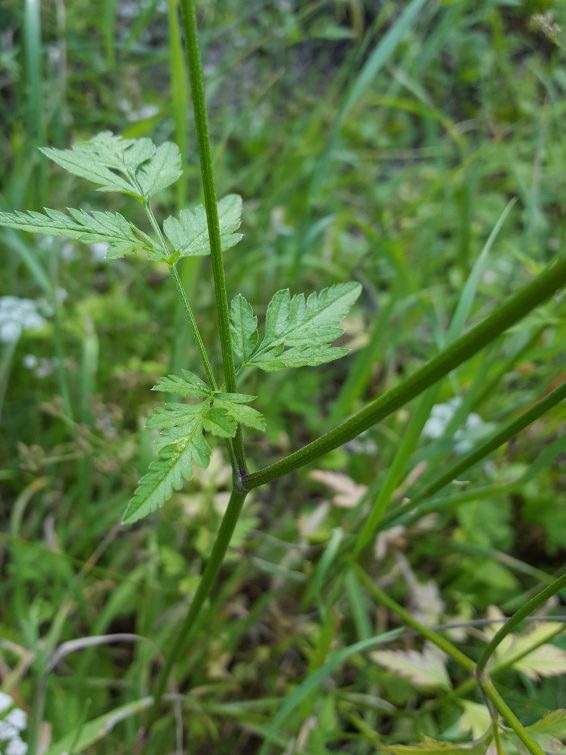
Stems: Compared to wild chervil, these are reasonably thin, and can appear with only one main stem. You can find them growing up to around 1 m high, depending on whether its unlucky enough to meet the mower. The stems are covered in small adpressed hairs.
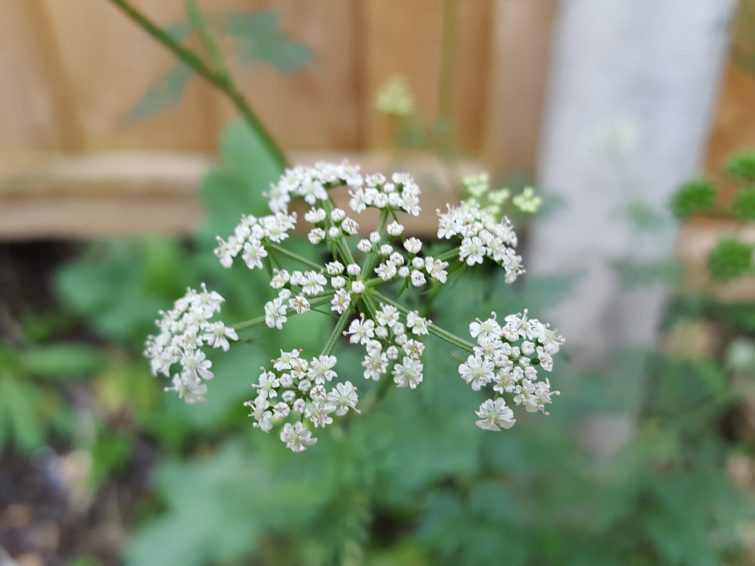
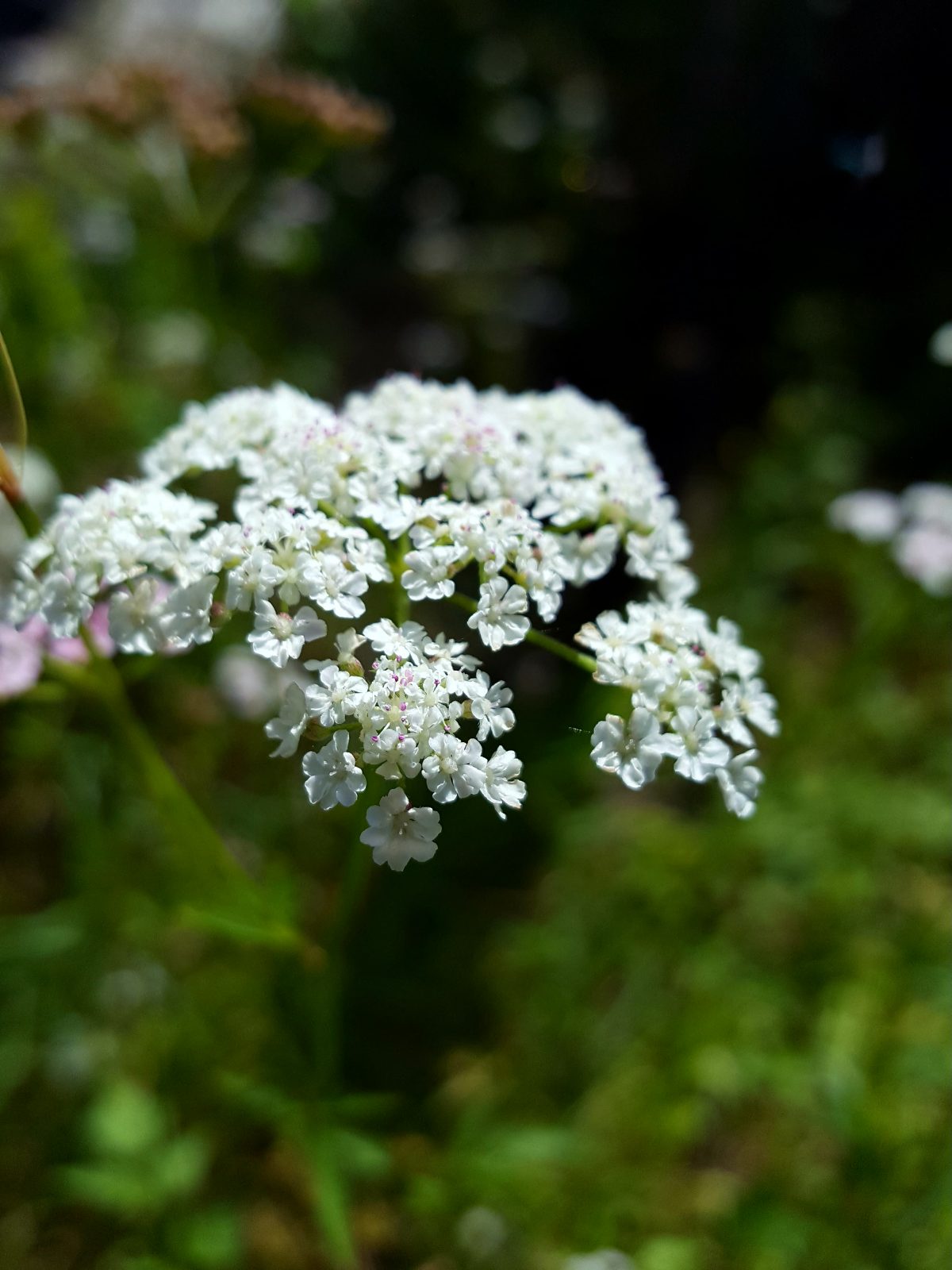
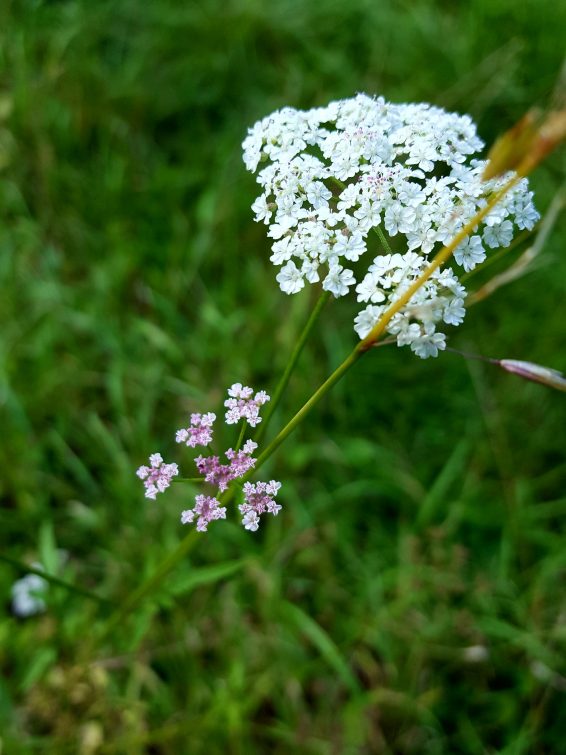
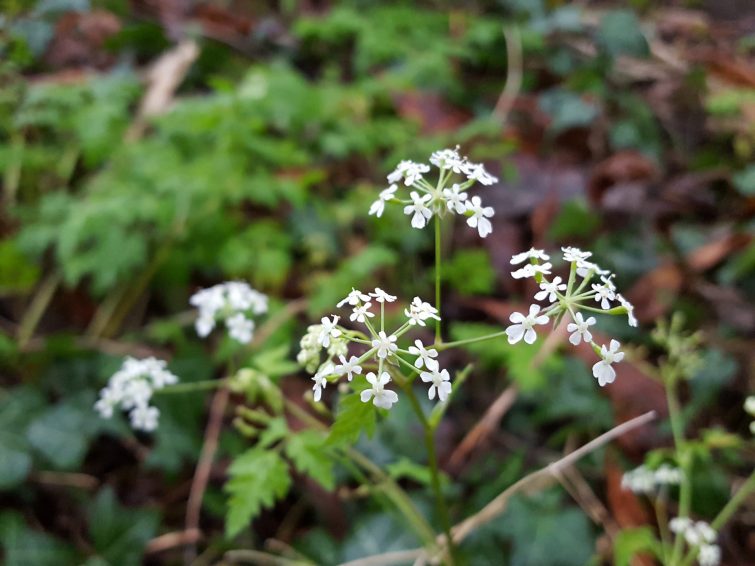
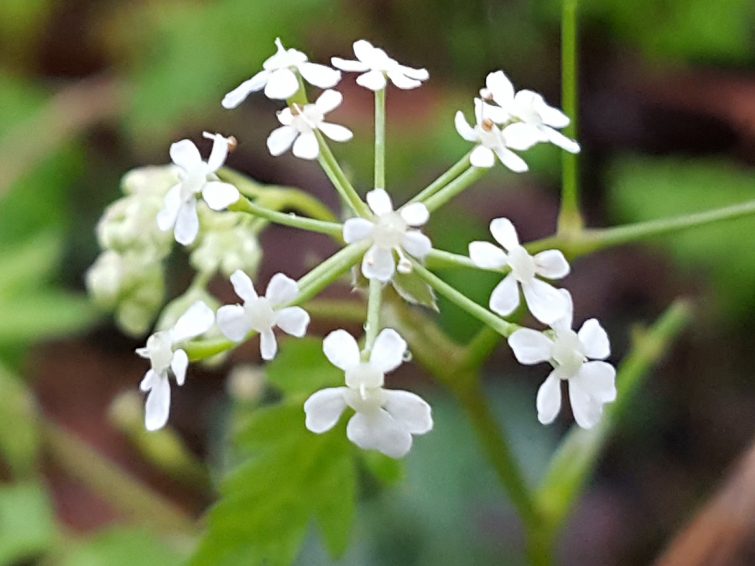
Flowers: Small, white-flowered compound umbels. Usually 20-50 mm across. There are usually bracts underneath the compound umbel.
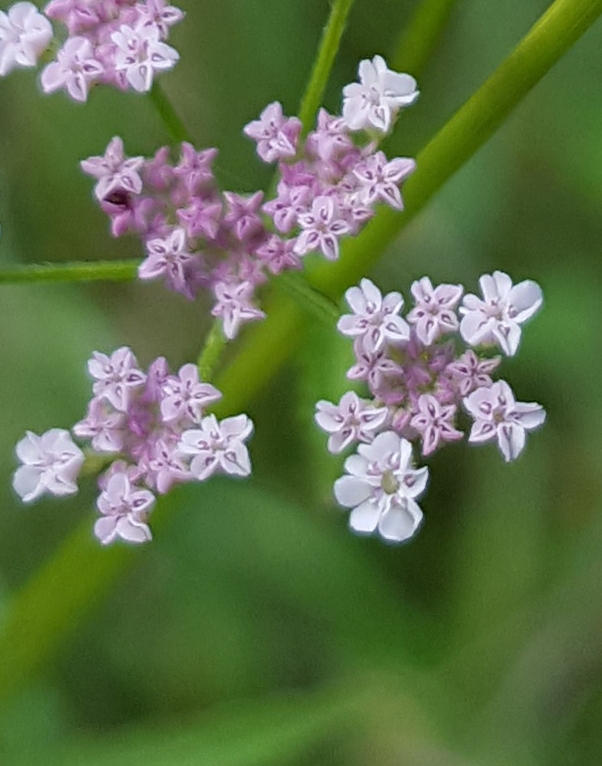
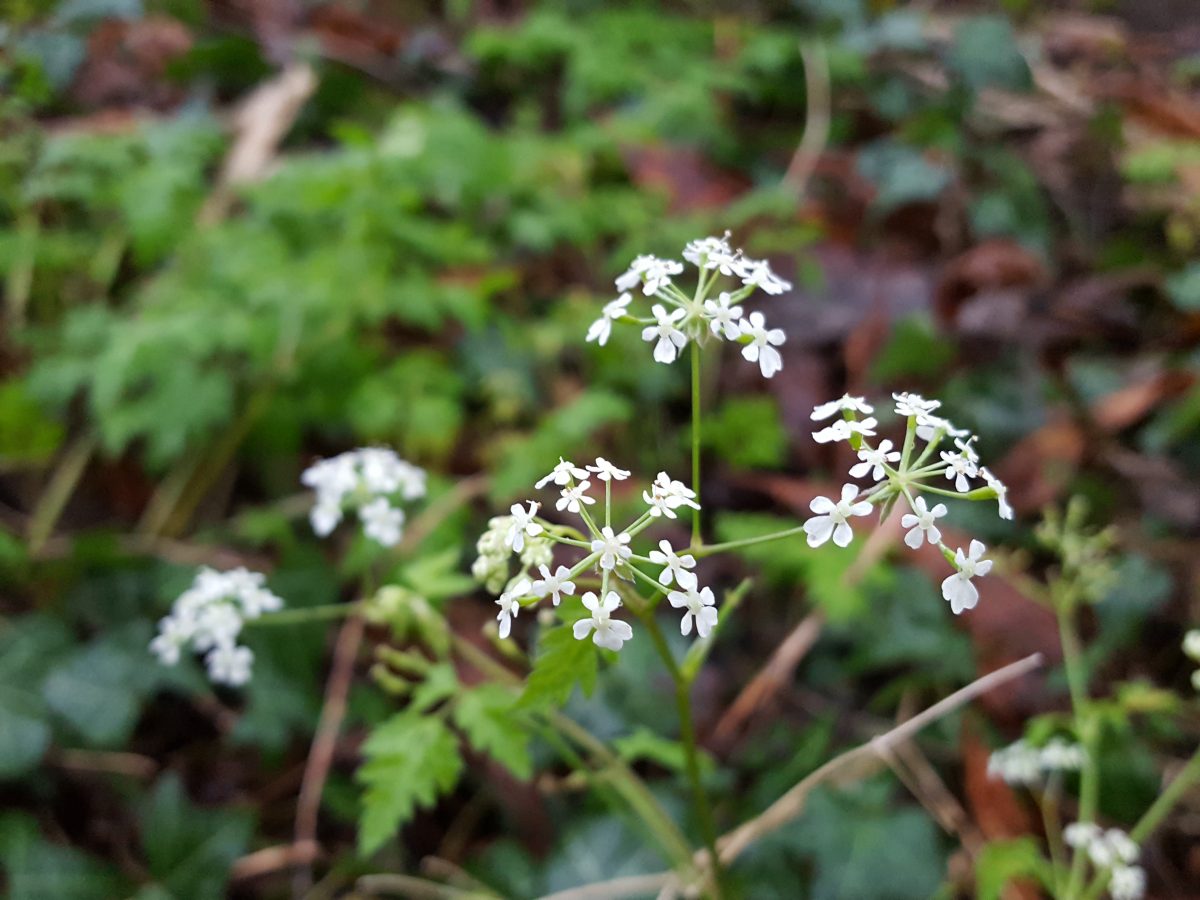
Thin and erect stems, producing small flowers which occasionally emerge pink.
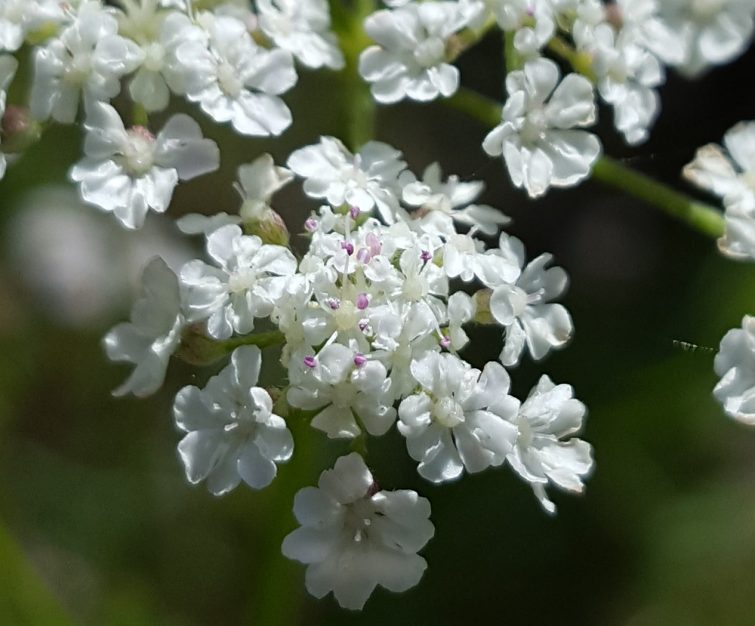
The petal lobes are wide and somewhat frilly to look at. Petals can initially be flushed pink on opening. Red-pink tipped stamens surround the stigma on the central rays of the inflorescence.
Frilly-looking white flowers with wide petals and pink-tipped stamens in the centre.
Flowering season: From July into September. My favourite UK wild flower field guide, from Blamey, Fitter and Fitter, mentions Japanese hedge parsley as being the last of our most common white-flowered hedgerow umbellifers to bloom in the summer. It follows wild chervil and the purple-spotted, coarsley-hairy stems of the rough chervil (Chaerophyllum temulum).
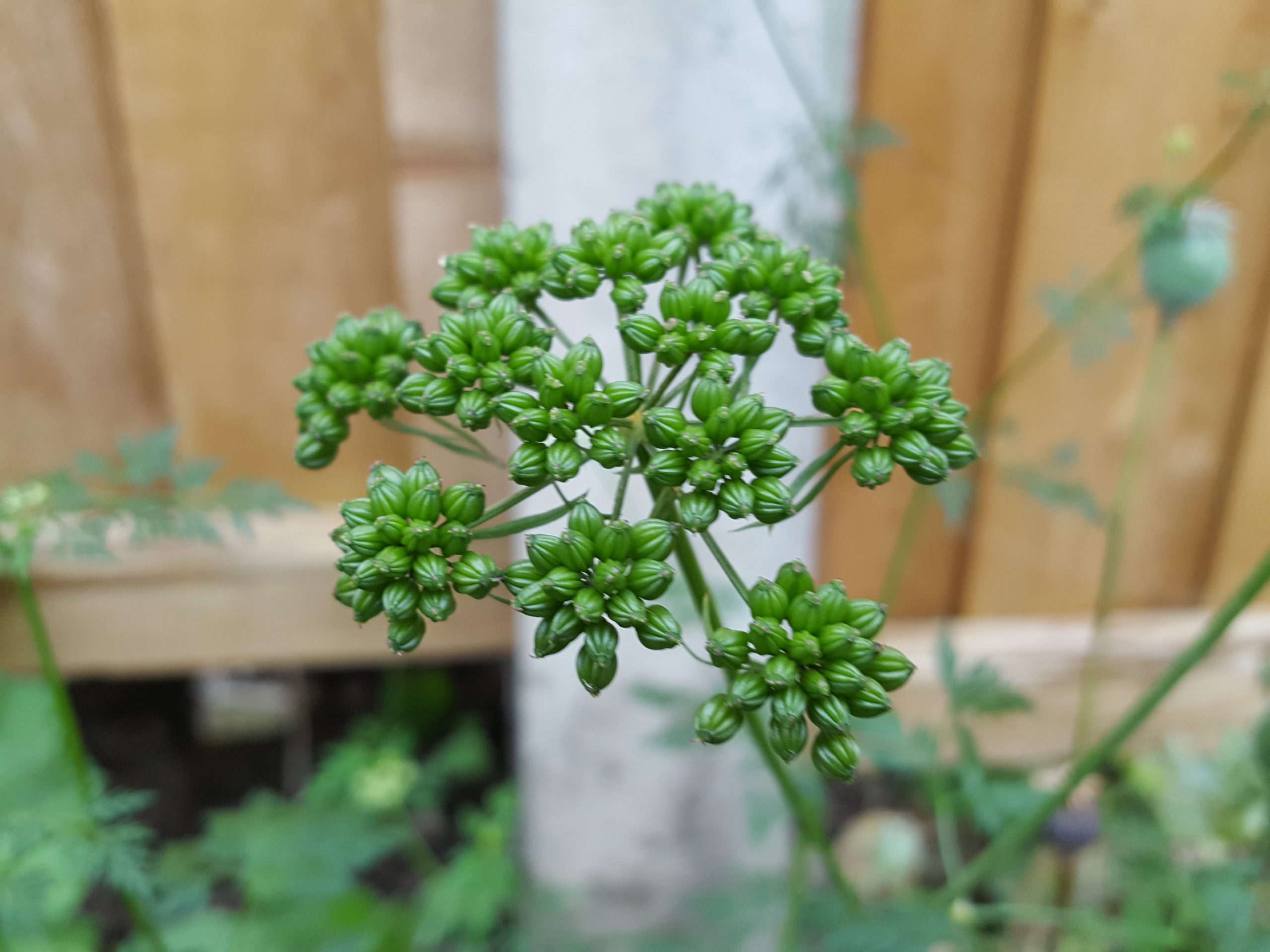
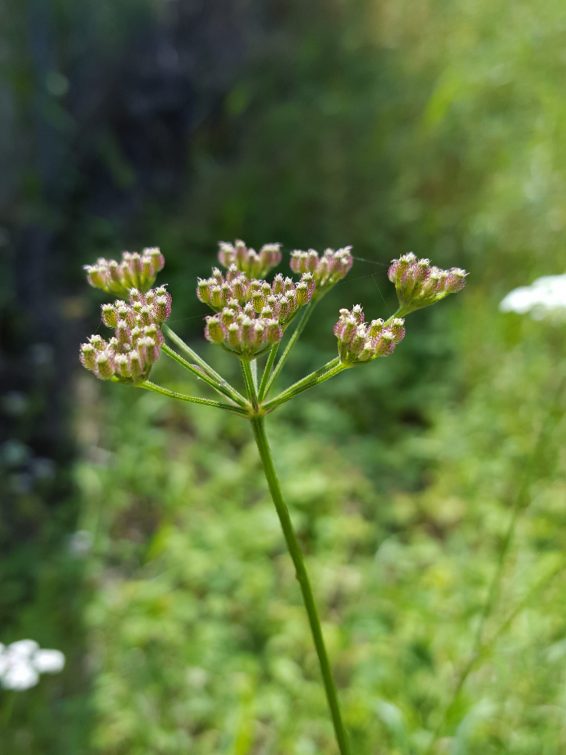
Fruits: A dry schizocarp that splits into two oval fruits, covered in short, hooked hairs.
Fruits of the Japanese hedge parsley are oval-shaped, and covered in hooked hairs.
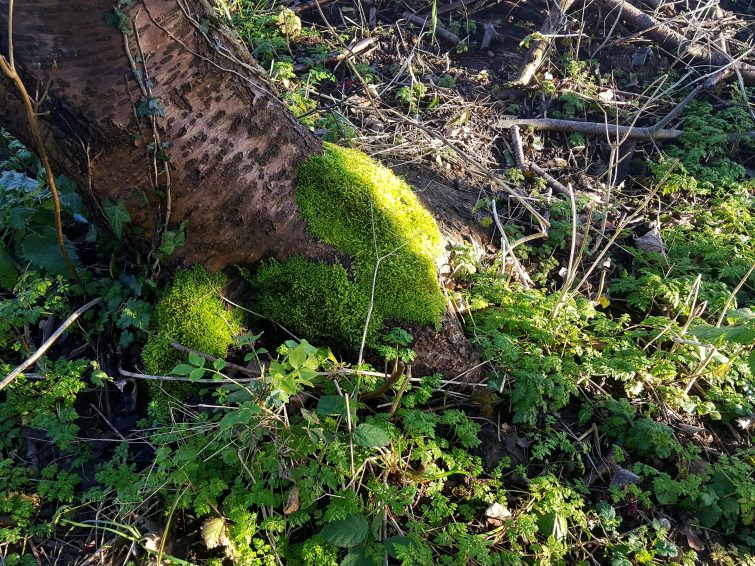
Habitats: Hedgerows, woodland edges, and suitable sites on neutral to alkaline soils.
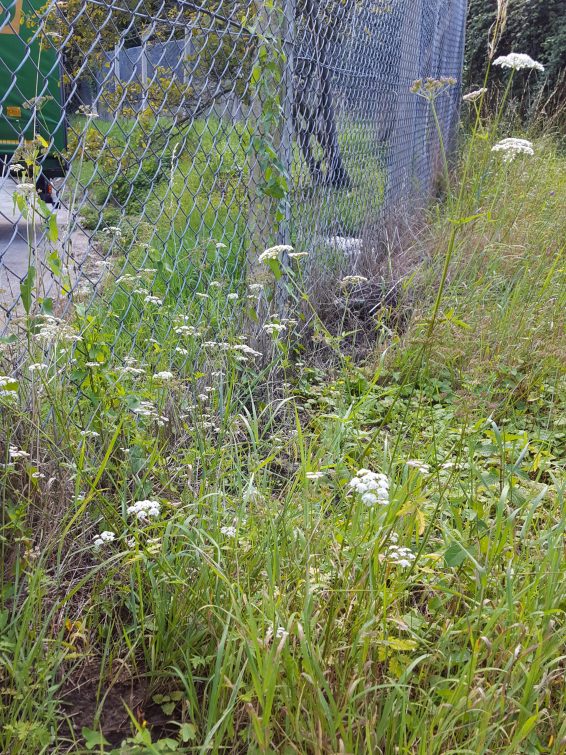
Japanese hedge parsley pretending a fence is a hedgerow in Glastonbury.
This is a lowland plant that won’t be found at altitudes above 400 metres. To see its geographic range here in the UK, just follow this link.
Parts used: Leaves. Roots, Fruits.
Medicinal uses: This is a plant well-used for centuries in traditional Chinese medicine. It has been prescribed for dysentery, fever, haemorrhoids, and uterine tumours. The juice of the root is often used. I can’t find much reported use for the plant as a herbal medicine in western herbal systems. I suppose this isn’t surprising for an exotic species.
However, an interesting aromatic sesquiterpene molecule called ‘torilin’ can be extracted from the fruits. This compound has shown anti-tumour activity against a number of cancers.
It is also a potent inhibitor of the enzyme 5-alpha reductase. Now then. All boys and men should listen up right here, because it’s this particular enzyme (as we age), that’s responsible for converting testosterone (good hormone) into dihydrotestosterone (bad hormone).
This can potentially result in prostate enlargement and possible prostate cancer, as I discuss in my article on nettles. Not surprisingly, Torilin is subject to ongoing research. All males are wise to do theirs.
Harvesting: For food use, take the whole leaf away from where the petiole meets the stem. Strip the leaflets off before using. For other plant parts, you might want to make use of all the tips and techniques discussed in my harvesting guide.
Other notes: There are two other ‘hedge-parsley’ species growing in the wild here in Britain. These are the knotted hedge parsley (Torilis nodosa), and the spreading hedge parsley (Torilis arvensis).
In certain states of North America, this plant is considered an invasive weed. Because I am yet to experiment much with the plant, I haven’t discovered how versatile or how viable a wild food crop this could be. We know enough already to value to it as a medicine. It feels to me like this plant has more secrets to unveil.
If you have any questions about Britain’s wild plant guides, do not hesitate to drop me a line.
Learn how to confidently find and identify wild chervil (Anthriscus sylvestris) Apiaceae family
Foraging for wild chervil has for many years now been one of my favourite spring foraging missions. In this article (soon to be part of an online course on plant families) you can lean how to positively identify, then confidently and safely go foraging for wild chervil.
This is one of the tastiest wild foods available during early spring as far as I’m concerned! It’s definitely one of the most common plants out there. And, just as excitingly, one of the most dangerous to misidentify! Get this one wrong and you could be eating something for the last time! You need to fully engage your senses when foraging for wild chervil.
As all us foragers know, identifying certain plants can be confusing enough without having numerous lookalike relatives to discombobulate you! It’s like trying to remember which twin’s name is which, in a room full of twins!
Wild chervil can dscombobulate you, until you become acquainted.
But fear not! This website is designed to give you the tools to help identify all of our edible, medicinal, and poisonous plants, and not just the easy and obvious ones. Up for the challenge? Then read on!
Globally, wild chervil is one of approximately 3700 species in the tricky-to-identify carrot family. In the UK, we have approximately 48 or so species that find a home here. I reckon that a good ten or more of them, can at first glance, or from peripheral vision, look like wild chervil. There is no getting away from the fact that these plants are difficult to decipher.
We learn as children that just because something is difficult or potentially dangerous, this does not mean that we should avoid doing it. It means we need to show extra dilligence, bravery and fortitude, and also in this case, care.
Saying all that, and even after reading this guide, if you happen to misidentify something nasty and come a cropper…well my disclaimer reminds you that I am exempt from any responsibility regarding your thoughts and deeds!
What’s in a name?
We know that a great deal of information can be harvested from investigating the etymology of plant names. For plant name nerds, check out this great botanical dictionary of epithets.
I’m a big believer in scientific names being a gateway to an enhanced way of knowing plants. This knowledge is more than handy when identifying plants in the field.
The generic part of the name Anthriscus can be traced back to the Greek word for the plant – Anthriskos (also Anthrikon). Some reports suggest a connection with the Greek noun – ‘ather’, which means ‘awn or beard of ear of grain’.
The Romans knew the plant as Anthryscum, which has developed into the ‘new’ Latinised word ‘Anthriscus‘.
The species epithet sylvestris, as previously mentioned in my article on Malva sylvestris, tells us of plants that love to grow in woodlands.
Wild chervil in the woodland habitat it was named after.
Our common name wild chervil can be traced back via the old English name ‘cerfelle’, from the old Latin word chaerephyll. This word has its roots in the older Greek word ‘chairephyllon’, which translates as ‘leaves of joy’. This suggests to me that the name chervil was likely to have been given first to the aromatic culinary herb – ‘garden chervil’ (Anthriscus cerefolium).
This plant is also well-known as ‘cow parsley’, and I have often seen confusing references to the name ‘Queen Anne’s lace’ being attributed to it. This latter name is far more commonly associated with the wild carrot (Daucus carota).
Botanical Description
First a warning! You may find some technical words here that you don’t know yet. So, if you need to at any point, simply pop over to my glossary and learn some new things!
Wild chervil has triangular shaped fern-like leaves, common to many umbellifers.
Leaves: The triangular-shaped, compound-pinnate leaves are often described as ‘fern-like’, ‘feathery’ or ‘lacy’. They are 3 x pinnate, meaning they generally have three pinnate leaf divisions. ‘Pinna’ is Latin for feather.
Individual leaflets are pinnately-lobed. The lobes are ovate to lanceolate-shaped and have serrated margins.
Wild chervil has deeply cut, feather-like leaflet lobes, almost down to the mid-vein, and has rounded lobe tips.
The leaves are a lightish green, and somewhat dull in lustre, compared to say, the blue – green shinyness of one of its family relatives, Aethusa cynapium.
Fools parsley is hairless, a different colour, and obviously not wild chervil!
More importantly, wild chervil needs comparing to Conium maculatum, a.k.a the deadly poisonous hemlock!
Look closely for the serrated leaflet lobes when foraging for wild chervil.
The leaves of wild chervil are hairy, often more so below, as well as occasionally in the leaflet axils. Hairs are also found on the leaf margins. Crush a leaf, and a sweetish, fresh mild parsley scent will be produced. In contrast, hemlock has a foetid stink, does not have hairs, and is typically 3 to 4 times pinnate.
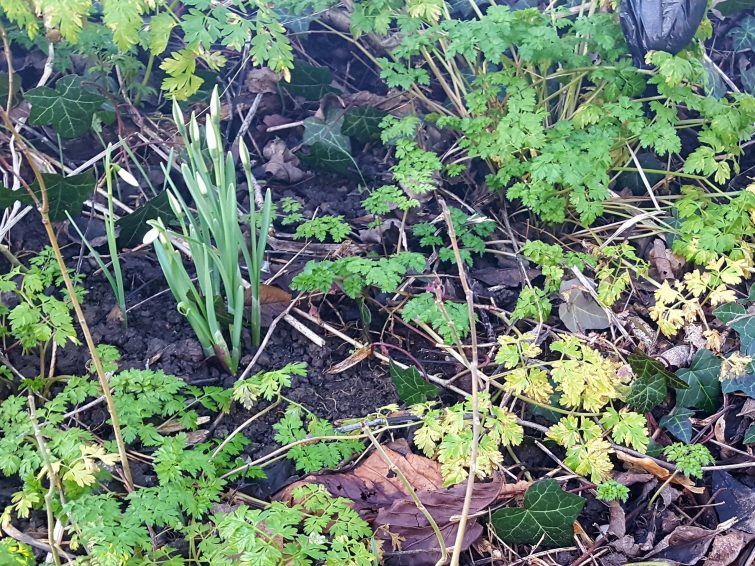
Wild chervil with snowdrops. A floral bonus when foraging for wild chervil in late January.
Petioles: These are often key to I/D. Wild chervil usually has quite long petioles. They are always hairy, slightly ridged, and sheathed at the base. You will see it is hollow and exudes a little white latex when it’s young and first cut. Also, notice the distinct channel running down the leaf stalk.
By comparison, hemlock doesn’t have hairs, produces an almost cylindrical-shaped leaf stalk, and is typically found with a lot of red-purple spotting on it. These three petiole characteristics are crucial and go a long way in getting to a positive identification.
If you are as silly as I was once, and accidentally nibble a hemlock leaf from a cocky peripheral vision I/D, you will immediately notice the extreme bitterness, and then the pain from microscopic skin-piercing calcium oxalate crystals. Ouch!
Always cut a petiole in cross-section. With wild chervil they reveal a horseshoe or ‘U’shape. You can’t help but notice the channel running down the length of the stalk.
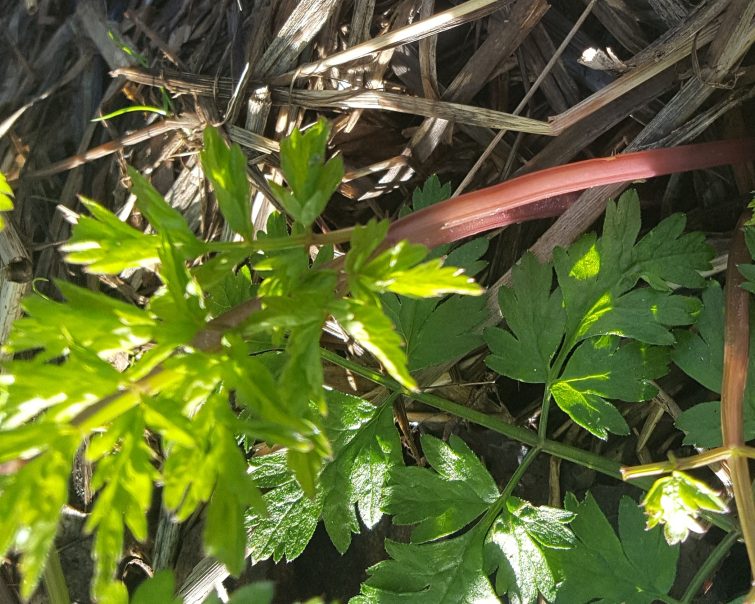
After a few times foraging for wild chervil, and in a big enough stand of it, you will occasionally see the odd specimen exhibiting pure red to purple coloured leaf-stalks, just to make you double take.
Wild chervil occasionally dresses its petioles in red or purple.
Roots: Wild chervil has a tap root that grows up to 2 metres long. The root shoulder produces numerous leaf shoot ‘buds’.
Stems: The flowering stems are branched, ridged, and hairy and quickly turn hollow. They can reach up to 1 m 50 cm or so high and usually appear a dark purple colour.
When crushed or cut, the stems, like the leaves will produce parsley-carrot aromatics (at least to my nose).
Wild chervil flowering on a mild winters day in January.
Flowers:
Wild chervil has lacy-looking compound umbels. Each individual umbel will typically produce 10-14 rays, each with a small white flower. The five petals are often notched at the tip and can be flushed with pink as they emerge. They have larger petal lobes on the outer edge of the umbel.
Wild chervil typically shows 10 -14 rays per umbel with larger outer lobes.
Fruits: Avid readers will already know a schizocarp when they see one. This plant produces 10 mm long, thin, black, ridged fruits. They are a little disappointing for me, simply because they are not aromatic.
Flowering season: Field guides continue to advise the main flowering period as from April to June. However, as with other perennial plants, wild chervil can potentially flower at anytime.
Plants aren’t like us with fixed absolute notions of what to do and when to do it. Whenever it has put on enough growth, and where its particular conditions are favourable, a plant will flower. Global heating is presenting plants here in the UK with more opportunities to flower ‘out of season’.
Often we can see perennials who have their flowering initiation set, but their production interupted, sometimes repeatedly. It is important to remember that it takes a good few weeks from flower initiation happening inside the plant for recognisable features of flowering to be noticable by us, outside of tbe plant.
This wild chervil may flower early with this growth already in January.
Therefore, where conditions furnish such flowering behaviour, and where the plant has already set sail, so to speak, they will do no more or less than try and produce flowers and viable seed, no matter what time of year.
Hence the 8 or 9 inch high common hogweed plant I saw on a footpath by a busy road near Oxford a few years back. I will never forget it because it completely stopped me in my tracks.
I bent down and began to stare at the tiny stem and its flowers. Usually this plant can reach up to 1 metre 80 cm high with numerous stems. Here it was no more than 9 inches high, with a single stem and a flower head almost its typical size.
I was completely dumbstruck. The sheer unnegotiable driven need to express form and reproduce. That to me almosts points to a creative consciousness and some sort of relentless will of nature.
Habitats: Everywhere! Well almost. This is the most common umbellifer we have in the country. By far! This map from the BSBI shows how much of Britain has wild chervil growing in it.
Regular foraging for wild chervil will quickly demonstrate that it is a lover of woodland edges and clearances, as well as hedgerows, roadsides, field edges, parks and gardens. It grows on the vast majority of soils, except on the highest ground.
Parts used: Leaves, leaf shoots, young flower stems, flowers.
Plant chemistry: There are negligable amounts of the phototoxic compound furucoumarin (also known as furanocoumarin) in wild chervil. These molecules are well-known for being present in potentially dangerous concentrations in a number of carrot family plants.
Because understanding these molecules are paramount to foraging safety, furucoumarins are central to an upcoming springtime essay on the actual real and present dangers from foraging for chervil, hogeeed, parsnip, and other common carrot family plants. Watch this space!
Furucoumarins are also found in citrus fruits and other unrelated species. For most people, these are not molecules that will pose a danger when we are eating them in regular dietary amounts.
These compounds are only reactive under sunshine, or more correctly, ultra violet light, when they are in contact with your skin. This can lead to various states of dermatological dis-ease, from a mild tingly sensation and redness, to 3rd degree burns (from plants with much higher concentrations).
With wild chervil, I feel it safe to say that for the overwhelming majority of people, this plant presents no danger whatsoever. None. Yet we all know that everyone is different. Someone with an existing allergy against celery may possibly have a reaction when handling a peeled wild chervil flowering stem. Wear gloves if worried.
Wild chervil contains very small amounts of furucoumarins.
Harvesting: Picking the leaves can be done pretty much all year, although August to April in Southern England is the peak time for me. I pick the leaflets off the fibrpus mid-vein, except on the newest, most tender foliage.
The young unfurled shoots are well worth having in late winter early spring. Use whole.
The stems can be harvested from March in most places. This is temperature dependent though. Mild winters equals early tender flower stem production.
If the stems are really flexy then you are good to go. If not then they will be fibrous, tough and no good to eat. The truth is that you have to experiment to know for sure. Just start with the bendiest and biggest ones you can find.
As with all plants, you should test your tolerance before consuming. This and all other golden rules of foraging need to be adhered to when foraging for wild chervil.
The stems need the outer hairy skin removed before you can eat them. Either use a knife or fingernail to prize away the tougher material from the green flesh below. A host of other useful tips and techniques can be picked up from my harvesting guide.
Other notes: Aside from the negligible furucoumarin content, wild chervil does not have any other striking medicinal constituents or actions.
From my research wild chervil is not a plant commonly employed as medicine anywhere. This is not surprising, becuase in this plant family it is predominatly the essential oils that impart the medicinal actions. Still, you can’t have everyrhing!
Another species fom the exciting carrot family is coming up next…
Foraging for common agrimony (Agrimonia eupatoria) Rosaceae family.
Learn how to find, identify, and use, the sacred Druid herb common agrimony. Discover its history, as well as its traditional and current uses in medicine.
This pretty little perennial plant can easily be overlooked or mistaken for something else. This is partly due to its relatively demure stature, and becuase of its passing resemblance to a few other plants.
Common agrimony botanical description
You will come across some technical terms here, just like the ones used in botanical field guides. Have no fear, because this glossary will be your friend! Being comfortable with a new language takes practice. It will also help kick start your foraging adventures!
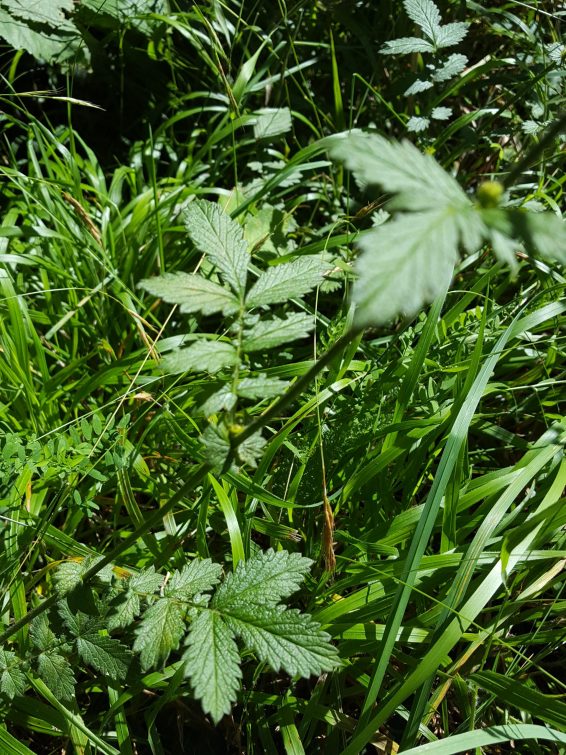
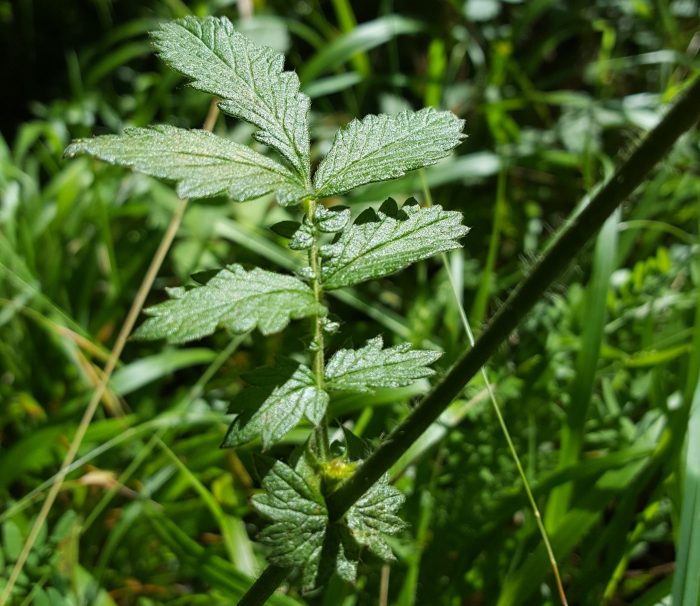
Leaves: Common agrimony has dark green, compound-pinnate leaves. They are oval to elliptic-shaped, with oppositely-faced leaflets.
Two or three pairs of small intercalary leaflets are found between each pair of larger leaflets. The terminal leaflet is often the largest.
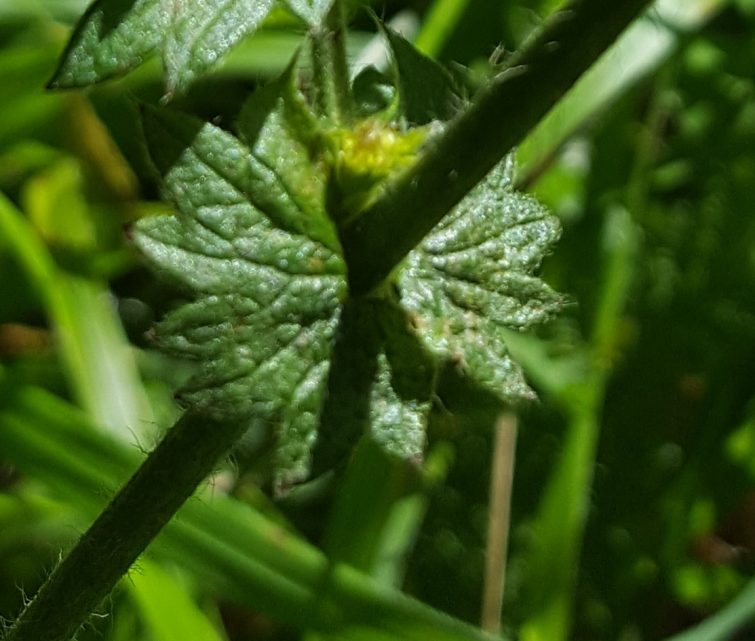
The leaf margins are deeply serrate or serrate-dentate. The leaves are aromatic, but not strongly so. They are hairy above and below.
Petioles: Hairy, approximately 3-5 cm long.
Stipules: These are present at the base of the leaf as is common with the vast majority of Rose family plants.
Roots: Agrimony has a perennial rootstock. Their starch-laden rhizomes sustain the plant through its winter dormancy. The rhizomes have a brown-coloured skin.
Stems: The stems can reach anywhere from 30-60 cm high. They are rough to the touch and covered in glandular hairs.
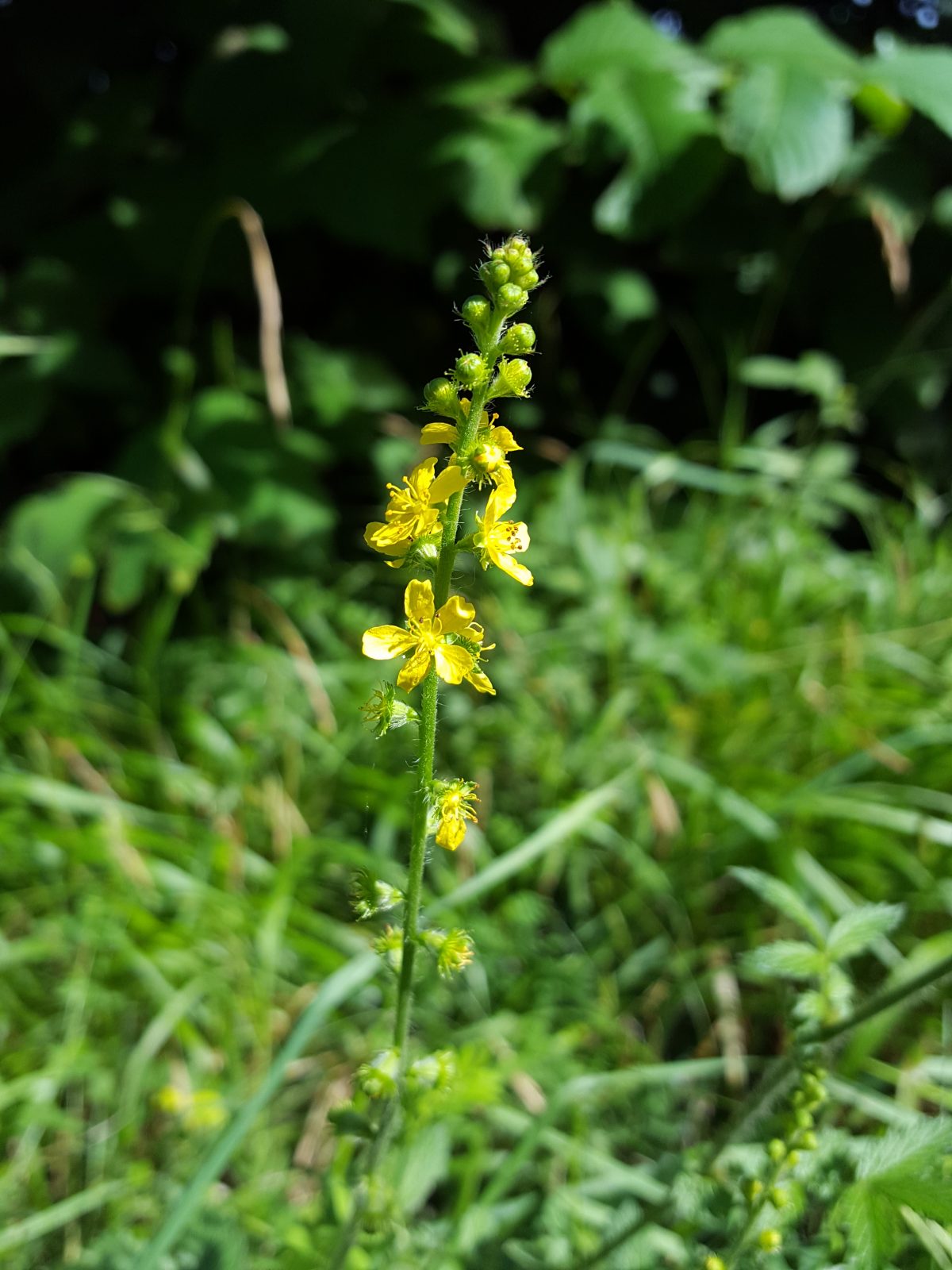
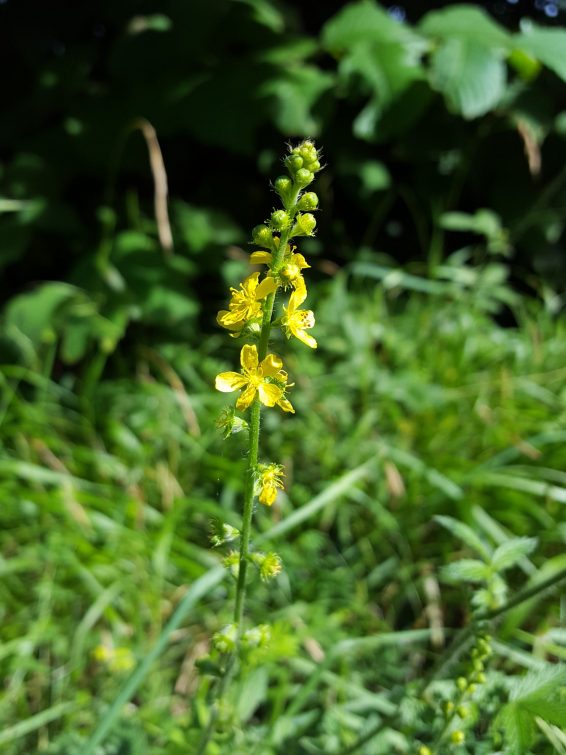
Flowers: Spikes of small yellow flowers with the rose signature of 5 green sepals, 5 petals, and a mass of stamens. It is these spikes that gave rise to one of its other common names, ‘churchsteeples’.
Flowering season: Any time from May throughout the late spring and summer into October.
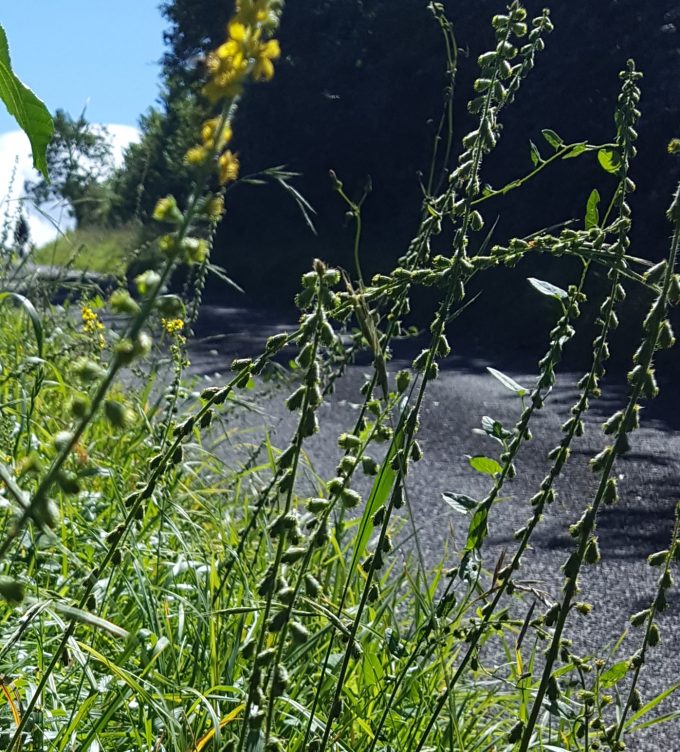
Fruits / Seeds: The small fruits are approximately 5 mm across and covered in hooked hairs.
Agrimony obviously evolved to utilise the different animal furs, similar to burdock, to successfully spread their seeds around.
Habitats: This plant will most easily be found in grasslands, hedgerows, grassy banks and woodland rides, on limestone and other calcareous ground.
Its definitely one of the plants that urban foragers in our larger towns and cities are unlikely to see a lot of without getting into the countryside!
While it is common to much of the southern half of the UK, common agrimony is essentially a lowland plant. It won’t be found much at all at heights above 300 metres. This BSBI map shows agrimony is absent from large parts of Scotland, North England and Wales.
Parts used: Leaves and flowering tops.
Harvesting: The best medicine will be had from the flowering tops when most of them are just opened. You can use all above ground parts for tinctures. Check out this guide to harvesting edible and medicinal plants.
As a food I will occasionally toss some flowers in a salad. As far as the leaf is concerned, well, agrimony has astringent, tough ones that are only really fit for a post-apocalyptic pottage broth. There are many better edible leaves out there! Corn salad anyone?
Other notes: Formerly much used as a herbal medicine, both here and in Europe. Agrimony is approved for use by the E.U on the basis of its long standing traditional use for certain disorders.
Agrimony can be usefully prescribed by physicians and herbalists for gastric disorders, mouth and throat disorders, and to be used topically, applied on minor wounds and inflammations.
The Druids of ancient Britain are beleived to have held this plant as sacred, alongside another 12 or so herbs. From our knowledge of the Celts and contemporary historians such as Dioscorides, the plant was known to be infused into an oil and used alongside juniper (Juniperus communis) as an annointing herb.
Agrimony is one of the 38 Bach flower remedies. It is used for anxiety, inner tensions, and hidden emotions. It reportedly gives relief from extreme anxiety disorders and post-traumatic stress syndrome.
More identification guides are coming up soon on the UK’s most comprehensive foragers plant identification website.
Learn how to identify and use common mallow (Malva sylvestris) and other easy-to-find edible mallow species (Malvaceae).
Certain plants, such as the common mallow, seem to be our constant companions, no matter where we are.
The more you learn about plants and foraging, the more you will notice that the really common and familiar plants often soon become some of our really useful and valued species. Their usefulness to man, I believe, is reflected in their persistent proximity to people..
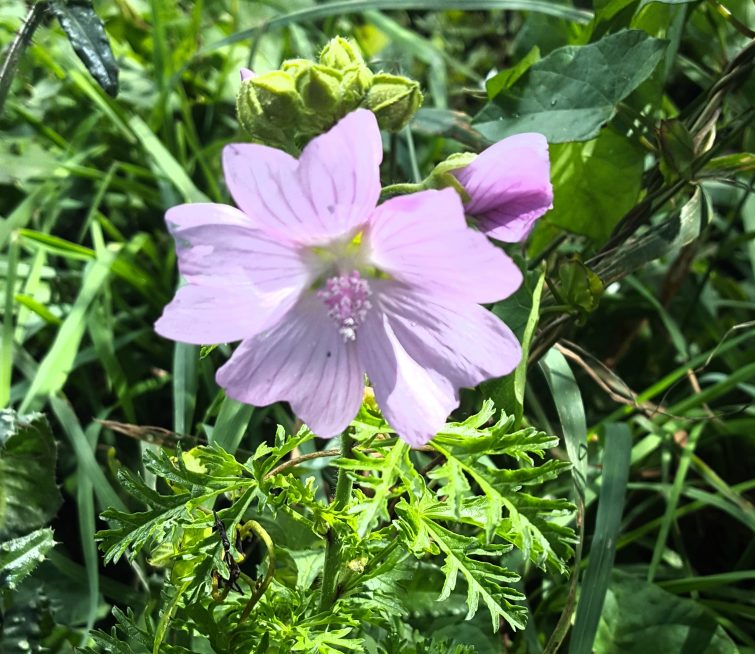
Musk mallow (Malva moschata). One of the tastiest mallows you can add to salad.
Our hand has dramatically re-shaped the landscape. And for most of our existance, certainly up to the Agrarian revolution in the 20th century, the vast majoroty of people on this planet fully utilised their plant resources. Thankfully, as you will read later, the retained collective knowledge of local plant resources helped save thousands of starving people as recently as 1948.
So rather than being looked upon as persistent weeds, the mallows can be more usefully described as some of our gloriously abundant plant allies.
There are around 25 or so plants currently assigned to the genus Malva. All are edible. A number of mallow species have long been used as a food and medicine, wherever they are found growing native, and especially by people in the Middle-east and Asia.
In Britain, Europe, North Africa and South-west Asia, you really won’t have to go far to find common mallow, and a host of other species either.
What’s in a name?
The generic name Malva comes from the old Latin name for this plant, which is itself a word related to the old Greek word – malakhē.
The specific part of the name sylvestris denotes a plant whose favourite habitat is woodland (from the old Latin word sylva – meaning forest or trees).
Our common name mallow is derived from the old latin name Malva via the old English word ‘mealwe’.
Common mallow botanical description.
Our other commonly found mallows will be also be discussed here, with articles posted in due course. Right now I will concentrate on our common mallow, also known as the ‘wood mallow’.
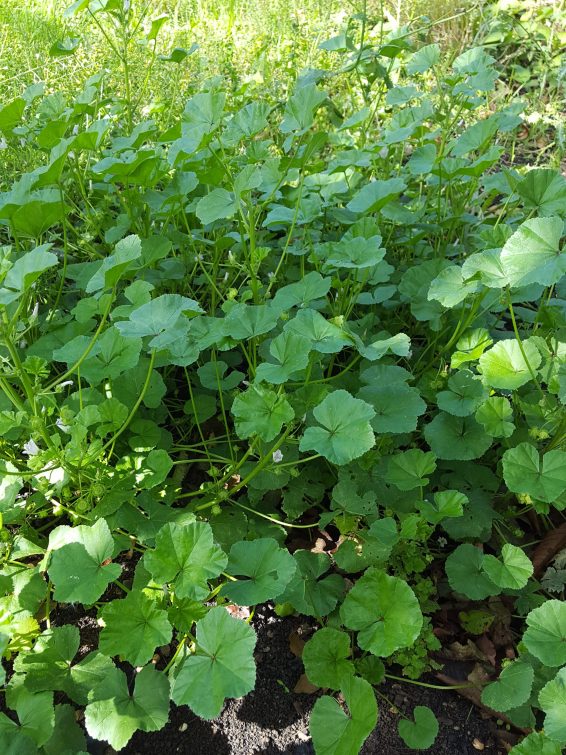
This ubiquitous species can be found growing erect or prostrate, which may initially cause confusion, because its easy to assume that they might be two different species.
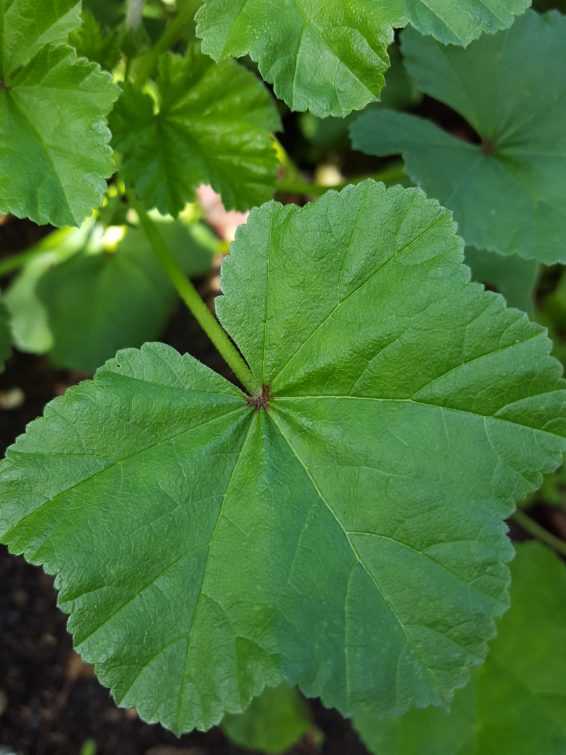
Leaves: Mallow’s kidney-shaped or palmately-lobed leaves are notably creased, and typically with dentate margins. They can grow up to 20 cm across and more on larger plants.
The leaves often show a purple spot in the centre of the base of the leaf and this can also be seen to run down the petiole on some specimens.
On other specimens, the purple leaf spotting and colouring is completely absent.
The deep green foliage colour hints at a well-renowned drought tolerance.
If you crush or tear a leaf you will discover one of the mallow family patterns, the demulcent mucilage. It is the mucilage that gives the leaves their softness and aids thier drpught tolerance.
Petioles: Mallow leaves are always on long petioles, typically greater than 10 cm long.
Roots: The common mallow has long creamy-white coloured roots. They are high in the polysaccharide inulin and just like the rest of the plant, are high in mucilage.
Stems: As mentioned, common mallow can grow upright or prostrate on the ground. The stems are branched, solid and hairy.
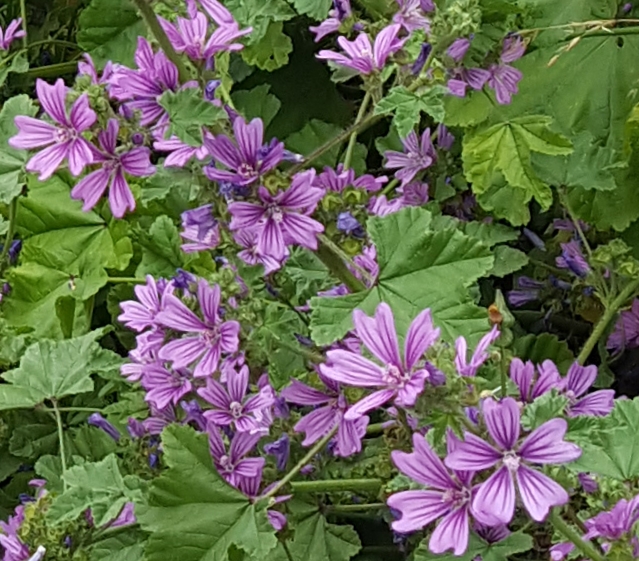
Flowers: In bloom, the Malvaceae family plants all produce five large notched petals in each open flower.
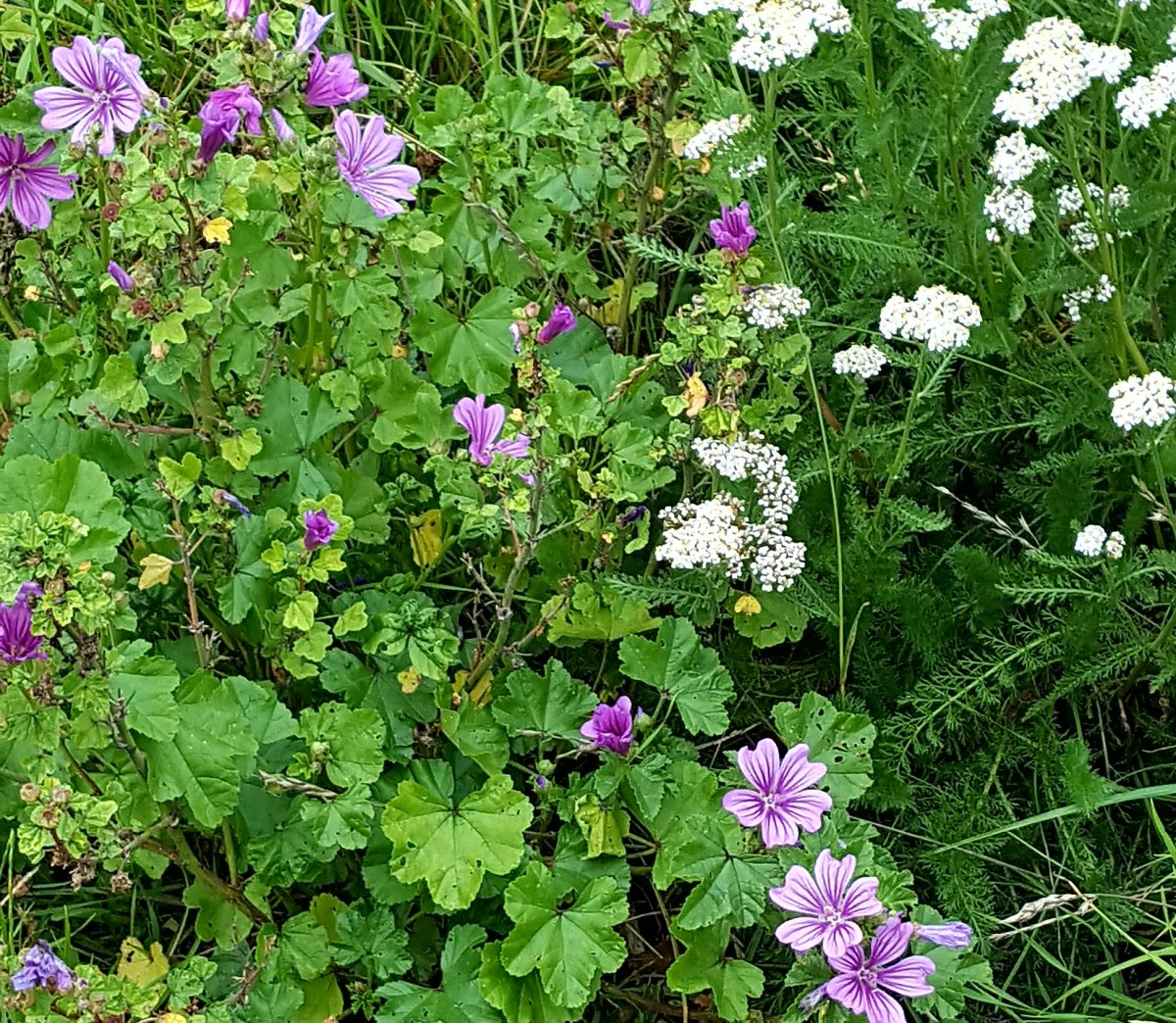
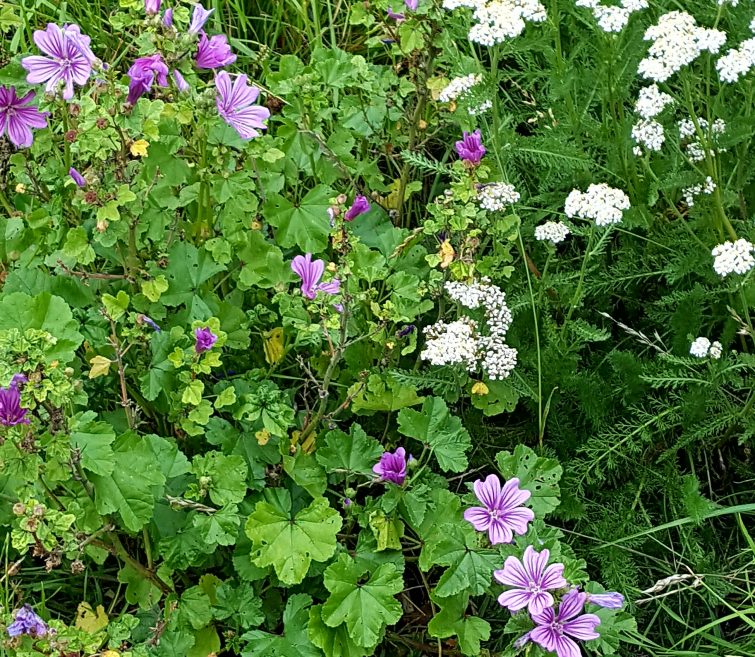
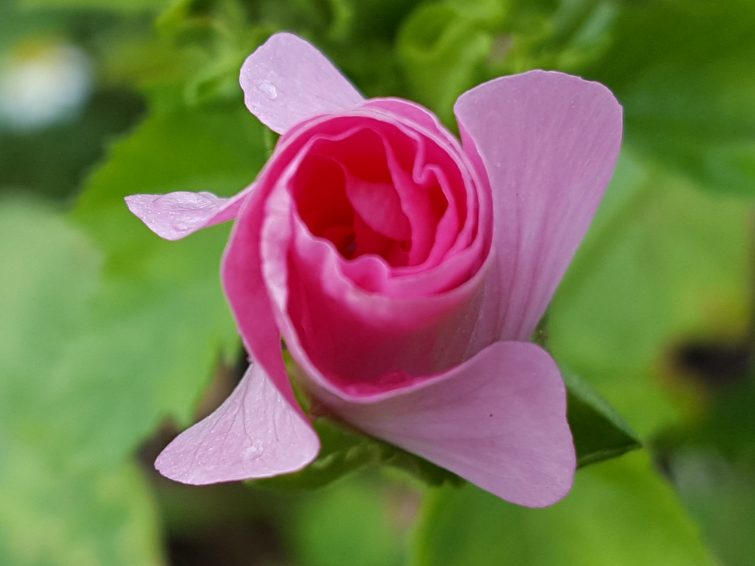
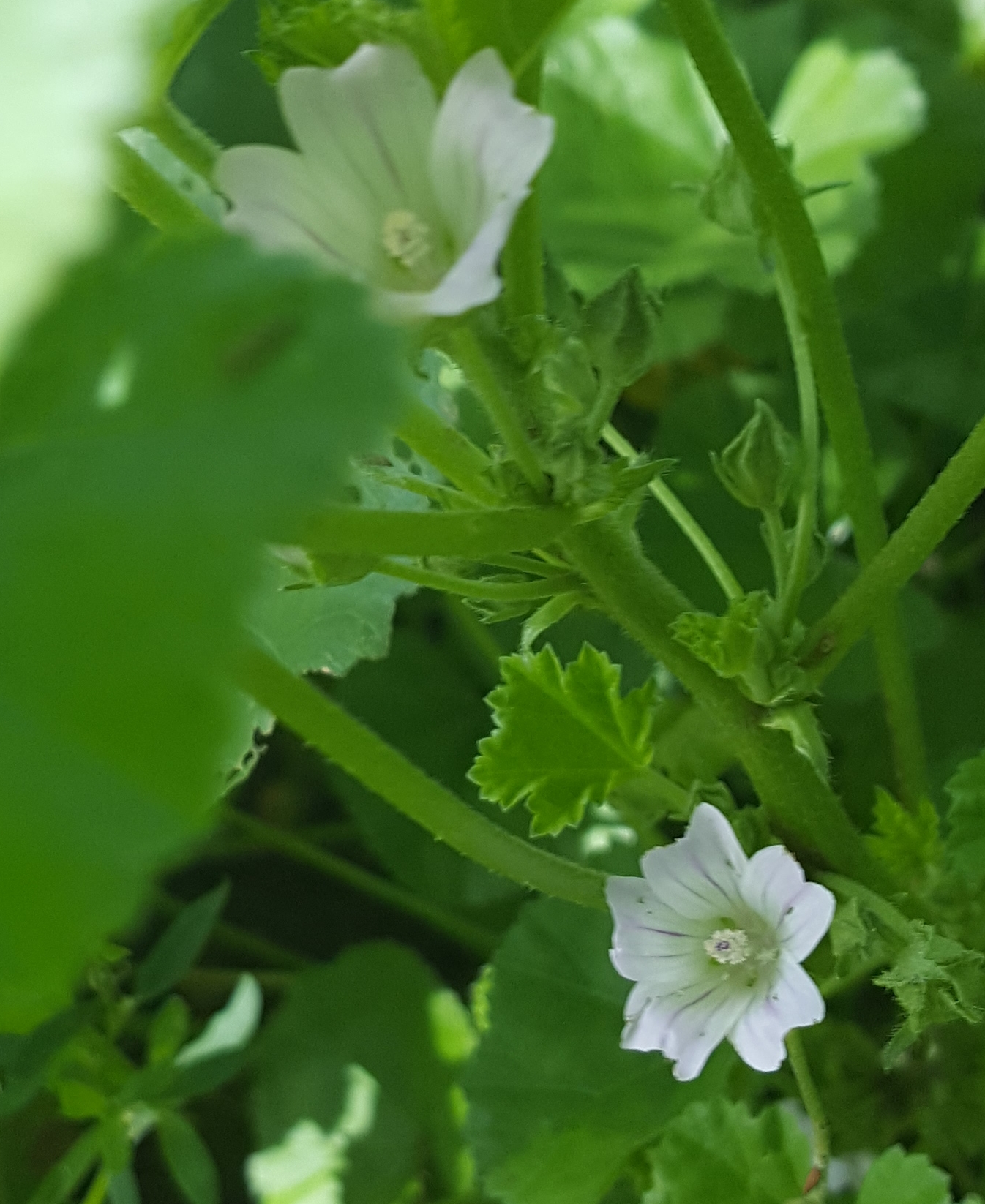
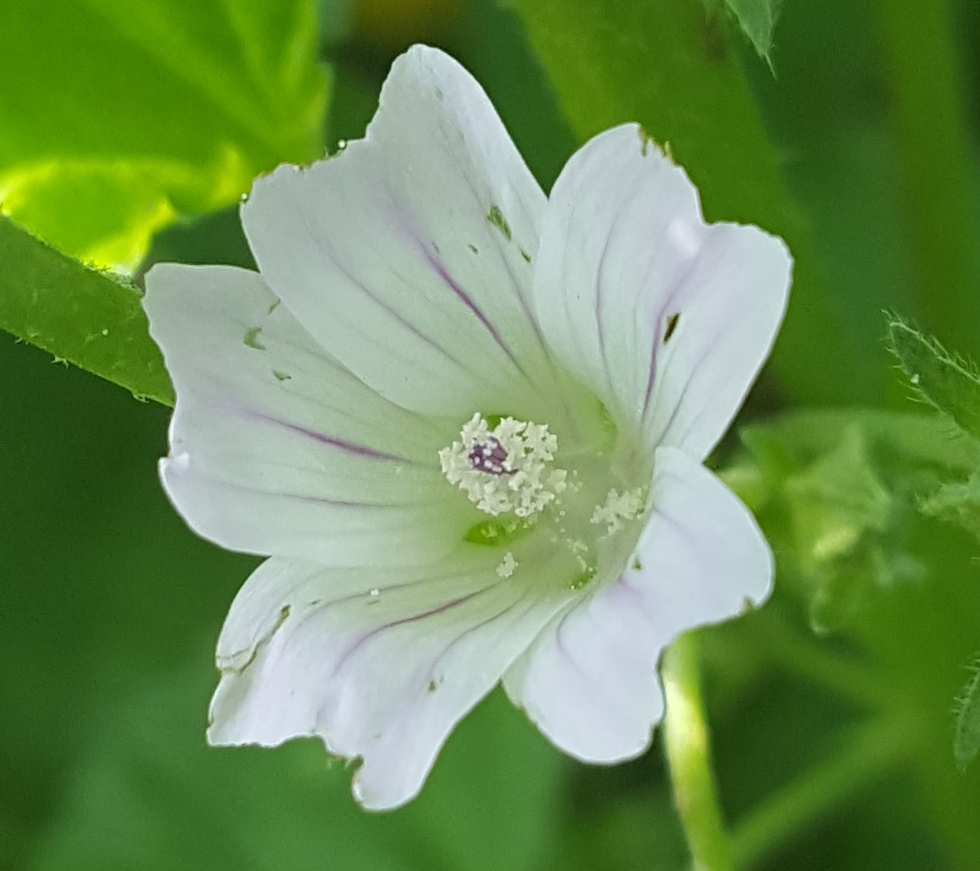
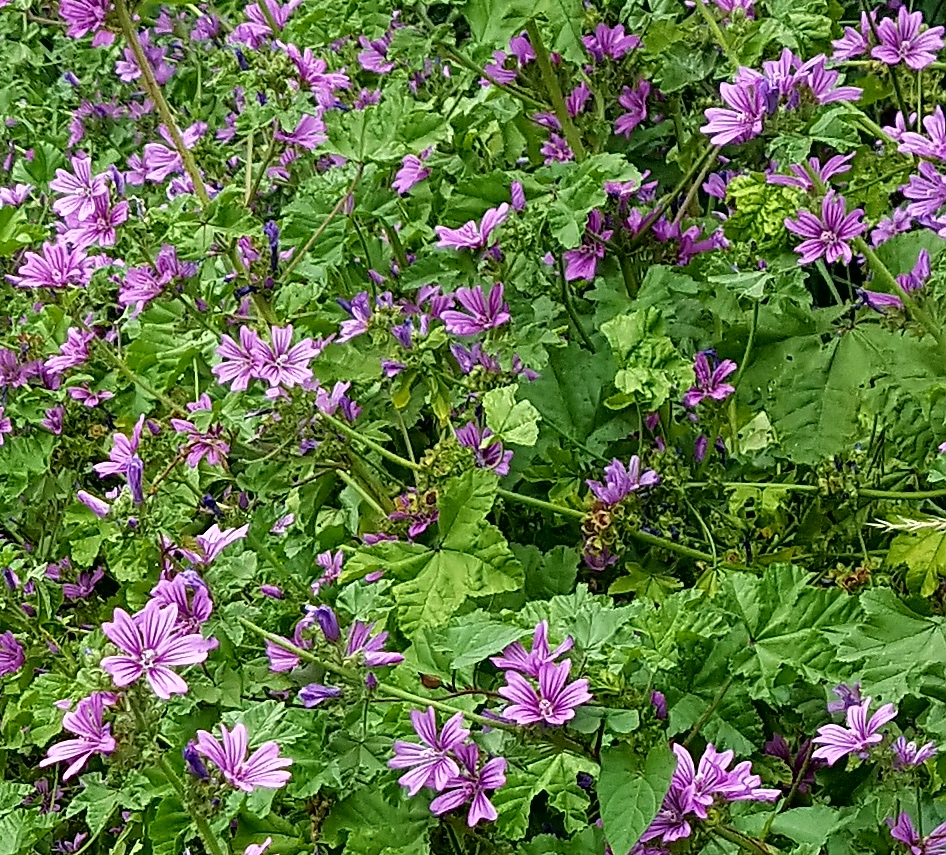
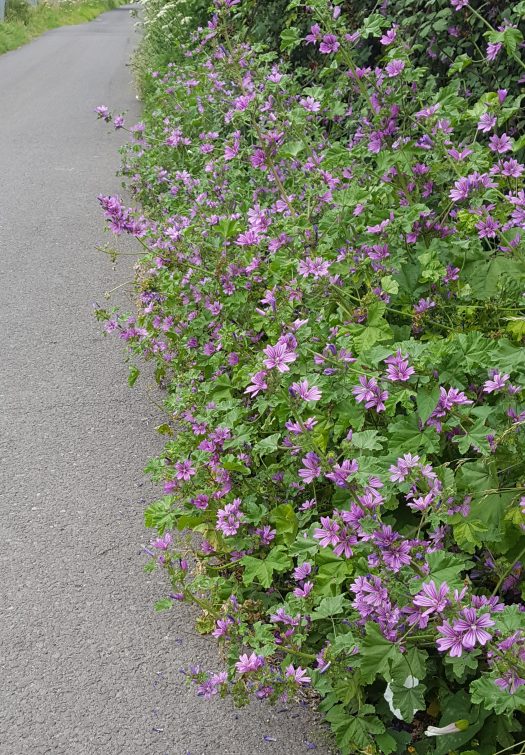
Common mallow has showy pink petals laced with darker-coloured strokes. The musk mallow has a similar size and coloured flower. in contradt, the smaller but similar species, dwarf mallow (Malva neglecta), has much more pale lilac-coloured flowers.
Other mallows that grow here, such as M.neglecta,M.parviflora and M.pusilla, have much lighter-coloured and smaller flowers.
In the centre of all mallow flowers lies a pollen-loaded column of fused stamens. This surrounds the stigma, which rises above the column.
Flowering season: Mallows tend to have a long flowering season that starts during late spring and continues en massè throughout the summer.
Fruits: Mallows are known to freely seed. They produce round seed pods, known colloquially as ‘cheeses’, or botanically as schizocarps.
The cheeses are held close to the flower stem on short stalks. They soon follow after the first flowering.
They are crunchy, juicy little bites were once popularly munched by children on their way to and from school.
The favourite habitats of mallows:
The common mallow loves a roadside where it can take a regular knock back by mowing. You will find mallow on most soils, from coastal to the more marginally upland habitats. In fact, most settings are adequate for this resilient plant. It loves waste-ground as well as grassland; gravel as much as coastal edges, and waysides as it likes hedges.
Parts used: Leaves, flowers, seed pods, roots.
Harvest: For the above ground parts. Leaves are best harvested n spring, taking advantage of the spurt of fresh new leaves.
The flowers can be picked as soon as you start to see them in late spring; and the seed pods are available from early summer. Roots can be harvested from leaf rosettes whenever large enough. If you want to learn more about harvesting our wild plants, be sure to read this article.
Traditional and contemporary uses of common mallow: As with many wild food plants, the common mallow has also had a long history of medicinal use.
Due to their high mucilage content, mallows make excellent soothing demulcent herbs, especially for cases of inflammation, either for the urinary, digestive or respiratory systems.
Pregnant women or new mothers may like to know that mallow leaves can provide useful amounts of Iron, as well as being quite high in zinc and most vitamins.
All of the Mallow family with exception of the cotton plant (Gossypium hirsutum), are reportedly edible. With their high mucilage content, the leaves can also usefully be taken as an emergency antidote to irritation or burning. This is useful to know if you ever accidentally eat any acrid plants from the buttercup family. This article on Britain’s poisonous plants will help you get to know all the plant hazards on these islands.
Creative cooks can substitute mallow for spinach in many dishes, including soups, salads, gnocchi and quiche. Try flash-frying larger mallow leaves for just one second in hot oil to make mallow popadoms! Mallow also makes a great addition to soups, where the mucilage helps to thicken them.
In Jewish culture, mallow has been been considered the ‘most important plant in local gather society’. Every spring mallow is gathered in the countryside. It’s common name in both Hebrew and Arabic, translates to ‘bread’.
During the war of 1948, when Jerusalem was under siege, mallow was an important famine crop, and one that is still celebrated on Independence day every year with a traditional dish made from mallow leaves.
Common mallow can be substituted for the family relative Corchorus olitorius aka ‘jutes mallow’, when making the Egyptian / Middle-eastern dish ‘Molokhia’. This traditional dish is usually served with chicken.
In China, mallow roots are a popular and common ingredient in making hearty, yet medicinally potent soups and broths. The inulin-rich tap roots of a number of different mallow species, including our common mallow, have been used.
The seed pods can substitute for most of the egg white if wanting to make mallow meringues.
Simply boil up the peeled seed pods using 3 parts water 1 part seed pods, and reduce the liquid by half. For every half cup of liquid add one egg white, ¼ t-spoon of cream of tartar, some vanilla and castor sugar, then whip it up until foamy and stiff, just like meringues.
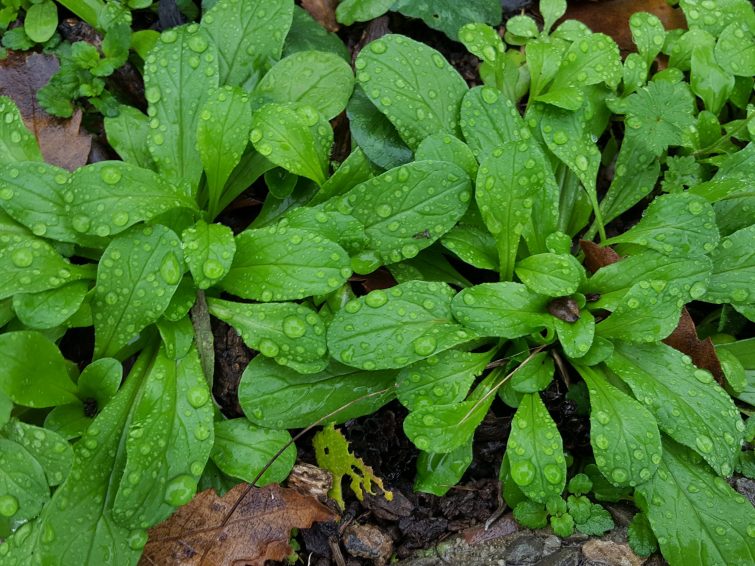
Leanr how to find and identify the tasty salad plant, Winter purslane (Claytonia sibirica) Portulacaceae family
Foraging for winter purslane was unheard of in Britain only 250 years ago. This plant arrived with a number of other really useful plants from North America, in the toings and froings of empire.
Collectively, these imported edibles make me wonder if there has ever been a better time to be a forager in the UK.
Even as recently as 100 years ago, there would have been far less of this particular tasty wild food than we find today. This then, is a relatively recent and welcome introduction to our naturalised flora as far as I am concerned.
The plant is known to be annual or a short lived perennial. It is not frost hardy which explains its love of the South West Atlantic coastal counties.
Winter purslane is now a very popular garden plant and a regular ingredient in commercial salad bags. Its earthy-tasting, fleshy leaves are a really great eat, and one that readers in the west of Britain should be delighted that they can now find relatively easily.
Putting aside the discussion of exotic species in the landscape and the abilities of our native plants to compete and exist alongside winter purslane, we foragers can only ever deal with the reality of the situation on the ground, so I accept what’s what when I cant change things, and embrace any and all wild edible and medicinal plants I find.
What’s in a name?
The generic name Claytonia was given to these plants in honour of the new world colonialist, botanist and plant collector- John Clayton (1695 – 1773).
The species epithet sibirica refers to the Asian north wrst where it is likely winter purslane was first recored by Western botanists.
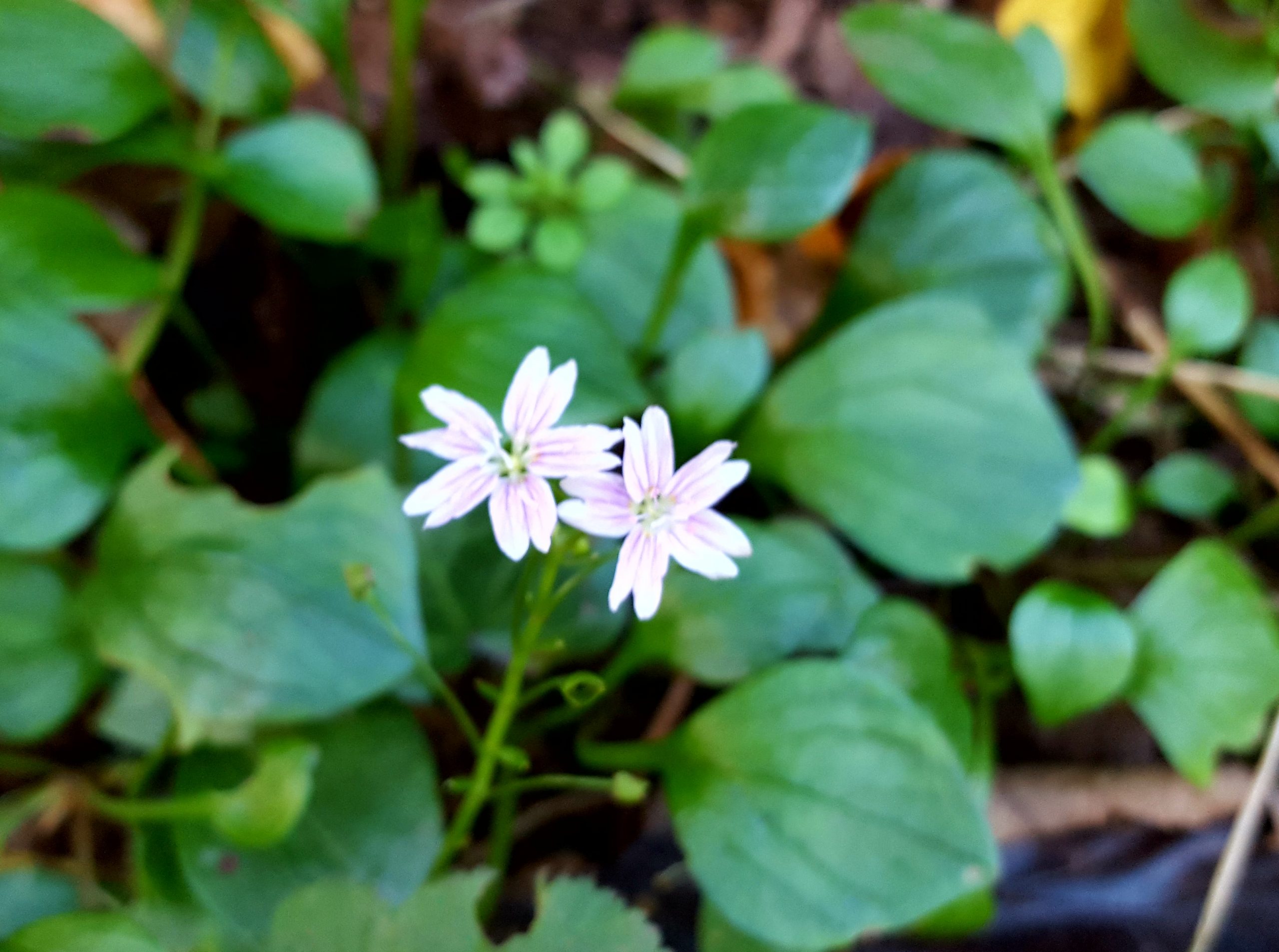
This plant is also known as ‘pink purslane’, or ‘miner’s lettuce’, and is sometimes mistakenly called the ‘spring beauty’. That particular name is more correctly given to its closely related cousin, which is also known as ‘Blinks’ or the ‘perfoliate purslane’. (Claytonia perfoliata).
Winter purslane was reportedly first cultivated here in the 1760’s. The first record of it in the wild here was in 1838. It’s spread has been rapid since then, and it is now naturalised in many settings throughout the island.
Botanical description
Don’t forget that I have made a big fat glossary of terms to help you if you get stuck with the technical terminology
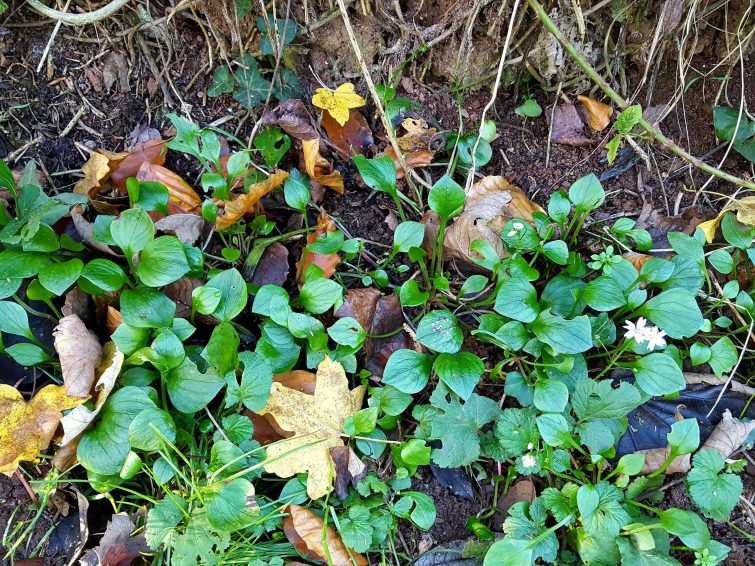
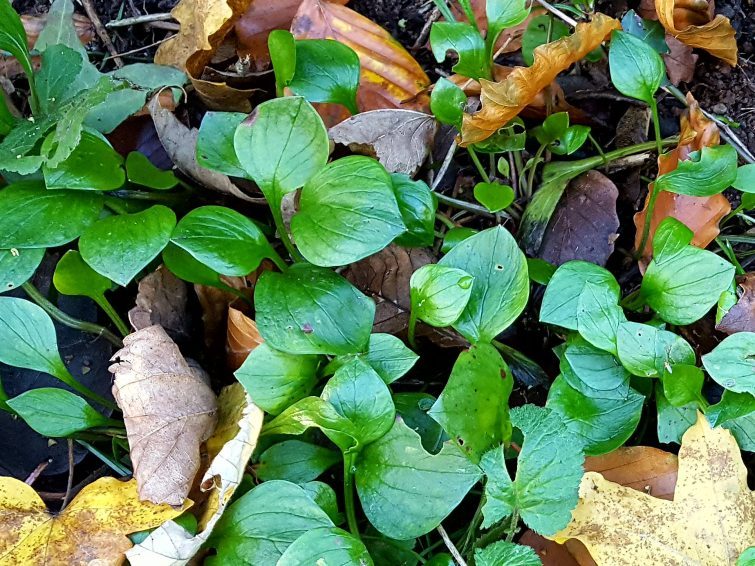
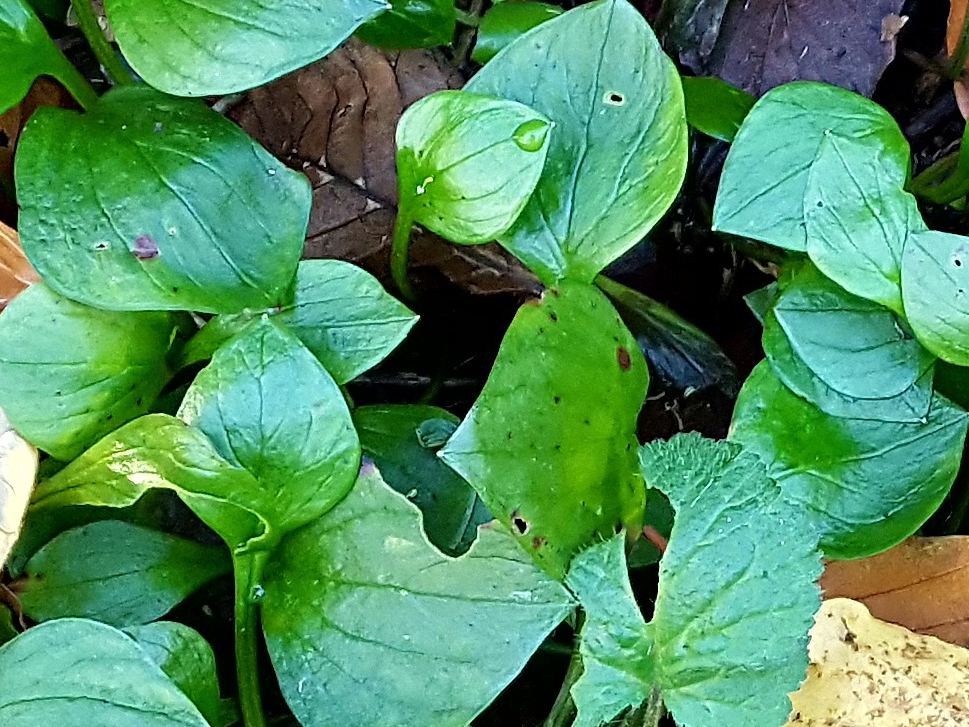
Leaves: Winter purslane leaves are quite an unusual shape. They look like a wide spatular, and botanists know these leaves as ovate-rhombic.
The apex of the leaf is acuminate, with a tiny white hydathode at the tip, that will darken with age. Shiny dark green above but paler underneath. and at the base. Fleshy, hairless.
Petiole: This is more or less flattened and solid. Sometimes weakly sheathing at the base. Approximately 8 cm long.
Roots: Winter purslane has a slender roots and can also produce small rhizomes and stolons.
Stems: These can be erect or spreading, and are usually thin and brittle. The stem leaves are sessile, but are never perfoliate.
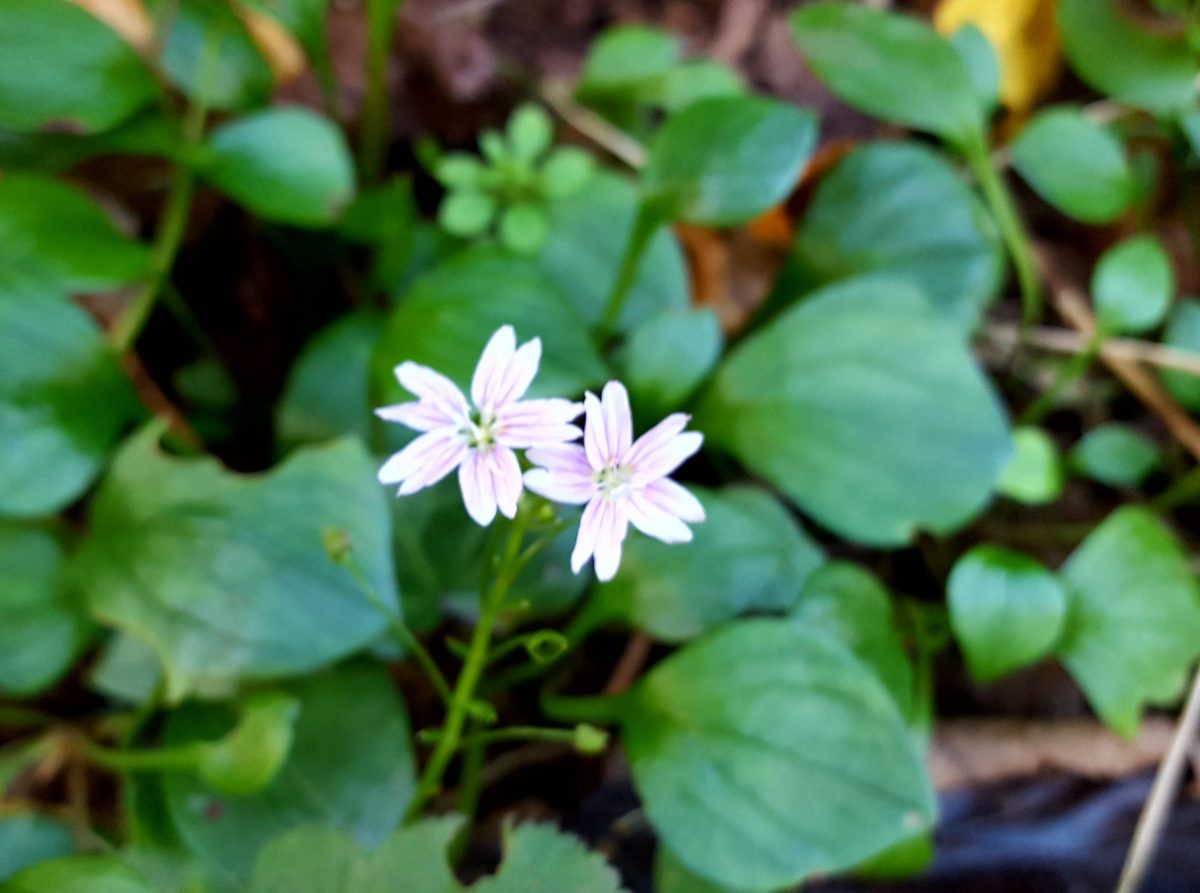
Flowers: The flowers are borne on elongated cymes and each flower is found on long drooping flower stalks. Its pink-white flowers have five petals (12 mm) with noticable notches at the apex. The petals typically show fine striations.
Flowering season: Late March through into early May.
Fruits: Egg-shaped seed with an elaiosome attached. The elaiosome is a protein and lipid-rich structure attached to some seeds, which attracts ants to help disperse them!
Habitats: This plant is still extending its range here in Britain, which helps to demonstate how long it takes for ecologies to fully adapt to an exotic alien plant. It will only be after its geographical spread plateaus that we can analyse its impact on the rest of the ecosystem.
It finds a home wherever it finds suitable dampness. It will spread wirh speed in areas where it also has warmth.
Harvesting: The best time to go foraging for winter purslane leaves is before the plant comes into flower. This could be early, mid, or late spring, dependent on your location. You can learn more about harvesting our wild plants here.
Parts used: Leaves, young flowering tops, flowers.
Other notes: One of a few plants to have the common name of ‘purslane’. Winter purslane is not rated to the tadty estuary plant sea purslane. It must purely be a reference to the succulence on the leaf.
Morw articles to help ypur plant idemtification coming soon .
If you have liked this article and nowcwant to know more about getting started foraging then my articles for beginners will be morw than useful. If you want practical help identifying plants then please read this article on how to identify plants in a day!
Learn how to find, identify and use the mysteriously magical vervain!
Verbena officinalis (Vervain) Verbenaceae
I often wonder long and hard about certain herbs and their fall from prominance and former reverance. The previously well-known and well-used herb, vervain, epitomizes this particular pondering.
Vervain was formerly one of the most sacred herbs in these islands, as well as across many different cultures througout the ancient world. Our relationship stretches back more than 4,000 years.
During the medieval period, vervain was known as the magicians herb. Its main magical properties and uses, were and are, for protection and exorcism.
It is one of the sacred herbs of numerous pre and post-Christian cultures that sprung up around the Mediterranraen sea and beyond.
Vervain has always been associated with mysterious, magical practices. High priests and priestesses from the ancient Egyptians, Phoenicians, Cretens and Greeks, Celts, Druids, and Vikings are all known to have used Vervain in rites, and to adorn themselves and their alters with this herb.
The Egyptians believed vervain to be from the tears of the Goddess Isis, as she mourned the death of her husband Osiris.
What did they know that we don’t!? Following on from them, the Romans developed similar practices. They created a specific noun for sacred ceremonial twigs or branches used to adorn wreaths or alters during rituals; calling them ‘Verbena’.
The species names ‘officinalis‘ tells us that this herb was also an official apothecary herb.
During the medieval period the French were calling the plant ‘Verveine’ and it’s from here we can see how the middle English word ‘Vervain’ was derived.
Botanical Description
Vervain is a distinctive looking plant, but its slender form and habit can make it oh so elusive to find!
Leaves: This plant doesn’t produce much foliage. Its opposite leaves are simple and lobed, typically 3-lobed. They grow to approximately 12 cm long. The upper surface is coarse with tiny hairs. The leaf is net-veined, and the margins are dentate toothed.
Petioles: The leaf blade tapers towards the base. Petiole from 12 – 25 mm long.
Roots: Vervain has a perennial rootstock. It is a yellow-white colour, thin and fibrous. The plant is not particularly deep rooting.
Stems: Typically these are sturdy and stiff, and rough to touch. Vervain produces many branched, four-angled, solid stems. They can reach anywhere from around 70 – 120 cm high.
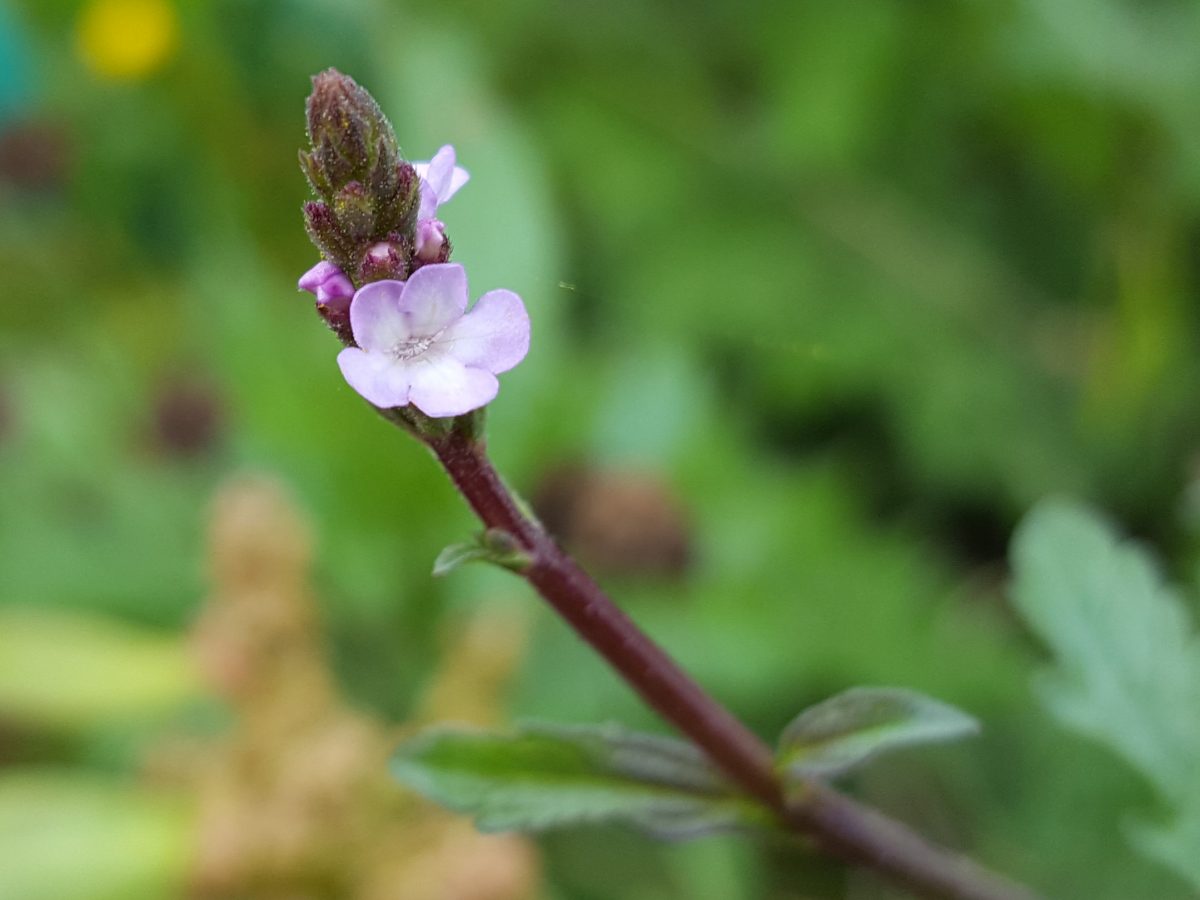
Flowers: Borne on leafless spikes, from a distance these small, 3-4 mm, lilac-mauve flowers can look like tiny jewels suspended and sparkling in the air.
The corolla consists of five petal lobes and a long tapering corolla tube that sits in a purple-tinged, green calyx.
The two-lipped flowers contain four stamens and a pistil fused of four carpels.
Flowering Season: Depending on where you are in the country, vervain will be found in bloom from just after summer solstice through into early October.
Fruits: If pollinated, vervain produces up to four little nutlets.
Harvesting: You can harvest the whole plant above ground just as it comes into flower in late June and early July.
Parts used: All above ground parts are used. Although bitter, the plant is edible. An article on the poisonous plants of Britain can be found here.
Medicinal Constituents: Iridoid glycosides, caffeic acid glycoside verbascoside, flavonoids including luteolin,triterpenoids, tannins. This overview of our medicinal plant constituents and actions will help your plant chemistry understanding.
Uses: Traditionally used as a herb to help wounds, digestive issues, depression, insomnia, jaundice and dysmenorrhea.
Legend has it that vervain was used on Jesus to cleanse and heal wounds from the crucifixition.
Habitats: Vervain is quite fussy and particular about soils. It prefers free-draining calcareous ground, in open settings or on bare ground. This map shows you if you are likely to have it in your area.
Other notes: Modern science has yet to discover evidence to support traditional uses. We know that many traditional herbal medicines simply haven’t had the research carried out, or experiments undertook and studies produced. Therefore we will definitely see a lack of evidence.
In my opinion, the ‘lack of evidence’ argument should not ride roughshod over thousands of years of anecdotal and historical evidence. One of the key factors with herbal medicines is that, properly prescribed they address the causes of the dis-ease within an individual, and not attempting to treat symptoms.
Medicinal herbs can work more effectively in certain individuals and less effectively in others, just like allopathic medicines. If one herb doesn’t work that effectively for a given condition, simply try another herbal remedy.
Vervain is listed in both the British Herbal Pharmacopeia and the Pharmacopeia of The People’s Republic of China.
An extract of vervain has been found to help prevent certain processes involved in the development of Alzheimer’s disease. For someone almost 50, I am now casting an eye over all I can to do with the prevention of, and remedies to alleviate, Alzheimers.
Previously, this plant belonged to the Verbenaceae family along with what used to be another 200 or so genera. With the advent of DNA technologies, a number of plants have been shuffled between different families. Hence today many plants previously in the Verbenaceae family are now placed in the Lamiaceae (mint) family. Nowadays the family has 35 genera and around 1,200 plants.
Keep your eyes peeled for exciting new website development in the next three months, as I continue to create Britain’s most comprehensive wild plant identification resource for foragers.
Learn how to confidently identify fools parsley so you can always avoid it!
Fools parsley is a plant worth knowing. Many foragers shy away from the similar-looking plants in the carrot family, but how are you going to get to know the safe and tasty ones if you don’t get to know the poisonous plants?
Fools parsley is an annual plant reportedly first recorded on these islands in the 1560’s. It is likely the plant came over as seed in shingle ballast on ships.
This is typically a herb of cultivation. So, many gardeners are likely to have it popping up around the place.
What’s in a name?
The generic part of the scientific name is taken from Greek mythology – Aethusa was the daughter of Poseidon, and its said she escaped from her underwater home Arcadia, and sprung forth as a fresh water fountain on the island of Sicily.
Online research provides numerous references to the Latin name being taken from an Arab word ‘ai’ that means burning. This alludes to the sensation you will get if you mistakenly eat the plant raw
The specific part of the name – cynapium, comes from the Greek word ‘cyno’ – meaning dog. Plants that have he word ‘apium’ (from the Greek ‘Apis’ for Bee) in the name, are referring to our busy buzzy friends (which all this family of plants attract in numbers).
Our common name comes from historical and anecdotal reports of a stupor that the herb can produce if consumed in a large enough dose.
Botanical description
Some technical terms may be unfamiliar to you so please refer to our foragers glossary.
Leaves: The compound pinnate leaves are triangular in outline shape. They are hairless, and typically a dark blue-green to glaucous-colour. The leaves are either 2 to 3 times pinnate, even when on the stem.
The lanceolate-shaped leaflet lobes are quite small and narrow (0.5 – 1.5 cm) and the terminal lobe is much larger than the rest. The leaves are aromatic, when crushed, but not pleasantly so. They are distinctly fetid smelling.
Petiole: This is solid, slightly ridged, with a rectangular-shaped channel running down it.
Roots: Like many of its relatives, thus plant has a creamy white coloured tap root.
Stems: These can grow up to 100 cm high. They are hairless, glaucous, mostly solid and with fine lines running down it.
Flowers: Compound umbels. No bracts. Each individual umbel has approximately 14 to 20 rays. Long beareded bracteoles are present.
Tiny (2 mm) individual white flowers in the umbels. Can be tinged pink when young. 5 unequal sized petals, 5 stamens Fused pistil with a two lobed stigma.
Flowering season: You can find this plant in flower anytime from April through into October.
Fruits: All carrot family plants produce two-part dried fruits that we commonly call seeds. Technically called schizocarps, this type of fruit dries and matures on the flower head, before eventually splitting into two.
Harvesting: Homeopathic practitioners may consider harvesting this plant. It is reportedly not safe to use as a herbal medicine or as a food.
Habitats: An opportunist annual that finds a suitable home in the disturbed soils of gardens and on wastegrounds. It is a lowland plant and is absent from high ground in England, Wales and Scotland.
This plant could, at a glance, be confused with edible members of this family such as cow parsley, sweet cicely or wild carrot. However, the visual and written clues presented here should make that impossible to occur.
If you want to fast track your foraging skills, then why not take the time to read my beginners guide!?
Learn how to identify, and successfully go foraging for corn salad (Valerianella locusta) *Valerianaceae family
For years I got increasingly frustrated at being hopeless at foraging for corn salad.
It’s all too easy to walk past edible plants. Especially low-growing, small annual plants. After all, one of the mechanisms that a static organism can employ in order to stay alive, is to mimic other organisms in the hope of being overlooked.
Corn salad is small enough, and looks enough like a few other small herbs to have stopped me finding and grazing on it for many a year!
I finally got to know the plant in 2004 when growing it as a winter salad crop at the large East London squat I lived in at the time. It’s sweet with a somewhat nutty flavour, which together with its soft texture, makes it a winning salad plant.
Only a few wild plants are deemed worthy of serious commercial cultivation. Corn salad, also known as lambs lettuce, is for some reason, not just one of these, but is often one of the more expensive salads, weight for weight, that you can buy!
Dont let this little plant pass you by! Learn here, and in my beginners guide, how to confidently and quickly identify and successfully go foraging for corn salad.
The generic part of the scientific name – Valerianella suggests it was simply named as the ‘little Valerian’. This well known and closely related medicinal plant got its name from the latin verb ‘valere‘, which means ‘to be healthy’.
The specific name locusta is Latin for grasshopper. Maybe these insects enjoy foraging for corn salad?
The common name corn salad, today seems like a misnomer because it won’t really be found in corn fields! I dare say many hundreds of years ago it may well have been found there with a number of other weeds amongst the grain.
The name lambs lettuce implies to me how soft and tasty the plant is!
Botanical description
While I endeavour to keep the technical language to a minimum, some terminology is unavoidable. Have no fear though, for a full glossary is available for those readers unused to botany chit chat.
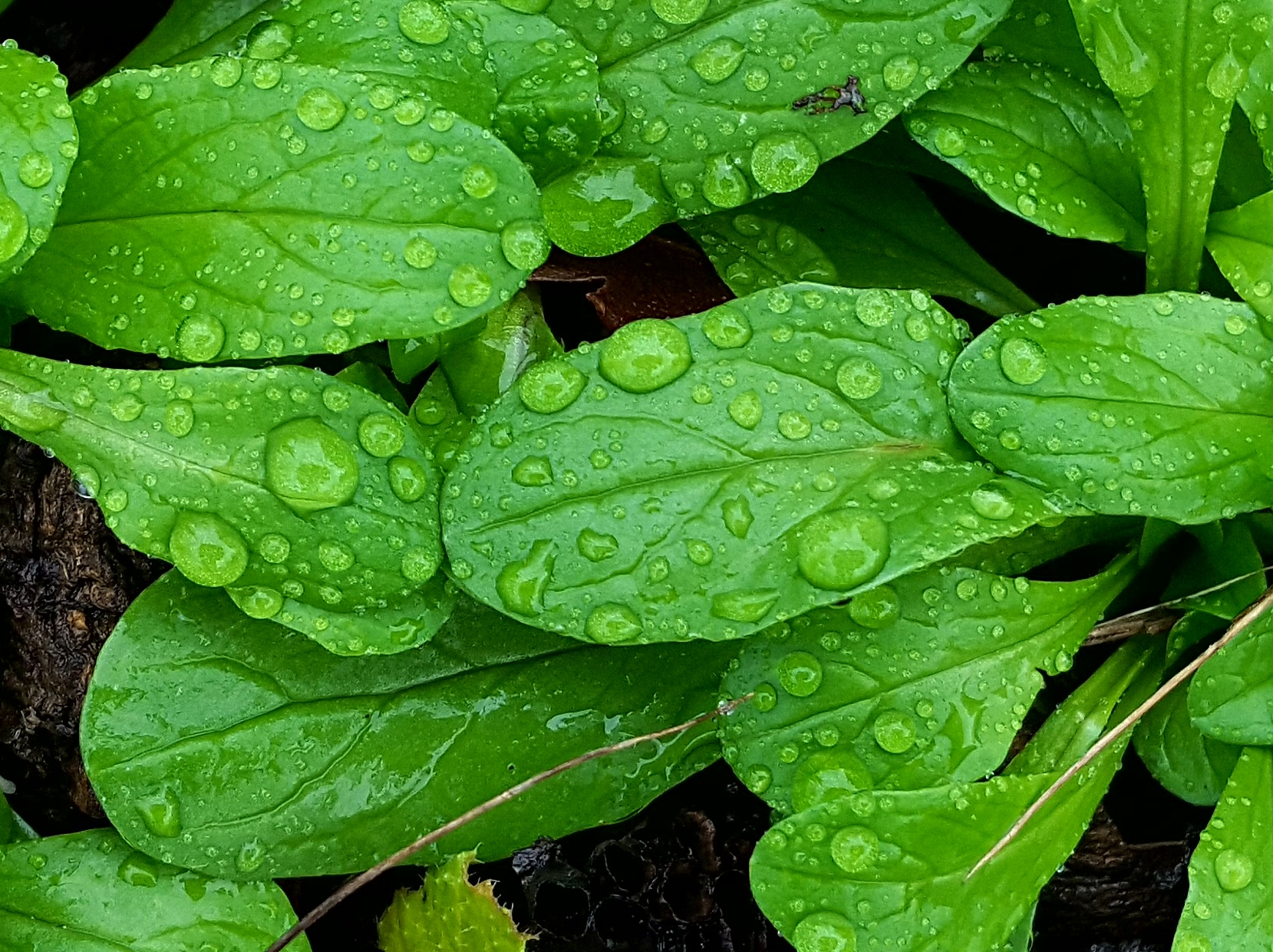
Leaves: Bright green, small, simple and opposite; Basal leaves often in rosettes. Anywhere from 3 – 10 cm long, and 0.5 – 1.2 cm wide. Spathulate to linear-lanceolate-shaped.
The margins are entire or occasionally with teeth. The leaves are mostly hairless, though some rough hairs are found on the surface and on the margins towards the base. Tiny white hydathodes are present at the leaf tips. (Use a hand lens if you want to see these).
Its worth bearing in mind that our top botanists say that one of the characteristics of corn salad and other Valerianella species is the lack of uniformity in their vegetative traits.
The leaves emerge slightly rolled at first, typically going somewhat limp pretty soon after unfurling. When crushed the leaves are a little aromatic.
Petiole: Pretty indistinct, because the base of the leaf is usually tapered cuneate.
Roots: The fibrous roots are creamy-coloured and weakly aromatic.
Stems: These grow to around 30 to 40 cm high on a good specimen. There are anywhere from 3-15 stems per plant. The plants are dichotomously-branched, hollow and ridged, with some hairs on the ridges.
No leaves are produced in the stem axils, but leaf-like bracts will be found subtending the small flowers. The inflorescence is a branched cyme type.
Flowers: White to light mauve or light blue. Small with five fused petals, forming a corolla tube that is held within the calyx. Three stamens are found around a three-lobed stigma in the centre of the flower.
Flowering season: Corn salad is an annual species. It flowers quite early in the year, especially with our milder winters here in Britain. You will find them blooming in the South West towards the end of March and through April.
Habitats: Scree, waste grounds and disturbed soils, dunes, gardens and allotments. Valerianella locusta will not be found at altitudes much greater than 350 m.
Parts used: Leaves.
Harvesting: The best leaves are gathered in the autumn and winter, from basal rosettes, or anytime before flowering. A basket full of my harvesting tips can be found here.
Other notes: From my experience, I have always found it more in towns and cities than anywhere else.
*This plant has now been reclassified as part of the Caprifoliaceae family (elderflower and honeysuckles).
Subscribe today for email alerts on my next plant species article coming up, on the most comprehensive foragers plant identification in the UK!
Bring some springtime zing into your life and go foraging for Larch leaves (Larix decidua,L.Kaempferi, and L. x marschlinsii) Pinaceae family
For me, one the best treats of spring are the zesty pine-lemon flavours we can get from foraging for Larch leaves and other conifer trees.
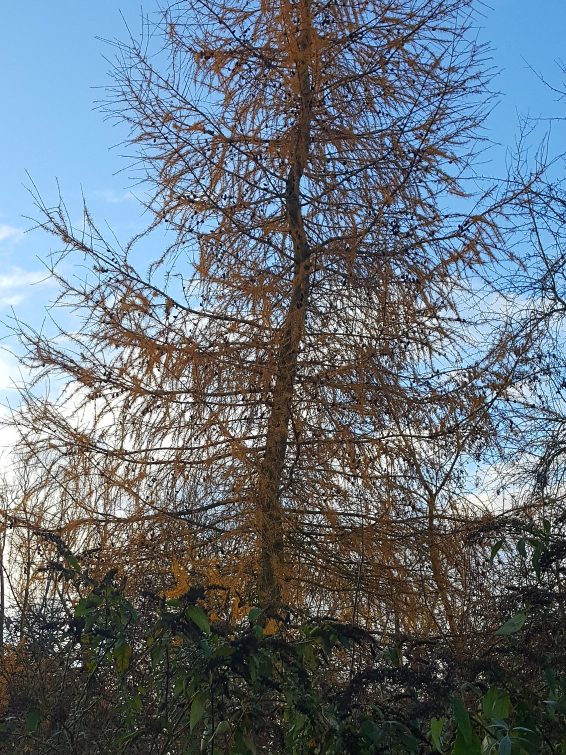
I couldn’t really care less that they are not native trees, because larches harmonize superbly with our mix of deciduous and evergreen species in the landscape, creating spectacular golden autumn displays.
The European larch was reportedly first brought to Britain in the early 1600’s. The Japanese larch was subsequently brought here in the early 1800’s as a superior timber tree, due to increasing incidences of canker (a type of fungal infection) affecting the European larch.
The Japanese larch doesn’t suffer from canker as badly, and will therefore yield a better timber crop.
You can now find three larches in the UK. The third larch to naturalise in these islands was as a result of a cross between the European and Japanese larches.
The larches produce a superb spring and autumn show, and offer us foragers tasty reward from their fresh new foliage.
Both its purple and green cones, and its golden-yellow autumn leaf display can stop you in your tracks when you chance on one or more of these plants.
What’s in a name?
The English name larch can be traced back to the old Greek word ‘láros’, meaning pleasant. This word is almost certainly from where the Latin name Larix originates from.
The old German word ‘Larche’, and the old French name ‘Larice’ show more of the lingual roots.
Our common name is also similar to the Danish name ‘Lærke’ and the Dutch word ‘Lorken’, both derived from the old Latin name ‘Larix’ (also Laricis).
My etymology research suggests this word may have been co opted from an Alpine-Gaulish language.
The species name decidua refers quite obviously to its deciduous nature, which is quite unusual for the conifer-bearing ‘evergreen’ trees.
The species epithet kaempferi is in honour of the 17th century botanist Englebert Karmpfer. The hybrid was named after the late 18th century botanist, Carl Ulisses von Salis-Marschlins.
Botanical description
Leaves: Larches are notable for producing many needles from each shoot. Anywhere from 12 to 30 are found on the European larch (L.decidua)
Whereas a range of 15 to 40 needles can be seen on the Japanese larch (L.kaempferi), and between 40 to 50 needle leaves on the hybrid (L.marschlinsii) will be visible.
The leaves of the European larch are a vibrant bright green colour. They are typically around 5 – 7 cm long and 1 mm wide. Leaf midribs are raised below.
Petioles: The leaves of all three species are sessile, so petioles are not present, but you will see a short shoot or leaf ‘cushion’ from where the needle leaves arise. The shoots can be between 3 – 7 mm long.
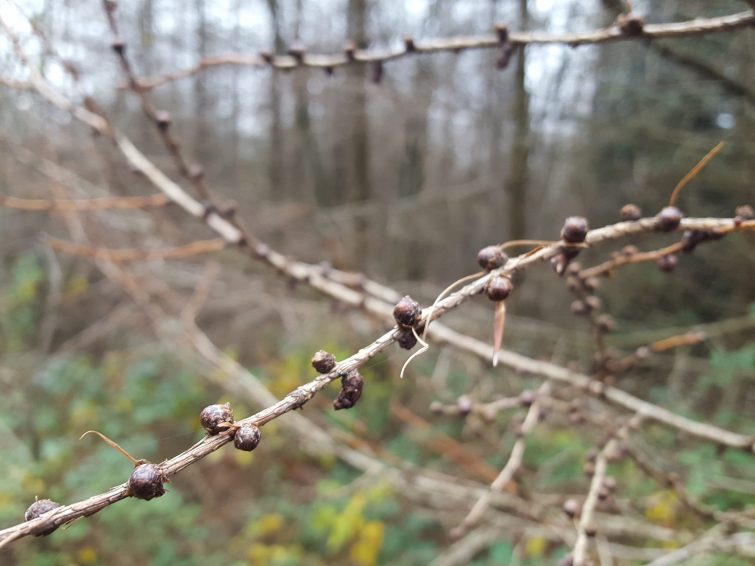
Buds: The ovoid-shaped, light-brown buds are approximately 4 mm long, 3 mm across and with numerous scales.
Twigs: The twigs and old cones easily gather algae, moss, and lichen on the living and dead twigs, so the actual tissue colour can be difficult to see.
The European larch has hay-coloured, hairless twigs, while the Japanese type has initially pruinose stems, that develop a reddish brown tinge. They are sometimes sparsely hairy to hairless.
The hybrid larch has twigs somewhat pinkish-brown, and usually hairless.
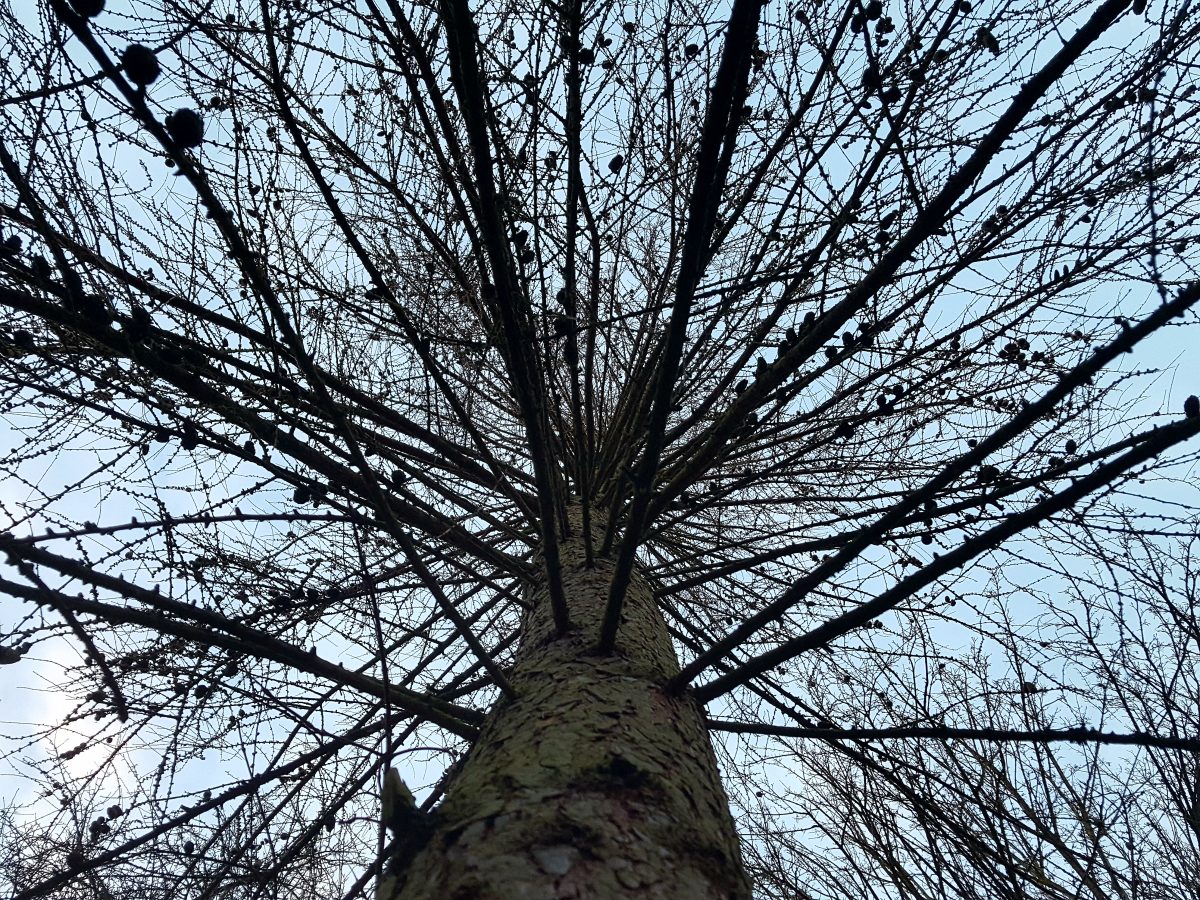
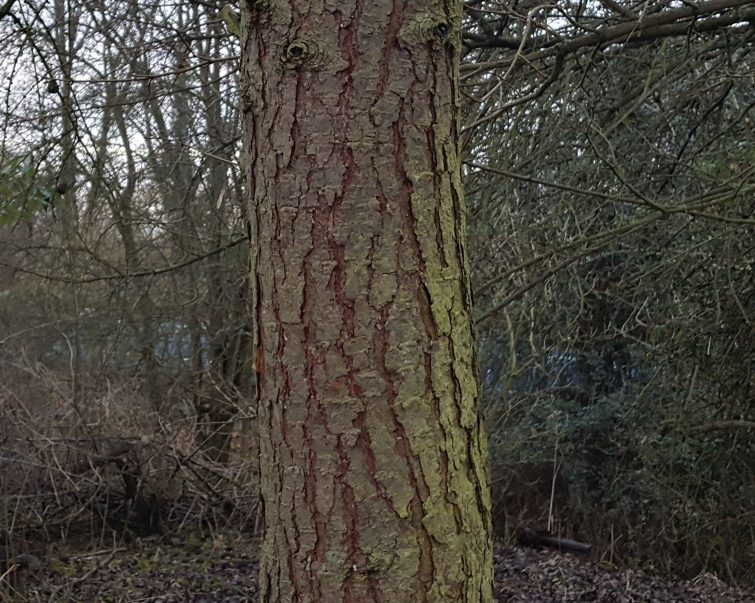
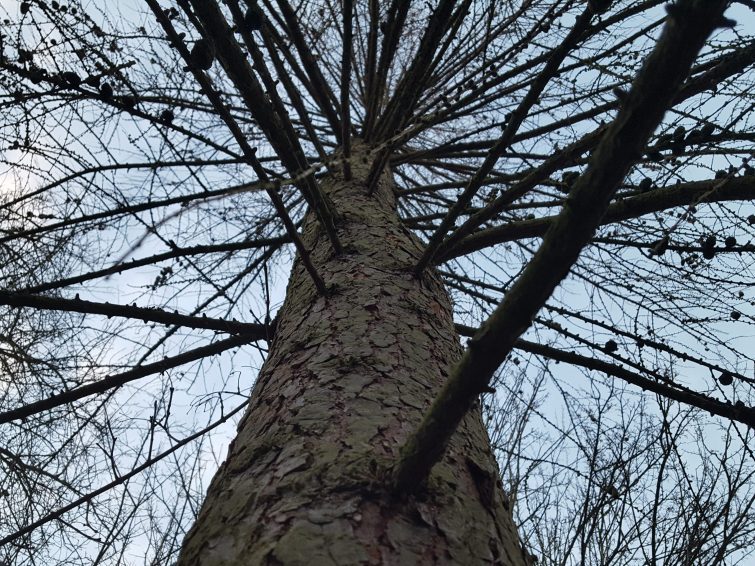
Bark: The bark takes on a pink to russet brown appearance from an early age, developing the narrow fissures as it matures. The bark can bulk up to a thickness of 10 cm on large specimens.
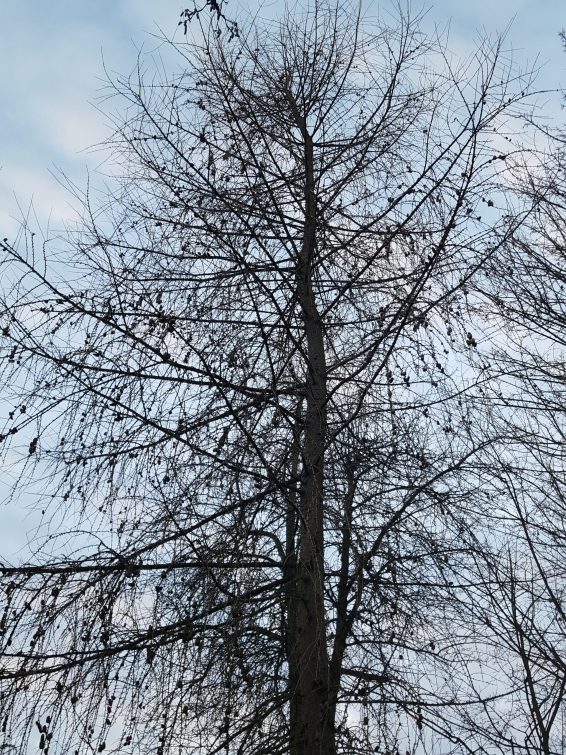
Habitats: The vast majority of larch trees in the UK are in plantations. You will also come across plants borne from parent’s plantations, or as amenity specimens in parks and gardens.
All three are naturalised in the wild across much of Britain, at a range of sites on various soils. All these sites will meet its requirements of being not to dry or too wet.
Flowering season: Depending on your location you can go see rhe flowers during April into May.
Flower colour: The European larch produces absolutely stunning purple-coloured female flowers. They are often sited close to the smaller, yellow, pollen-loaded male flowers.
Japanese larch produces creamy yellow flowers. The hybrid is the most boring-looking for me, with its yellow-green colour. These flowers are larger than the other two with broader cone scales.
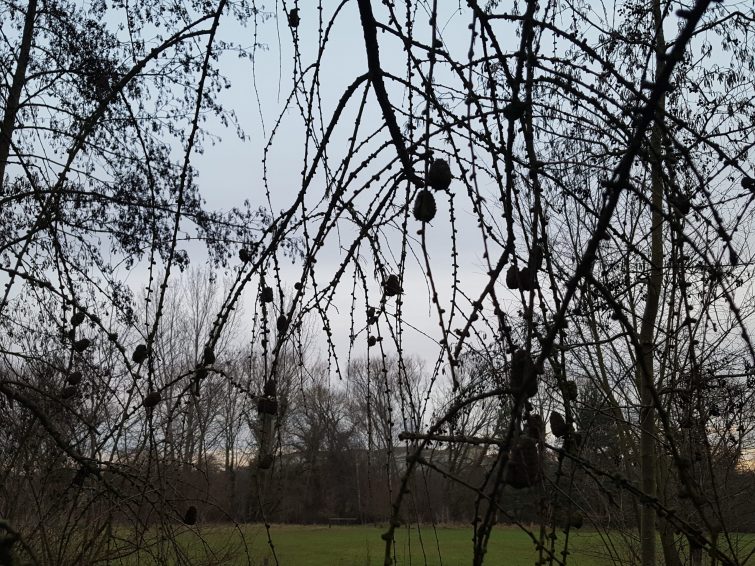
The flowers eventually harden and turn grey-brown. When pollinated they produce tiny seeds inside their 6 – 7 cm long cones.
Fruits: Being gymnosperms, these plants produce ‘naked seeds’ without a fleshy or dry membrane to protect it from the outside world. The conifer plants are older in evolutionary terms than the rest of the flowering plants (angiosperms) found on Earth.
The larch produce copious amounts of seed which are a valuable source of food for birds.
Harvesting time: These are getting increasingly difficult to call due to global heating. In southern England you can generally go out foraging for larch leaves and their fresh, zingy flavour anytime from early May.
Other Notes. Chefs love playing with the aromatic needles. The young shoots and needles can be boiled and eaten. You can use the lemon-pine flavours in sauces, sorbet, ice cream, syrups, cordials, cakes and more! The leaves also make a very refreshing and vitamin C-loaded tea.
Like a number of trees, the inner cambium layer of bark can be collected and ground into a flour amendment.
If you look carefully in the summer and early autumn you may find edible fungi. There are a few edible mushrooms commonly called by the name ‘larch bolete’ you can find when out foraging.
Possibly the most common species is Suillus grevillei. This reddish brown-coloured fungus can be found growing in close quarters to the various species of larch.
Sadly, due to another type of fungus (Phytophthora ramorum) a.k.a ‘ramorum disease’, ‘larch tree disease’, and ‘larch sudden death’, the value of larch as a timber crop has crashed. This water mould is a notifiable disease. Essentially the plant is now worthless as a forestry crop in some areas.
More photos of the plants in spring and summer will appear here so remember to check back!
 hat’s in a name?