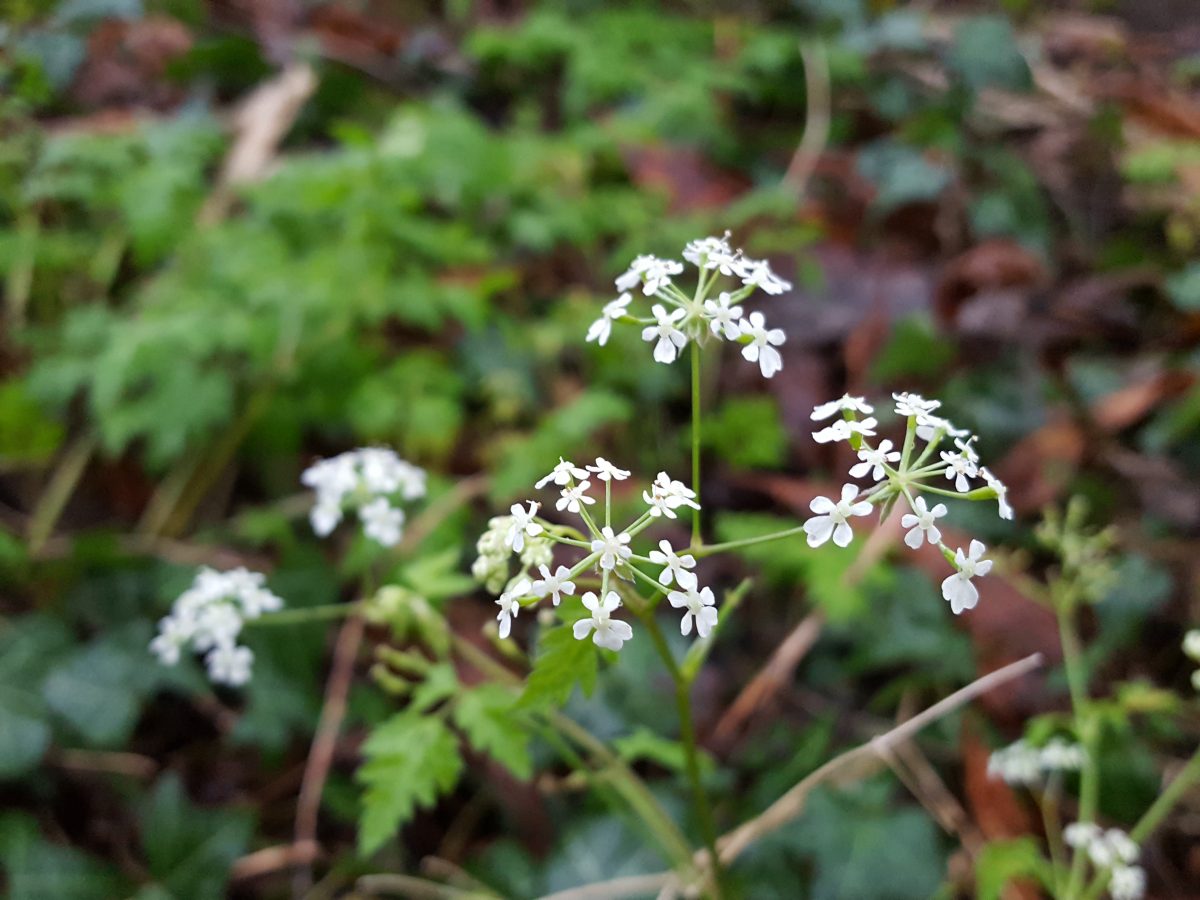
Learn how to confidently find and identify wild chervil (Anthriscus sylvestris) Apiaceae family
Foraging for wild chervil has for many years now been one of my favourite spring foraging missions. In this article (soon to be part of an online course on plant families) you can lean how to positively identify, then confidently and safely go foraging for wild chervil.
This is one of the tastiest wild foods available during early spring as far as I’m concerned! It’s definitely one of the most common plants out there. And, just as excitingly, one of the most dangerous to misidentify! Get this one wrong and you could be eating something for the last time! You need to fully engage your senses when foraging for wild chervil.
As all us foragers know, identifying certain plants can be confusing enough without having numerous lookalike relatives to discombobulate you! It’s like trying to remember which twin’s name is which, in a room full of twins!
But fear not! This website is designed to give you the tools to help identify all of our edible, medicinal, and poisonous plants, and not just the easy and obvious ones. Up for the challenge? Then read on!
Globally, wild chervil is one of approximately 3700 species in the tricky-to-identify carrot family. In the UK, we have approximately 48 or so species that find a home here. I reckon that a good ten or more of them, can at first glance, or from peripheral vision, look like wild chervil. There is no getting away from the fact that these plants are difficult to decipher.
We learn as children that just because something is difficult or potentially dangerous, this does not mean that we should avoid doing it. It means we need to show extra dilligence, bravery and fortitude, and also in this case, care.
Saying all that, and even after reading this guide, if you happen to misidentify something nasty and come a cropper…well my disclaimer reminds you that I am exempt from any responsibility regarding your thoughts and deeds!
What’s in a name?
We know that a great deal of information can be harvested from investigating the etymology of plant names. For plant name nerds, check out this great botanical dictionary of epithets.
I’m a big believer in scientific names being a gateway to an enhanced way of knowing plants. This knowledge is more than handy when identifying plants in the field.
The generic part of the name Anthriscus can be traced back to the Greek word for the plant – Anthriskos (also Anthrikon). Some reports suggest a connection with the Greek noun – ‘ather’, which means ‘awn or beard of ear of grain’.
The Romans knew the plant as Anthryscum, which has developed into the ‘new’ Latinised word ‘Anthriscus‘.
The species epithet sylvestris, as previously mentioned in my article on Malva sylvestris, tells us of plants that love to grow in woodlands.
Our common name wild chervil can be traced back via the old English name ‘cerfelle’, from the old Latin word chaerephyll. This word has its roots in the older Greek word ‘chairephyllon’, which translates as ‘leaves of joy’. This suggests to me that the name chervil was likely to have been given first to the aromatic culinary herb – ‘garden chervil’ (Anthriscus cerefolium).
This plant is also well-known as ‘cow parsley’, and I have often seen confusing references to the name ‘Queen Anne’s lace’ being attributed to it. This latter name is far more commonly associated with the wild carrot (Daucus carota).
Botanical Description
First a warning! You may find some technical words here that you don’t know yet. So, if you need to at any point, simply pop over to my glossary and learn some new things!
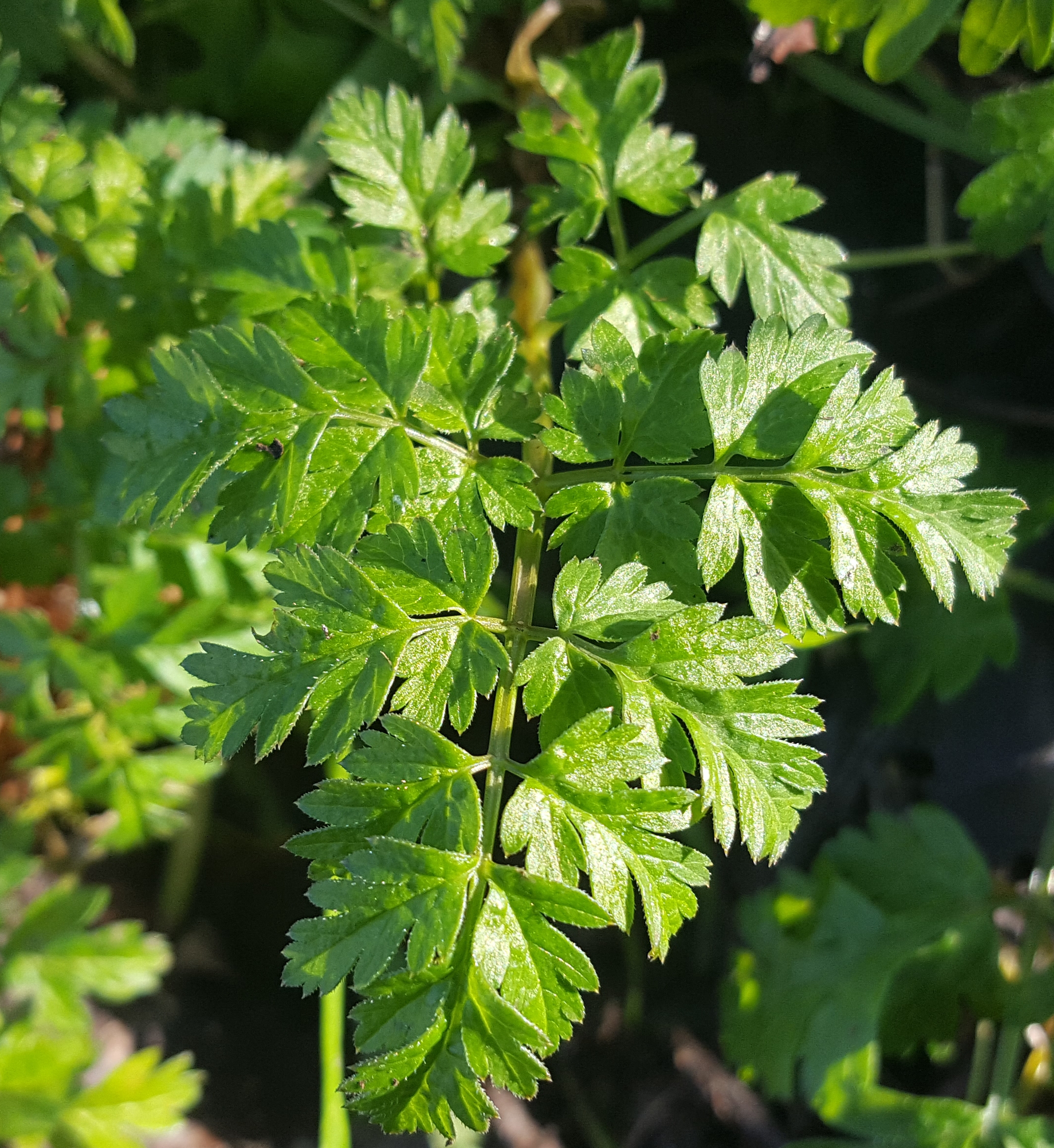
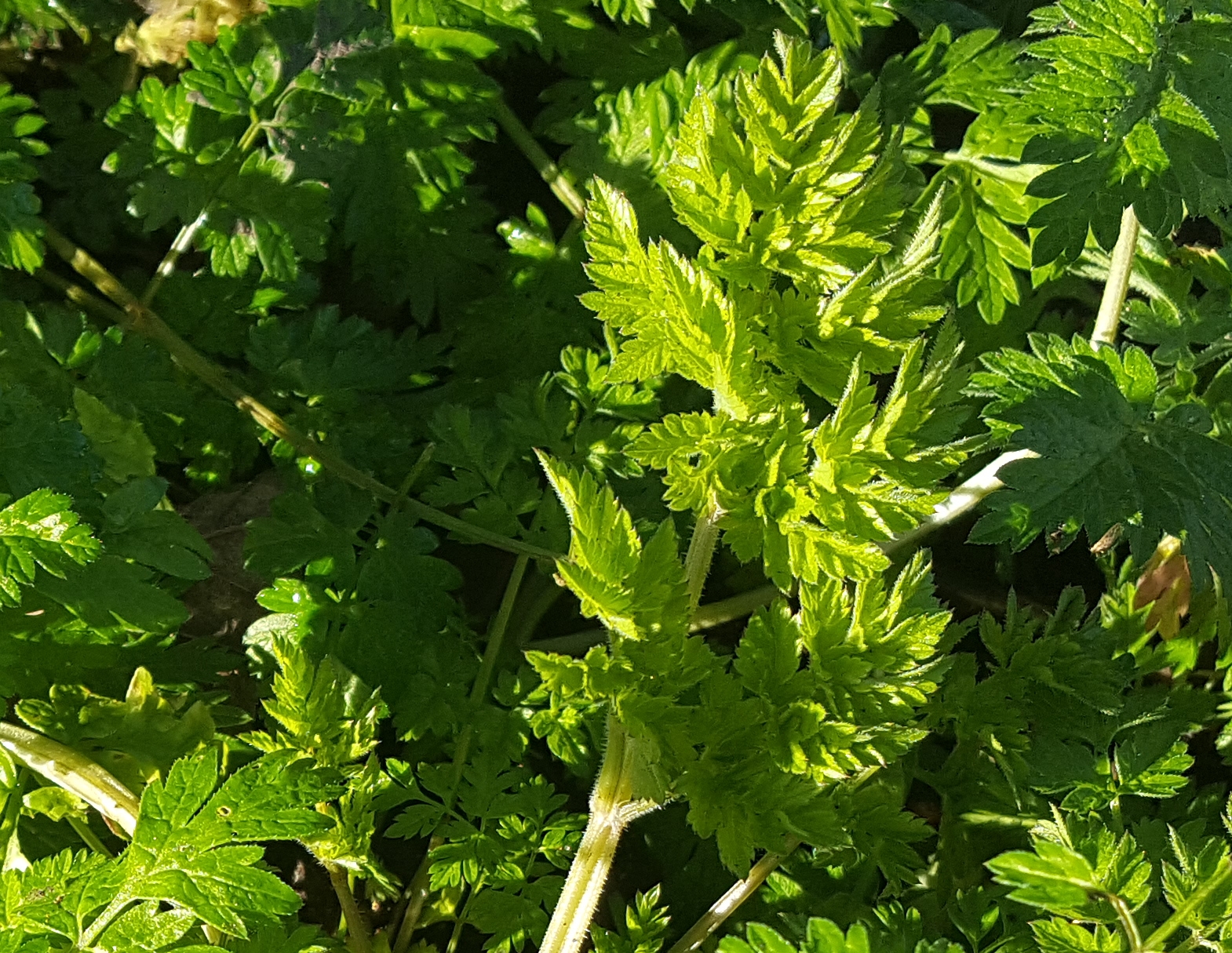
Leaves: The triangular-shaped, compound-pinnate leaves are often described as ‘fern-like’, ‘feathery’ or ‘lacy’. They are 3 x pinnate, meaning they generally have three pinnate leaf divisions. ‘Pinna’ is Latin for feather.
Individual leaflets are pinnately-lobed. The lobes are ovate to lanceolate-shaped and have serrated margins.
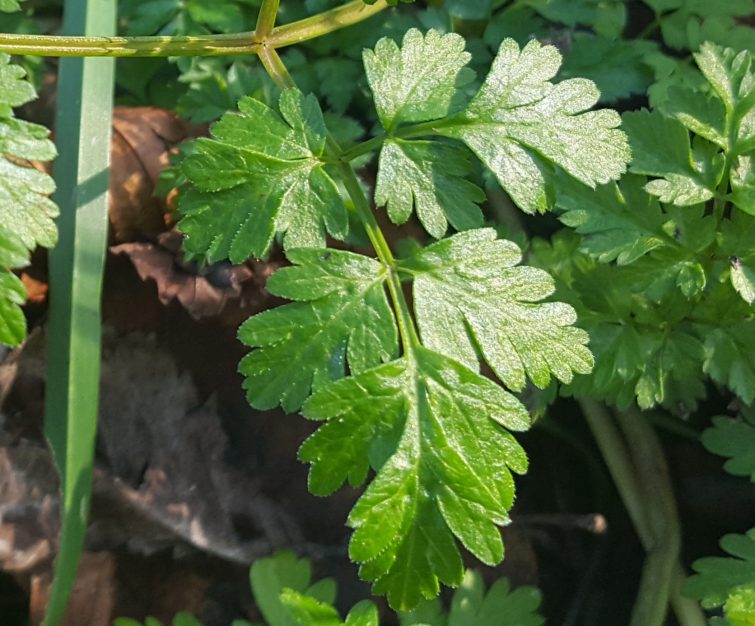
The leaves are a lightish green, and somewhat dull in lustre, compared to say, the blue – green shinyness of one of its family relatives, Aethusa cynapium.
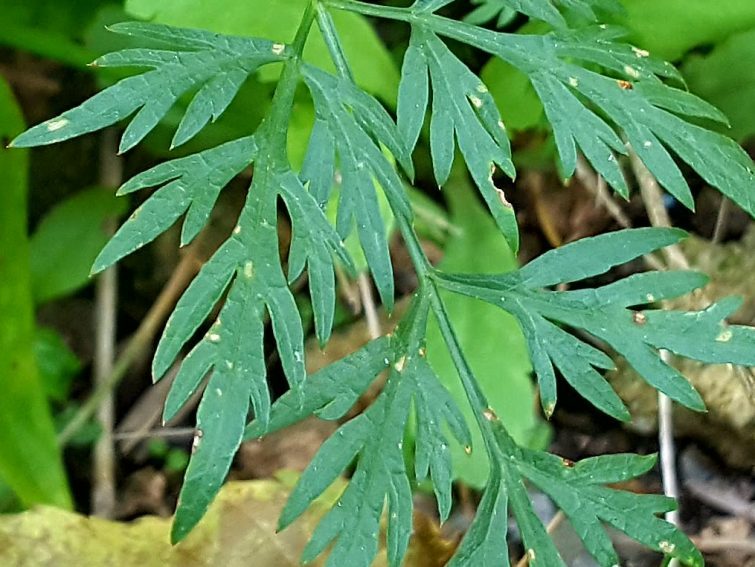
More importantly, wild chervil needs comparing to Conium maculatum, a.k.a the deadly poisonous hemlock!
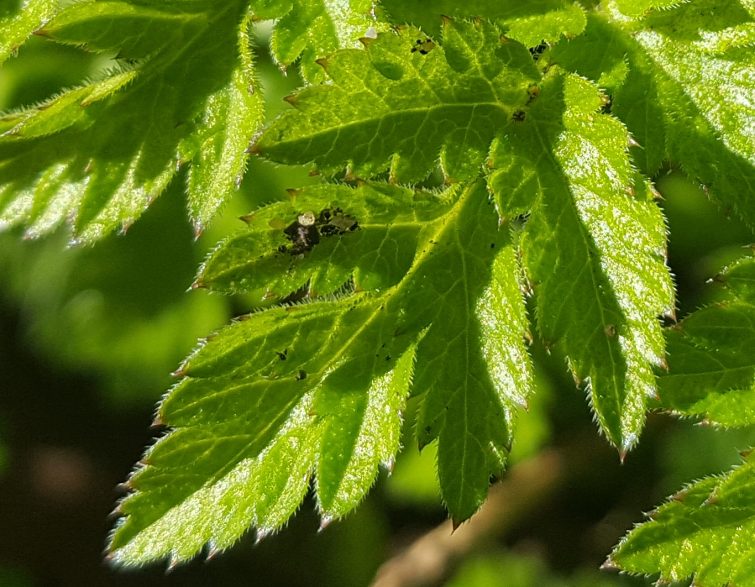
The leaves of wild chervil are hairy, often more so below, as well as occasionally in the leaflet axils. Hairs are also found on the leaf margins. Crush a leaf, and a sweetish, fresh mild parsley scent will be produced. In contrast, hemlock has a foetid stink, does not have hairs, and is typically 3 to 4 times pinnate.
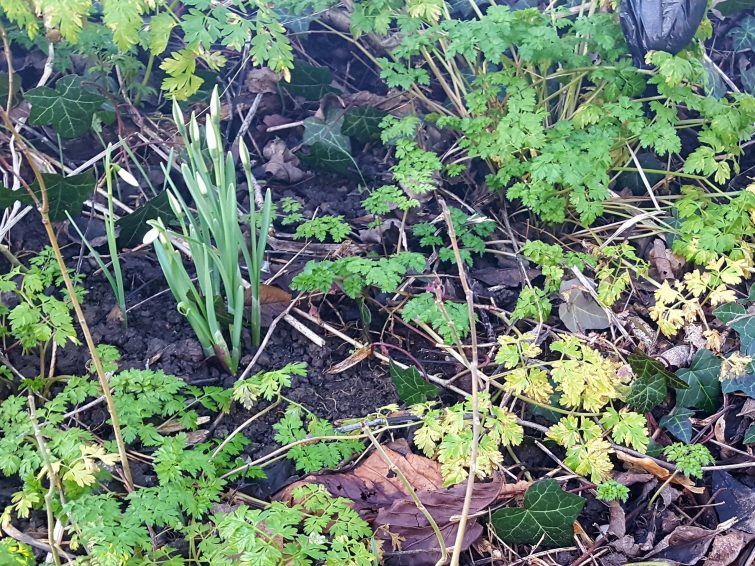
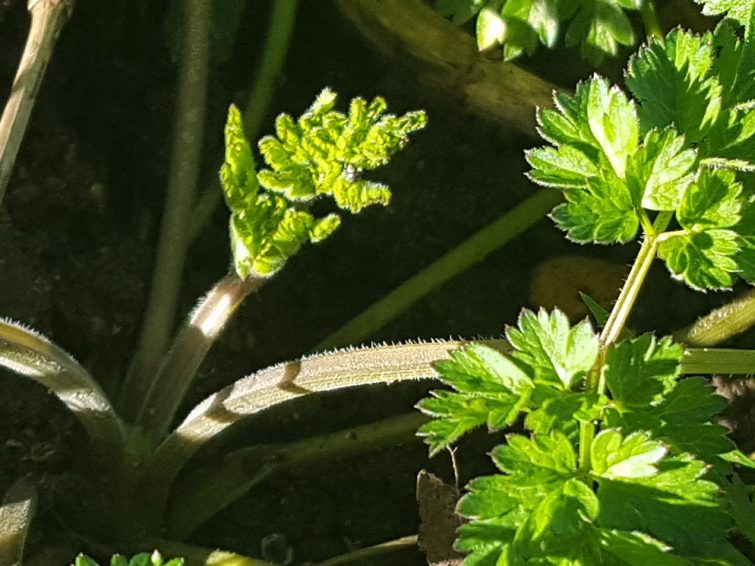
Petioles: These are often key to I/D. Wild chervil usually has quite long petioles. They are always hairy, slightly ridged, and sheathed at the base. You will see it is hollow and exudes a little white latex when it’s young and first cut. Also, notice the distinct channel running down the leaf stalk.
By comparison, hemlock doesn’t have hairs, produces an almost cylindrical-shaped leaf stalk, and is typically found with a lot of red-purple spotting on it. These three petiole characteristics are crucial and go a long way in getting to a positive identification.
If you are as silly as I was once, and accidentally nibble a hemlock leaf from a cocky peripheral vision I/D, you will immediately notice the extreme bitterness, and then the pain from microscopic skin-piercing calcium oxalate crystals. Ouch!
Always cut a petiole in cross-section. With wild chervil they reveal a horseshoe or ‘U’shape. You can’t help but notice the channel running down the length of the stalk.
After a few times foraging for wild chervil, and in a big enough stand of it, you will occasionally see the odd specimen exhibiting pure red to purple coloured leaf-stalks, just to make you double take.
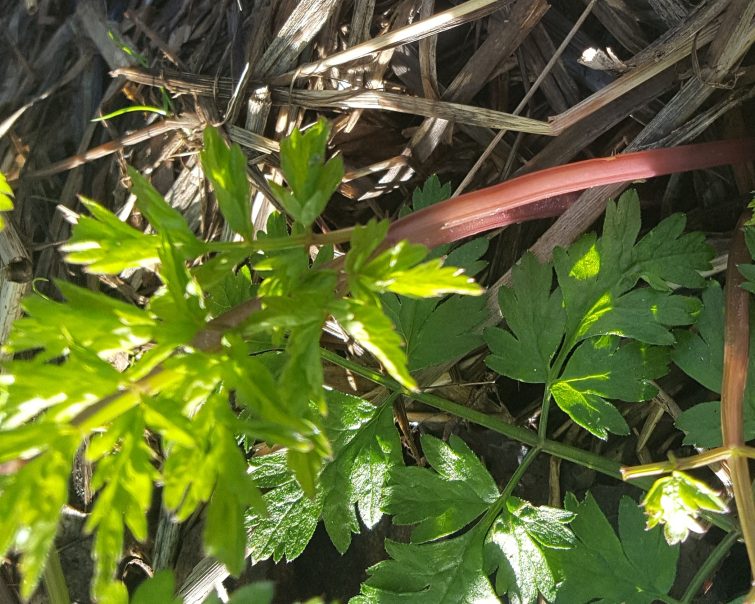
Roots: Wild chervil has a tap root that grows up to 2 metres long. The root shoulder produces numerous leaf shoot ‘buds’.
Stems: The flowering stems are branched, ridged, and hairy and quickly turn hollow. They can reach up to 1 m 50 cm or so high and usually appear a dark purple colour.
When crushed or cut, the stems, like the leaves will produce parsley-carrot aromatics (at least to my nose).
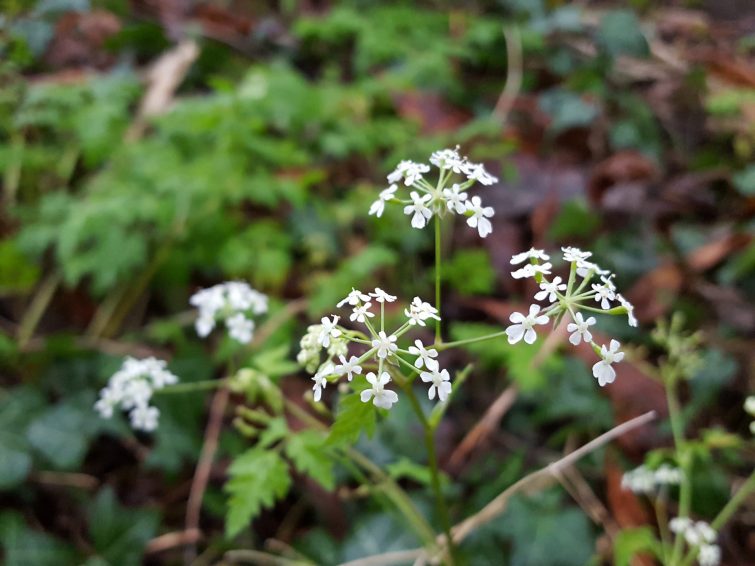
Flowers:
Wild chervil has lacy-looking compound umbels. Each individual umbel will typically produce 10-14 rays, each with a small white flower. The five petals are often notched at the tip and can be flushed with pink as they emerge. They have larger petal lobes on the outer edge of the umbel.
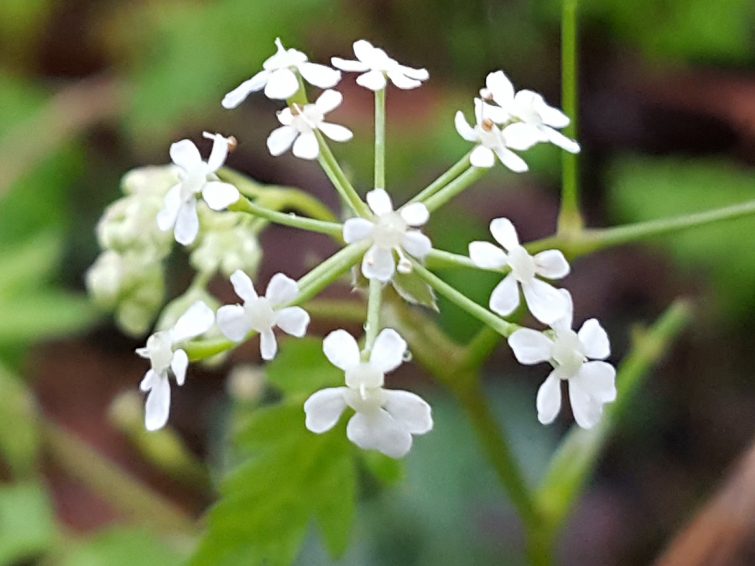
Fruits: Avid readers will already know a schizocarp when they see one. This plant produces 10 mm long, thin, black, ridged fruits. They are a little disappointing for me, simply because they are not aromatic.
Flowering season: Field guides continue to advise the main flowering period as from April to June. However, as with other perennial plants, wild chervil can potentially flower at anytime.
Plants aren’t like us with fixed absolute notions of what to do and when to do it. Whenever it has put on enough growth, and where its particular conditions are favourable, a plant will flower. Global heating is presenting plants here in the UK with more opportunities to flower ‘out of season’.
Often we can see perennials who have their flowering initiation set, but their production interupted, sometimes repeatedly. It is important to remember that it takes a good few weeks from flower initiation happening inside the plant for recognisable features of flowering to be noticable by us, outside of tbe plant.
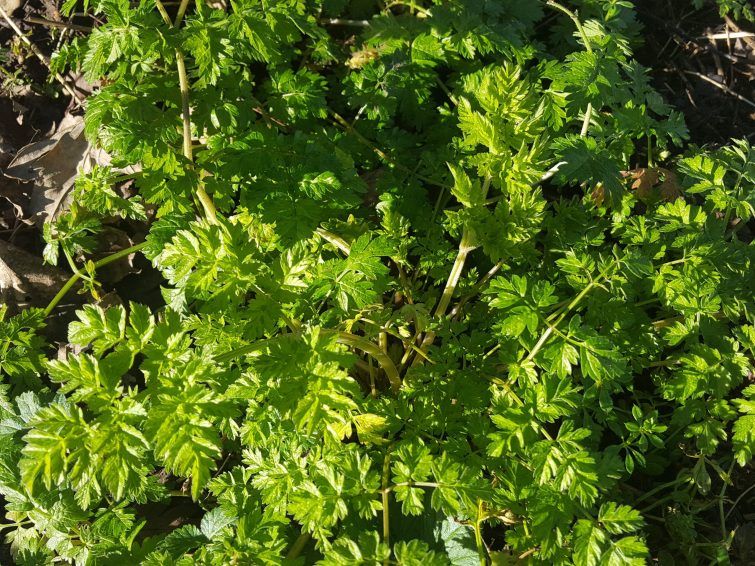
Therefore, where conditions furnish such flowering behaviour, and where the plant has already set sail, so to speak, they will do no more or less than try and produce flowers and viable seed, no matter what time of year.
Hence the 8 or 9 inch high common hogweed plant I saw on a footpath by a busy road near Oxford a few years back. I will never forget it because it completely stopped me in my tracks.
I bent down and began to stare at the tiny stem and its flowers. Usually this plant can reach up to 1 metre 80 cm high with numerous stems. Here it was no more than 9 inches high, with a single stem and a flower head almost its typical size.
I was completely dumbstruck. The sheer unnegotiable driven need to express form and reproduce. That to me almosts points to a creative consciousness and some sort of relentless will of nature.
Habitats: Everywhere! Well almost. This is the most common umbellifer we have in the country. By far! This map from the BSBI shows how much of Britain has wild chervil growing in it.
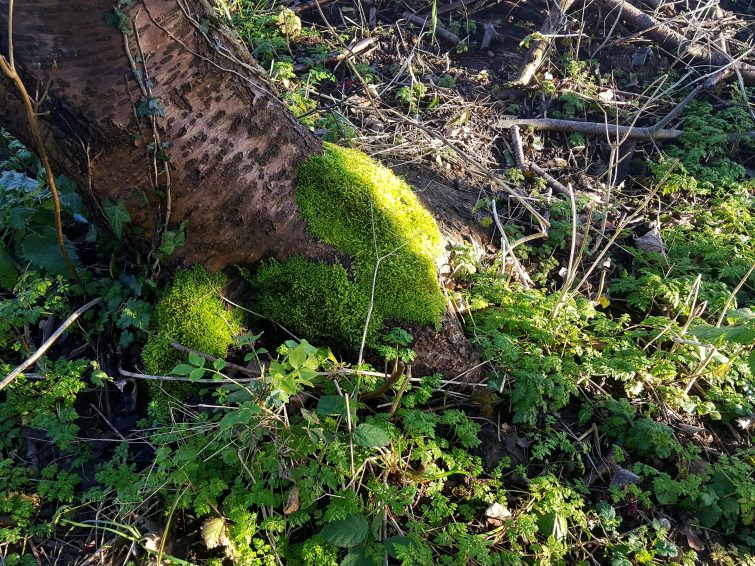
Regular foraging for wild chervil will quickly demonstrate that it is a lover of woodland edges and clearances, as well as hedgerows, roadsides, field edges, parks and gardens. It grows on the vast majority of soils, except on the highest ground.
Parts used: Leaves, leaf shoots, young flower stems, flowers.
Plant chemistry: There are negligable amounts of the phototoxic compound furucoumarin (also known as furanocoumarin) in wild chervil. These molecules are well-known for being present in potentially dangerous concentrations in a number of carrot family plants.
Because understanding these molecules are paramount to foraging safety, furucoumarins are central to an upcoming springtime essay on the actual real and present dangers from foraging for chervil, hogeeed, parsnip, and other common carrot family plants. Watch this space!
Furucoumarins are also found in citrus fruits and other unrelated species. For most people, these are not molecules that will pose a danger when we are eating them in regular dietary amounts.
These compounds are only reactive under sunshine, or more correctly, ultra violet light, when they are in contact with your skin. This can lead to various states of dermatological dis-ease, from a mild tingly sensation and redness, to 3rd degree burns (from plants with much higher concentrations).
With wild chervil, I feel it safe to say that for the overwhelming majority of people, this plant presents no danger whatsoever. None. Yet we all know that everyone is different. Someone with an existing allergy against celery may possibly have a reaction when handling a peeled wild chervil flowering stem. Wear gloves if worried.
Harvesting: Picking the leaves can be done pretty much all year, although August to April in Southern England is the peak time for me. I pick the leaflets off the fibrpus mid-vein, except on the newest, most tender foliage.
The young unfurled shoots are well worth having in late winter early spring. Use whole.
The stems can be harvested from March in most places. This is temperature dependent though. Mild winters equals early tender flower stem production.
If the stems are really flexy then you are good to go. If not then they will be fibrous, tough and no good to eat. The truth is that you have to experiment to know for sure. Just start with the bendiest and biggest ones you can find.
As with all plants, you should test your tolerance before consuming. This and all other golden rules of foraging need to be adhered to when foraging for wild chervil.
The stems need the outer hairy skin removed before you can eat them. Either use a knife or fingernail to prize away the tougher material from the green flesh below. A host of other useful tips and techniques can be picked up from my harvesting guide.
Other notes: Aside from the negligible furucoumarin content, wild chervil does not have any other striking medicinal constituents or actions.
From my research wild chervil is not a plant commonly employed as medicine anywhere. This is not surprising, becuase in this plant family it is predominatly the essential oils that impart the medicinal actions. Still, you can’t have everyrhing!
Another species fom the exciting carrot family is coming up next…
Happy foraging!
Leaves:
Petioles:
Roots:
Stems:
Flowers:
Flowering season:
Habitats:
Harvesting:
Other notes: