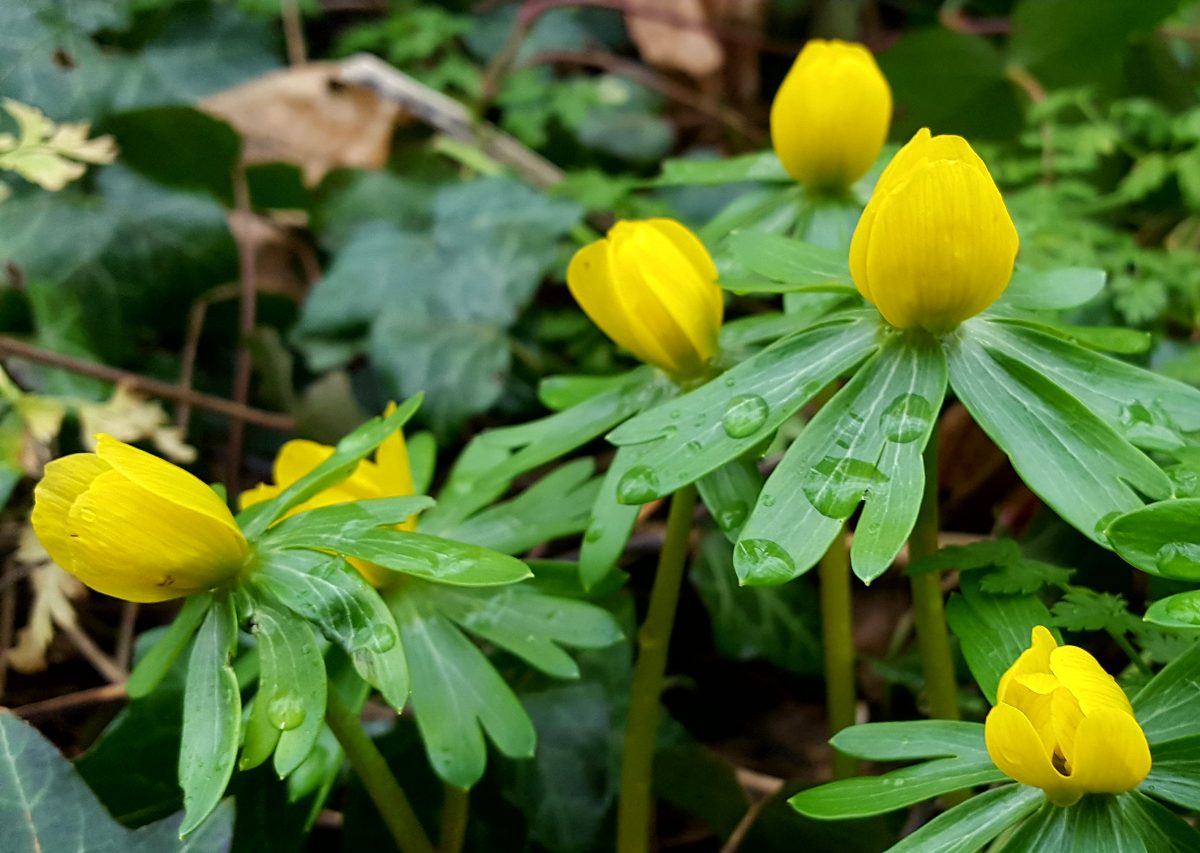
Identifying the poisonous winter aconite (Eranthis hyemalis) Ranunculaceae.To learn them is to leave them!
In this quick to read wild plant guide, you can easily and confidently learn how to identify the beautiful winter aconite.
This is a delightful winter flowering plant, that brightens up woodland floors with carpets of yellow flowers in January and February. Together with its soon-to-flower close cousin, the lesser celandine, this plant is a spring messenger!
If you are new to foraging, I strongly advise the reading of my beginners guide, and this article on how you can identify plants in a day.
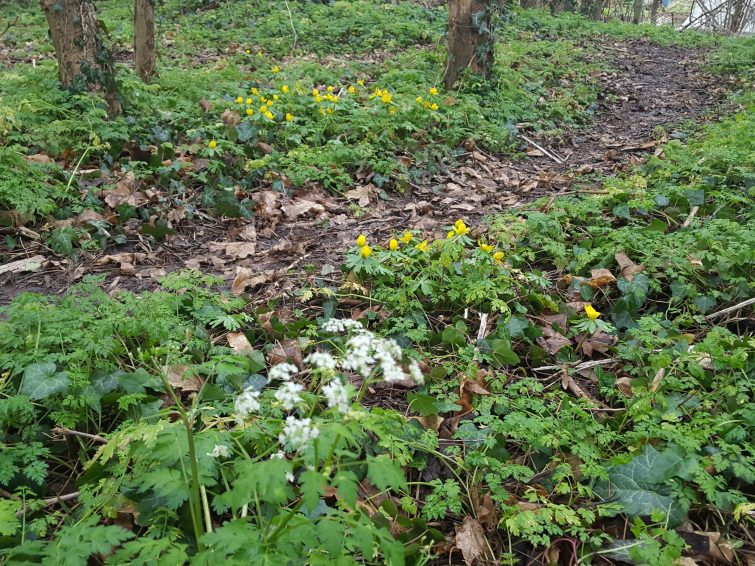
As I write on the eve of imbolc 2021, this plant is in flower sharing my local woodland floor with lovely white snowdrops, wild chervil and many re-emerging lords and ladies.
With the simple triggers of the time of year (more accurately the plant’s perception of far red light (from around 660 – 700 nanometres on the visible spectrum), alder and hazel catkins are gently stretching out to release their pollen.
Some of the young trees have the common woodbine snaking up around them, and are just beginning to poke out their new leaves, as are the elder trees. Blackthorn buds are whitening up and catching the eye.
Seeing the different plants join the new calendar’s colourful cacophony, really nourishes my soul. Their appearance finally means we start to come out of the darkest hour of winter.
Somehow, many of the plants that we can’t eat or are best avoided, produce timely hits of colour, and with it, offer us foragers other rich rewards.
Winter aconite was reportedly brought to Britain in the 1530’s as a garden plant. It was first recorded in the wild here in the early 19th century and it has increased its populations and geographic range since.
What’s in a name?
The scientific name Eranthis comes from two old Greek words – ‘Er’ translates to ‘spring’ and ‘anthis’ meaning flower.
The specific name hyemalis comes from a Greek word meaning ‘of winter’.
The common name winter aconite is alluding to the similar-looking, deeply divided leaf lobes of buttercup family relatives such as Aconitum nepellum.
Winter aconite botanical description.
Leaves: Orbicular to palmate-lobed root leaves. These generally appear after the flowers, although on young tubers, only small basal leaves appear in the first year or two. The leaves can reach up to 13 cm across. They are glossy green, palmately-lobed and deeply divided.
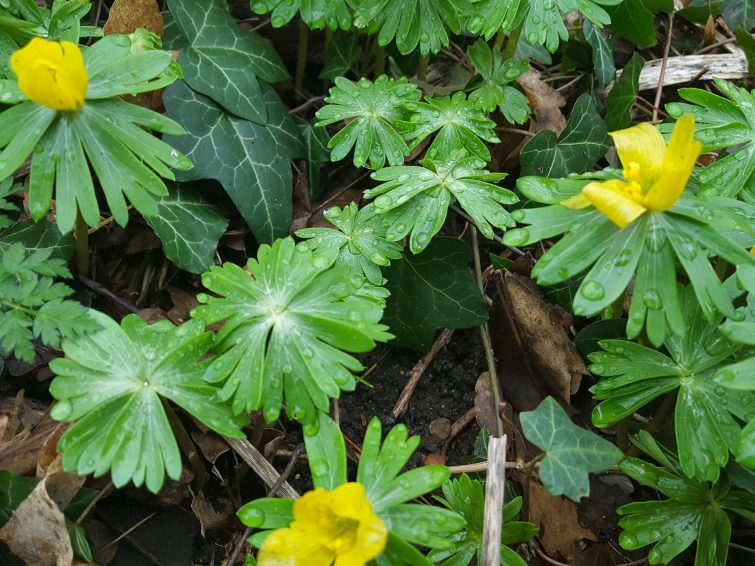
White veins are easily noticable towards the base of the lobes. At the apex, the leaf lobes are rounded with a tiny white tip.
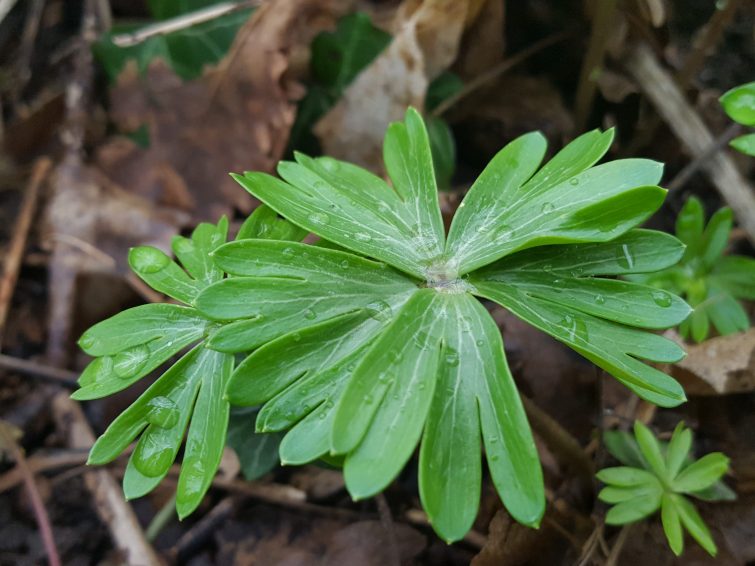
Petioles: These are long and hollow. The leaf-stalks typically reach to around 12-15 cm.
Roots: Small round perennial tubers, not knobbly like lesser celandine. The tubers are covered in a black skin.
Stems: Each flower sits on a short, hairless, unbranched terminal stem. They are hollow and grow to approximately 10 – 20 cm high.
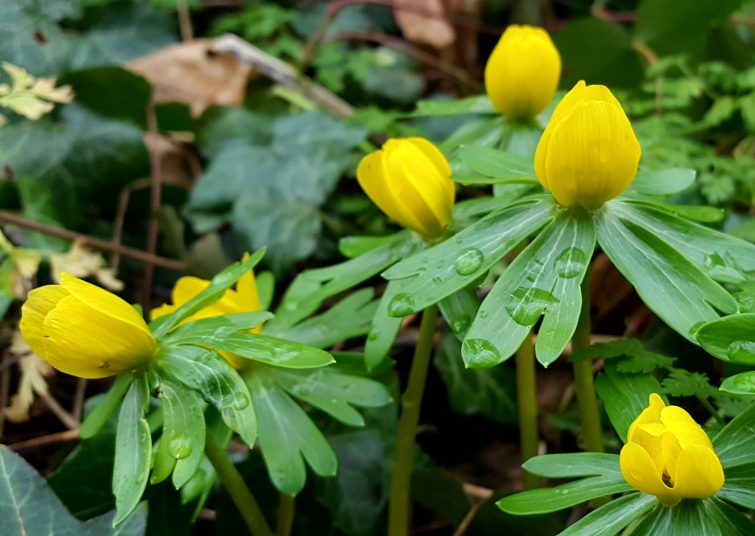
Flowers: Single yellow flowers with anywhere between 5 – 8 yellow sepals. The petals are usually absent, replaced by tubular nectaries. In the centre of the flower are fused pistils, surrounded by a mass of stamens.
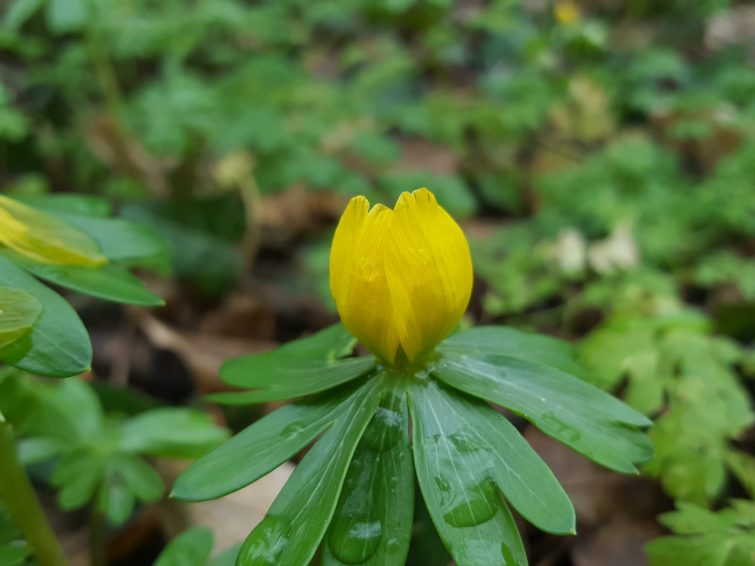
Each flower sits just above a frilly, deeply-divided, leaf-like bract, looking like a collar or an Elizabethan-style ruff.
Flowering season: January to March, say the books currently.
Fruits: Oblong to oval-shaped seeds. These are formed in the nectaries and drop to the floor when mature.
Habitats: The natural home for this plant is in woodlands. Here it joins the ephemeral springtime flowering show that occurs before the tree canopy is fully out and open. This map shows its geographic distribution across the UK.
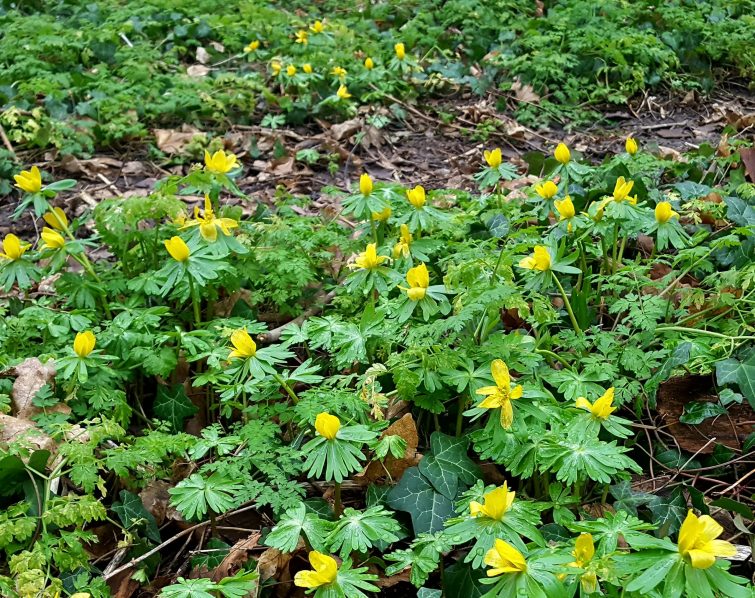
Simce its arrival in the UK as a garden plant, winter aconite has escaped and found a home in numerous shady and damp spots. Urban foragers are as likely to see this plant in parks, gardens and churchyards as we are in a more natural wooded setting.
Other notes: All parts of this plant are reportedly quite poisonous. As a whole this family are known to contain alkaloids and other irritant compounds, and have been documented as having some of the most deadly poisons known to man. Some reports say that nausea, vomiting, colic and visual disturbances can occur if eaten.
Although the mallow family of plants are known to soothe irritation from many buttercups, if you accidentally consume this plant you should of course quickly seek professional medical attention.
As spring approaches I will be offering one-to-one mentoring and tuition, both online and in real-time, as and when current covid restrictions allow. Standby for more information on what will be available and when!
Happy foraging!