How to Identify Red Valerian (Centranthus ruber) Valerianaceae Family

Learn how to identify red valerian with the UK’s most comprehensive forager’s plant identification guide.

The following article will hopefully enable you to quickly and confidently identify red valerian. At the same time it will help you know the differences between this herb and its related namesake, the medicinal valerian (Valeriana officinalis), for which it is often confused.

Beginner foragers are at this juncture, directed towards these handy guides to starting out foraging and harvesting wild plants. As well as the hundreds of wild edible and medicinal plants covered here, you are also strongly advised to get well acquainted with Britain’s poisonous plants, because to learn them helps to leave them alone!

This plant was reportedly first brought here during the 1590’s. It was first recorded in the wild by 1734. Red valerian is a plant that some love, and some hate, but, if social media is anything to go by, many still regularly mis-identify. That is surely down to to plain old misplaced assumptions, because it is quite a distinctive looking herb, especially in its preferred habitats.

What’s in a name?

The first part of the scientific name Centranthus is derived from the Greek words ‘kenton’ meaning spur, and ‘anthos’, the old Greek word for flower. The specific moniker ruber, means red.

It shares both a family and a common name with the medicinal herb valerian. This name, as readers of the corn salad article will already know, comes from the Latin word Valere, and translates as ‘to be healthy’. Red valerian shares no medicinal properties or actions.

Other common names you may see include ‘Foxes brush’ and ‘Jupiters beard’.

Botanical description

Some technical language is necessary here. New readers may wish to bookmark this helpful glossary for foragers.

Leaves: The leaf shape is generally elliptic. The leaves will be found as upward thrusting rosettes throughout the winter. This should help to raise a forager’s interest levels when you are out foraging in December or January. New leaves appear in March.
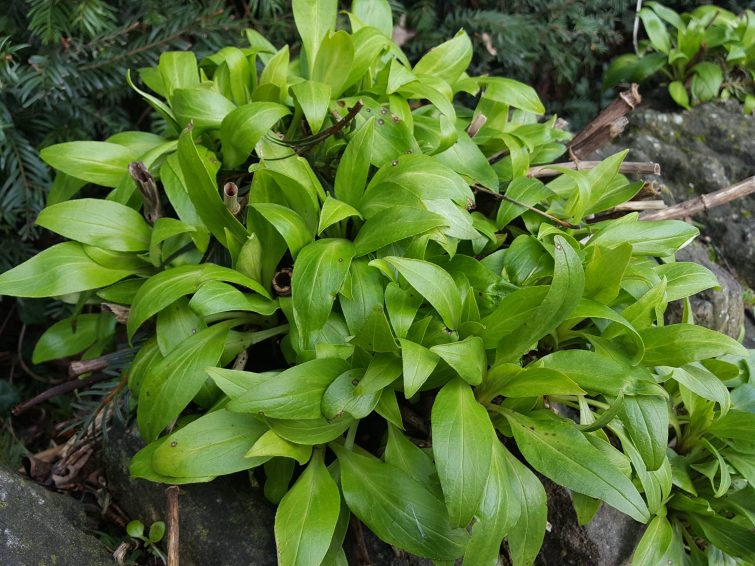
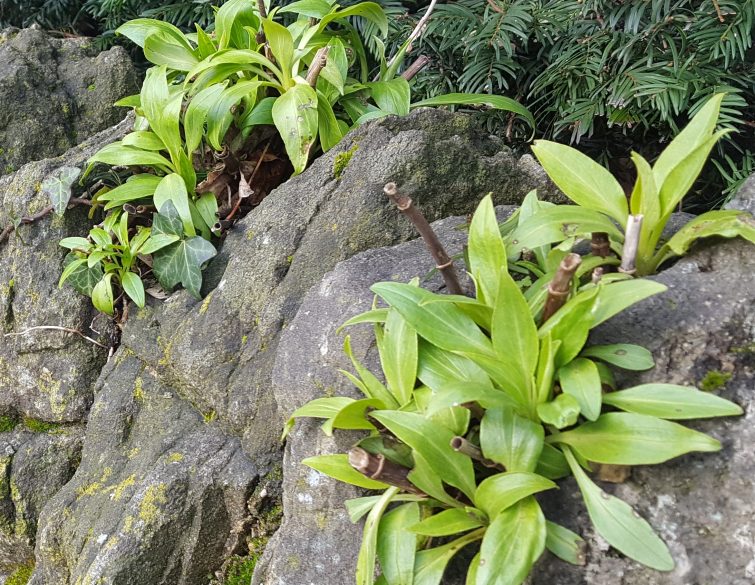
Rosettes of overwinterering, upward thrusting leaves are a key habit to know when trying to identify red valerian
Red valerian with its rosettes of over-wintering, upward thrusting leaves.

The simple, hairless and somewhat glossy-looking leaves, have a raised midrib below and a few whiteish veins above.
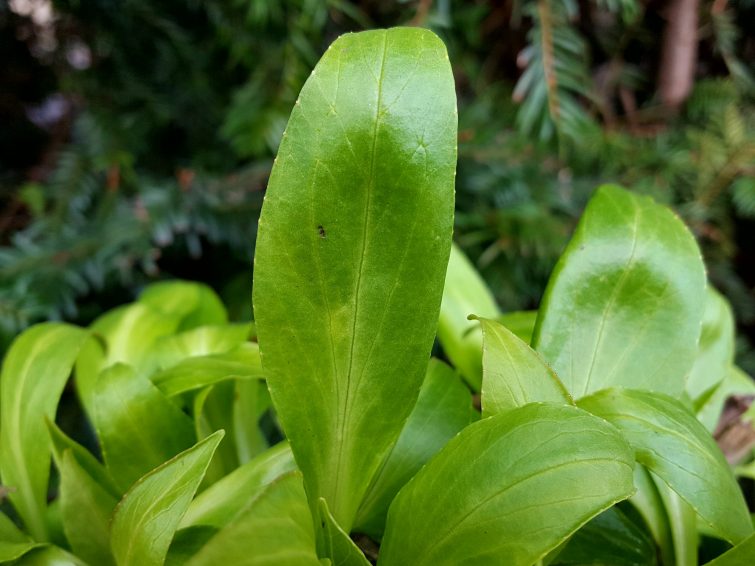
Simple hairless leaves with whiteish veins are the chief vegetative characteristics you see when trying to identify red valerian
Red valerian leaves are simple, hairless and elliptical-shaped with whiteish veins.

The leaf margins are minutely crenated with a series of white hydathodes visible with close inspection. Contrast these leaves with the large compound-pinnate leaves of the medicinal valerian.
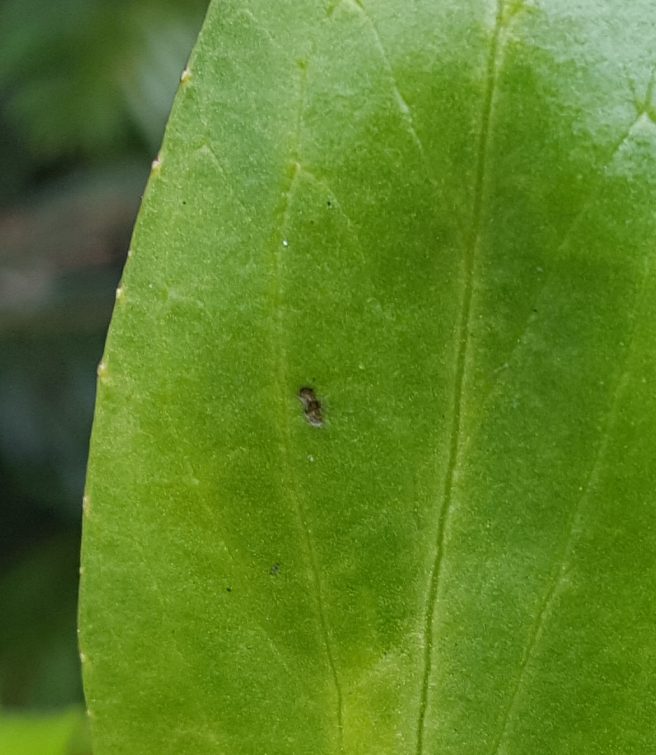
Red valerian has whitiesh veins, is glossy-looking and has tiny white hydathodes on the leaf margins.
Red valerian’s glossy-looking leaves have tiny white hydathodes on the margins.

Petioles: Typically the small leaf stalks on basal leaves reach 5 cm or so. The oppositely-spaced stem leaves are smaller, and become sessile.

Roots: This plant has a winter-hardy, fibrous and rhizomous rootstock.

Stems: The flowering stems start to rise in late spring. They grow up to around 1 metre or so. They are typically round to weakly angled, and not swollen at the nodes. Eventually they become hollow and will snap audibly. Try it! During May the plant begins to put on an often spectacular display, especially when found en massé.

Flowers: Although most specimens have pink -red flowers, many will display brilliant white blooms. A darker magenta colour will also be found.
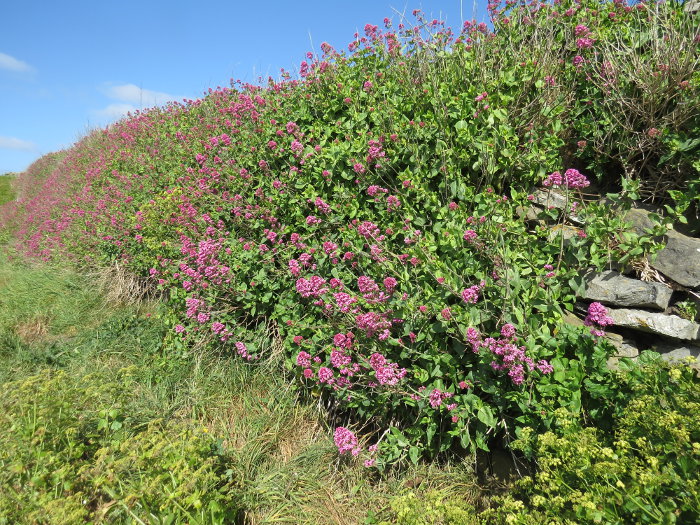
From June you can find impressive displays of red valerian flowers by the coast
From June you can find impressive displays of red valerian flowers by the coast. Here near Douglas, Isle of Man.

Flowering season: This plant will be in full bloom in our increasingly warmer climate from June. It then flowers all through the summer into late September and early October.

Fruits: The pollinated flowers produce numerous tear-drop shaped, ridged seeds, with short pappus hairs. The seeds are dispersed mainly on the wind.

Habitats: This plant thrives in Britain in habitats replicating its Mediterranean home. Absent in the higher parts of England, Wales and Scotland, you can find it in large numbers by the coast.
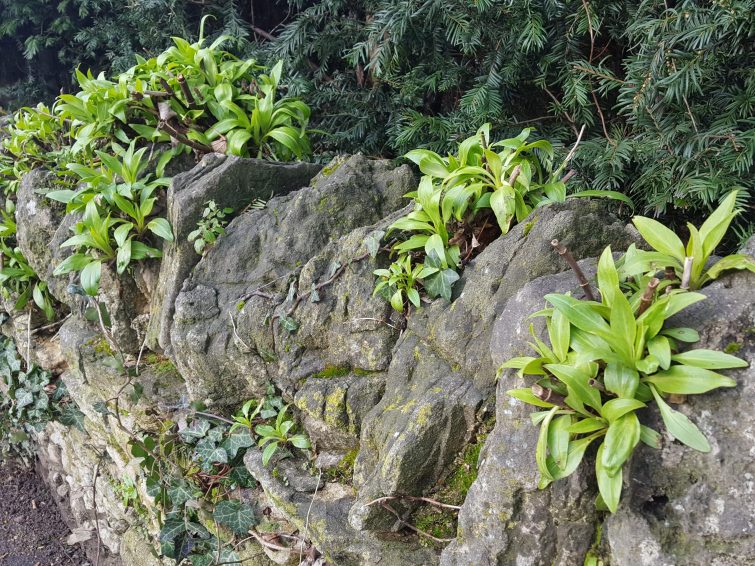
Red valerian enjoys life in places that replicate its native Mediterranean sea home. You will be able to identify thexplant in winter by visitinv old stone walls.
By knowing the habitats it likes you can hone in and identify red valerian on old stone walls.

It also loves life on stone walls and old crumbling buildings, railway and road embankments, distubed ground and other free-draining lowland sites. The plant is absent on higher ground in England, Wales and Scotland.
Parts used: Leaves, flowers and roots have all been used as food.

Harvesting: Leaves are best harvested in the winter months when they are not as bitter as they can get in the hotter months. Flowers can be picked as soon as they appear. Roots are best picked in the late autumn and winter months.

Edible uses: In its native range, this plant has a documented history of use as food. In Italy the leaves are used in salads or in a cooked dish of wild greens known as preboggion. 

The young flowering stems are possibly worth experimenting with, as many pre-flowering stems are. The small flowers can also be added to salads. The roots have been documented as an edible, after cooking.

Other notes: As pretty as it is, this plant will quickly damage old stone walls. With the price of stonemasonry, this should be enough warning for homeowners to remove the plant from places other than the tops of walls.


How to Identify Green Alkanet (Pentaglottis sempervirens) Boraginaceae Family

Learn how to identify green alkanet, know its lookalikes and discover its history and uses.

It is well worth getting to know how to identify green alkanet. Then you will also be able to confidently identify and harvest other similar-looking plants. This is because a study of green alkanet also requires a little study of its relatives, comfrey, borage, and forget-me-not’s.

Experienced foragers will already recognise this plant as one that we only really enjoy for its early spring show of flowers. Whereas beginner foragers will often ask… “is this plant borage, or forget me not’s, or comfrey?” This article can hopefully be used to answer the now yearly spring time social media barrage of questions and answers relating to sightings of this plant.

With its coarse hairiness, and the presence of bitter alkaloids (incluing traces of pyrollizidine alkaloids), many wild foodies already know that this plant is mostly off the menu. But that does not necessarily mean these plants are of no interest to us at all.

Green alkanet was reportedly first brought to Britain before 1700 and first recorded in the wild in 1724. It feels right at home here in many settings.

Before we look into the origins of the name, and its botanical description, I just want to remind all beginner foragers that there are hundreds of other plants to explore here, both written and photographed. These include an overview of the relatively small number of toxic and poisonous plants that reside here in Britain.

This site also provides you with a basket full of harvesting tips and tricks to help your foraging missions, and a glossary of terms to assist with any difficult botanical language.

For the more serious wannabe gastronomical botanists, there is my two-part, fast-track version of learning how to identify plants in a day, simply from the flower patterns they produce. Take your time to read and memorise the keywords in part 1 and part 2, because this will save you hundreds of hours of fruitless, back and forth searching through field guides, like I did when first getting to grips with plant I/D.

What’s in a name?

Unlike the previous plant covered here, Gorse, the green alkanet does not have a particularly interesting origin to its name.

The second part of its common name ‘alkanet’ derives from the old Arabic word for Henna, al hinna – alluding to the fact that there is a red coloured dye that can be obtained from the roots.

It must be noted however, that this is not the same red-coloured dye as is extracted from the roots of the related plant Alkanna tinctora. This particular herb is native to the Mediterranean region and is now widely known as the ‘dyers alkanet, or also simply just ‘alkanet’. Plants with the name ‘tinctoria’ and ‘tinctora’ are all pointing to their valued use in dyeing.

The generic part of the scientific name Pentaglottis comes from the old Greek language, and simply means five tongues. The word ‘penta’ equals five and ‘glottis’ refers to the tongue (although medically it’s the part of the throat where we find the vocal chords).

The specific epithet sempervirens is two cojoined Latin words that translate to ‘evergreen’ or ‘always alive’. True to its name, you can find this plant happily over-wintering here in Britain as large rosettes, looking a lot like borage, or comfrey.

Botanical description

Leaves: This plant produces mostly basal leaves. These are characteristically ovate to lanceloate shaped, and always tapering towards a sort of wedge-shape at the base. Typically they reach around 15  cm – 25 cm long and 7 cm or so wide. The margins are mostly entire, but are occasionally found with a few very obscure and irregular teeth.

In comparison, forget-me-not’s have much smaller leaves; comfrey’s are more narrow; while borage has a wider, shorter leaf and it’s much more wrinkled in appearance.

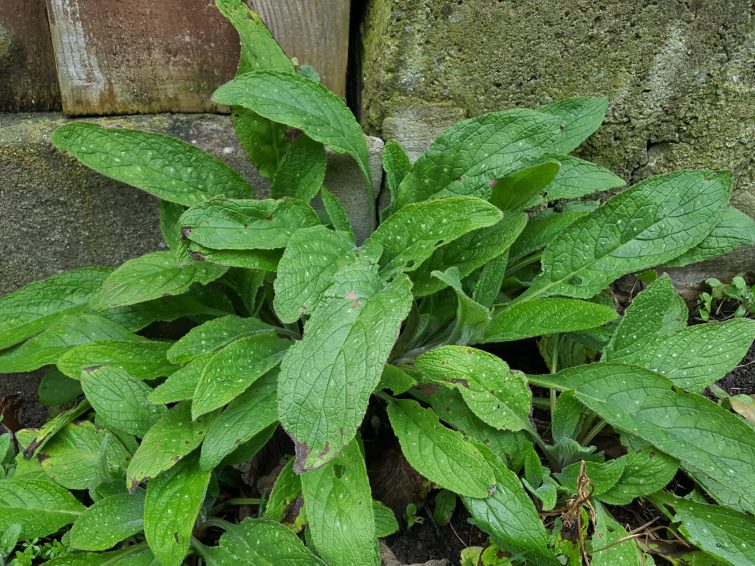
Often large clumps of briefly spotted leaves help to identify green alkanet
You can begin to identify green alkanet from the winter presence of large clumps of hairy leaves.

Green alkanet’s leaves are always noticeably bristly hairy. In common with other members of the family, these hairs can cause a rash on sensitive skin.

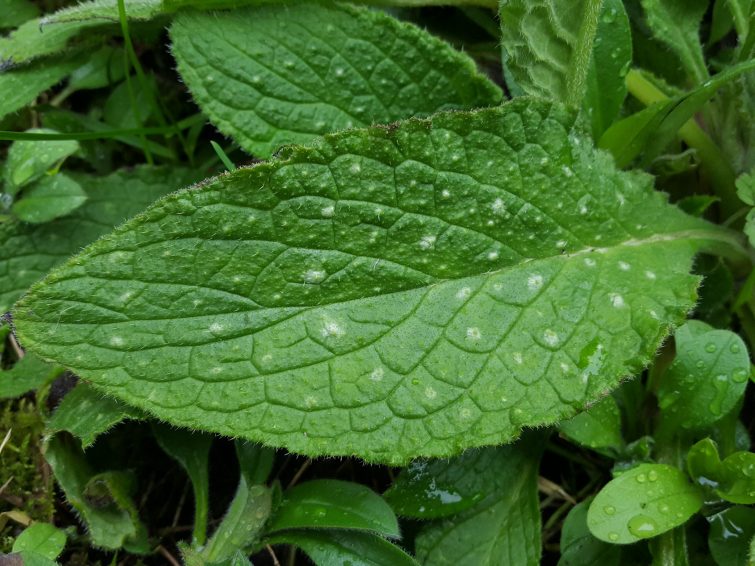
The leaves will mostly, but not always, show a number of raised white spots on the surface. None of its relatives discussed here have white spots. Green alkanet suffers from rust and many plant leaves will appear with small brown rust patches.

The spots are mostly but not always present on green alkanet's leaves.
The commonly found, tell-tale white spots, are present on the majority of specimens.

Petioles: These are always present except on the smallest stem leaves. Reaching up to 10 cm or so, the winged and channeled leaf-stalk is covered in bristly hairs.

Roots: Big, brittle taproots with black skin and yellow-orange inner flesh.

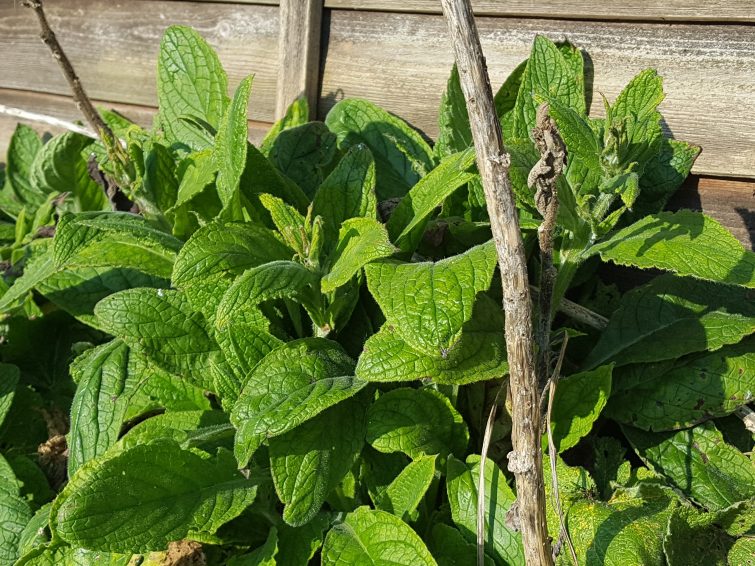
Stems: The green, hairy, angled stems can reach up to 1 metre high. They either grow on their own or with several others. Their branched stems appear from March.

Green alkanet flowering stems appear from March, and are found earliest where its sunniest
You can find the new flower stems appearing from early March.

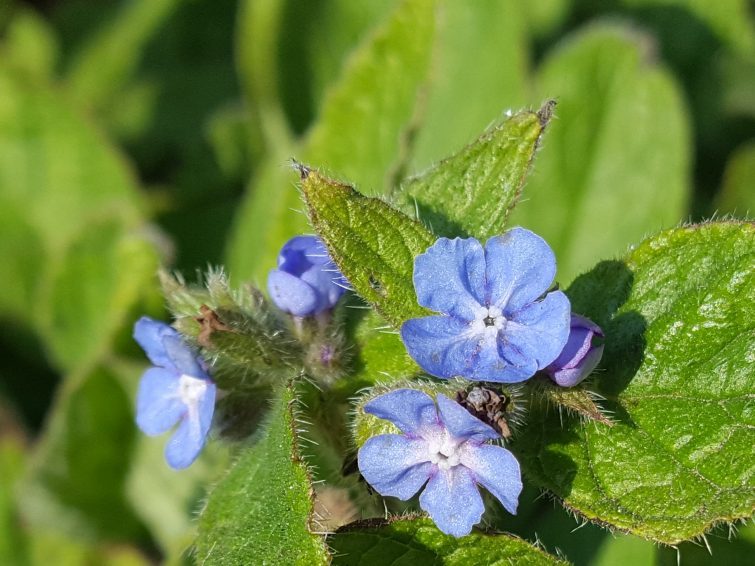
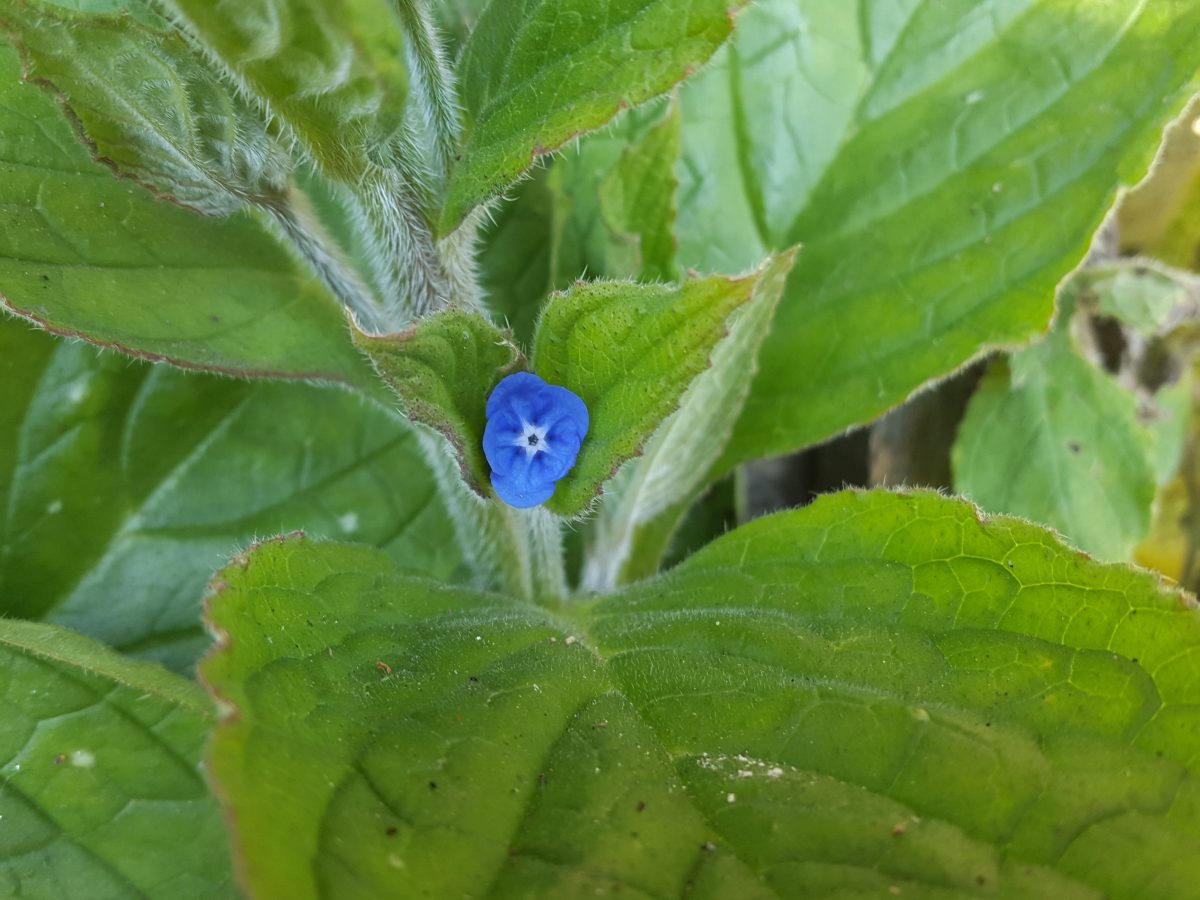
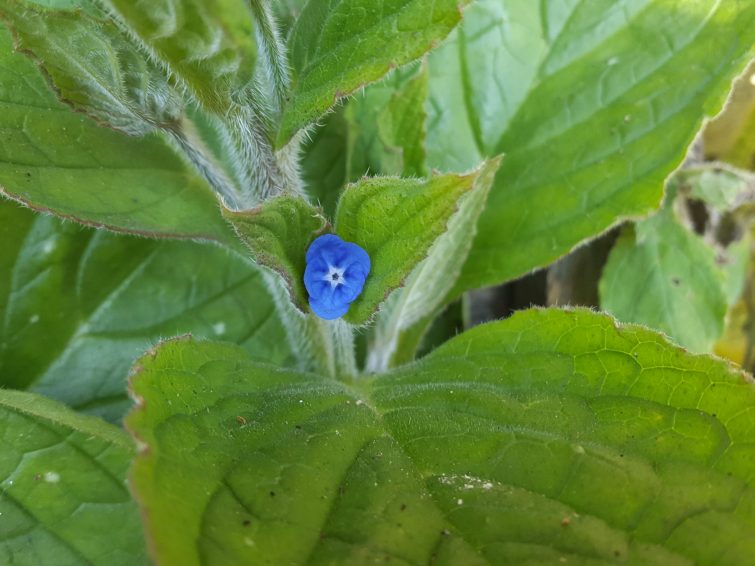
Flowers: Striking blue or blue-purple splashed flowers, with a white centre spot, that resemble large forget-me-not’s.  They appear in leaf axils as well as in small clusters. (This inflorescence is botanically classed as a cyme). Five petal lobes are fused together and form a small corolla tube. Hidden from sight in the centre of the tube are the stamens and stigma.

The flowers look like large forget-me-not’s with the small white spot in the centre.

Flowering season: Green alkanet will flower here in Britain from March through into early May. The earliest flowering plants are usually in sunny and protected urban spots.

Appearing as a cyme type of inflorescence, the small clusters of borage blue flowers make it easy to identify green alkanet in spring
Small clusters of borage blue flowers make it easy to identify green alkanet in spring.

Fruits: During the late spring and early summer, four slightly ridged nutlets will be found in each flower.

Habitats: Green alkanet has been bern described as an urban loving, street fighting bruiser! It appears on many types of soils throughout much of Britain, although only in lowland settings below 350 metres or so. It particularly likes wastegrounds, hedgerows, scrub, woodlands and riversides. This plant can be very invasive, and will spread quickly by its copious seed and by shards of root.

Parts used: The flowers can be used as garnish or plonked into ice cubes for cocktails and mocktails. The roots have a orange-red pigment that can be harvested for dyeing.
Harvesting: Flowers can be picked most of the spring, from March. Roots can be collected in the early autumn.

Medicinal uses: I have struggled to collect any medicinal information on this herb.

Other notes: This is a fantastic early season plant for certain bees, butterflies, moths and flies, who adore this plant, just like they adore its relative, borage. For gardeners, the leaves of green alkanet can be composted down to make a liquid plant feed, as you would comfrey.

More plant articles are coming soon. Happy foraging!


Foraging for Gorse flowers (Ulex europaeus) Fabaceae family

Discover quite literally how horrific it is to go foraging for gorse flowers in the UK!

For the more patient wild food afficianados, foraging for gorse flowers reaps a tasty, if occasionally painful reward.

This is another of Britain’s wild plants that many people know already. If so, you may only want to read the fascinating  origins of the how gorse got its name, discussed presently.

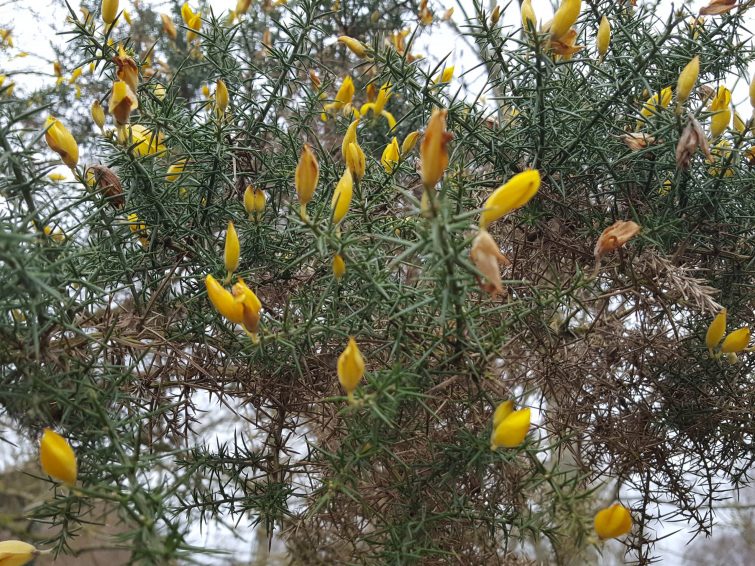
While it may be occasionally painful, foraging gorse flowers can reap tasty rewards.
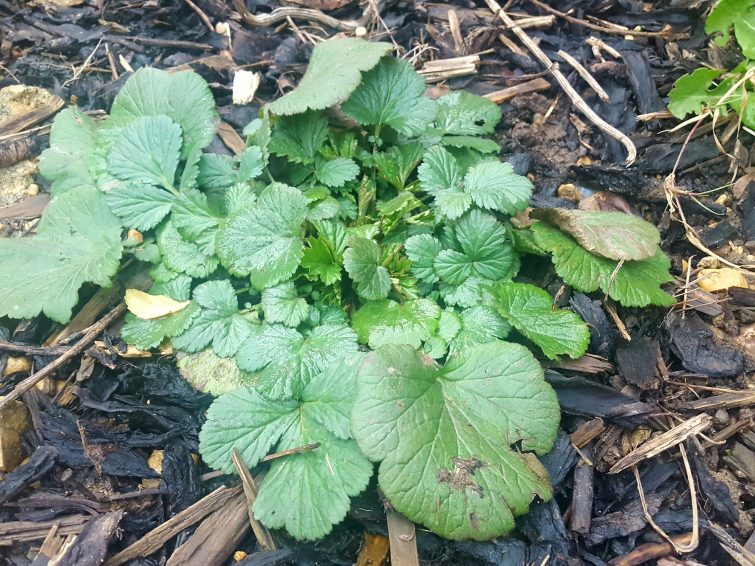
Masess of spines will occasionally make it painful foraging for gorse flowers.
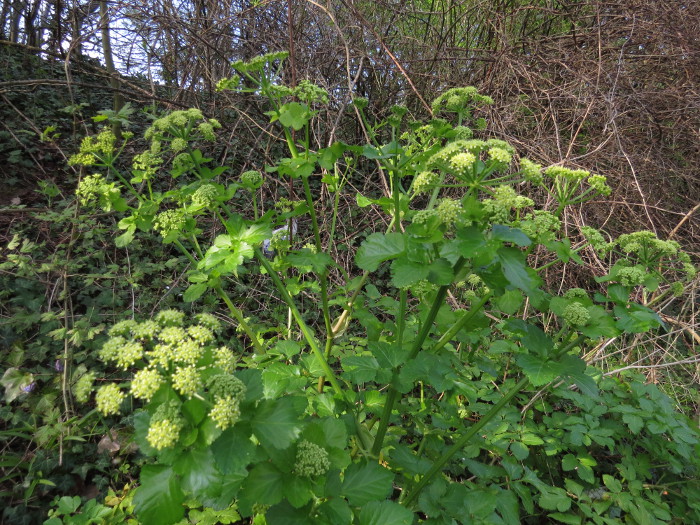
The botanical description is primarly designed for absolute beginner foragers, taking you through the key identification features, which in the long run will help you separate this plant from the dwarf gorse or the Western Gorse, if you fancy that sort of thing.

Gorse is well known by many and hardly needs a botanical description.

To help you, this more than useful foragers A-Z glossary is here to be your constant friend. For difficult words, just look them up!

What’s in a name?

The English common name Gorse is acknowledged by professional wordsmiths to have its roots in the archaic proto-Germanic language, where the plant was known by the name ‘Gorst‘. This old word came from the ancient language which eventually morphed into the current Dutch, German, and English languages.

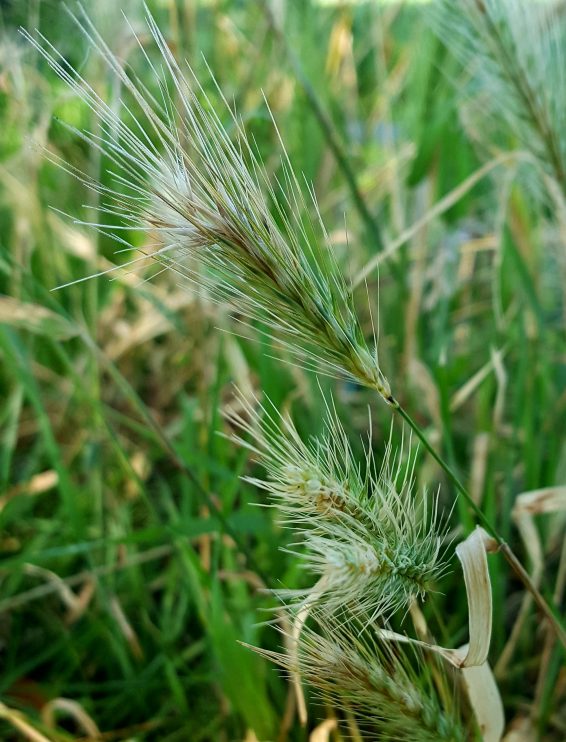
The Old German word, as well as the old Saxon word for this plant, is ‘gersta’. In Germany, the cereal grain we know here as barley, is commonly called ‘gerste‘. This grass is identifiable from its long bristles on their flower heads.

The long bristly hairs on barley are the reason why gorse and barley share the same origins of names.
The long bristly hairs on barley species are why these plants shares the same etymological origins as gorse.

It further transpires that the original source word comes from even before the Germanic language. The word ‘gorst’ has its roots in an Indo-European word ‘ghers‘, which means ‘to bristle’. Incidentally the Germans now call gorse ‘Stechginster‘ and a gorse bush  ‘Stechginsterstrauch‘.

Brilliantly, the word horror also has its roots in this ancient word ‘ghers‘, as does the scientific name for barley (Hordeum vulgare). That’s amusing to me because I imagine that most people in Britain would find the idea of picking a few hundred grams of gorse flowers absolutely horrific! They would literally be correct.

As the English language developed and changed, the plant name evolved into ‘Gors’, then finally turning into the word we have today, whenever it was our modern English was formatted.

The generic part of the scientific name – Ulex, was originally a Latin word, apparantly meaning a ‘shrub like rosemary’. Although I have also seen reference to the word ascribed to the Roman diarist Pliny, and being used to describe gold mining. The specific epithet europaeus tells us this is the common species that grows all over Europe.

Botanical description

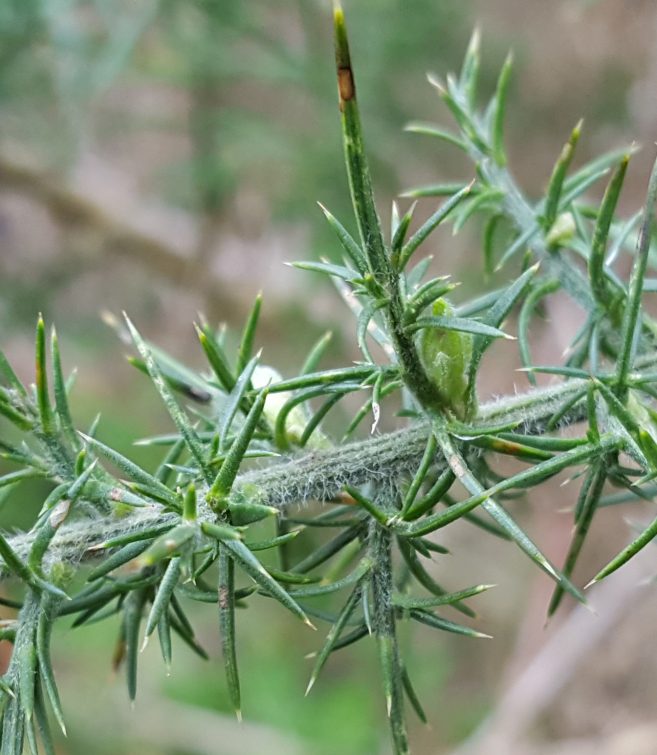
Leaves: When first growing as a seedling, gorse has trifoliate leaves that soon change into  spines. Johann Wolfgang von Goethe, mentions in his book “The metamorphosis of plants”, that if gorse is put in controlled conditions under glass with 100% humidity, it grows clover-like, trifoliate leaves.

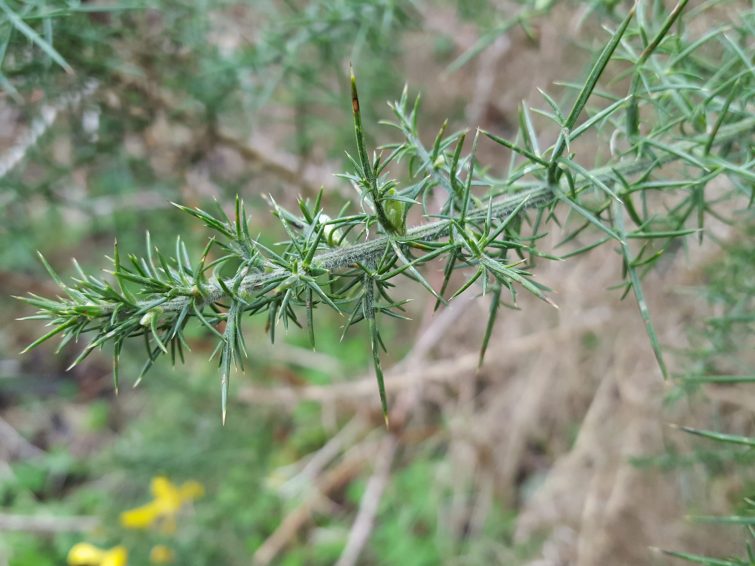
Gorse’s numerous rigid spines are sturdy and wider at the base. Terminal spines are longer (25 – 30 mm) than the lateral ones (10 mm). All the spines have small (2mm) tips. You need to be constantly vigilant of the spines when foraging gorse flowers.

The young, hairy, and irregular-shaped green twigs of gorse will soon turn woody and brown.
The young, hairy and irregular-shaped twigs of gorse, soon turn brown and woody.

Petioles: No

Roots: This shrub initially develops a tap root but soon develops a large, matted, fibrous root system.

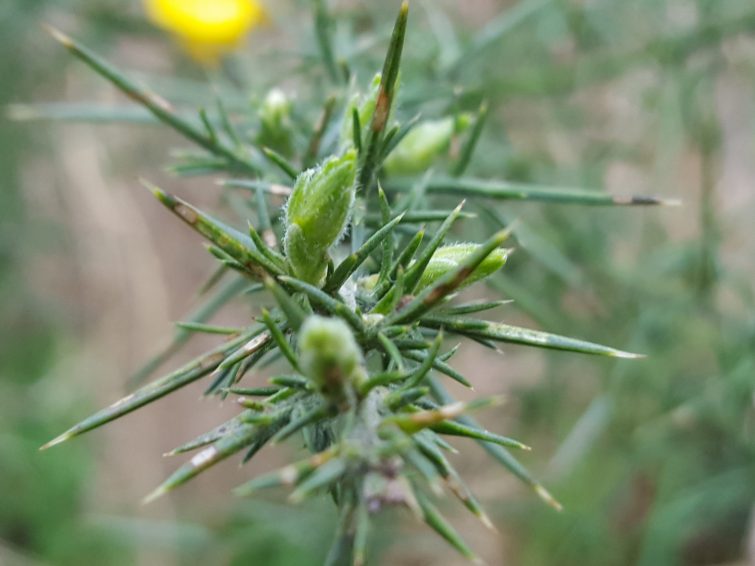
Stems: Irregular-shaped. From green, hairy, young first year twigs they they turn woody and light brown from the second year.

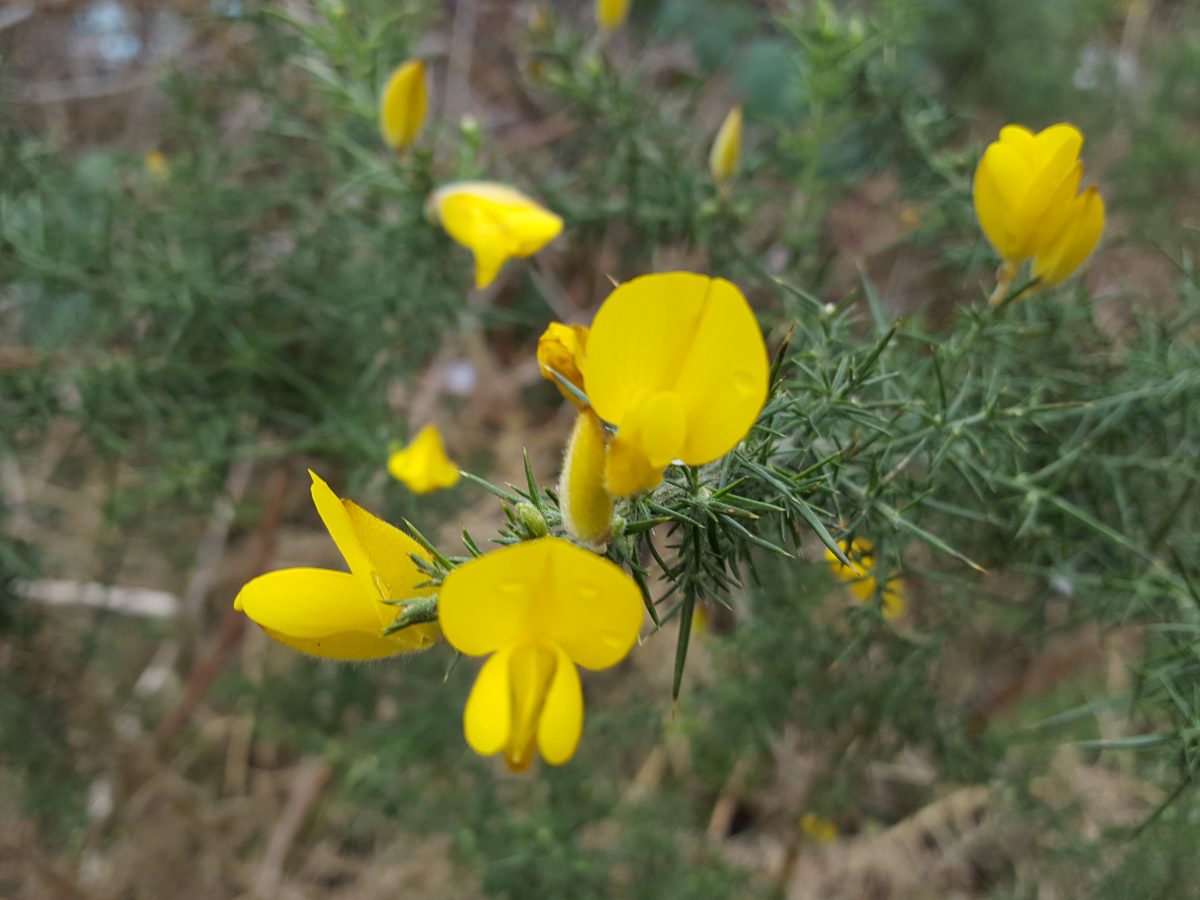
Gorsextwig with numerous flower buds just waiting for the longer spring days to burst into life
In spring, these oval flower buds will burst open and cover the plant in yellow flowers.

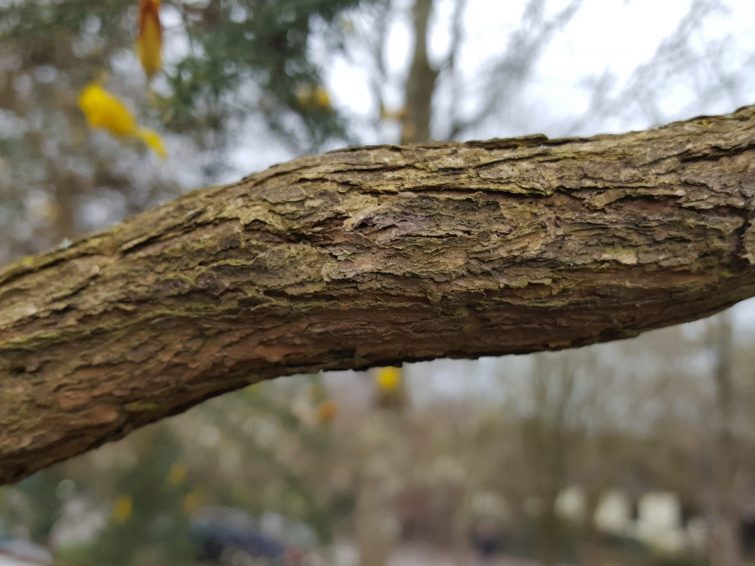
Bark: Light brown with wavy fissures.

Mature bark from gorse trunks show wavy, shallow fissures
Mature bark from gorse trunks showing its wavy, shallow fissures.

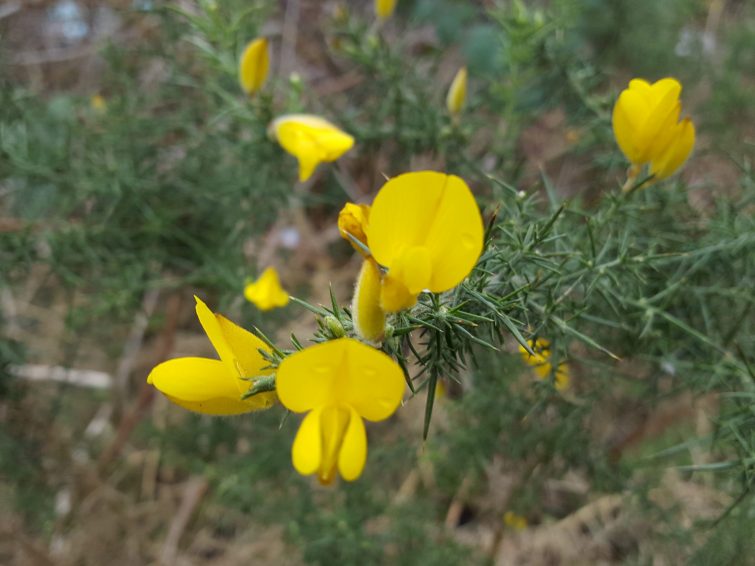
Flowers: From the oval green buds, emerge bright yellow flowers with the classic pea family shape and arrangement. These pretty and somehow  beautifully exotically-scented flowers have a large ‘banner’ petal lobe, two winged lobes, and a ‘keel’, which consists of two petals fashioned together underneath.

Gorse has the classic pea family arrangement of a 'banner, wings and keel' petal pattern.
Gorse has classic pea-like flowers, making it easy to identify.

Flowering season: The old saying goes ‘that kissing is out of fashion when gorse is not in bloom’. This points to the fact that you can always see some gorse flowers during any month of the year. Its chief flowering period, depending on your location in the UK, will be from late March to May.

Fruits: The dead brown flowers persist for a long time, protecting a small, hairy, brown – purple pod. They are easily visible in the summer and autumn months. These eventually split open in hot weather to reveal two or three black seeds.

Habitats: It can thrive where many other plants cannot. Gorse loves rocky, sloping clifftops, sandy and slightly acid heathlands. It can also be found in woodland rides and clearances as well as on wastegrounds and alongside railway tracks. It is a lowland plant generally, but has been recorded at altitudes of 600 metres.

Parts used: Flowers for food; branches and stems for hot burning fires!

Edible uses: Wines, cordials, soft drinks and sugar syrups can all be made. Flowers can also be tossed into salads for a little pea- like flavour.

Other notes: A couple of other Gorse species, the dwarf gorse (U.minor ) and the Western Gorse (U. gallii) also grow in the UK, although moreso in the Western side of the country. These two species are much more low-growing and they come into flower at a different time.

I hope you found this article interesting. Remember that there are hundreds of medicinal and edible plants covered here, as well as Britain’s array of poisonous plants. 

More plant species are coming soon!

Happy Foraging!


How to identify Lords and Ladies (Arum maculatum) Araceae family

Ensure you never pick the leaves of this poisonous plant by mistake, with our UK foraging guide to identify Lords and Ladies !

This article on how to identify lords and ladies could save your life! How? Because this plant is an ever-present danger for novice foragers everywhere in the UK.

For complete beginners I will take you through all its stand-out features, and its little-known characteristics, helping you to get to know and positively identify it, no matter where you find it. To keep you safe all year round, this website also shows you Britain’s other poisonous plants.

It's easy to identify Lords and Ladies if you pay close attention to the features of its leaves.
It’s easy to identify the poisonous Lords and Ladies if you pay close attention to its leaves.

Interestingly, this plant has also been used as a food source. Only a few hundred years ago people were extracting the starch from the corm of the plant. Portland sago was the name commonly given to the product made on the island many years ago.

Quite how tbey managed to extract the abundant starch without the potentialy deadly calcium oxalate crystals, I’m still not completely sure. I did read many years ago that it was a hugely labororious and time consuming process, and surely one driven by a lack of other food, as well as economic factors.

If our an ancestors used and valued it as a food source then this begs a couple of questions…how little food did they have? Or maybe more importantly, what skills and knowledge did they have that we do not?

Until armageddon, I am happy to treat this plant as a poisonous plant that I leave alone. For that is what the raw plant is. All of it!

What’s in a name?

The generic part of the name Arum comes from the old Greek word ‘Aron’, the name which they called the plant.

l cannot seem to find any other explanation about the origins of the name.

The specific part – maculatum, comes from the word maculate, meaning spotted. Many, but not all of the specimens you will find, have spotted leaves.

Botanical description to identify Lords and Ladies.

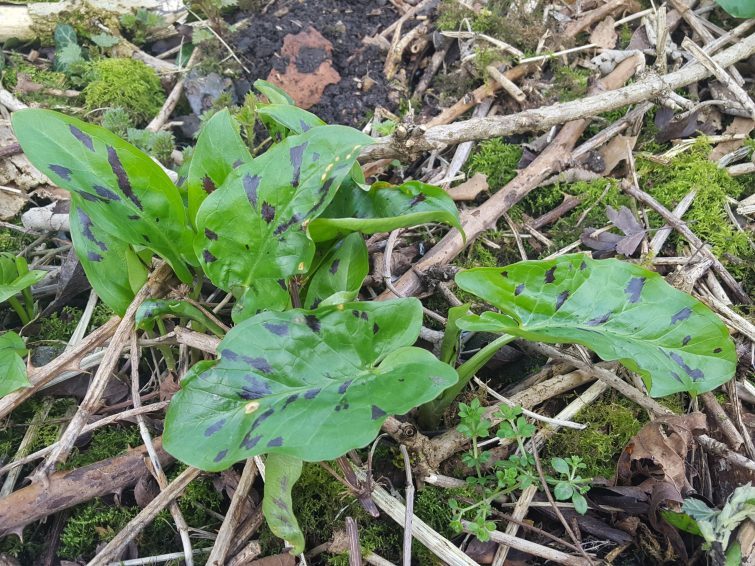
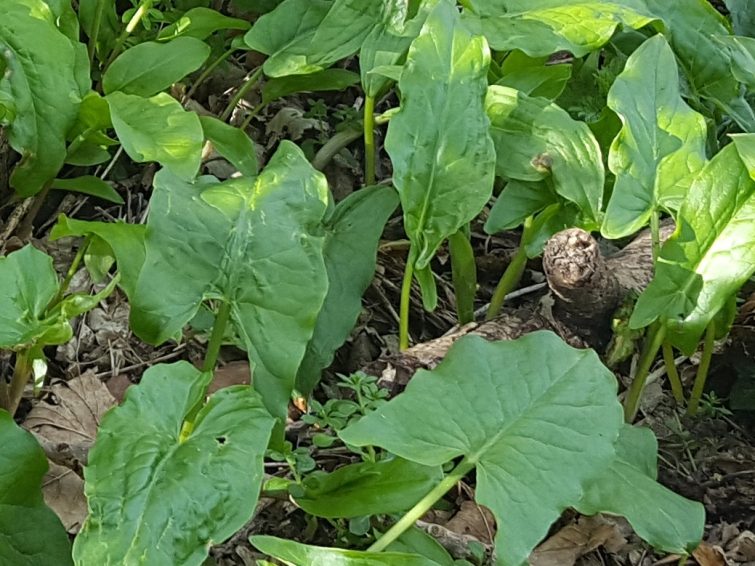
Leaves: The leaves are broad, and arrow-shaped, with large, rounded basal lobes. These are always present. The plant is hairless.

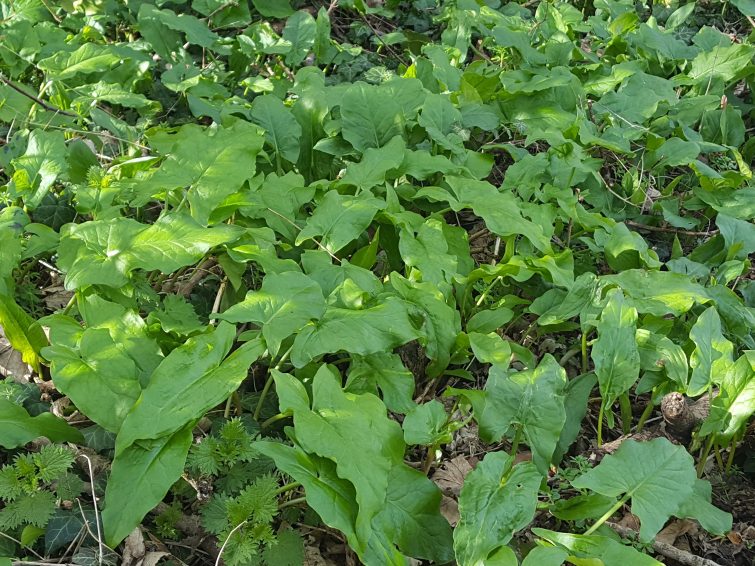
Broad, glossy, and hairless, arrow-shaped leaves emerge in January.
The broad, glossy, and hairless, arrow-shaped leaves help identify Lords and Ladies when appearing in January.

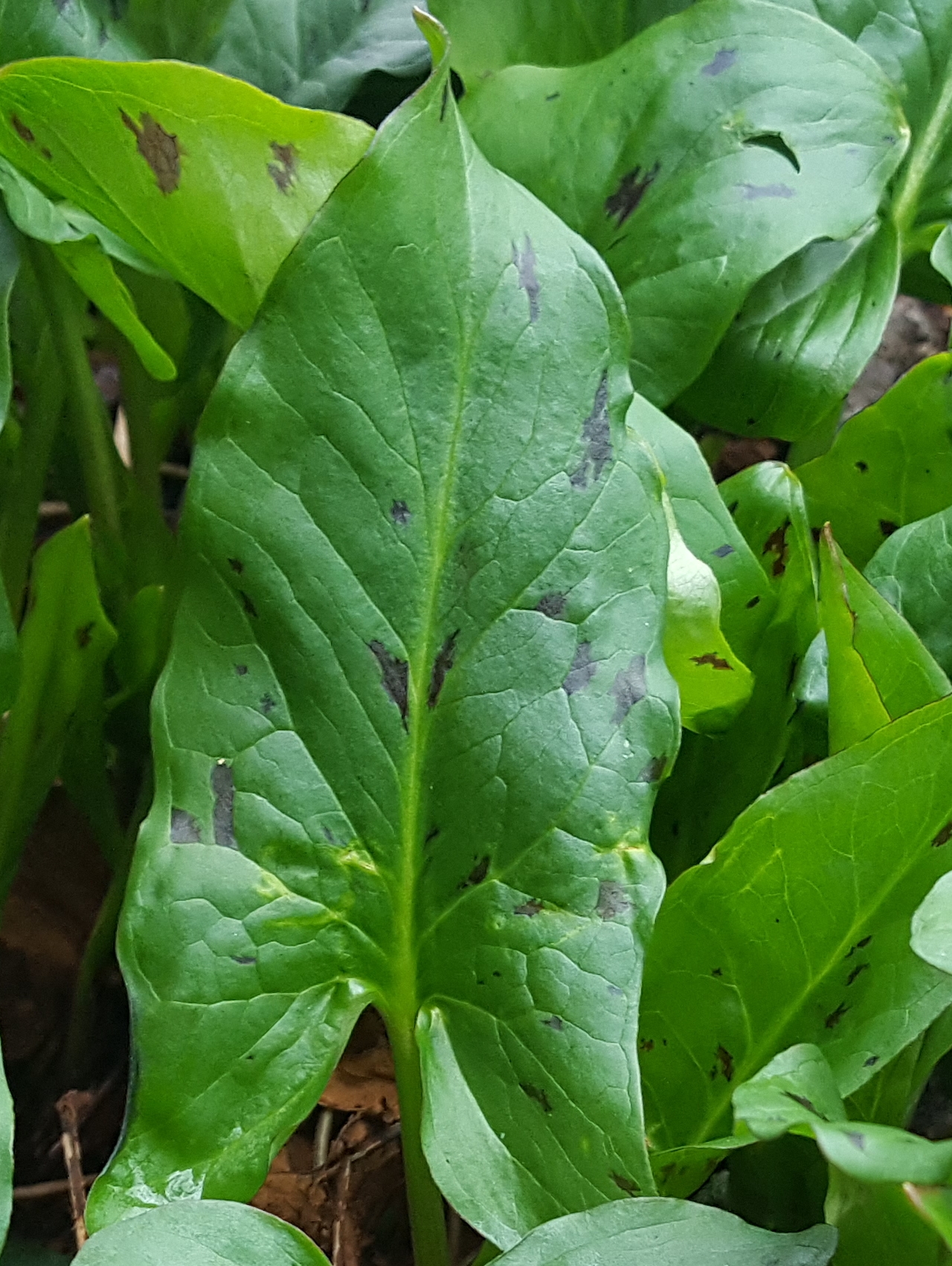
Leaf veins are in a net pattern, with anastomising veins at the margins. As you can see, the veins join together forming a single vein running around the leaf about 5 or 6 mm from the edge. This feature helps to differentiate it from common sorrel, which also has arrow-shaped leaves and can be found sharing the same hedgerow or shady field margin.

The anastomising veins help to identify Lords and Ladies, and differentiate it from similar-looking plants.
The distinctive anastomising veins help to identify Lords and Ladies, from similar-looking plants.

When mature, a leaf will typically reach up to 20 cm long. In some places you will find carpets of leaves.

Carpets of Lords and Ladies adorn our woodland floors in February.

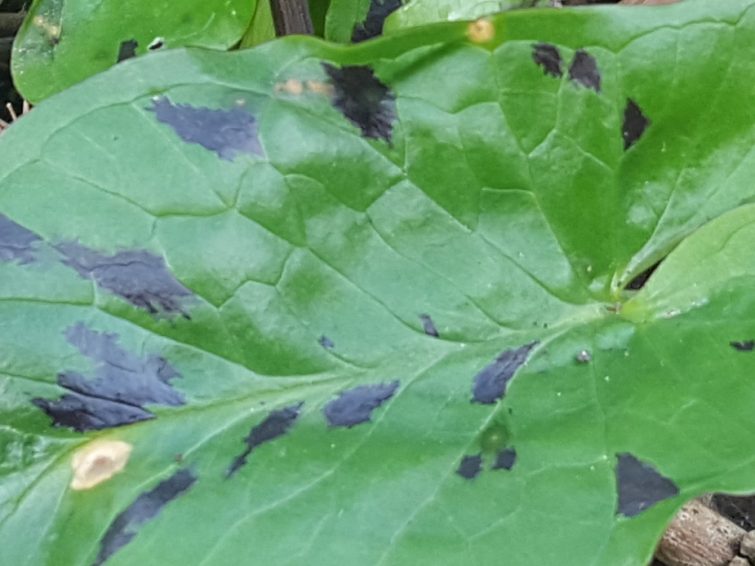
As mentioned previously, the leaves will often show dark spots or streaks.

The spotted leaves are not always but often present on Lords and Ladies, and give rise to its scientific name.
The spotted leaves are not always but often present on Lords and Ladies.

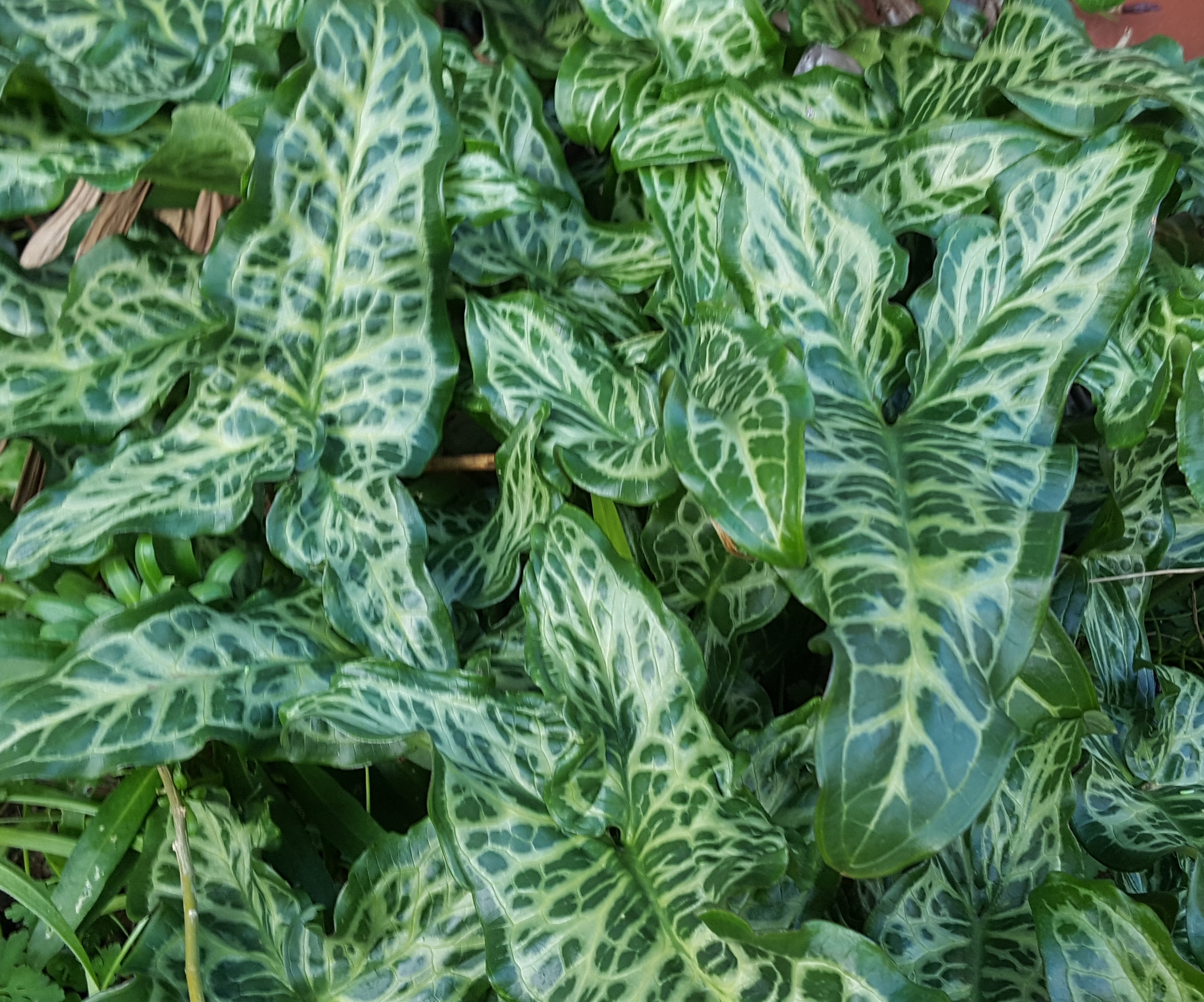
Every now and again, especially in urban settings, you may see a very similar-looking, but variegated plant. This will be the garden escapee and close relative A.itallicum.

If you find an Arum with variegated leaves it will be the closely related species A.itallicum
If you find an Arum with variegated leaves, it will be the closely related species A.itallicum.pq

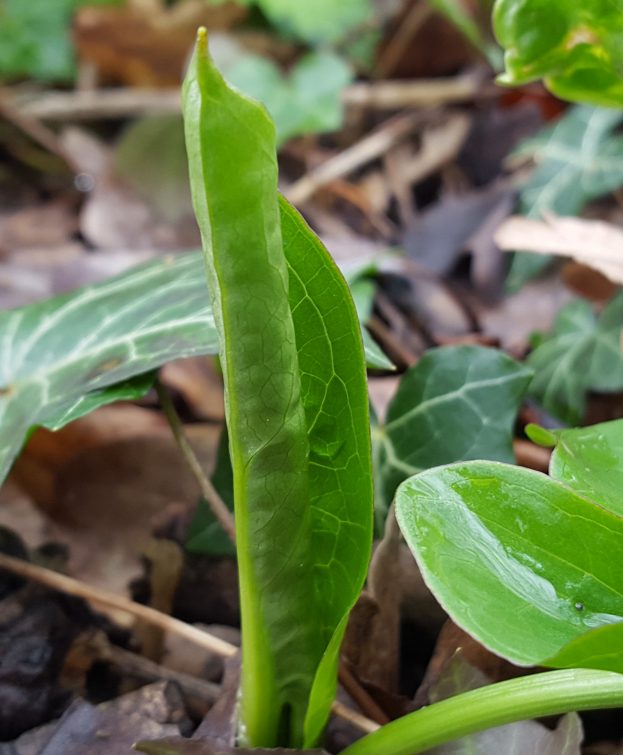
When first emerging, the leaves are rolled, and it is at this early stage when you could potentially mix it up with wild garlic (Allium ursinum).

When emerging, the leaves are rolled and potentially mistaken for wild garlic which emerges with similar energetics.
When emerging, the leaves are rolled and potentially mistaken for wild garlic.

Lords and Ladies will regularly be found in amongst patches of wild garlic. Please  note that it is of no use, and simply not safe, to listen to online ‘know it all’s, who simply say “if a plant smells of garlic it must be garlic”!

This is because handling some garlic leaves will obviously mean your hands smell of garlic! It is important that you know what to look out for that sets them apart from each other.  So, in order to further your plant identification skills and fast track your foraging, I have published the articles ‘how to identify plants in a day’, parts one and two.

Lords and Ladies nestling amongst wild garlic. Make surexyou know the features that help you identify Lords and Ladies.
Lords and Ladies is often found nestling amongst wild garlic patches.

Petioles: Grows to approximately 10 – 20 cm long, and sheathed at the base of the leaf.

Roots: Small turnip-shaped corms. Like other bulbs, these brown-skinned, starchy roots produce new leaves in winter and spring, then set flower and seed by summer.  The plants are dormant from late summer to mid winter.

Stems: A single flower stem rises from the plant  during April and May. Usually no more than 20 – 25 cm high.

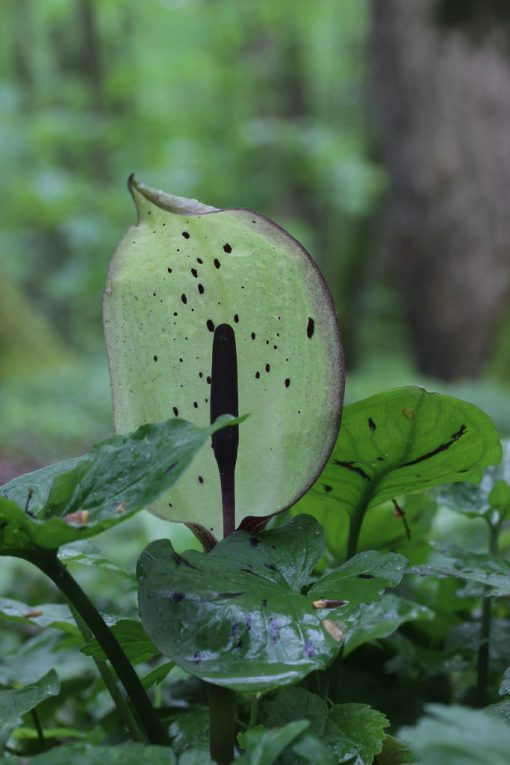
Flowers: Botanically this type of inflorescence consists of a hooded spathe, and the reproductive organs of the phallic-shaped spadix. The spathe is pale yellow-green and sometimes spotted, while the oblong-shaped spadix is purple or yellow. You can see why the minds of country folk started calling it Lords and Ladies!

The hooded spathe and spadix of “Wild Arum – Arum maculatum” by Björn S… is licensed under CC BY-SA 2.0

Flowering season: Field guides will tell you it can be found in bloom from April to June.

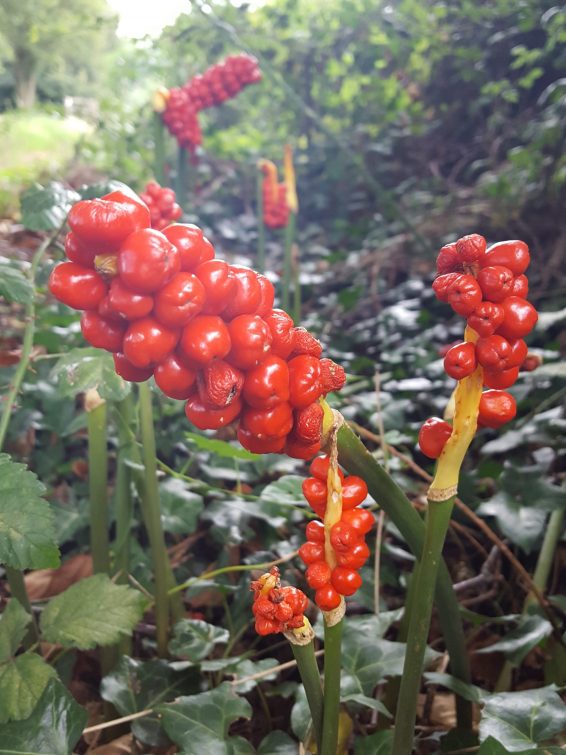
Fruits: Clusters of orange-red berries tightly held to the stem. These are one of the few plants my mum warned me about, as they are at so accessible and look so shiny and appealing. You will start to see lots of them from June.

Clusters of bright orange-red berries make it easy to idemtify Lords and Ladies in late spring and summer.
Clusters of bright orange-red berries make it easy to identify Lords and Ladies.

Habitats: A natural lover of woodlands, copses and shady hedge-banks. As you can see from this map, the plant grows in all lowland areas of our islands up to around 425 metres, so you can learn how to identify Lords and Ladies pretty much anywhere in the UK.

Other notes: The plant is also full of saponins which can be toxic to us in large concentrations. Like other Arum family plants, this plant is pollinated by flies and midges.


Foraging Primrose Flowers (Primula vulgaris) Primulaceae family

A guide to foraging primrose flowers in Britain. Learn how to identify and use these delicately-scented early spring blooms

I would guess that people have been foraging primrose flowers for as long as we have known them. These universally popular plants are one of the most beautiful of all our woodland flowers here in Britain.

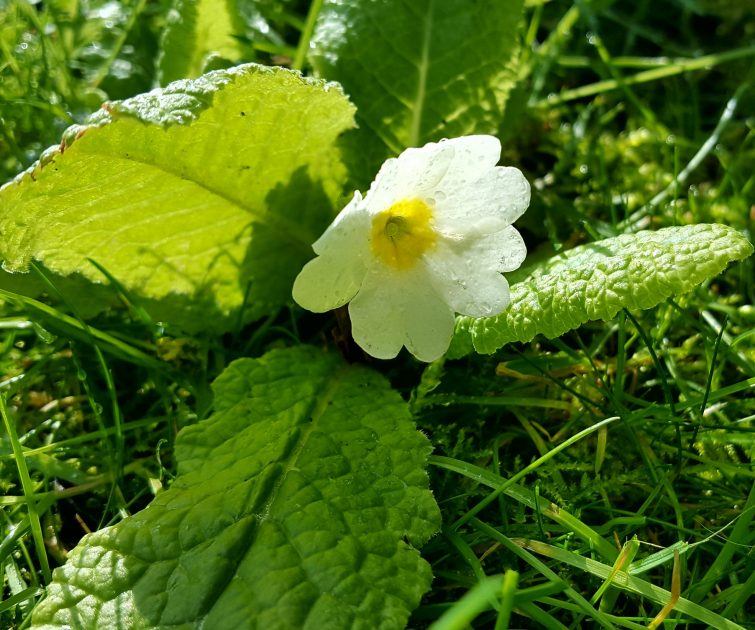
You cannot help but find this plant in most parts of the country. Its gorgeous yellow and orange-centred flowers often appear in large carpets when you are foraging in March and April.

The best time to go foraging primrose flowers is mid to late March and early April
Foraging for primrose flowers is quick and easy in March and April.

There aren’t a huge number of plants with which people have an unbroken relationship. Blackberries, sloes, rosehips, nettles, and wild garlic all spring to mind as plants that country people have always made time for harvesting. Primroses are surely another of these plants, whose lives intertwine with ours at least once a year.

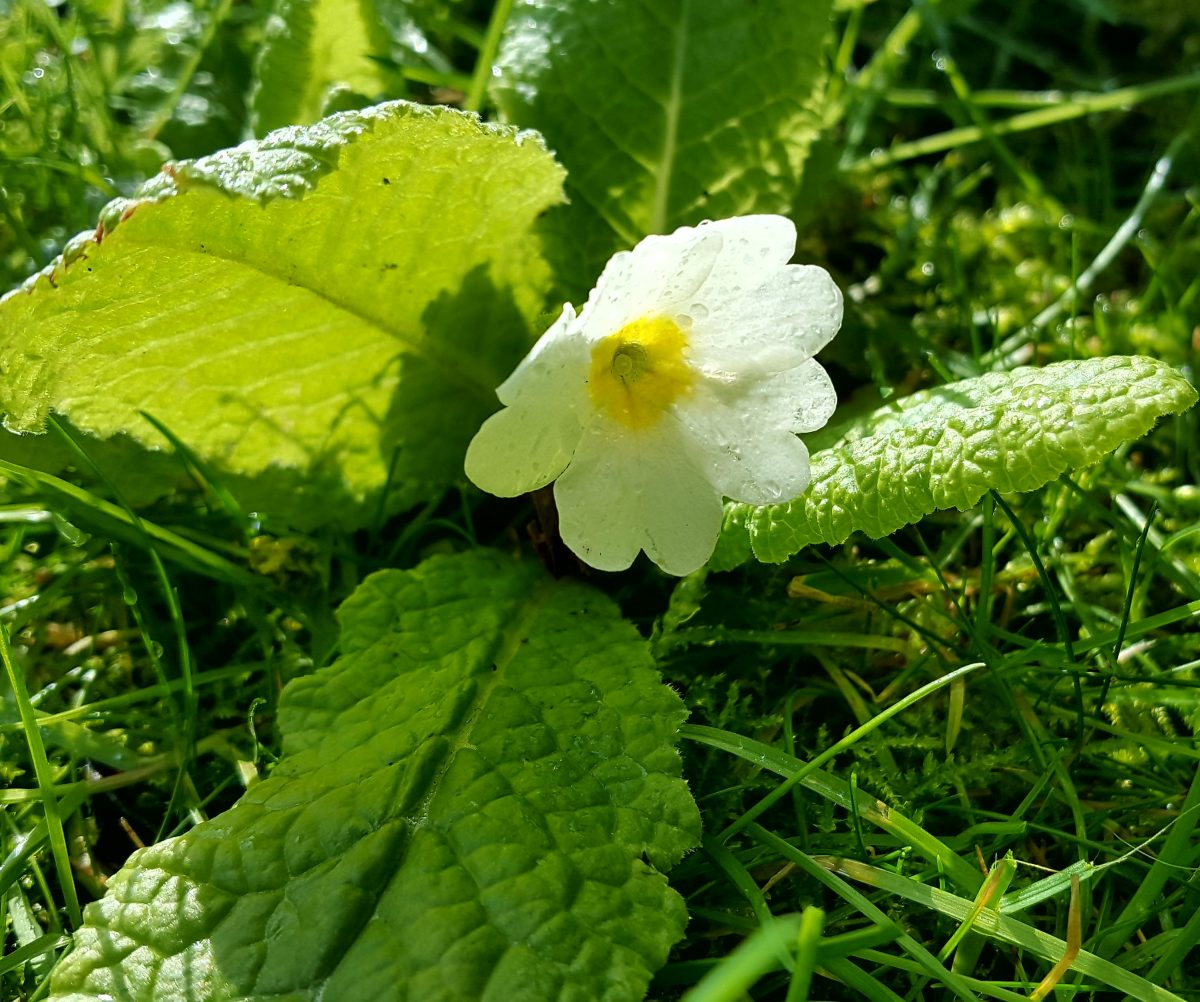
Primrose flowers are a sweet scented delight to find when you are out foraging
The delicately-scented primrose flowers are popular bedding plants, always available at Easter.

Primroses, or at least primrose bedding plant sales, are often associated with Easter. I like to think that our Western European pagan ancestors would also have gone foraging primrose flowers, to celebrate the much more ancient spring festival honouring the goddess Eostre.


What’s in a name?

Both the English common name and the scientific name tell us of its early season flowering habits. The generic part of the botanical name – Primula, comes from the Latin word ‘primus‘, meaning first.

The specific part if the name – vulgaris, simply means common or garden.

Our English common name ‘primrose’ is therefore self-explanatory…even though it’s not a rose family plant.

Botanical description to identify primrose

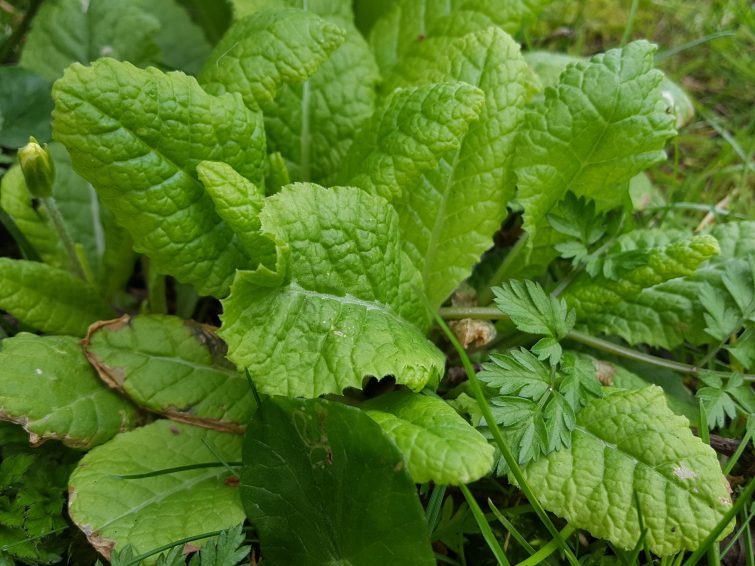
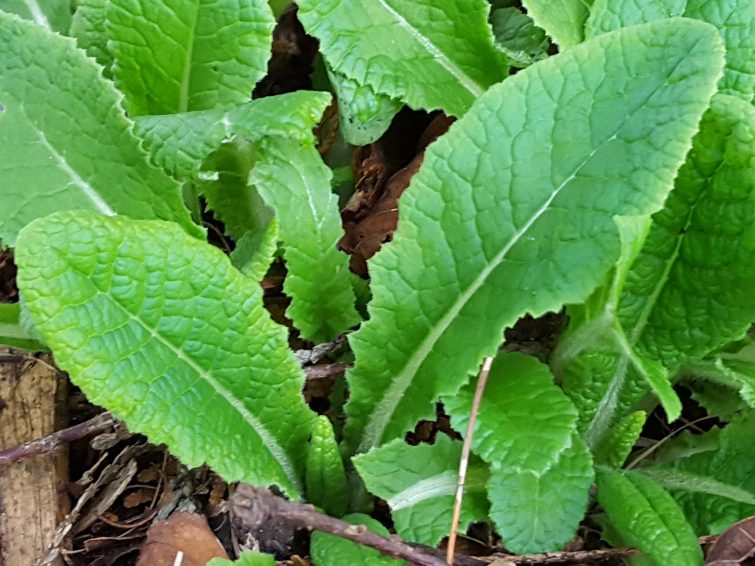
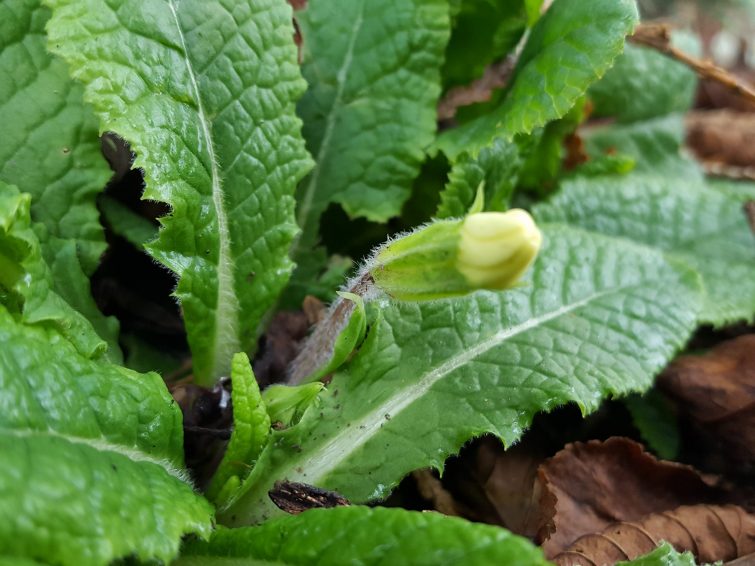
Leaves: The leaves on mature plants will overwinter as untidy-looking  rosettes, although new leaves also start to appear in the late winter.

Primrose leaf rosettes can be found over-wintering
Primrose happily over-wintering in Wolvercote, Oxford, in mid January.

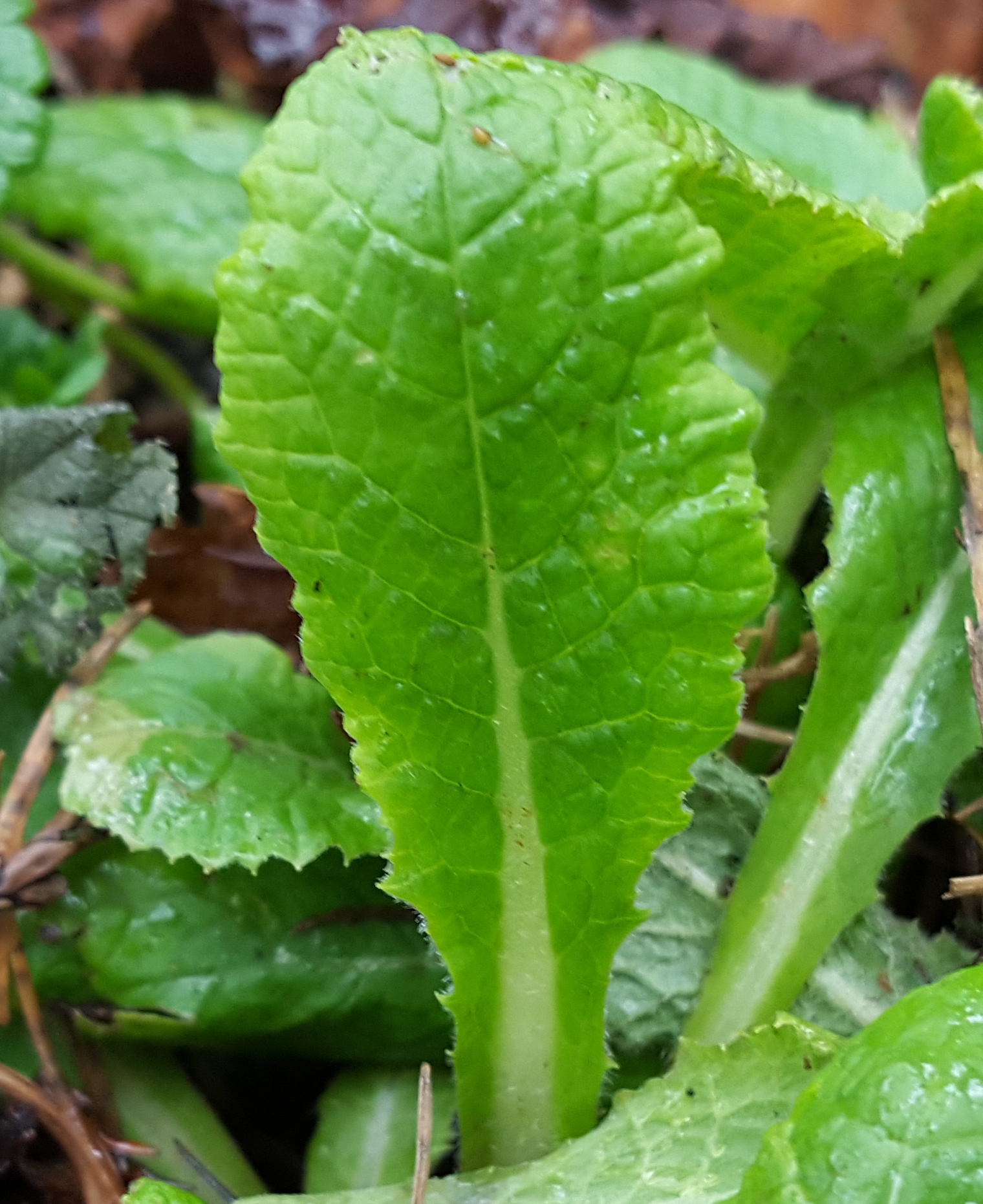
The leaves emerge rolled. When unfurled, they are typically obovate to spathulate-shaped. Their white mid-rib is broader at the base and tapers off near the apex.

primroses have broad, hairy and wrinkled leaves
Primroses have broad, hairy and wrinkled leaves that l emerge rolled.

The hairy leaves are often wrinkly and a little crinkly at the edges, a bit like myself. The margins have numerous teeth and tiny white hydathodes at their apex.

The wide leaves taper towards the base, while the distinctive white mid-rib tapers towards the apex.
Primrose has a distinctive white mid-rib that tapers towards the apex.

Petioles: No.

Roots: A perennial rhizomous rootstock.

Stems: Each flower is held on a thin and hairy, drooping flower stalk. This extends to approximately 10 – 15 cm long. Each plant produces numerous flower stalks.


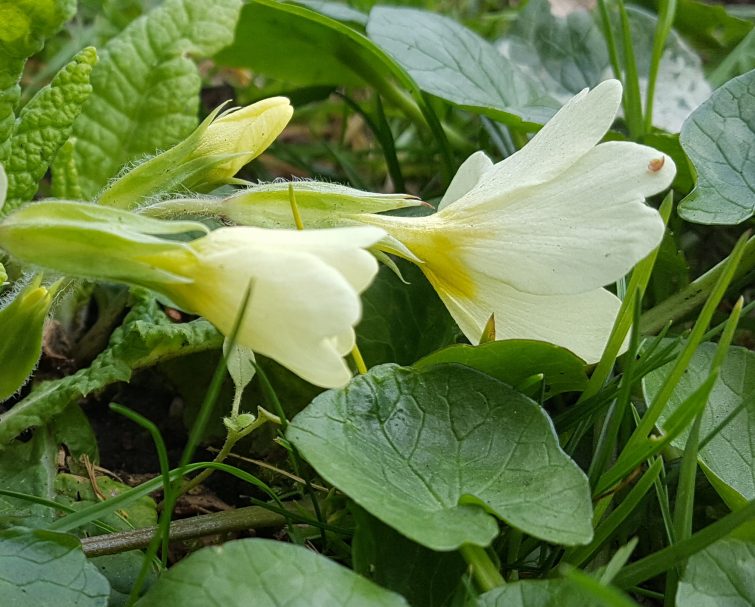
Flowers: The flowers are delicate-looking, but hardy enough to survive the sometimes biting-cold March weather. Primrose flowers have stunning light-yellow, notched petal lobes, fused together in a corolla tube.

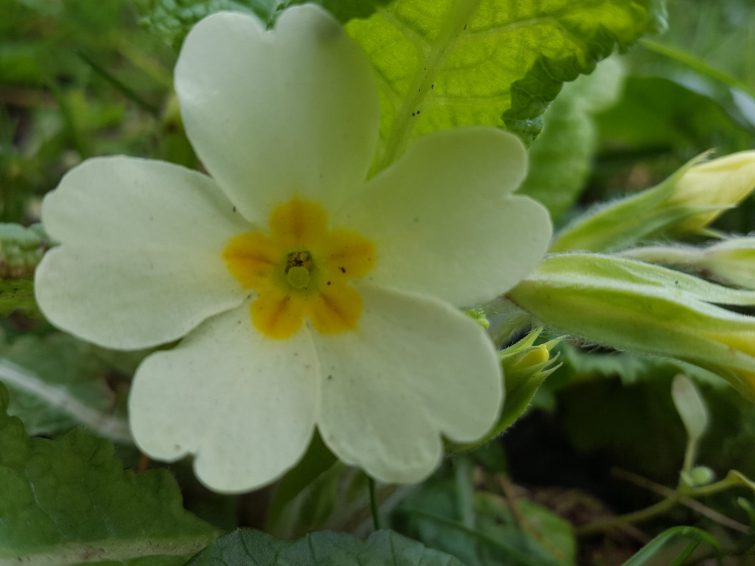
In the centre of the flower is the beautiful two-tone orange spot. The corolla sits in a long, green and hairy calyx with five pointed lobes.

Primrose flowers are held in a long, hairy calyx tube with pointed lobes
Primrose flowers are held in a long, hairy calyx tube, with pointed lobes.

A yellow, flat and round-headed stigma is visible in the centre of the flower. Sometimes the pollen-loaded anthers are found above the stigma, sometimes below.

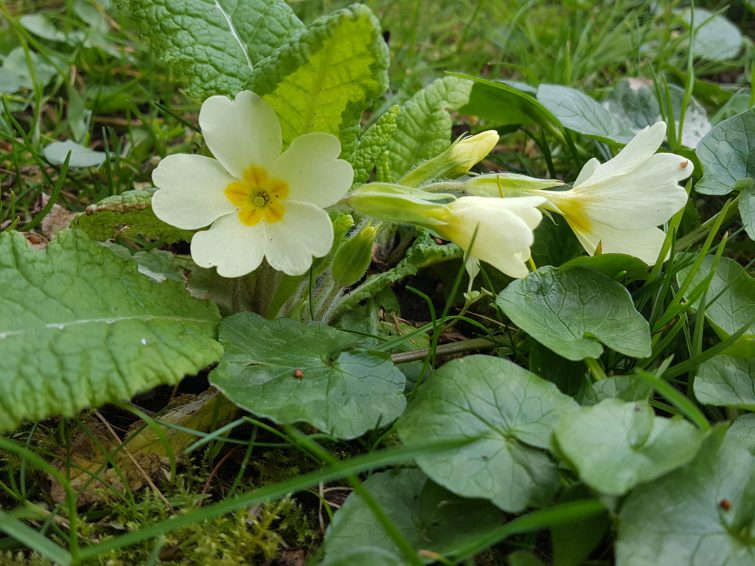
The notched, fused petals of primroses with their two-toned orange spot in the centre
Primroses have five petal lobes and a two-toned orange spot in the centre.

Flowering season: March and April. During flowering they are a food source for butterflies.

Fruits: The small seeds ripen to a black colour, maturing in round seed pods. The seeds are distributed by ants.

Habitats: This plant loves a damp and shady spot. These will include woodlands, copses, hedgerows, grassy banks, parks and gardens. It can be found in all areas, but for the highest mountains of Britain. The plant is an indicator of ancient woodland.

Parts used: The flowers and young leaves.

Harvesting: Collect the young almost-open flowers by pinching them about halfway below where the petals fit in the calyx tube. The corolla should slide out easily enough. Leaves are best harvested when very young and tender. In my harvesting guide you can discover more tips and tricks on picking our wild plants.

Edible uses: The flowers can be tossed into salads. They are popularly used to make crystalised sugar flower treats, using egg white and sugar syrup. These are often added as decoration to cakes. Many country wines are made from the flowers. I like to make infused vinegars and cordials with them too.

The leaves can be added to salads when young. Otherwise, they get too tough and bitter. To my palate there are hints of lemon in the baby leaves.

Medicinal uses: Traditionally used for a range of conditions. The whole plant has been used to treat all manner of muscular cramps, spasms, and rheumatic pains. More information on primrose can be read here in Mrs Grieves’ classic “Modern Herbal”. You may also like this overview on medicinal plant chemistry.

Other notes: Primrose can occasionally hybridize with other common relatives such as the cowslip (P.veris) and the oxslip (P.elatior).

If you liked this article and are just starting out foraging then why not dive in and discover how you can identify thousands of plants in a day!


Happy foraging!


Foraging in March for Britain’s Wild Foods.

At-a-glance UK wild food guide to foraging in March.


Foraging in March starts to get me really excited, because the long winter wait for abundant fresh new growth is almost over… almost!

Hopefully, by the time we reach the spring equinox, with the days and nights of equal length, we are able to pick and choose from many dozens of wild plants. We also know that summer is only three months away.

So, now we are rapidly returning to one of the busiest times of the foraging year (unless that is, we are experiencing bitterly cold ‘beast from the east’ winds and its associated snowy conditions).

As ever, the weather in Britain is extremely changeable and dominates what we will or won’t be foraging.

If you have watched my video on violet flowers then you will know some plants react in their developmental stages solely to daylength, rather than temperatures.

This means we will generally find them doing their thing, pretty much right on cue, no matter the weather. Other plants are the opposite and will be slowed and checked by low temperatures. 

One of the finest flavours for me at this time of year will be found on the flowering currant…a plant I immediately started calling the ‘thyme n sage’ currant a few years back, for reasons that will soon become apparent.

None of the following March plants are too tricky to identify, especially when using my handy, waterproof, field-guide style, I/D cards. These pocket-sized cards should help fine tune your field skills, and make you more confident when identifying unknown plants in the wild.

Learning the easy-to-remember plant family patterns in part one and part two of  my ‘how to identify plants articles will also increase your abilities to positively I/D plants when out foraging this spring. As will knowing Britain’s poisonous and toxic plants.

So then, what plants can be easily found when foraging in March?

Wild food foraging in March

Get stuck in with these nine tasty wild plants to find and try! Beginners can be helped on their way with my guide to starting out on your foraging journey.

To help you and the plants, there is a basket full of useful harvesting tips and tricks that can be accessed here.


Wild chervil  (Anthriscus sylvestris) Apiaceae family.

wild chervil is so common that it is practically unavoidable when you are out foraging in March
Wild chervil is practically unavoidable when you are out foraging in March.

The tender young pre-flowering stems of wild chervil are one of my all time favourite wild food trail snacks. This full length article shows how to confidently identify this most common of all our wild umbellifers.

Common hogweed  (Heracleum sphondylium) Apiaceae family.

For me hogweed is one of the yearly foraging treats, and a plant that should be abundant by the end of March.
Hogweed is one of the yearly foraging treats, and should be abundant by the end of March.

Another fantastic wild vegetable that you can find in abundance when foraging in March. The young leaf stalks are a truly delicious wild food, as Roger Phillips mentions in his classic “Wild Food” book, now reprinted as a hardback.

Hogweed can easily be found and identified all over the country, and provides numerous other tasty plant parts during the year. Watch this space for an upcoming full length article!


Nettles (Urtica dioica) Urticaceae family.

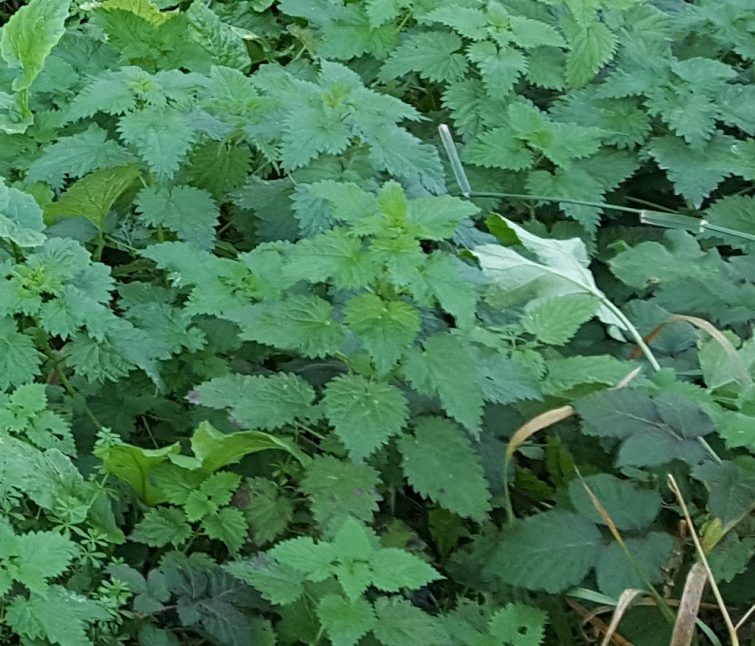
Nettles appear in.huge numbbers during March, and the top sets of leaves are used.
Nettles start to appear in huge numbers during March. The top two sets of leaves are best.


This is a brilliant wild plant. Not only is it a nutritious food and valuable medicine, it is great when made into a liquid manure for the garden, as well as providing strong fibres to make an excellent string and rope substitute.

Known by everyone, nettles will never be hard to find. This is a fantastic plant that has a high nutritional content, being rich in iron, protein, Vitamin E and calcium, amongst others.

As a food it makes a great cooked green. Try replacing spinach with nettles in a saag aloo, and have a go at using the leaves to make a crisp, refreshing, and tasty beer.

As a medicine nettles can help pregnant and breast feeding mums keep their own mineral levels up. For us men, it can keep the prostate healthy, as my upcoming article will reveal.

Clove root / wood avens (Geum urbanum) Rosaceae family.

Clove root is easy to find when foraging in March. You will need landowner's permission to harvest roots, which need to be used fresh.
Clove root is easy to find when foraging in March. The aromatic, fibrous roots need to be used fresh.

This small herb has roots with big flavour. You can find the plant growing happily over winter. During the colder months it grows as rosettes, both in woodlands, and in any available nook and cranny in the urban environment.

March is likely to be the last good month in which you will be able to harvest its aromatic fibrous roots as it will begin to flower during April and May. Due to the magic of plant chemistry, these thin, creamy white roots smell very similar to cloves. This warming flavour can only be captured when the roots are fresh. Once dried, the flavour all but disappears.


Alexanders (Smyrnium olusatrum) Apiaceae family.

Àlexanders stems need to be harvested before the flower buds open, while the stems are tender.
Harvest alexanders stems before the flower buds open, while they are tender.

Such a versatile and welcome wild food, as my recent article showed. As this is an invasive plant, you shouldn’t have any problem getting landowner’s permission to uproot the plant in winter, for its large taproot, if you wanted to.

Try making rhubarb and alexanders jam from the tender young pre-flowering stems. Quite how they combine to develop such an exquisite and unique flavour I don’t know! The taste of this jam is similar to kiwi fruit or watermelon !


Cleavers / Goosegrass / Stickywilly (Galium aparine) Rubiaceae family.

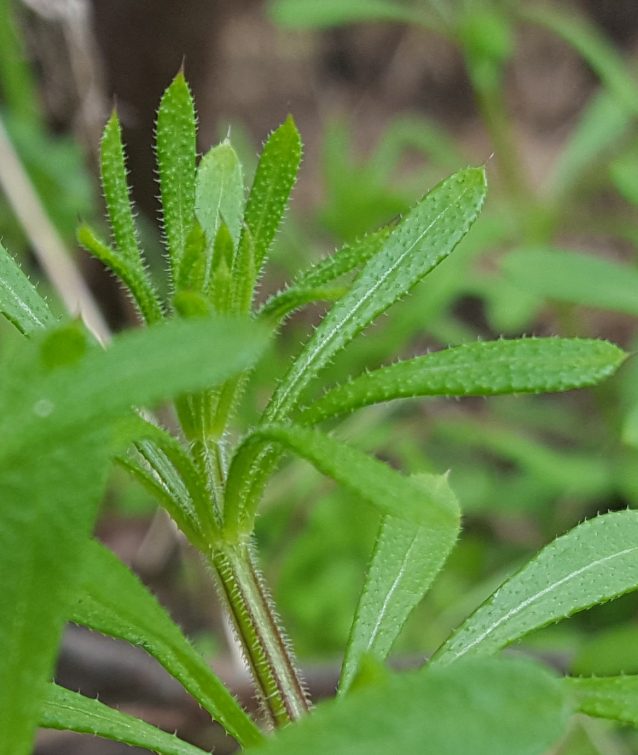
The top whorl of leaves of cleavers can be added to soups and stews. The rest is to stringy.
Only the top whorl of leaves of cleavers are worth adding to soups and stews.

You may have already read about this plant’s long-standing traditional medicinal benefits. Herbalists know it as one of the best spring tonics there is. Cleavers acts on the lymphatic system, helping to rid the body of accumulated waste products that can build up over the winter months when we are more sedate.

Pick all of the above ground parts for medicine, but only the very top whorl of leaves for food, unless you can be bothered to strip off the leaves. This is because the plant quickly gets fibrous and inedible.


Rosebay and greater willow herbs (Chamerion angustifolium / Epilobium hirsutum)  Onagraceae family.

Willowherbs begin re-appearing from their perennial roots during March.

Either the rosebay or greater willow herb shoots can be used, although the flavour of rosebay is less astringent. Greater willowherb has square stems, and opposite leaves. The rosebay has round stems and a spiralling leaf arrangement. Remove the shoot by cutting with a knife, an inch or so below ground. Strip the leaves off before using. Try steaming, frying, or lacto-fermenting. 

Cherry plum blossom (Prunus cerasifera) Rosaceae family.

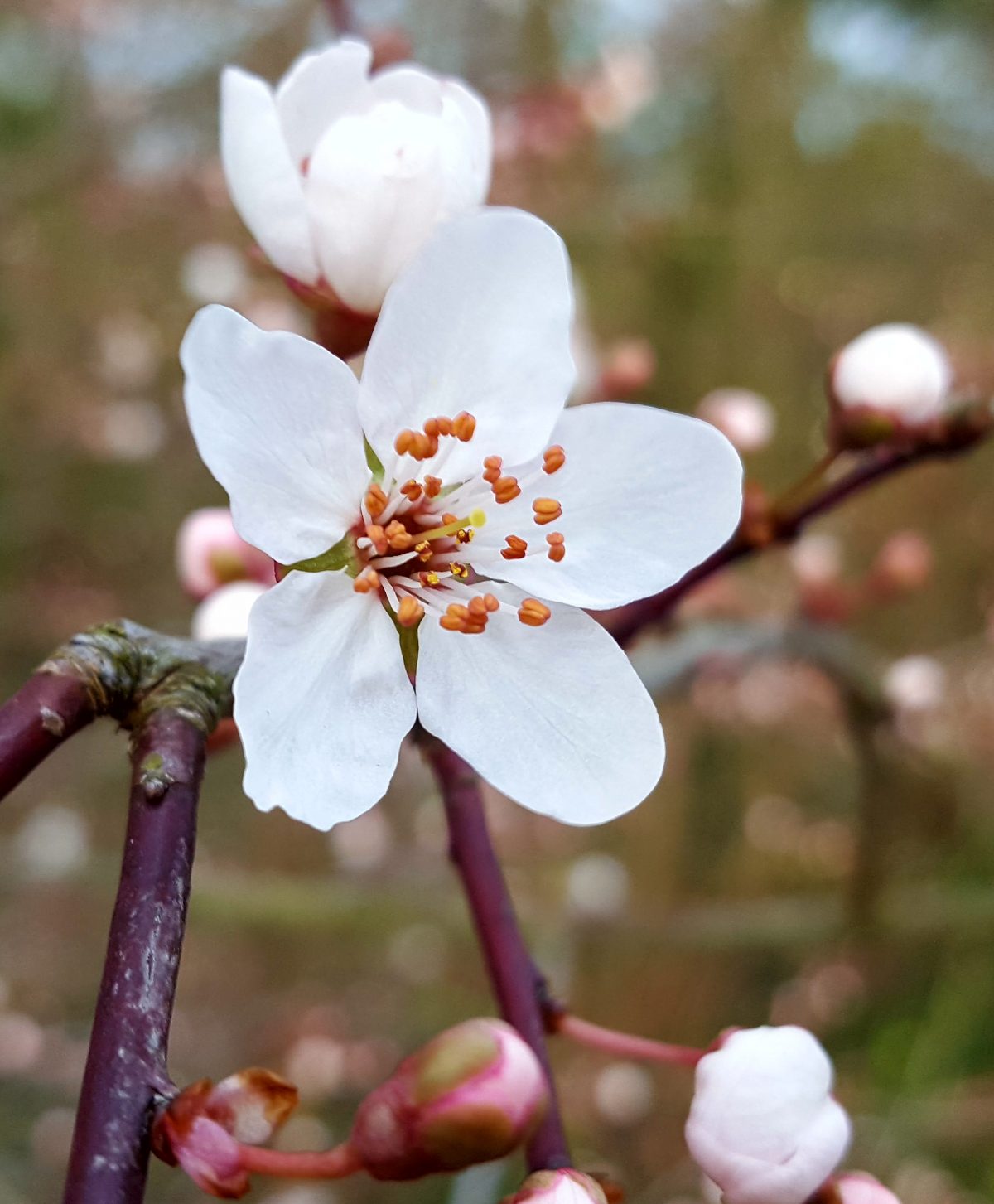
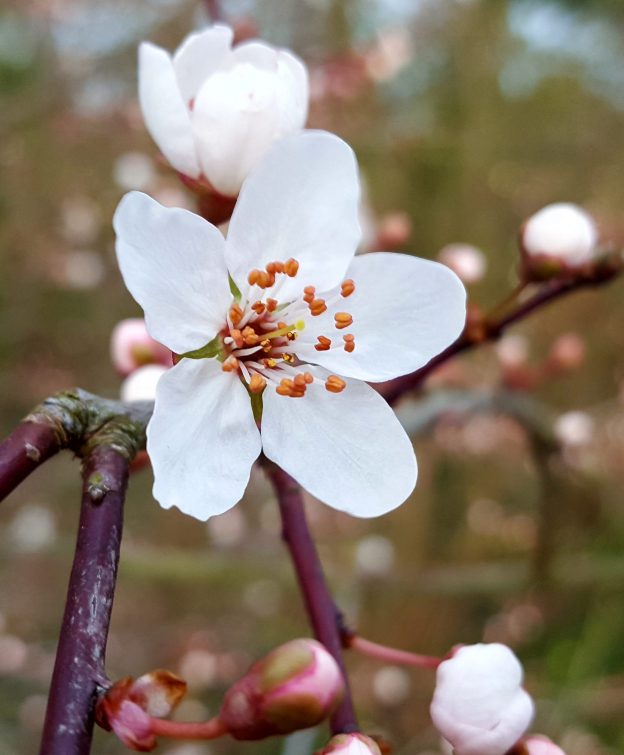
The pink flushed buds and orange-tipped stamens of cherry plum help to distinguish it from its close relative, blackthorn.
The pink flushed buds and orange-tipped stamens of cherry plum.

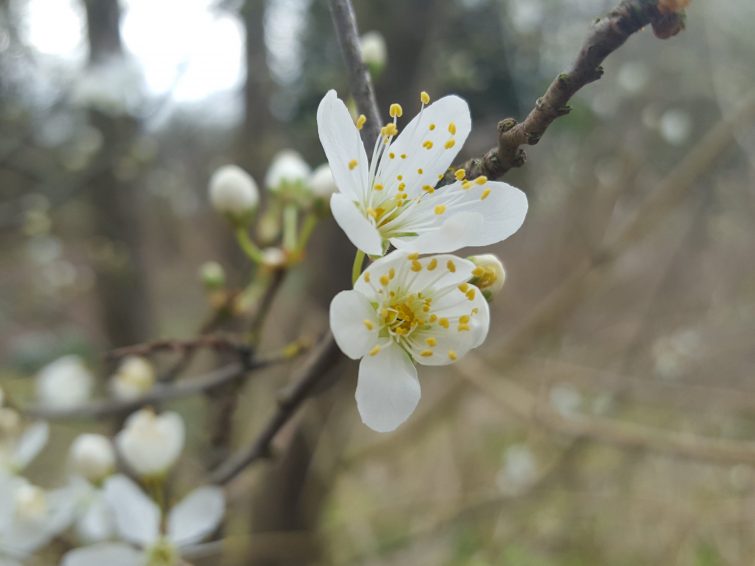
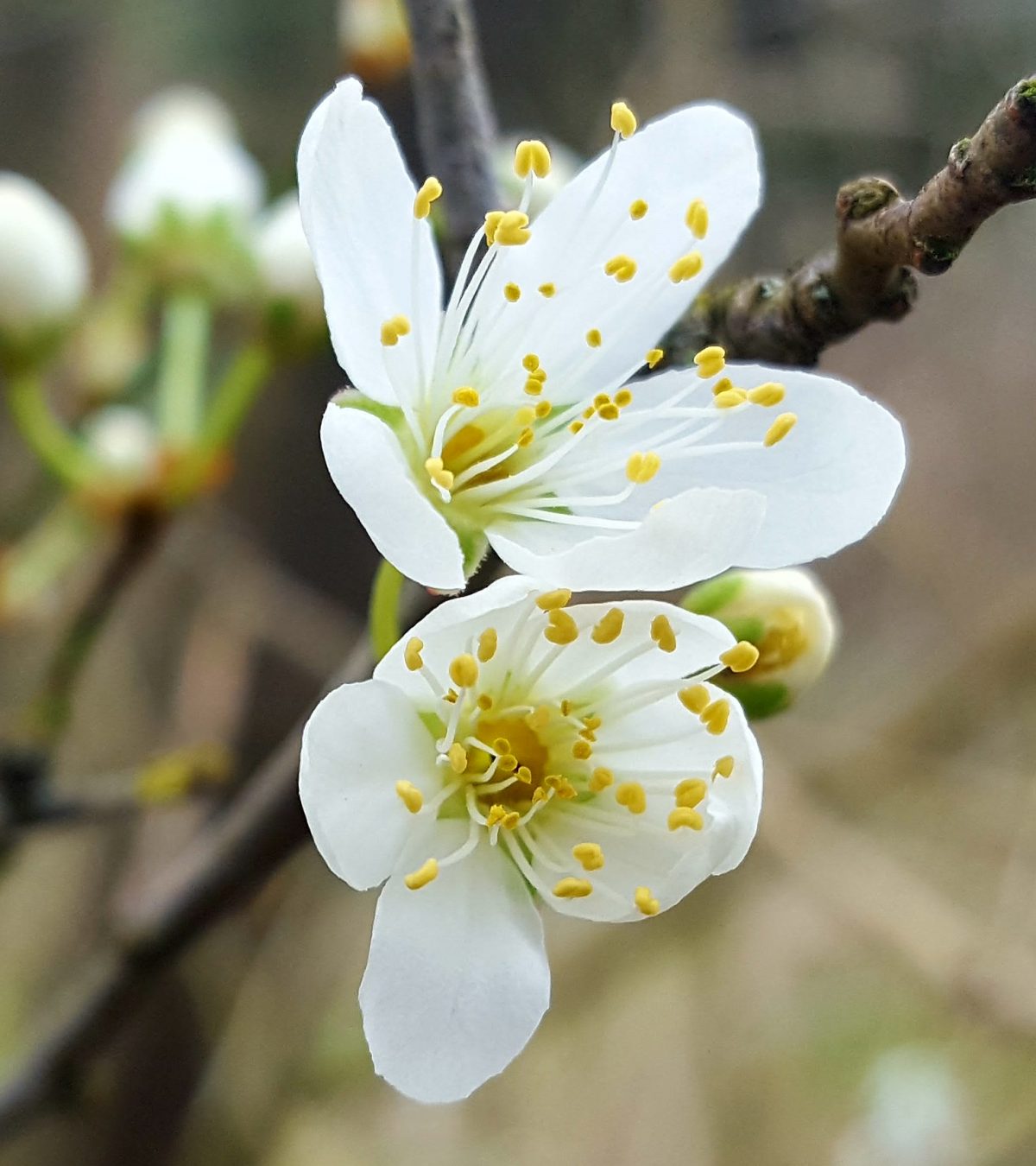
One of two beautifully almond-scented Prunus species available, as we turn into March.  The cherry plum has pink flushed flower buds, and sometimes very pink petals and orange tipped stamens. Compare this to the white petals and yellow tipped stamens displayed currently on blackthorn flowers.

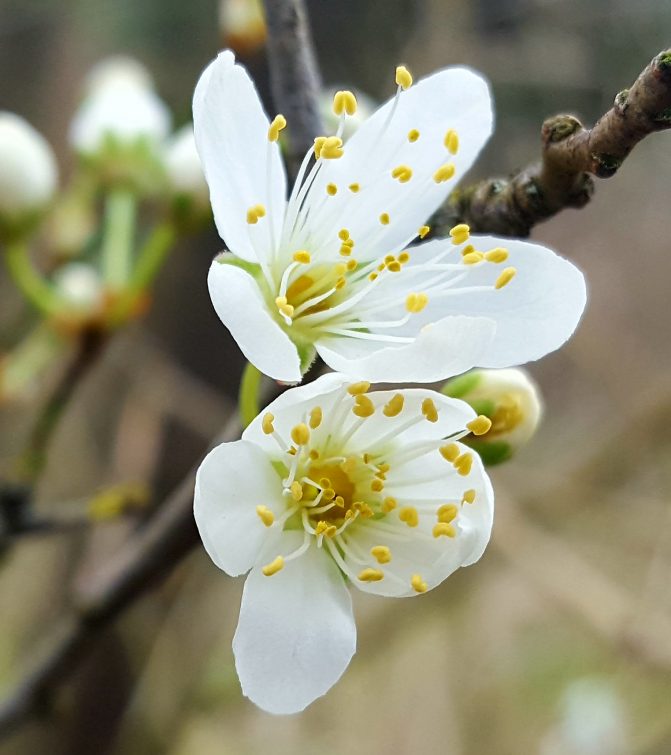
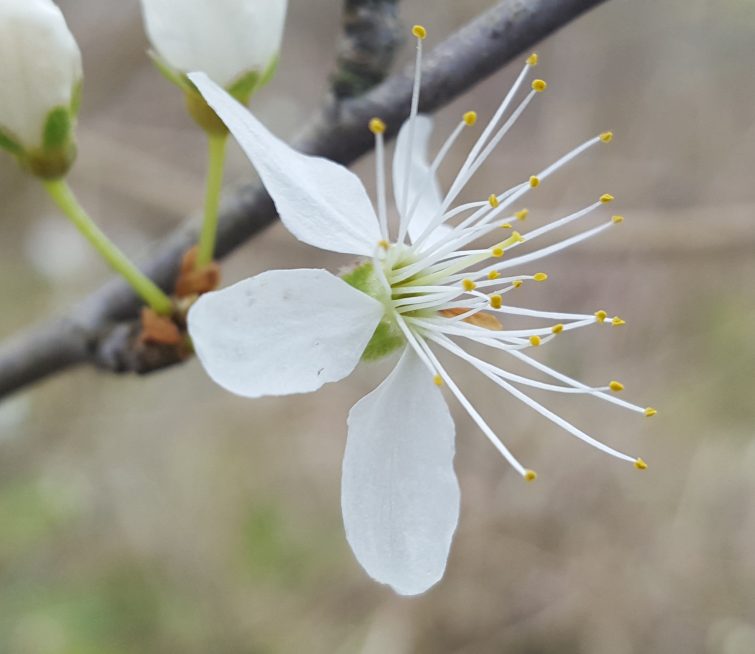
Blackthorn flowers showing their yellow-tipped stamens.


Silver birch sap and twigs. (Betula pendula) Betulaceae family.

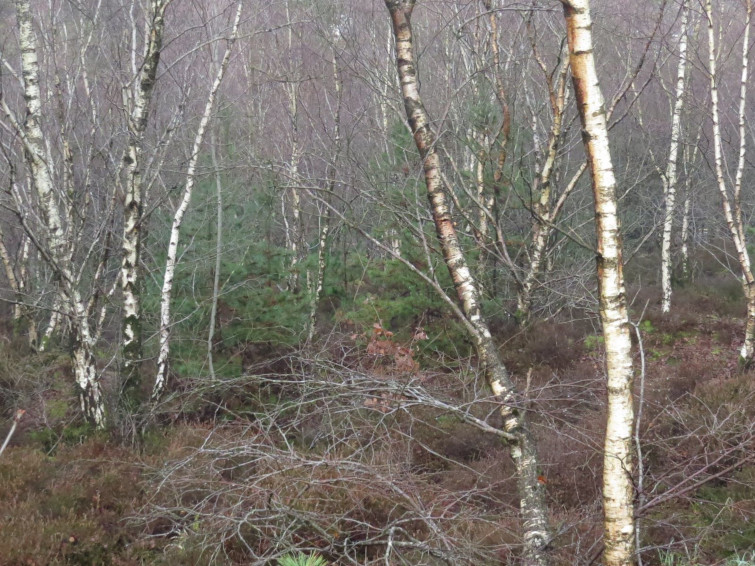
Silver birch offers plentiful supplies of sap to tap in early spring
Silver birch offers plentiful supplies of sap to tap in early spring.

My travelling lifestyle has usually meant me not having many possessions and nowhere to store them close to where I live. So I have yet to tap birch. For a fantastic appraisal on the pro’s and cons of tapping birch, and the alternative method of using the thinner branches, instead of drilling invasive holes into the trunk, take a look at the one and only ‘Fergus the forager’s’ article.

March mushroom of the month

Oyster mushroom (Pleurotus ostreatus)

An easy to I/d edible mushroom, although there are a number of closely related edible species in the genus Pleurotus.

This fine edible mushroom can be found all year round, and it’s often easier to find when there isn’t so much else growing.

Being a bracket fungus, you will probably find it ‘shelving’, with one fruiting body directly above another, on both the standing and fallen trunks and boughs.

The oyster mushroom cap is grey and its closely spaced gills are creamy white. It can easily grow as large as your hand. The spore print should be white.


Foraging blackthorn flowers (Prunus spinosa) Rosaceae family

A guide to foraging blackthorn flowers and capturing their almond-like scent in cooking.

Our photographic guide to foraging blackthorn flowers will quickly show you how to confidently identify this almost ever-present hedgerow species, also commonly known as the tree that gives us sloe fruits.

Certain trees evoke quite strong feelings and emotions in me, catching my full attention and almost demanding I come closer, to touch, smell and taste them. I make no apologies here for repeatedly mentioning that you always need to engage each and every one of your senses when foraging!

Identifying trees in the winter can be impossible unless you know the form of the tree really well, or are prepared to start looking really closely at the minute features.

When you are starting out, study all of the plant parts. Observe the buds, and their arrangement on the stem. Are they opposite or alternately spaced? Look at the young bark and the older bark, as well as the branches. Always take note of their lenticels, including size, shape, colour, and patterning.

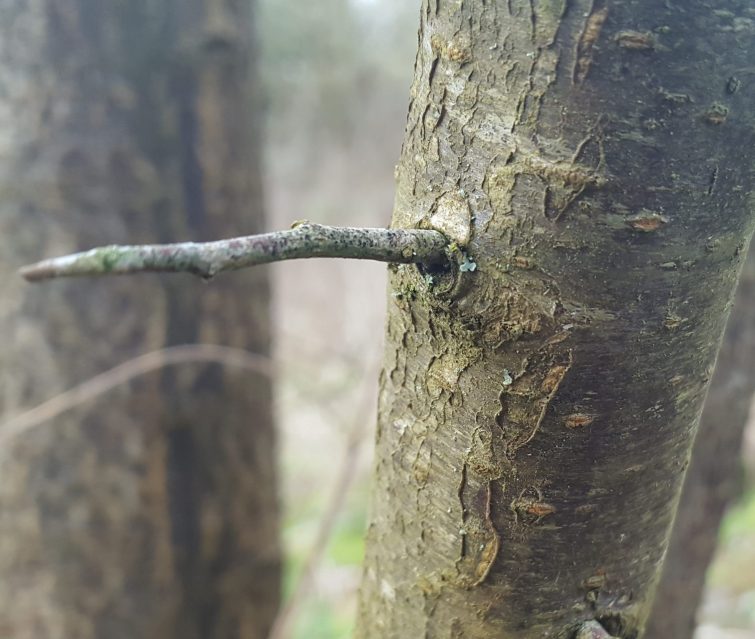
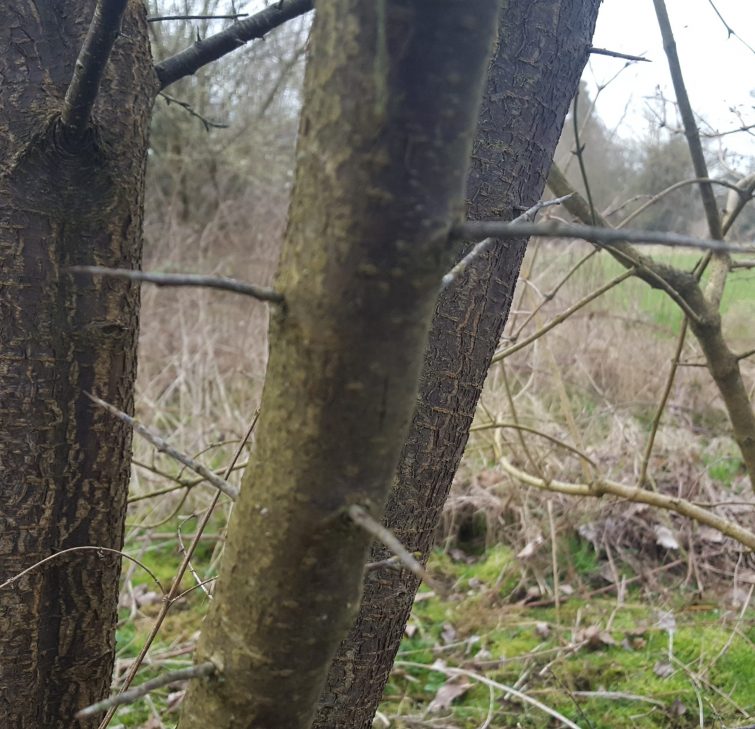
While its true that many other shrubs and trees in Britain have thorns, and believe me I have bled from most of them…none are quite as vicious as blackthorn can be.

Take extra care when foraging blackthorn flowers. Its spines can be particularly nasty if you snag yourself on one!
Take care when foraging blackthorn flowers, as the spines can be extremely painful!

Warning! Although the plant is not poisonous to eat, the spines can potentially be really nasty if you accidentally puncture your skin with one. Take extra care when you are foraging blackthorn flowers, and wear strong gardening gloves for extra safety if you fancy.

The blackthorn definitely lives up to both its scientific and English common names
Spiny by name, thorny by nature, blackthorn lives up to both its names!

Microbes living on blackthorn spines are thought to infect your blood, and if left unchecked and untreated, blackthorn punctures, esprcially where some plant material remains in the body, has in the past, led to sepsis and death.

However, these Vets and equine hospital specialists in Leicestershire, believe the pain and swelling comes from an array of alkaloid substances on the spines. Stay alert and safe!

All change in the hedgerow

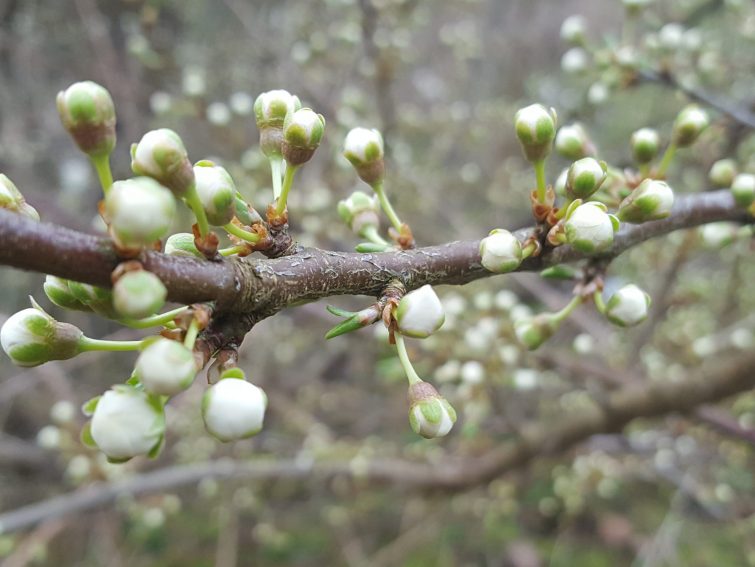
In the warmer, protected regions of Britain, from late February and early March, this plant transforms itself in front of your eyes. From a hard, wiry-spiny, uninviting thing, comes a soft and fluffy-looking, sweet-smelling, late-winter wonder.

In the space of a few days, blackthorns transform from uninviting to warming the cockles of my heart.
In just a few days, blackthorn transforms from an uninviting plant to one that warms the cockles of my heart.

I absolutely adore the scent of the flowers! When wandering past a blackthorn tree on a sunny warm day in March, it makes me want to eat Bakewell tarts, and drink Amoretto and Brandy hot chocolate!

Bud burst on blackthorns tell me that spring is here
Bud burst on blackthorns gently infuse rhe air with almond scent and tell me that spring is here.

Whats in a name?

The generic part of the scientific name Prunus is the old Latin name for plums – Pruñus, which is the plural of Prune. This name is now given to a number of species producing stone fruits that are botanically classed as drupes. The name was taken from the old Greek word – Pruónē, which itself can apprantly be traced back to a borrowed word from langauges in the area of the middle East previously called Asia minor.

The speficic epithet spinosa, tells us that this plant will be covered in thorns or spines.

Its common name blackthorn also tells us about its chief defense mechanism, as well as referencing the dark colour of its branches and bark.

Blackthorn botanical description

Leaves: Obovate to laneolate-elliptic in shape and quite small (approximately 2 – 1o cm long). Typically they are rolled when emerging. Sometimes minutely hairy, the leaves have numerous small teeth (anywhere between 20 to 40) on the margins.

New leaves appearing on blackthorn are usually rolled when emerging.
The new blackthorn leaves are usually rolled when emerging, typically coming after the flowers.

Petioles: This is quite short on the blackthorn. Usually between 2 – 10 mm long. Look out for the linear-shaped stipules at the base.

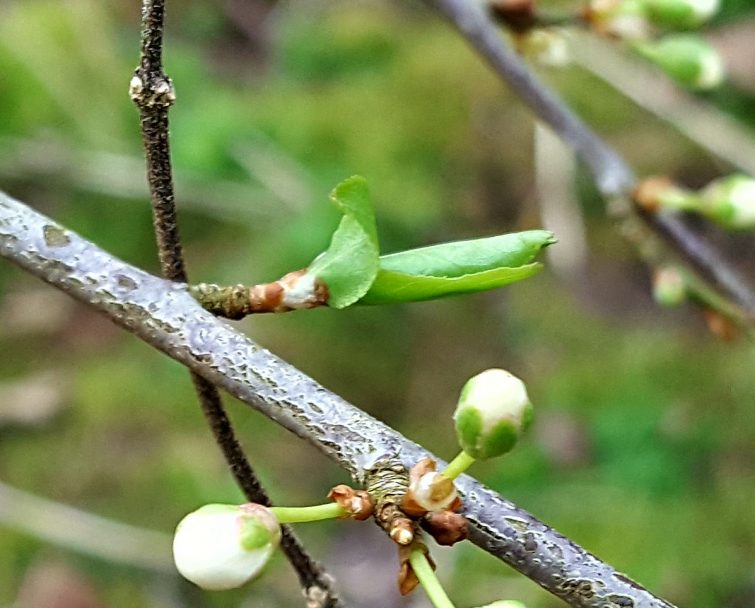
Twigs: Dark, occasionally downy, and purple-looking when they’re found with the pruinose coating on the twigs, as seen below. This thin layer of specialist protective cells is found on many unrelated plants. Over time, it will come away. The twigs often branch at 45° and 90° angles.

Toung blackthorn twigs will usually display a purple-coloured, pruinose coating. This will peel off in due course
Young blackthorn twigs are usually coated with a protective, purple-coloured, pruinose covering!

Buds: Oval-shaped, scaly, and brown. These soon turn into small pin-pricks of white and green as we pass imbolc in February.

Bark: On branches and trunks from about 4 or 5 years old, the bark becomes dark, rough and spotted with brown-orange lenticels.

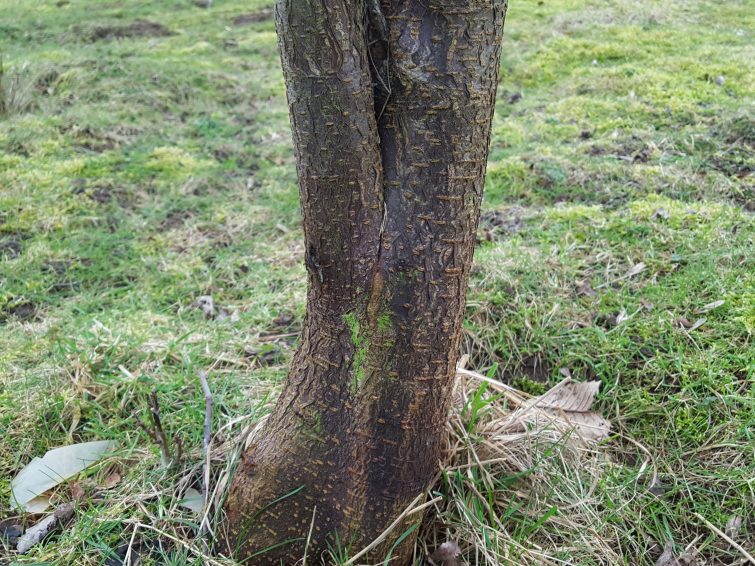
The trunks of blackthorn are sometimes multi-stemmed and often with suckers near to them.
Blackthorn trunks are sometimes multi-stemmed and often with suckers right by them.

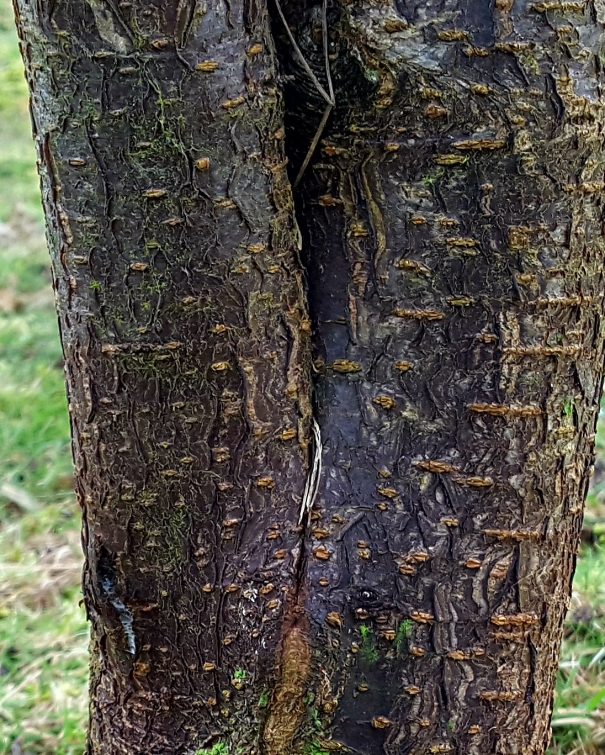
Wavy ripples appear on older branches and the young trunk. This gives way on older trunks to the familiar dark brown bark, with numerous lentils displaying as bands of thin orange stripes.

Blackthorn trunks are rough to the touch, dark coloured, with bands of orange coloured lenticels
Blackthorn trunks are dark and rough looking, with bands of orange-coloured lenticels.

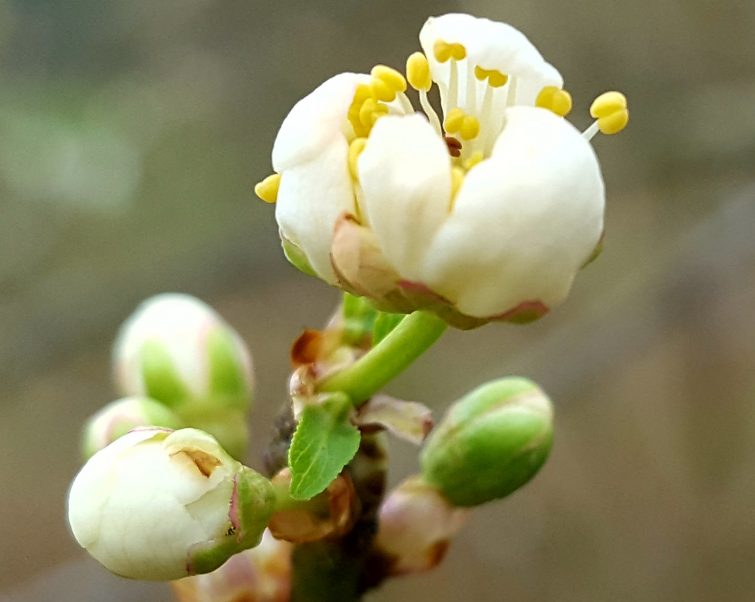
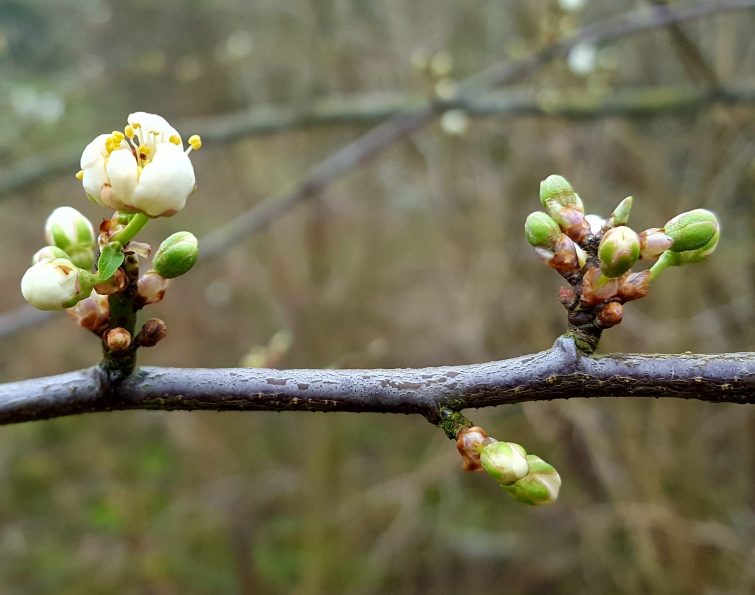
Flowers: Flowers appear on long, thin, green stalks. Typically displaying five green sepals, five white petals, and a mass of yellow-tipped stamens. A single style and stigma are found in the centre of the flower. These easy-to-spot patterns of plants are described and explained in parts one and two of my article “How to identify plants in a day”.

Foraging blackthorn flowers is best done just after opening when loaded with pollen.
Foraging blackthorn flowers is best done just after opening when they’re loaded with pollen.

Flowering season: I regularly see the first flowers in late February these days, but March was formerly the time of the first flush of flowers. Depending on location, you can still go out foraging blackthorn flowers well into April as well.

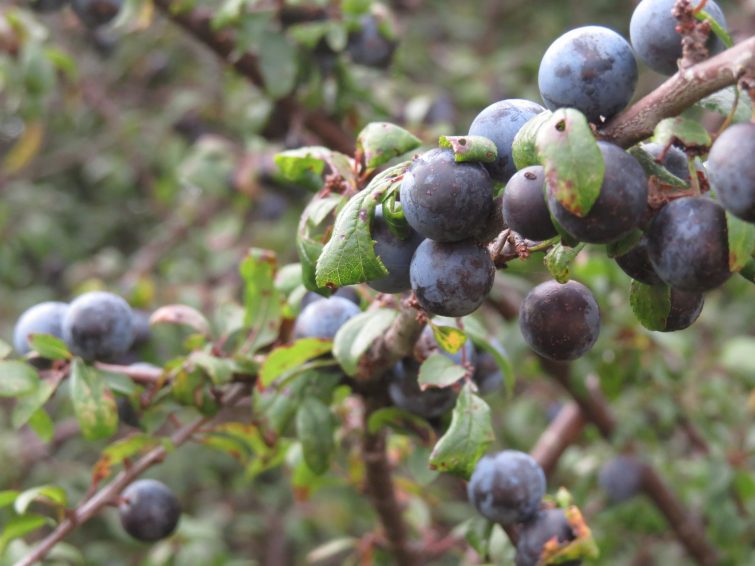
Fruits: Blackthorn produces the small, well-known, blue-purple stone fruits, commonly called sloes (10 – 15 mm). These astringent fruits are ready to go straight into gin from early October.

Blackthorn stone fruits are commonly known as sloes and when fully ripe in the autumn, make a cracking infused gin.
Blackthorn stone fruits are commonly known as sloes and make a cracking infused gin.

Habitats: The blackthorn is commonly found in hedgerows and woodland edges all over Britain, except for the very highest mountain peaks in Scotland.

Wherever it is found it can form dense thickets due to its habit of sending multiple suckers up from the roots.

Parts used: Only harvest the flowers when they are just opening, and while the anthers on top of the stamens are bright yellow, and loaded with pollen. The pollen soon goes and blows on the wind, and with it goes the almond flavour!

when you are foraging blackthorn flowers it is important to only harvest them with pollen-loaded stamens
When foraging blackthorn flowers it is important to only harvest the ripe and ready ones.

Harvesting: Simply pinch the whole flower off at the stalk, or select a few heavily laden twigs or young branches to judiciously prune off. Remember to check out all my other tips and tricks on harvesting wild plants.

Edible uses: What can you use this abundant flower full of almond flavour for? A lot! All maner of pastries, cakes and puddings can be enlivened with the benzaldehyde and hydrogen cyanide compounds responsible for the almond flavour.

Make blackthorn flower sugar syrup by infusing the flowers into warm water and melting sugar or honey into it. Use more sugar to make a cordial. The sugar syrup can be used in as many ways as you can think of.

Other notes: If you like me, love all the many different types of damsons, greengages, yellowgages and plums, then you can thank the blackthorn. They have all originated, or have been bred over thousands of years, from blackthorn.

Finally, and once more, please take extra care working around this plant…I want you to retun here just as you left!

Happy foraging!


Foraging Guide to Common Daisy (Bellis perennis)

Learn how to identify common daisy without flowers, and discover its traditional medicinal use

You might think that this foraging guide to the common daisy wouldn’t really require much description. Well, yes that’s true. At least it is when the plant is flowering.

I have tested dozens of people’s knowledge of the plant, by showing them just a leaf or a leaf rosette without flowers. Less than half of them knew the plant.

These days, the daisy is generally our constant flowering plant companion.  During the spring and into early summer, you can continuallly find, and probably have found, ridiculous amounts of them on show!

As the old country saying goes, when you can take a few steps with seven daisies underfoot, spring has truly arrived!

What’s in a name?

The English common name ‘daisy’, as many people will already know, is simply a corruption of the name ‘days eye’. Prefxing  the name with ‘common’ helps distinguish it from other daisy species such as the ox-eye daisy.

Daisies are now ever-present flowers in a warmer climate. They open with the morning light and close whenever the sun goes.

The 'days eye' opens with the morning light and closes with the setting sun.
Our common ‘days eye’  tracks the sun; opening with the morning light and closing when the sun sets.

The generic part of the scientific name, Bellis, stems from the Latin word bella, meaning beautiful. Anybody who has made daisy chains knows this to be true. The specific name perennis, simply denotes the plant as a perennial species.

During the 16th and 17th centuries, herbalists knew it also as the ‘bruisewort’, testifying to one of its traditional medicinal uses.

I like the alternative common  name in Scotland, where it used to be affectionately known as ‘bairnwort’. This relates quite how captivated children are with it, and how much they love playing with this bright little herb.

Botanical description to identify the common daisy without flowers

Leaves: Spoon-shaped leaves that taper towards the base. These are typically between  5 – 8 cm long and approximately 1 – 2 cm wide.

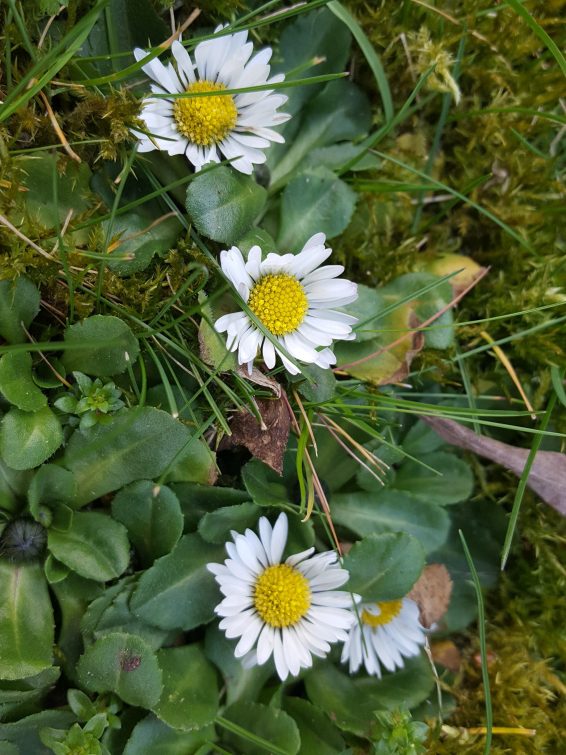
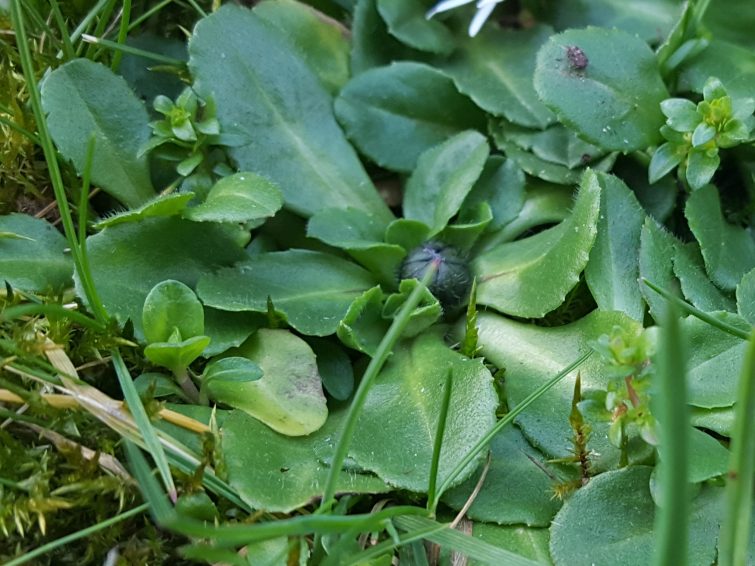
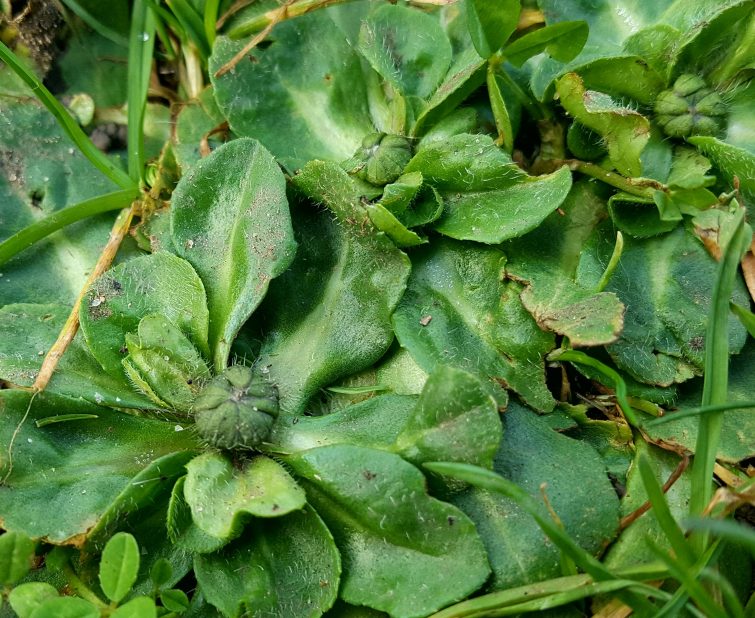
Daisy can be identified without flowers by its dark green, spoon-shaped, hairy leaves, with a few teeth on the margins
Identify common daisy by the dark green, spoon-shaped leaves with hairs and teeth.

The dark green leaves are hairy with a few teeth (usually 4 – 7) on the margins. The central white vein widens at the base. On the undersides, the mid-rib is raised.

Daisy plant chemistry has evolved bitter and aromatic components, meaning that insects don’t like eating the leaves. In occasional and regular dietary amounts, this plant is not toxic to us. There are people with allergies to this plant family, who will not be consuming, of course.

The daisy will only be seen growing leaves in rosette form. It gains a competitive advantage from its growth habit because the prostate leaves are so flat and low to the ground, nothing else can grow underneath.

Petioles: Short with a flange of leaf either side. Often purplish at the base and always with fine ciliate hairs.

Stems: Daisy flower stems are short and round. They are always without leaves, and reach between 3- 12 cm. In common with all the daisy family plants, they evolved a flower stem producing a solitary, terminal flower.

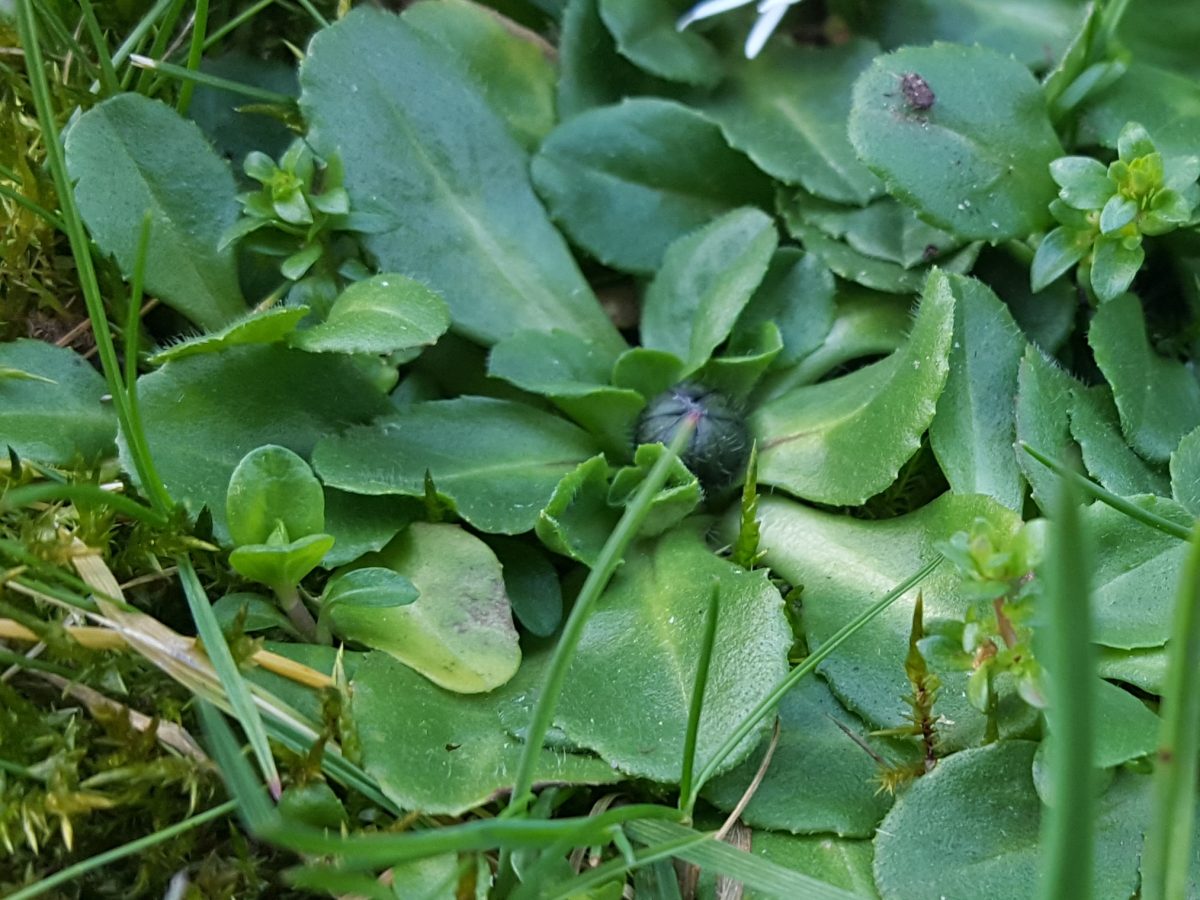
The common daisy has a single flower bud on a terminal stem
The daisy has solitary flowerbuds that appear in ridiculous numbers during spring.

Roots: This is a herb wirh rhizomes and stolons, allowing it to continually spread and colonise large areas in grassland.

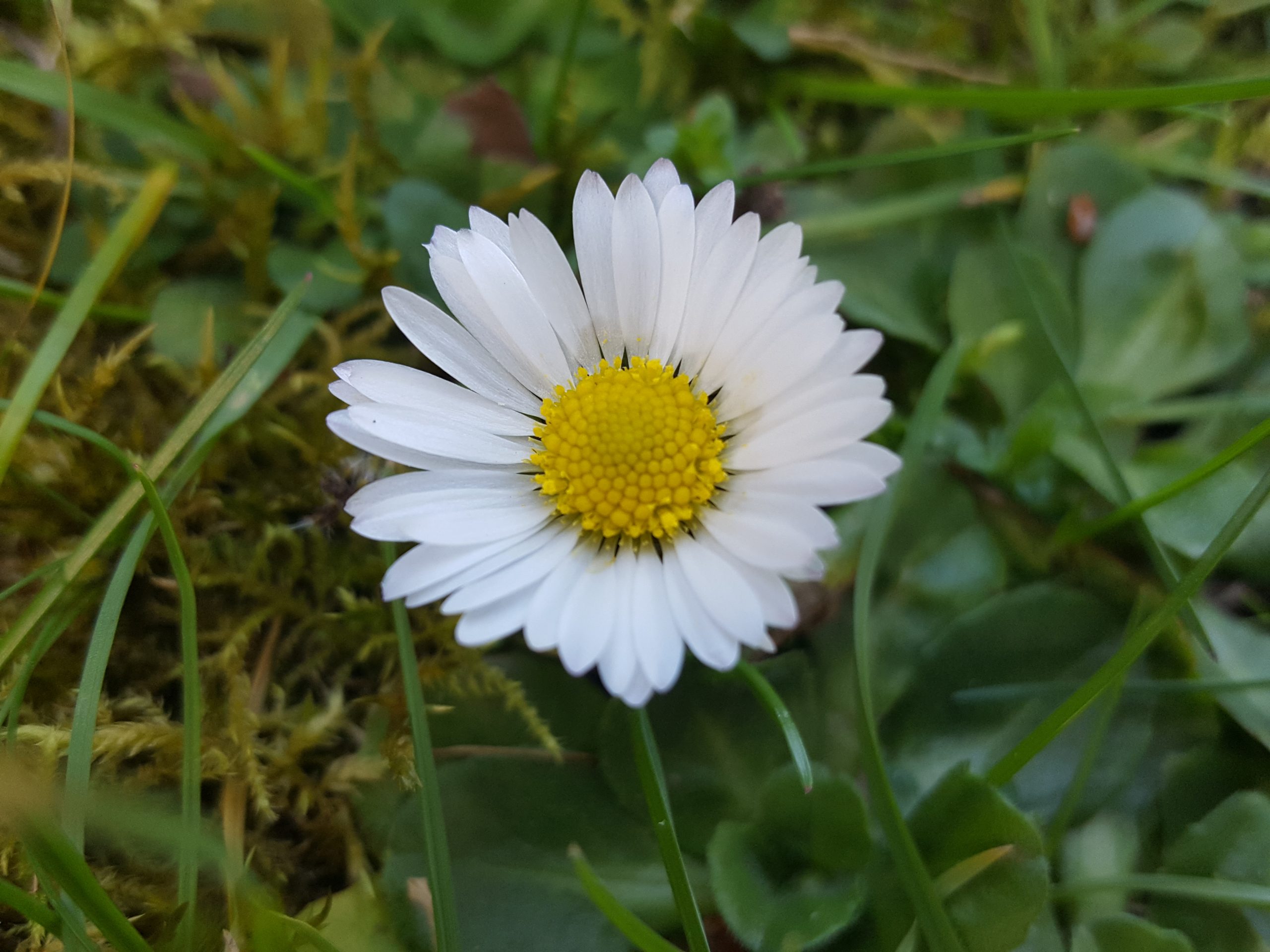
Flowers: Daisies have a composite inflorescence. The bud forms an involucre of narrow, black-tipped bracts. On opening, the white ray-florets are often beautifully crimson-tipped. These thin ray florets encircle more than a hundred yellow disc florets. The whole flowerheads are 12 – 20 cm across.

daisy flowers have hundreds of yellow disc florets surrounded by the ray florets
Daisy flowers are a composite form with more than a hundred yellow disc florets.

Fruits: After pollination the daisy eventually produces tiny dry achenes, without any white pappus hairs.

Habitats: Before humans invented lawns, the daisy evolved to populate various stream banks, edges of lakes, sand dunes, and any suitable and available setting in short grassland. In the British Isles this includes up to altitudes of 900 metres or so. These days you can find the plant in all manner of grasslands, also popping up in disturbed soils and wastegrounds.

Parts used: Leaves and flowers.

Medicinal use: Daisy has traditionally been used for wounds, fevers, numerous digestive ailments, and bruises. You can sense the aromatic medicinal qualities in its raw flavour. It is a little bitter and has astringency. Daisies can replace chamomile for topical use on young children.

Presumably we humans have been using the common daisy since those days 10,000 years ago, when ‘Cheddar Man’ was roaming around my manor in Somerset! On these islands the daisy is our native equivalent to the well-known herb Arnica montana.

Harvesting: You can collect leaves at any time of year. The leaves have a mild savory or some say, acrid taste, a little similar to the ox-eye daisy (Chrysanthemum leucanthemum). Simply pinch the petiole off at the base or snip off with small scissors. I then trim and discard the bottom 10 mm or so to reduce any stringy fibres.

Collect whole flower heads for medicinal and edible use. I sprinkle the white ray florets into salads and rice dishes. The flowerheads can be gently  decocted or infused into water, alcohols or oils, to make teas, tinctures, salves and ointments.

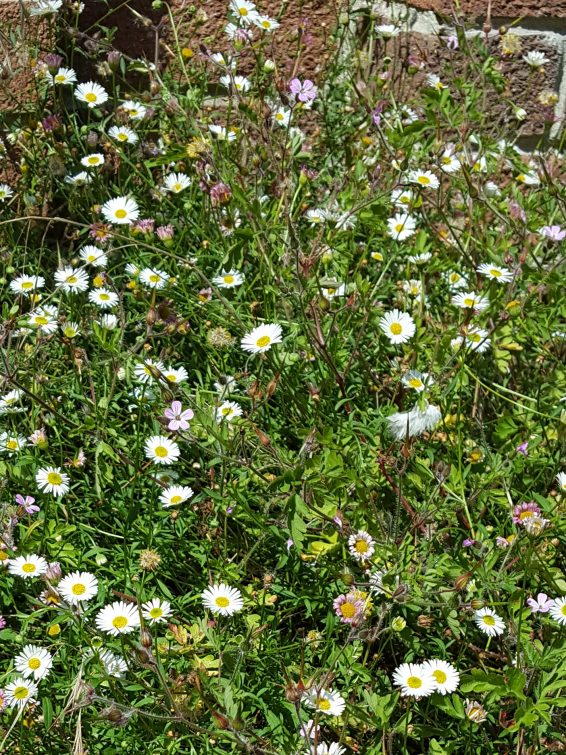
Other notes: There is another really common daisy flower you may be seeing a lot of. The Mexican fleabane’ daisy (Erigeron karvinskianus) is an imported garden plant, reportedly first cultivated here during the 1830’s. I have yet to research much about the food or medicine uses of this alien exotic.

It quickly escaped into the wild, and can now be spotted in our towns and cities all over the place, especially on different types of old stonework. It loves various rocky settings, and therefore really enjoys life by the sea.

This plant has much longer, trailing stems (to around 40 cm), and much more narrow leaves. The flowers are slightly  larger, and it grows in a somewhat sprawling mass in sunny spots.

You may come across the Mexican fleabane daisy growing in the urban environment. Knowing this plant can help you identify common daisy
Narrow leaves, trailing stems and larger flowers are hallmarks of the daisy lookalike, Mexican fleabane.

This particular plant usually appears in huge numbers growing from cracks and revices in stonework and concrete within urban areas.

More foraging guides are coming soon, on the UK’s most comprehensive foragers plant identification website.

Happy foraging!


How to Identify Red Dead Nettle (Lamium purpureum)

Read our short foraging guide and quickly learn how to identify the red dead nettle (Lamium purpureum) Lamiaceae family.

With this quick-to-read wild plant guide, you will soon be able to confidently identify red dead nettle, and then add some welcome wild greens to your diet in the winter months!

Novice foragers may be interested in our guide to starting out on your foraging adventures. I’d say it’s well worth a few minutes of your time, and might just answer a few of your most burning foraging questions.

The red dead nettle is a low-growing, often sprawling annual plant. It is one of the most common species you will find here in Britain, and belongs to a large family of mainly aromatic plants, formerly known as the Labiates. More information on our aromatic, essential oil bearing plants, is available here.

What’s in a name?

The generic part of the name Lamium comes ftom the old Greek word ‘laimos’ – meaning throat. This alludes to the shape of the long corolla tube.

The specific part of the name, purpureum, tells us of its colour.

The common name that it shares with other plants in the genus – ‘dead nettle’ -points to the similarity of its foliage to stinging nettles (Urtica dioica), and also tells us it won’t sting!

Botanical description to identify red dead nettle.

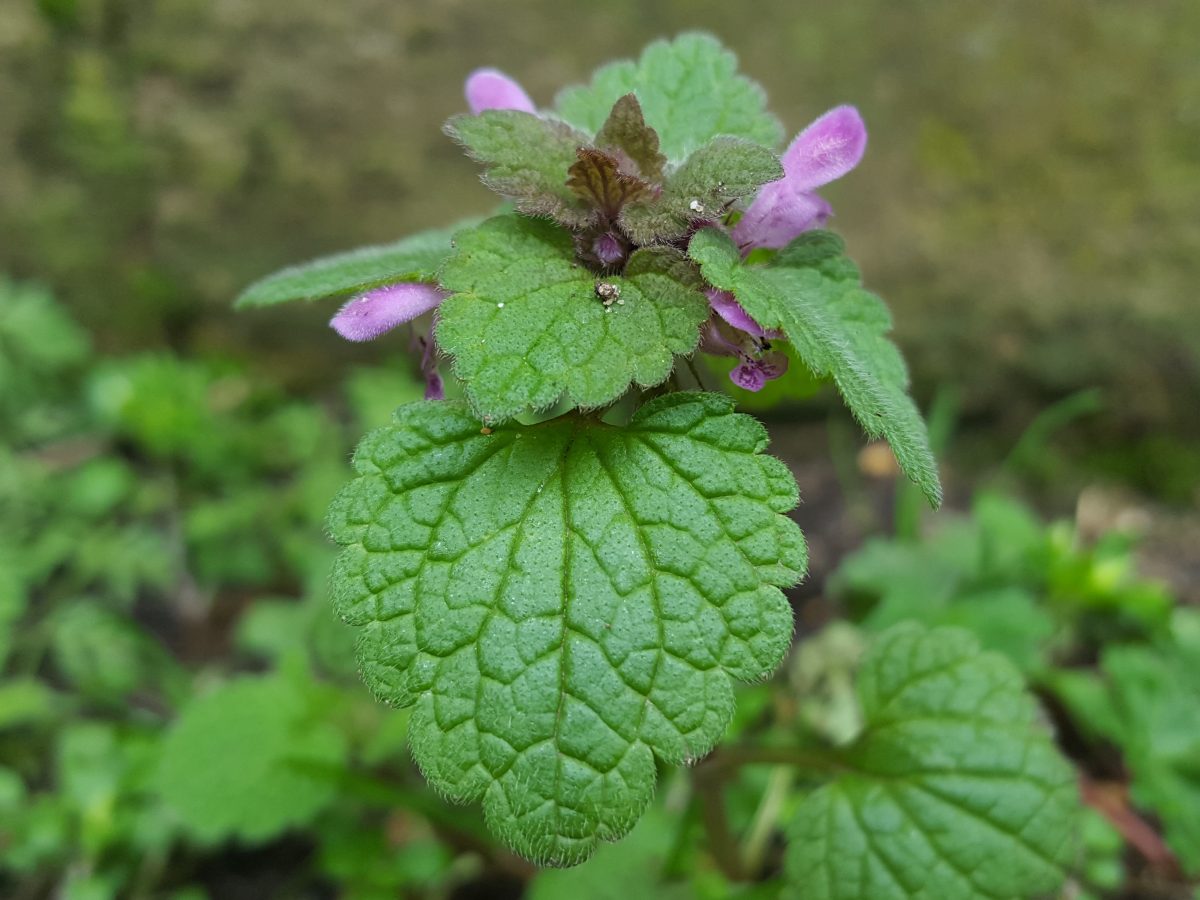
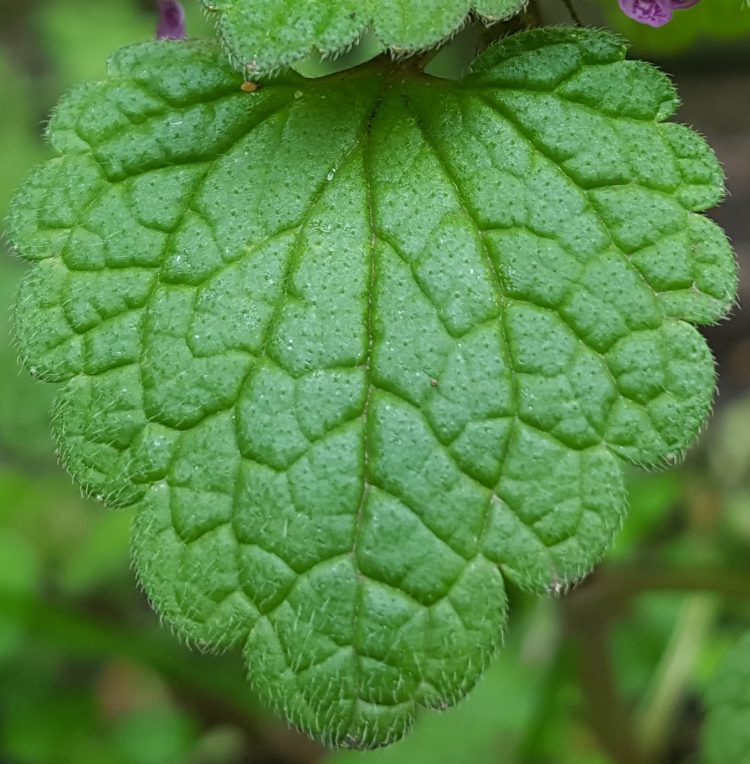
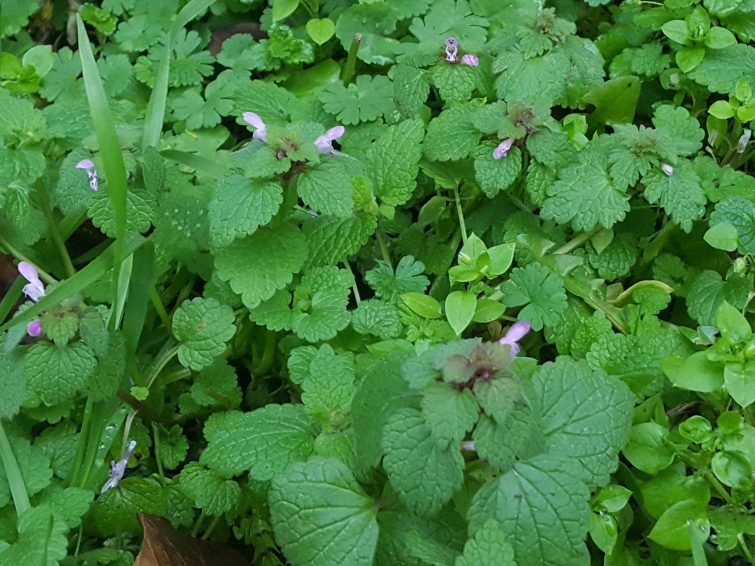
Leaves: This plant has simple, hairy, green leaves, approximately 3 cm across and 5 cm long. The leaves are basically ovate-shaped, and more often than not they are cordate at the base. The leaves are net-veined and somewhat crinkly in appearance.

The crinkly, net veined leaves are aromatic, if a little musty and earthy
The crinkly, net veined leaves of red dead nettle are aromatic, if a little musty and earthy.

The foliage is aromatic when crushed, albeit musty and earthy. Its leaf margins are crenated. Please refer to the glossary if you are bemused by the botany!

Petioles: These are quite short on the lower leaves, and are more or less absent on the stem leaves.

Roots:  The plant grows on a small tap root.

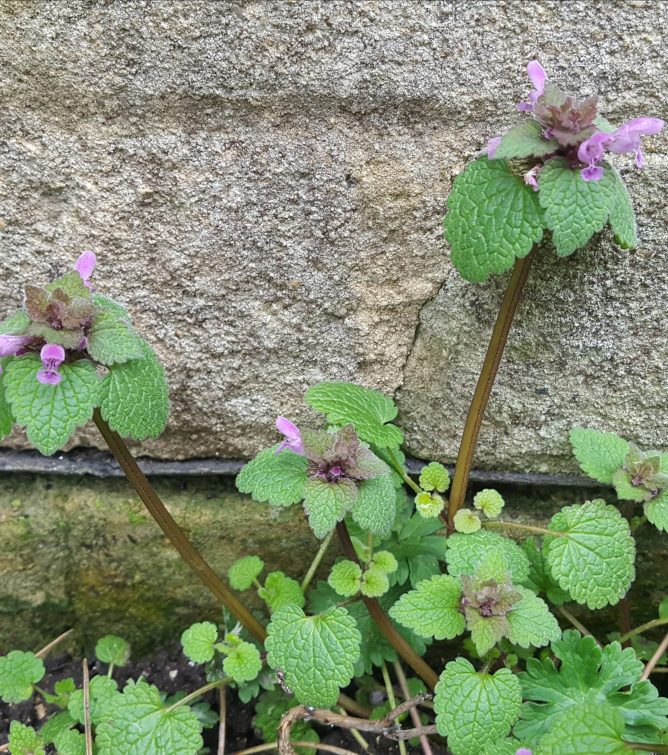
Stems: Square, hollow and  usually sparsely hairy. They will reach up to about 40 cm high in flower.

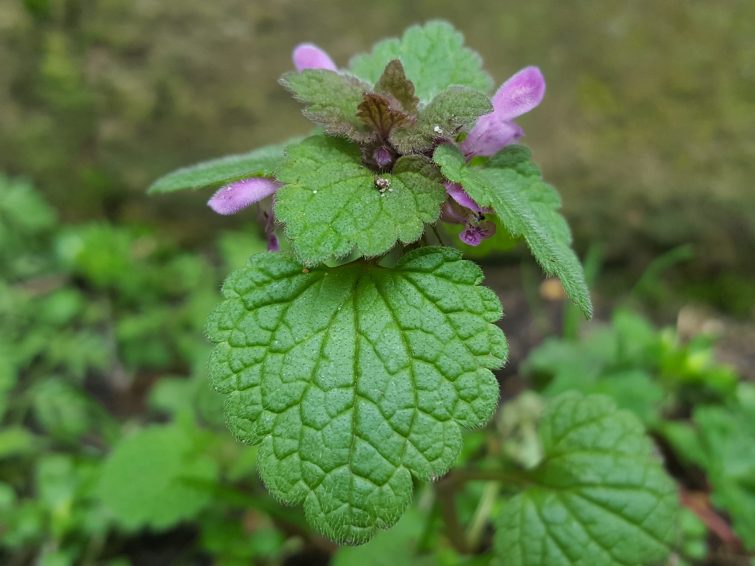
You can begin to learn how to identify red dead nettle from its square stems and their few red leaves.
Flowering stems have few leaves and reach up to 40 cm high.

Flowers: These are produced in whorls around the stem, arising from the leaf axils. The flowers are two-lipped, with a long corolla tube (10 – 20 mm).

Its easy to identify red dead nettle when in flower, as it produces whorls of pink-purple, two-lipped flowers
It’s easy to identify red dead nettle in bloom, as it produces whorls of pink-purple, two-lipped flowers.

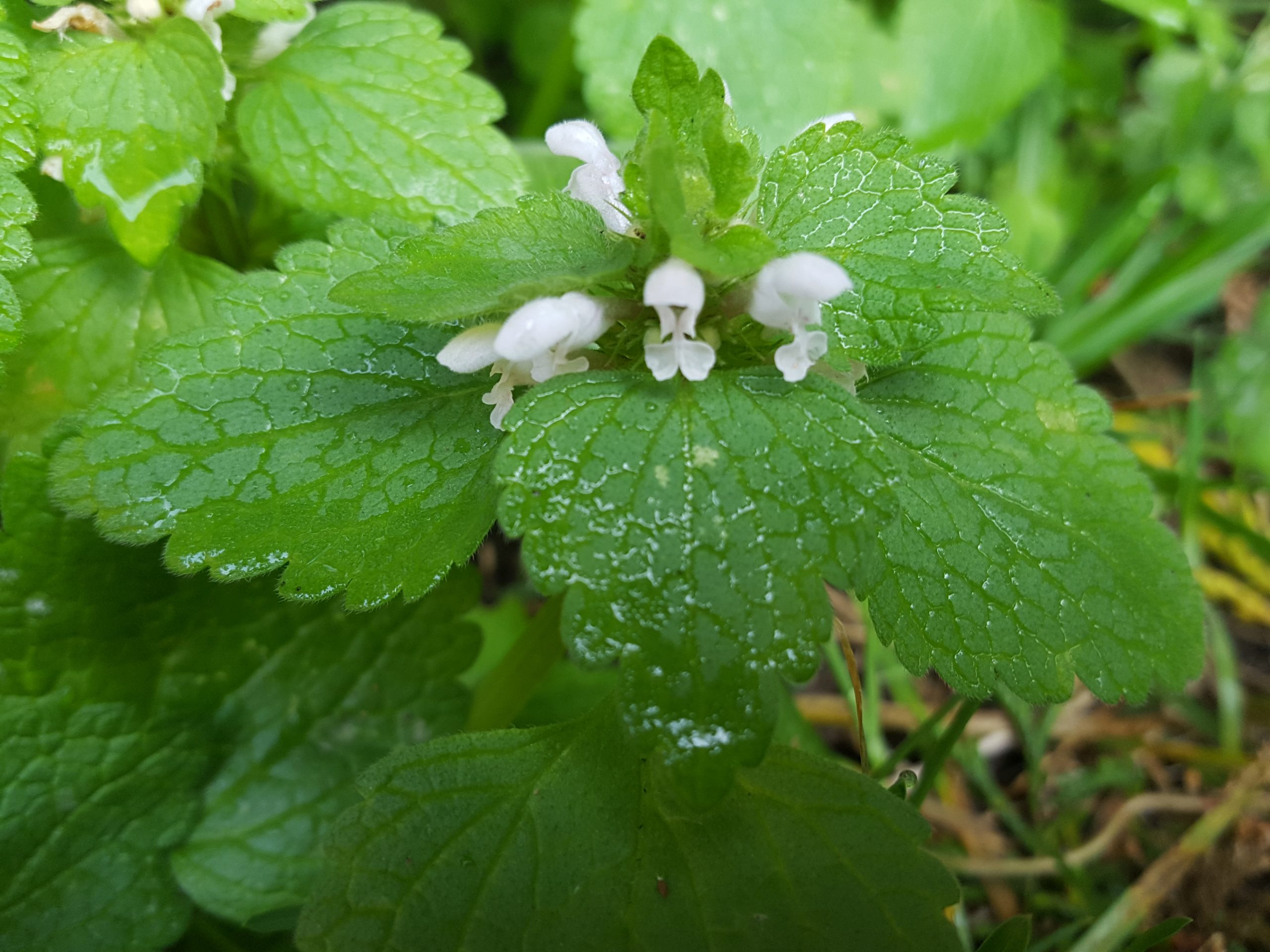
The flowers are generally a pink-purple colour, with mottled specks on the lower lip. Occasionally I see a white flowering form too.

Like many flowers, red dead nettle produces occasional white-flowered populations
Like many flowers, red dead nettle produces occasional white-flowered specimens.

The calyx from which the flower arises consists of five, green, pointed lobes. The lobes are nearly as long as the corolla tube. Inside the flower are four stamens, of which two are long and two are short.

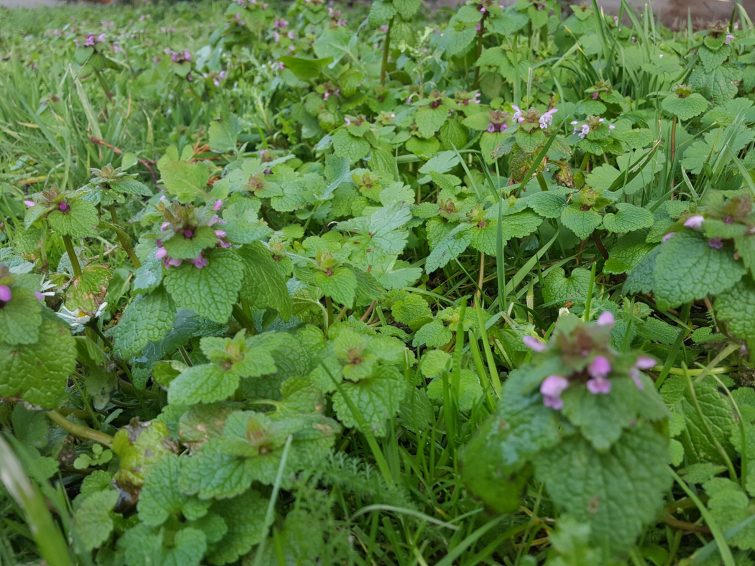
Flowering season:  As another of our short-lived ephemeral annual plants, it will be no surprise to learn that this plant can be found in flower from January to December. I always see it flowering en masse in the run up to spring equinox.

Although red dead nettle can flower at any time, it gives off its best displays in February and March.
Although red dead nettle can flower at any time, its best displays come in February and March.

Fruits:  Like many in the dead nettle family, this plant produces four tiny nutlets.

Parts used: Leaves, flowering tops and flowers.

Harvesting: You can usually find this plant all year round, but I think the months of February and March offer the most productive harvests.

Harvesting red dead nettle is easy. Simply remove whole stems and strip off leaves or pick a few leaves from each plant.
Red dead nettle will be best harvested in early spring. Take a few leaves from each plant.

I sometimes pick a whole stem and strip the leaves off, or just pick a few leaves from each plant in a stand. Flowers are easily plucked out.

Habitats: This plant loves fertile grassy areas, cultivated ground and wastegrounds, hedge banks, and various settings in urban environments.

Knowing the habitats that the plant loves will help you identify red dead nettle. It enjoys grassy areas, as well as cultivated and wastegrounds.
Red dead nettle loves grassy areas, cultivated and waste ground as well as numerous urban settings.

This is essentially a lowland plant, and can usually be found at altitudes below 550 metres.

Other notes: With its unusual mushroom-like taste, this plant lends itself to being stuffed in ravioli or added to gnocchi. It makes a nutritious addition to soups and casseroles. In salads, you may find its best to use finely chopped, like you would other aromatic pot herbs.

A similar-looking plant, the cut-leaved dead nettle (L.hybridum), has deeper cut teeth on the leaves and a smaller corolla tube. It can be used in the same ways.

If you have any foraging or plant identification questions, please dont hesitate to contact me.

Happy foraging!


How to identify hairy bittercress (Cardamine hirsuta)

Learn how to identify hairy bittercress and add some medicinal peppery punch to your winter salads.

Read our short wild plant guide and find out how to confidently identify hairy bittercress. This is a tasty but weedy species that divides plant lovers.

For gardeners, the plant can be a bain, what with it being a seemingly persistent presence. For foragers however, they are welcome edible plants, available during the barren winter months. Not only do they add some fantastic flavour  and texture to salads, they also provide us with a welcome shot of needed and powerful brassica family medicinal constituents.

To be fair, you could skip all the following plant I/D and simply crush and sniff the plant. This will soon tell you if you have a brassica family species!

The mustard aromatics are common in this family. All mustard family plants are edible, bar the wallflower (Erysimum) species. So with all the relevant understanding about edibility, toxicity and dose, I am more than happy to know I can eat a member of this family these days without knowing the exact species.

Shock horror, Yes I eat plants without 100% positive I/D! Why? Because I can with what I know!  This has taken many years of mistakes and research. I strongly advise you DO NOT DO THIS until you have met and know nearly 500 odd plant species in these islands, and know a hundred or so more down to the genus.

Acquiring positive I/D for a genus usually satisfies me these days. My interest in wild plants currently is much more in the experimental cookery and bushcraft domains, and my interest in wild foods leads me towards fungi, sea weeds and sea foods. In these realms, I always cross reference, at least twice over.

What’s in a name?

The generic part of the name  Cardamine was apparantly first labelled by Dioscorides. The name stems from the old Greek word ‘kardamon’, meaning ‘a kind of cress’ although some reports also suggests it means a ‘spicy pepper plant’.

The specific epithet ‘hirsuta’, as any bearded man should know, means hairy.

The common name ‘bittercress’ tells you two important things about its flavour.

Botanical description to help identify hairy bittercress.

If any of the following few technical terms has you confused, dont fret; just pop over to our foragers glossary page.

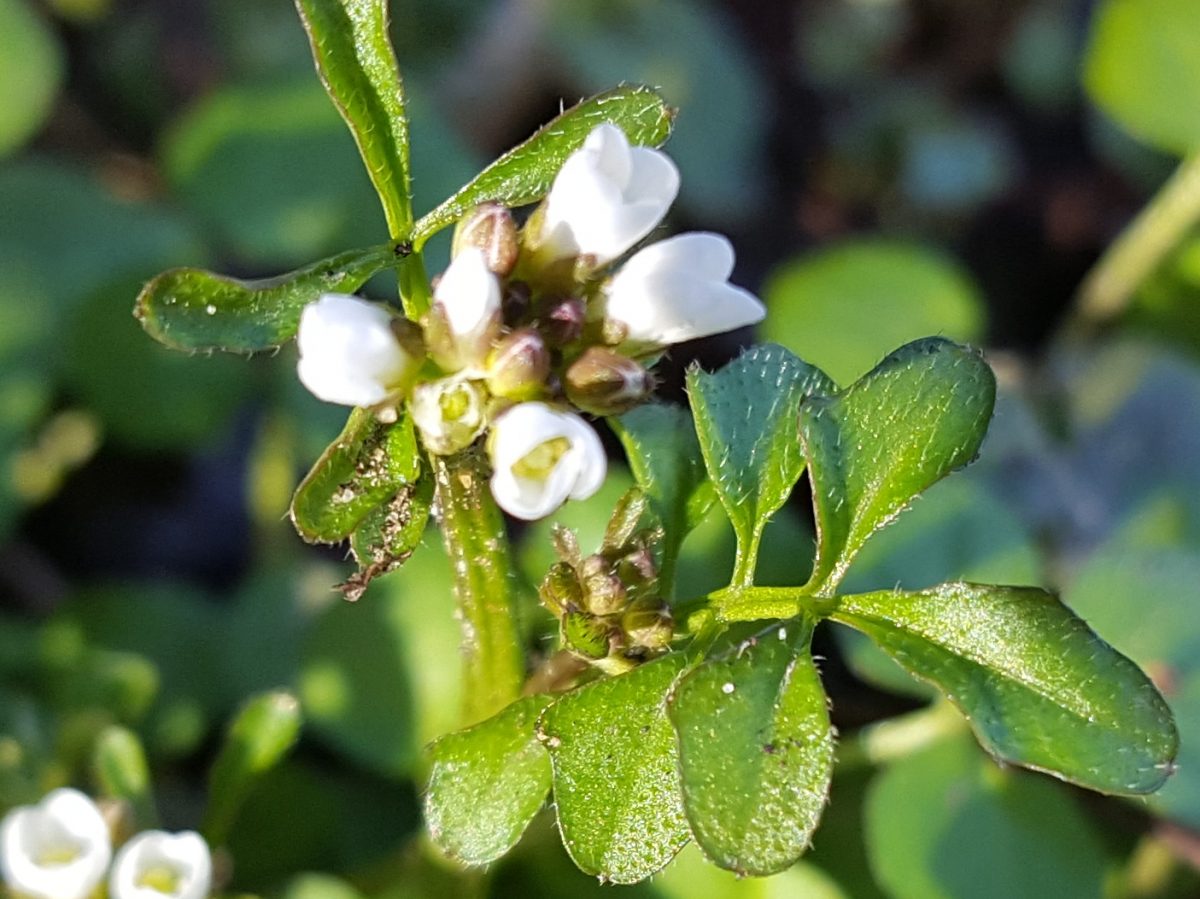
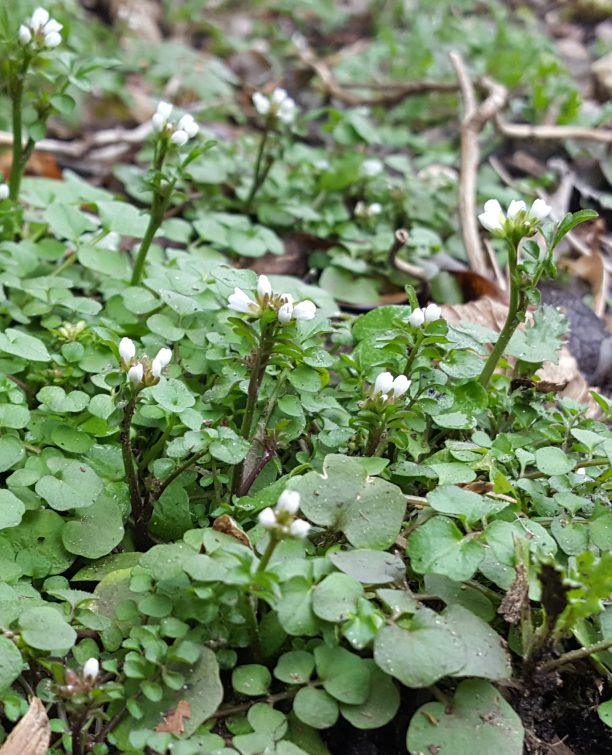
Leaves: This plant, like most of its relatives in the genus, has pinnate leaves made up of between 2-6 pairs of opposite leaflets.

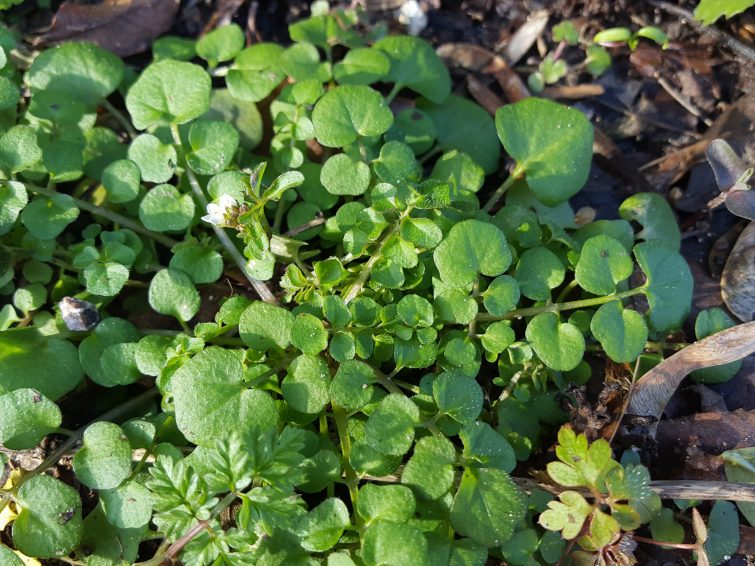
You usually find hairy bittercress with small, attractive leaf rosettes.

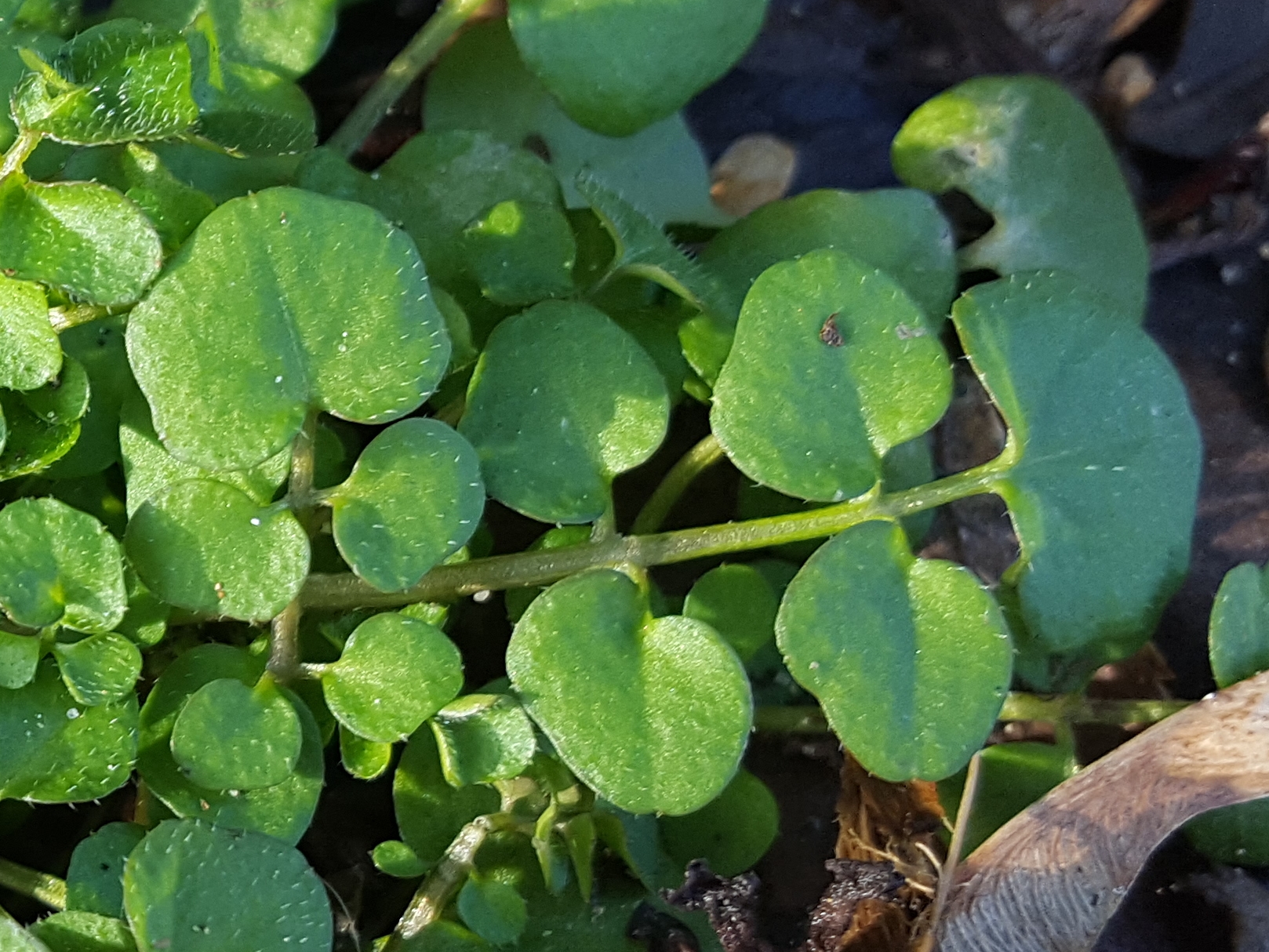
Hairy bittercress has small, hairy, oval-shaped leaflets, occasionally with mildly crenated or lobed margins. The terminal leaflet is always much larger than the others.

The pinnate leaves of hairy bittercress have between 2 and 6 pairs of leaflets.

The leaves form attractive small rosettes, and you will typically find a number of specimens growing as rosettes together.

Petioles:  Approximately 1-2 cm long.

Roots: The plant grows on a fibrous rootstock.

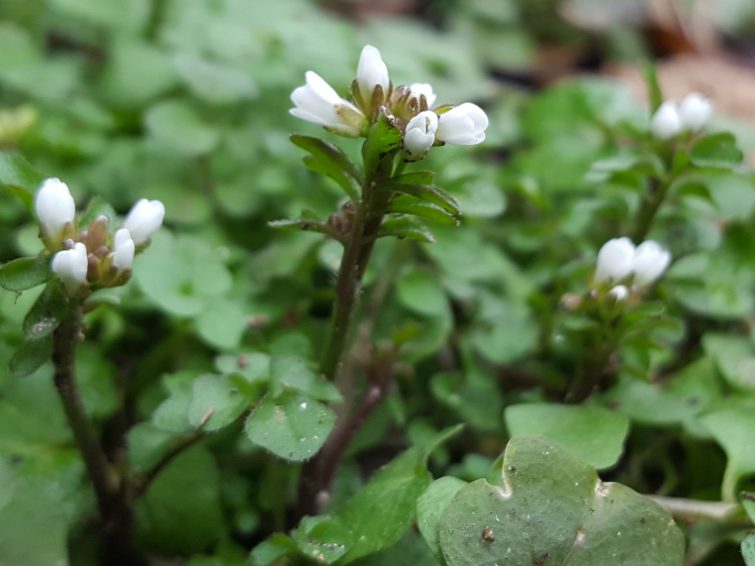
Stems: The small flowering stems usually reach between 8-20 cm tall. They are typically green-coloured with few branches. Their stem leaves are increasingly refined in form.

Small flowering stems are green and sparsely branched.
Hairy bittercress has small flowering stems; green-coloured and sparsely branched.

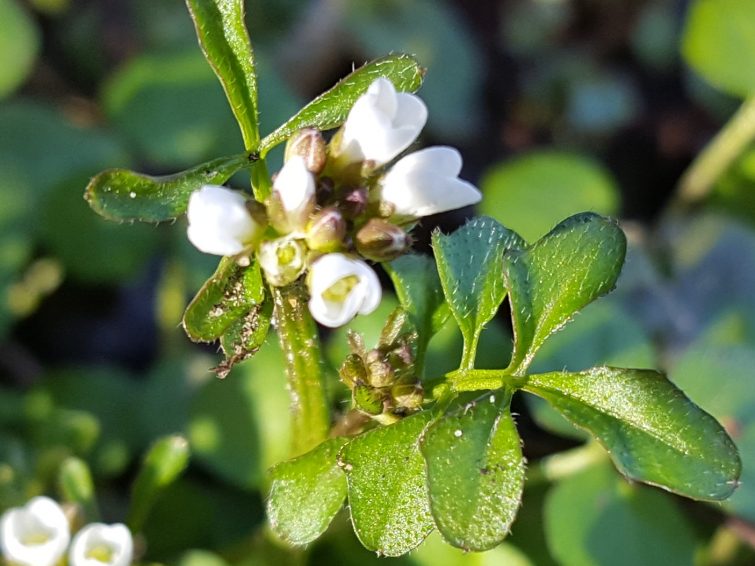
Flowers: The small inflorescence has the typical brassica family patterns. A miniscule ‘broccoli type’ raceme head forms, then stretches up and open to reveal the alternately-spaced, tiny white flowers (2-3 mm across).

To identify the species from other plants, you need to count the number of stamens inside the flower. Hairy bittercress has four stamens.
To identify hairy bittcress from others in the genus, you need to count the number of stamens in the flower.

Hairy bittercress has four stamens inside the flower. Other plants in the genus, such as wavy bittercress (Cardamine flexuosa) have six.

Flowering season: This short-lived annual plant will flower as soon as it has put on enough growth, or if it gets stressed when young. When you are out foraging during February and March you can find it in flower in abundance.

Fruits: Hairy bittercress, like many brassicas, produces dry fruits.  These are long thin pods with a flattened tip. They eventually split in two, revealing the tiny seeds.

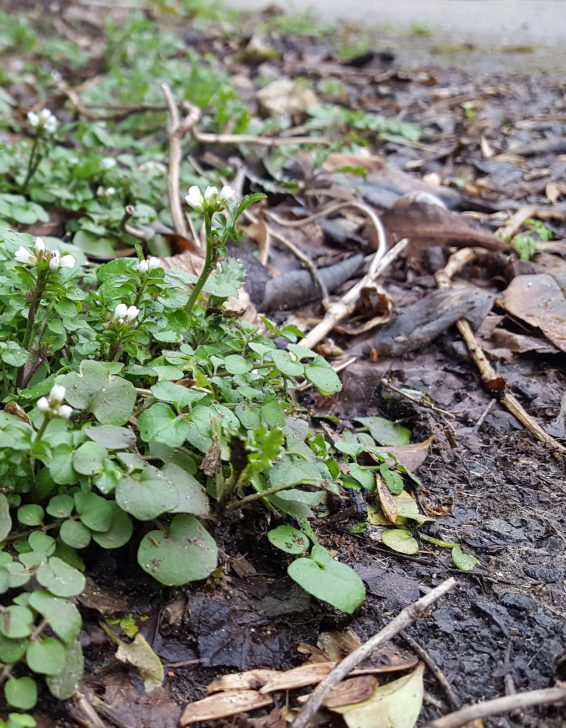
Habitats: Urban foragers will notice that this ruderal species basically finds a home anywhere it can, especially liking bare and disturbed soils. During summer you can still find the odd specimen, but only in cooler, shady spots.

Like other plants, the habitat you find it in will help you identify hairy bittercress
Like other plants, the habitat you find it in will help you identify hairy bittercress.

In the countryside, hairy bittercress particularly loves stream banks, old stone walls, and damp woodland clearances on suitable soils. It’s a hardy plant that can be found up to altitudes of around 1100 metres.

Parts used: The rosette leaves, and very young flowering tops.

Harvesting: You can potentially collect the basal rosette leaves during late winter, early spring, and autumn. I use a couple of methods to do this:

1)  Cut the plant at the top of the roots just under the leaves, removing it just like you would a whole lettuce.

2) Pick the leaves individually, by pinching the base of the petiole with your thumbnail and forefinger.

Discover lots more wild plant harvesting tips here, with our wild crafting guide.

Other notes: All the bittercresses are edible, and the larger species found by streams are available in mid to late spring. Look out also for Lady’s smock (Cardamine pratensis),  in damp meadows, and the narrowleaf bittercress (C.impatiens), with its exciting exploding seed pods!