Did the Neanderthals teach Humans about foraging for yarrow?
How foraging for yarrow today continues an intriguing plant-people relationship stretching back more than 50,000 years!
People have been foraging for yarrow forever! After you discover quite what this little plant can do, so will you!
You might need to use the glossary to help with some of the language. If you are a foraging beginner then my guide to starting out will be good to read later and bookmark.
It’s too easy to overlook and ignore some of the really common plants when out gathering wild food.
We repeatedly see a few common plants everywhere we go, and they can immediately just become part of the ‘green wall’.
Yarrow is a herb heavily steeped in myth and legend; and a plant that many cultures of the world have widely used and revered.
What’s in a name?
Achillea was named in honour of the Greek god Achilles; who according to legend, had course to widely employ this wound staunching herb on the battlefield.
The species name millefolium, translates to ‘thousand leaf’ and alludes to the deeply divided leaf. 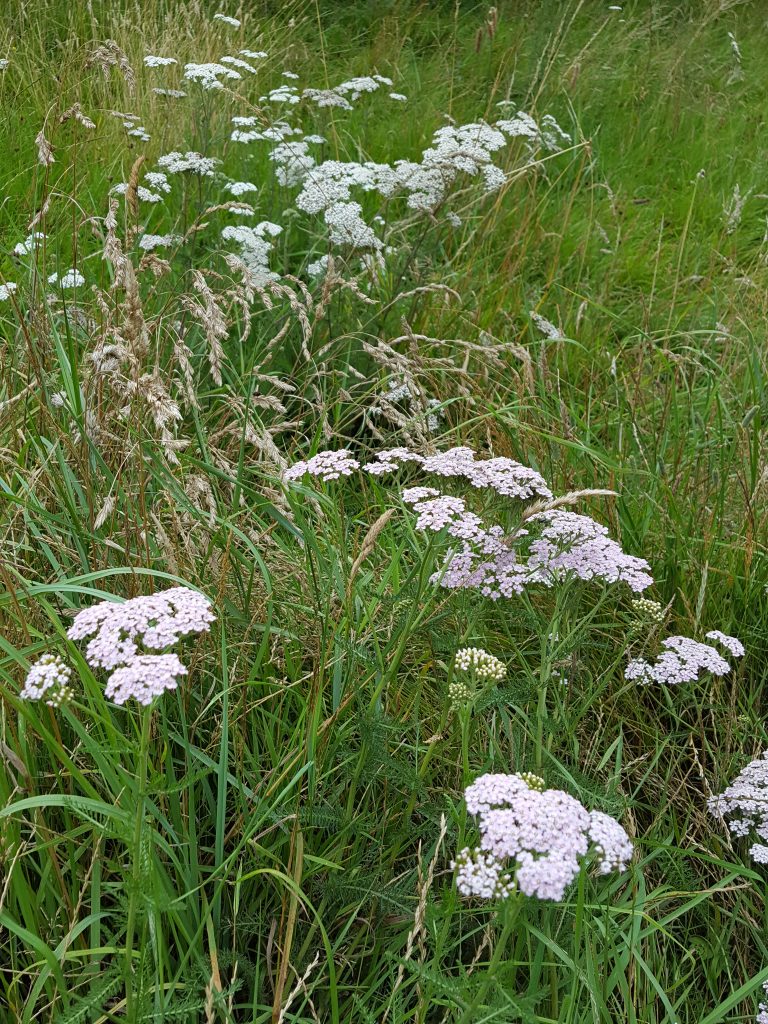
Our principle common name yarrow stems from the old English word Gearwe – yarrow. Both the English and the French have this feature in common names ‘milfoil’ / ‘la mille feuille’. The Greeks knew it as myriophyllon.
Yarrow became known as knights milfoil and soldiers wondwort and was one of the most important wound staunching herbs in the military. Battlefield medics in battle used to pin yarrow on their lapels to show who they were.
Old companions
Our relationship with yarrow is ancient. Many tens of thousands of years ago, the Neanderthals were foraging yarrow for use as food and for its medicinal properties.
This was revealed by the presence of a number of common wild plants found in the plaque on the teeth of Neanderthals excavated from graves in the Mediterranean basin!
We can confidently imagine our more recent Homind ancestors having a reasonably extensive knowledge of the wild plants they lived with, if only because they had to know them to survive.
I think its both lazy and insulting to not recognise that our hunter-gather-foraging ancestors would easily have known hundreds of plants.
It is likely that far more of our vast natural larder and medicine cabinet would have been familiar to them, than say, to the majority of people alive today in the Western world.
Today, yarrow remains a sovereign remedy of both Western and Eastern herbal medicine traditions, and rightly persists as a favourite of many practitioners working with plant medicines.
Alongside dandelions and plantains, yarrow can be considered another of our globally available, herbal first aid plants!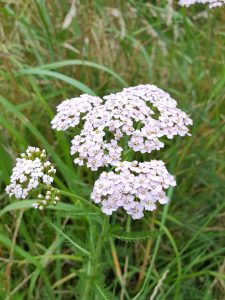
But it’s not just the medicinal uses of yarrow that stand this plant out from the crowd. This is the only plant used for the ritual purposes of divination in the Chinese oracle – the ‘I Ching’.
This 5,000 years old oracle, still much in use the world over, is traditionally consulted after preparing and throwing 49 Yarrow stalks into the air and then interpreting how and where they landed. Quite why the ancient Chinese decided upon this herb is unclear.
How to identify yarrow
Yarrow is easy to identify and difficult to confuse with other plants. It has wispy, feathery foliage, which can superficially resemble the wild carrot. Yarrow’s leaves are repeatedly divided, also known as bi-pinnatifid leaves.
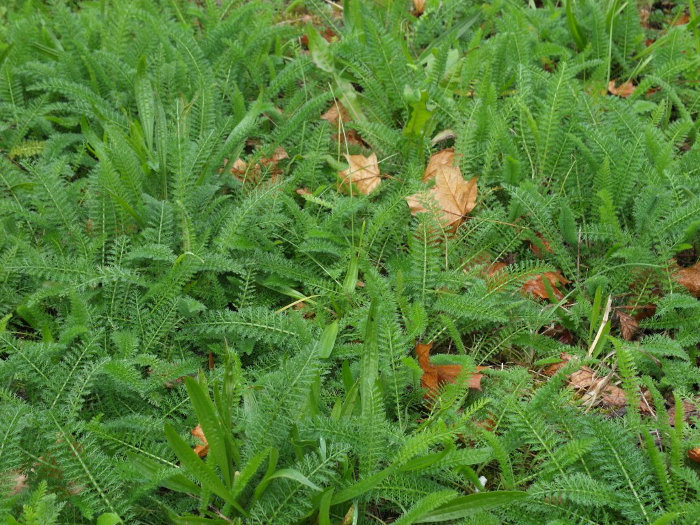
The basal leaves are sometimes quite large and sprawling, always on long petioles, and initially grow in a rosette. Leaves are typically around 20-25 cm long. The stem leaves become shorter, sessile, and alternately spaced.
In mild climates, you will see the plant happily overwintering. New growth will re-emerge from its creeping and steadily spreading rhizomes in early Spring.
This network of roots will mean that we regularly find the plant growing as dense mats and carpets.
Flowers
Yarrow can be found in full bloom from June. It has hairy and furrowed flowering stems, typically reaching heights of 60-70 cm.
Yarrow’s inflorescence is often referred to as ‘umbel-like’ in books, and this is because untrained eyes could initially mistake yarrow’s flowering structure for something in the carrot family.
However, look closely from below, and you will observe the numerous flower stalks are all condensed together high up on the stem. They do not all originate from a central point on the stem, as per umbelliferous plants. This inflorescence is botanically known as a corymb.
The individual flower heads are composite, and consist of tiny flowers (florets) grouped together on a ‘capitulum’.
Each composite head is singular and terminal, just like all daisy family plants. The family patterns are easiest to study on a sunflower.
Typically a singular yarrow flower head will have 5 or 6 individual florets. Read more on the easy-to-remember plant family patterns method of Plant I/D.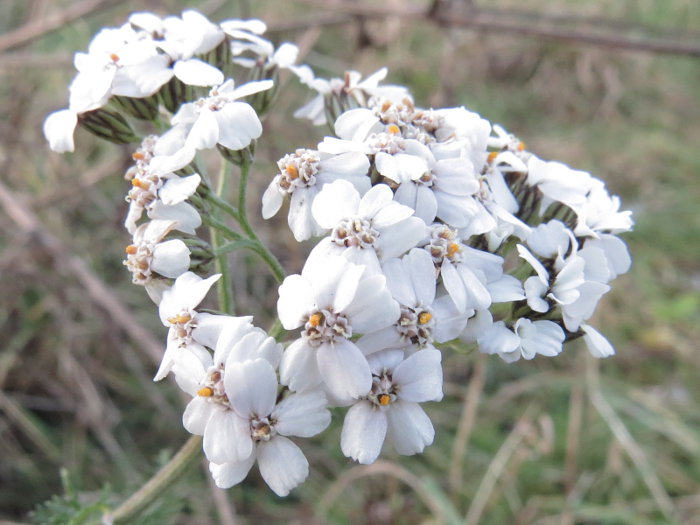
Yarrow flowers have a characteristic medicinal-savoury odour. They will taste bitter. Usually, yarrow has creamy white ray-florets, delicately framing the orange-tinted, central disk-florets. But pink flowering strains of yarrow will also frequently be seen.
Habitats to look in when foraging for yarrow
Yarrow grows in a range of habitats, throughout Britain and Ireland, except for areas that are permanently waterlogged, or on soils that are strongly acidic (pH < 5.5).
It happily colonises waysides, pastures, grassy places, hedgerows, and waste-ground, in town or country, throughout the land.

A lover of temperate climates, you can almost always easily find yarrow in Britain, even at altitudes of up to around 1100 metres.
On the coast, look in fields by the dunes and on stabilised shingle. This map from the online flora of Britain and Ireland shows just how much of the country is home to yarrow.
Yarrow thrives in harsh conditions without losing its fresh look of vitality. This becomes especially noticeable during droughts, when its dark green foliage stands out from brown and withered neighbouring plants, especially in grasslands.
Parts used: Leaves / flowering tops.
Harvest: Leaves: Spring – when young. Flowers: From July – September, just when opening. This guide to harvesting helps you get best results
Key medicinal constituents Volatile oil (including cineol, eugenol, thujone, camphor, azulene); bitter principles; tannins; salicylic acid, isovalerianic acid. (Learn more about the common medicinal plant constituents here)
Actions: Anti-inflammatory, antiseptic, diuretic, diaphoretic, astringent, expectorant, vulnerary.
Pharmacology and uses: As an edible, yarrow should be embraced in the kitchen of the adventurous, and by folk looking for foods that double as preventative medicines. So by foraging yarrow you get to kill two birds with one stone!
During spring and early summer, the younger leaves give a lovely, crunchy texture in a mixed salad, while offering slightly bitter, yet subtle and savoury medicinal tones.
A strong and intoxicating beer can reportedly be made with yarrow, for which a number of recipes can be used (watch this space)!
As medicine, yarrow has chiefly been used as a wound herb. The tannins exhibit an astringent effect, on both exterior and interior surfaces of the body.
The volatile oil constituents, such as cineole, have antiseptic qualities, while azulene, responsible for the blue colour of the essential oil, not only reduces inflammation but stimulates the formulation of tissue for wound healing.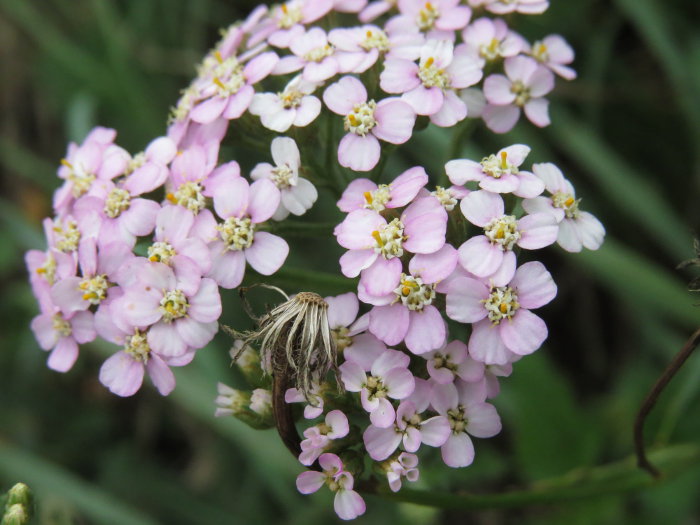
Couple this with the general astringency and yarrow can swiftly, and effectively, help seal and heal all manner of cuts and wounds!
Regularly eating or drinking yarrow helps prevent and treat dyspepsia and ulceration – two conditions that alcohol or caffeine, coupled with a rich diet, can help manifest.
Yarrow promotes a sedative activity on the nervous system and is often employed as an anti-spasmodic for nervous dyspepsia. Yarrow is acclaimed for helping heal and tone the mucus membranes throughout the gastro-intestinal-tract.
Nature’s abundant anti-inflammatory phenol, salicylic acid, can be found in yarrow, just as with meadowsweet (Filipendula sp) or willow (Salix sp). So try foraging yarrow, which is much more abundant than its relative, chamomile.
As a diaphoretic, yarrow will regularly be used for fevers, and also helps with palpitations, painful menstrual periods, and convulsions; as well as being of use as a peripheral vasodilator, diuretic, and mild expectorant. 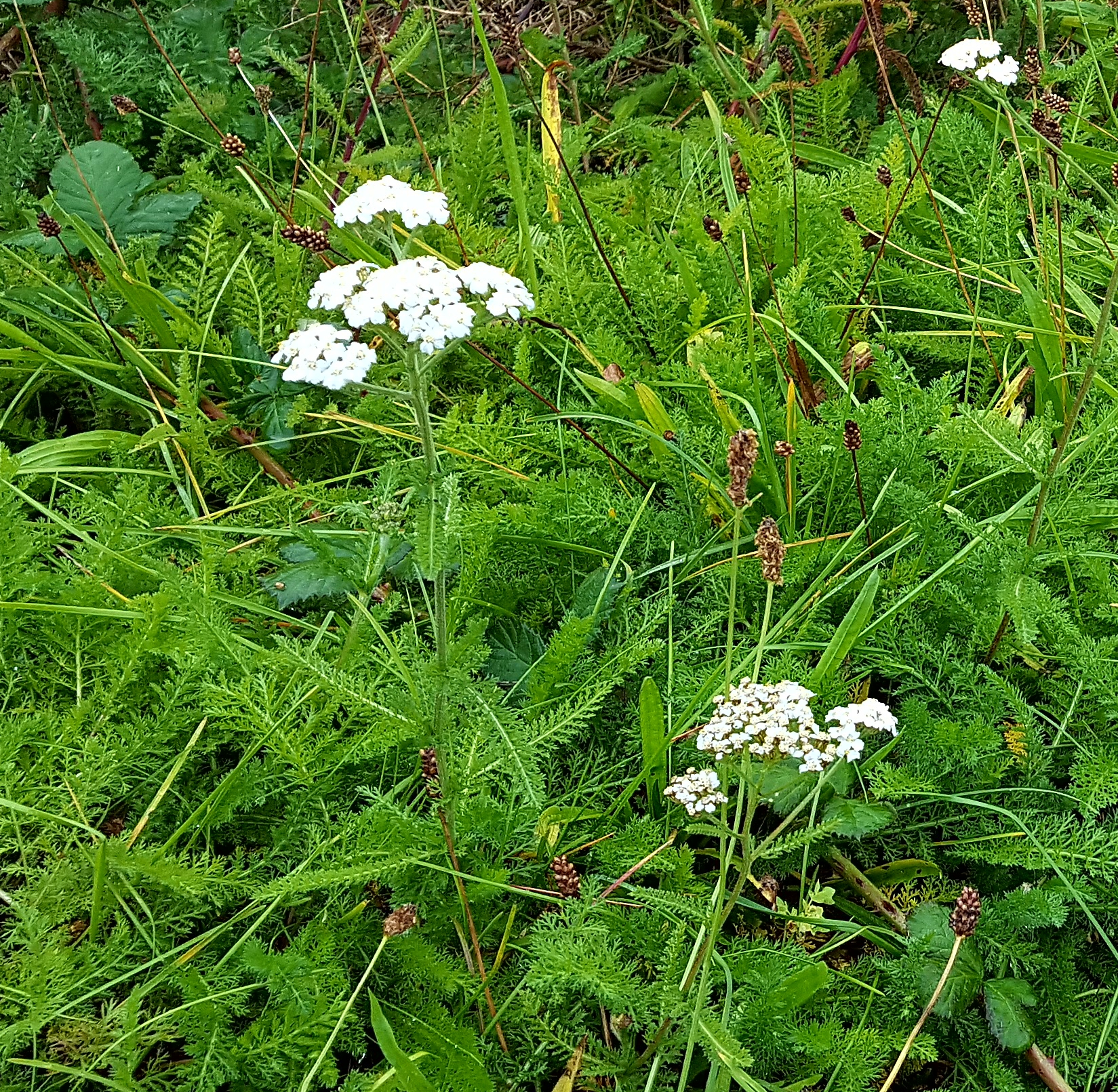

As with any member of the Asteraceae family, there comes a slight risk of possible sensitivity for some individuals, especially those with dermatological problems. As ever, always seek professional advice before using wild plants as medicines.
As well as the edible and medicinal plants, foragers also need to learn the poisonous and toxic plants, which I have briefly summarised here.
If you have any questions or queries, please drop ma a line!