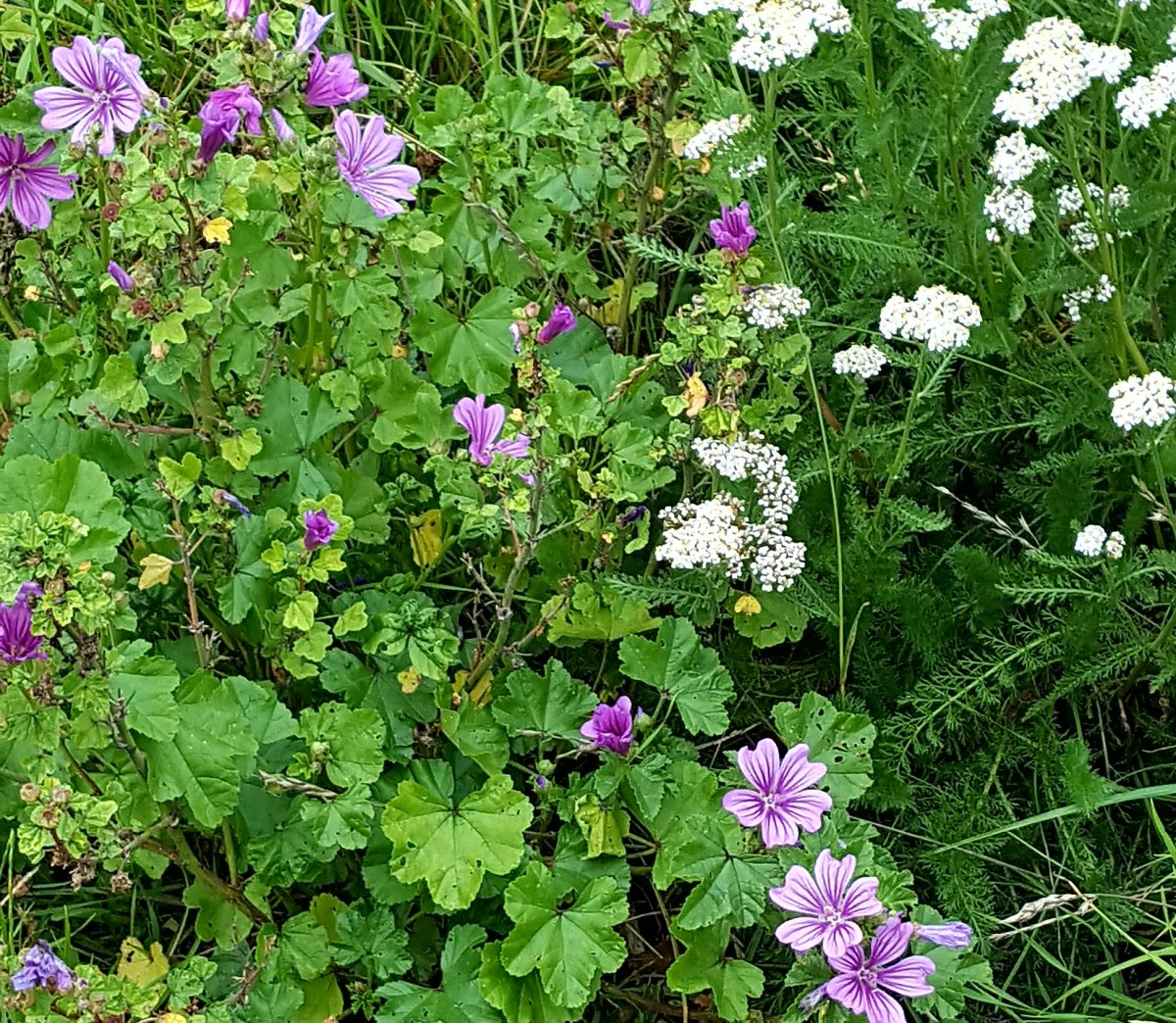
Learn how to identify and use common mallow (Malva sylvestris) and other easy-to-find edible mallow species (Malvaceae).
Certain plants, such as the common mallow, seem to be our constant companions, no matter where we are.
The more you learn about plants and foraging, the more you will notice that the really common and familiar plants often soon become some of our really useful and valued species. Their usefulness to man, I believe, is reflected in their persistent proximity to people..
Our hand has dramatically re-shaped the landscape. And for most of our existance, certainly up to the Agrarian revolution in the 20th century, the vast majoroty of people on this planet fully utilised their plant resources. Thankfully, as you will read later, the retained collective knowledge of local plant resources helped save thousands of starving people as recently as 1948.
So rather than being looked upon as persistent weeds, the mallows can be more usefully described as some of our gloriously abundant plant allies.
There are around 25 or so plants currently assigned to the genus Malva. All are edible. A number of mallow species have long been used as a food and medicine, wherever they are found growing native, and especially by people in the Middle-east and Asia.
In Britain, Europe, North Africa and South-west Asia, you really won’t have to go far to find common mallow, and a host of other species either.
What’s in a name?
The generic name Malva comes from the old Latin name for this plant, which is itself a word related to the old Greek word – malakhē.
The specific part of the name sylvestris denotes a plant whose favourite habitat is woodland (from the old Latin word sylva – meaning forest or trees).
Our common name mallow is derived from the old latin name Malva via the old English word ‘mealwe’.
Common mallow botanical description.
Our other commonly found mallows will be also be discussed here, with articles posted in due course. Right now I will concentrate on our common mallow, also known as the ‘wood mallow’.
This ubiquitous species can be found growing erect or prostrate, which may initially cause confusion, because its easy to assume that they might be two different species.
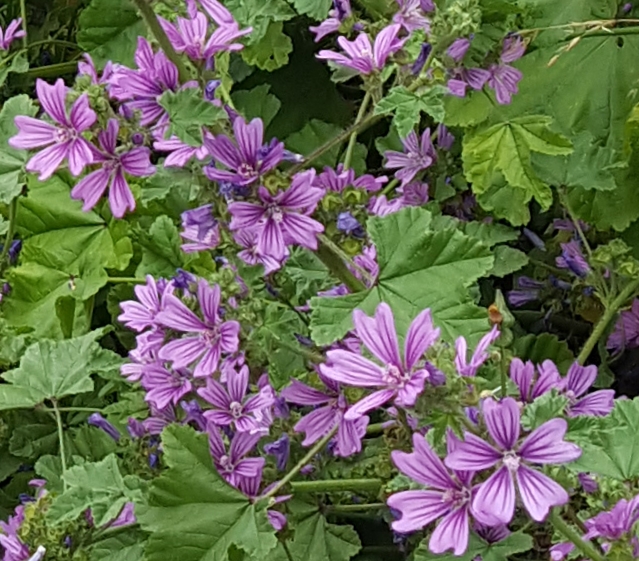
Leaves: Mallow’s kidney-shaped or palmately-lobed leaves are notably creased, and typically with dentate margins. They can grow up to 20 cm across and more on larger plants.
The leaves often show a purple spot in the centre of the base of the leaf and this can also be seen to run down the petiole on some specimens.
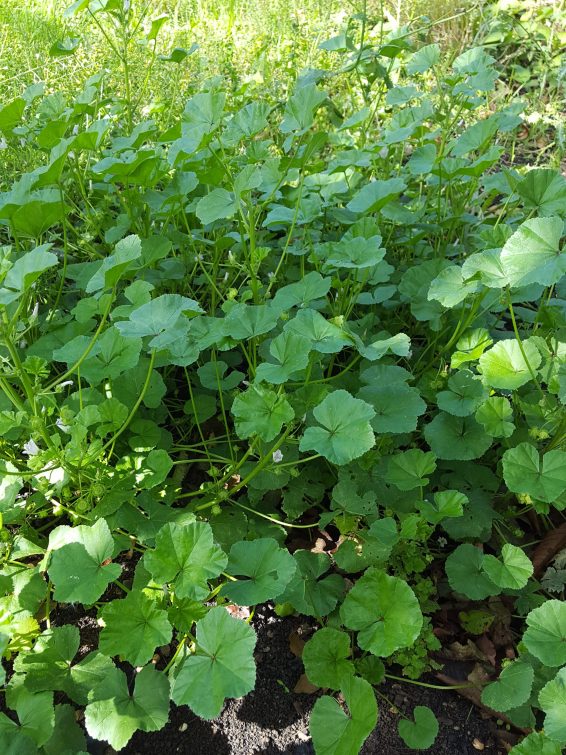
On other specimens, the purple leaf spotting and colouring is completely absent.
The deep green foliage colour hints at a well-renowned drought tolerance.
If you crush or tear a leaf you will discover one of the mallow family patterns, the demulcent mucilage. It is the mucilage that gives the leaves their softness and aids thier drpught tolerance.
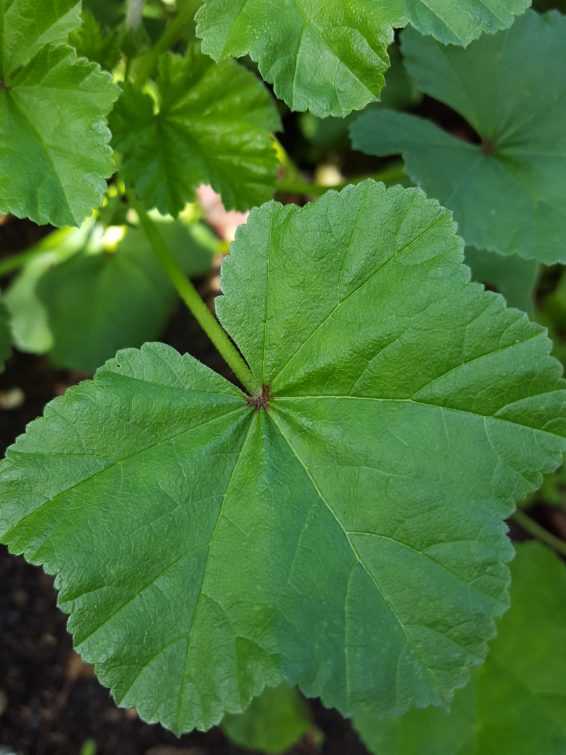
Petioles: Mallow leaves are always on long petioles, typically greater than 10 cm long.
Roots: The common mallow has long creamy-white coloured roots. They are high in the polysaccharide inulin and just like the rest of the plant, are high in mucilage.
Stems: As mentioned, common mallow can grow upright or prostrate on the ground. The stems are branched, solid and hairy.
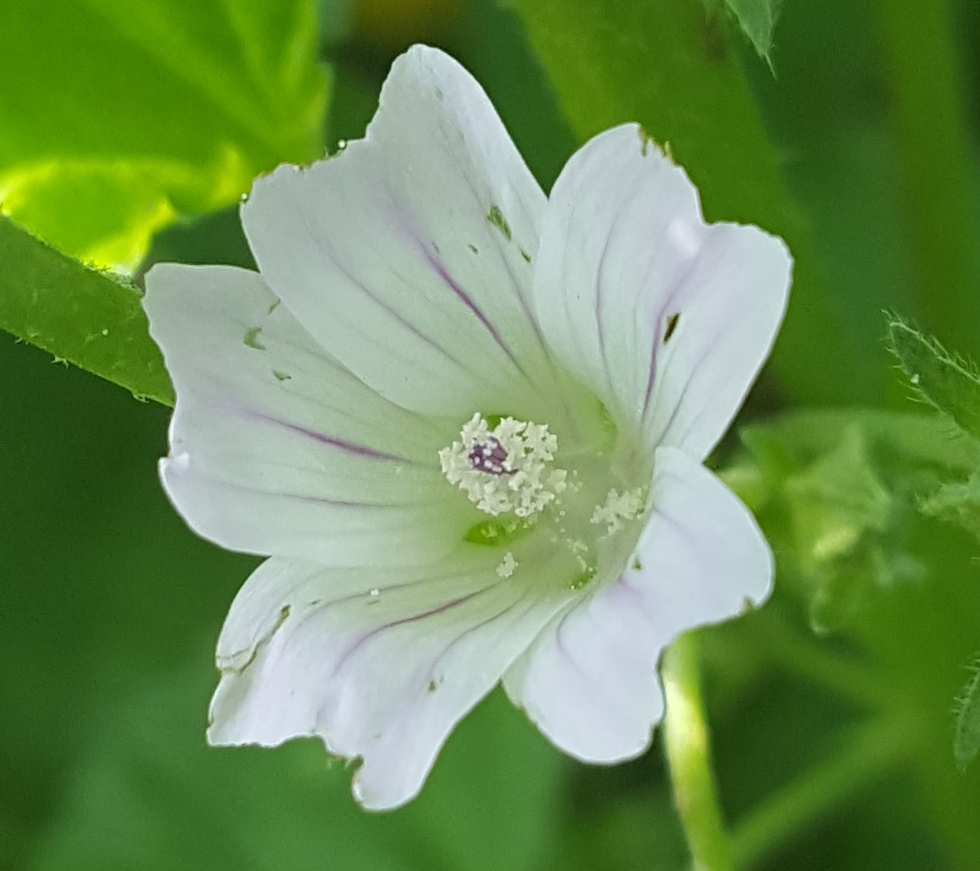
Flowers: In bloom, the Malvaceae family plants all produce five large notched petals in each open flower.
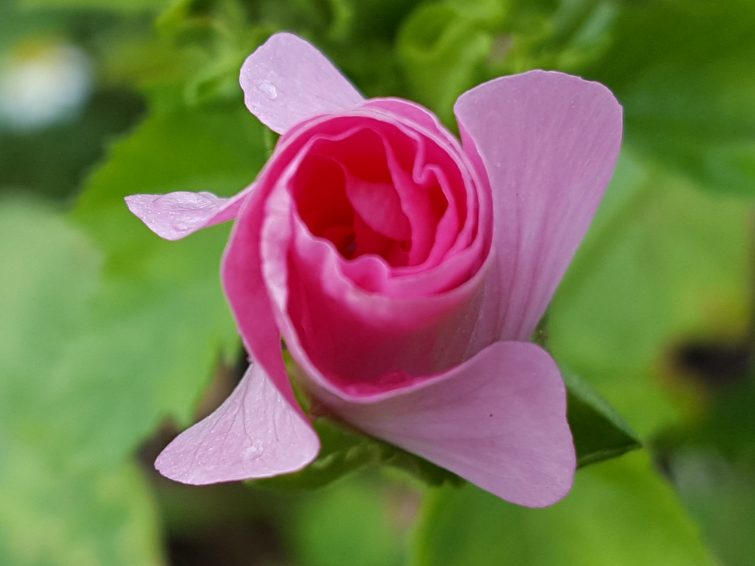
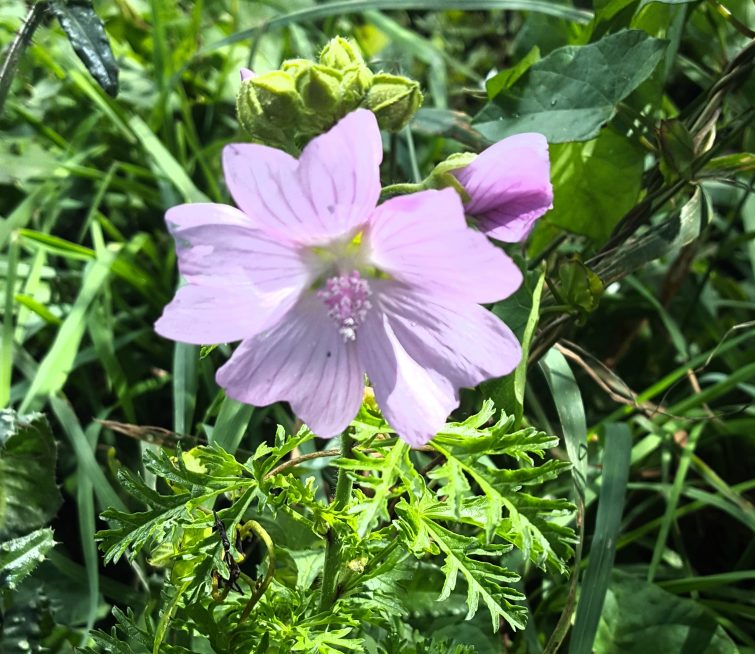
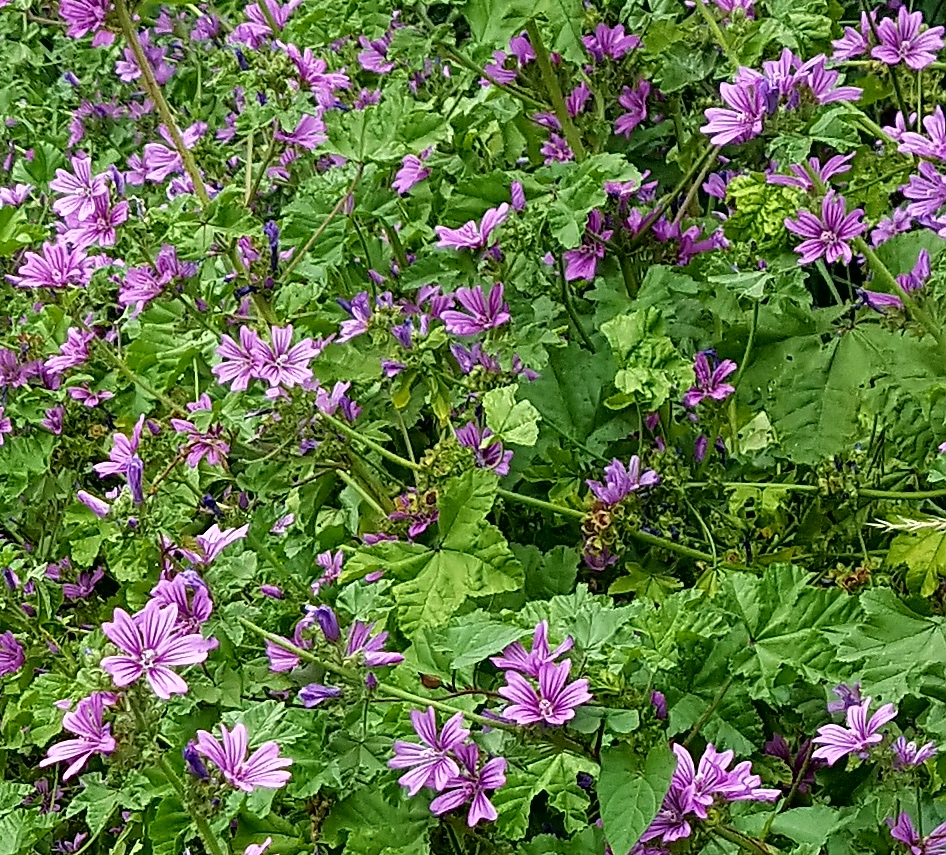
Common mallow has showy pink petals laced with darker-coloured strokes. The musk mallow has a similar size and coloured flower. in contradt, the smaller but similar species, dwarf mallow (Malva neglecta), has much more pale lilac-coloured flowers.
Other mallows that grow here, such as M.neglecta, M.parviflora and M.pusilla, have much lighter-coloured and smaller flowers.
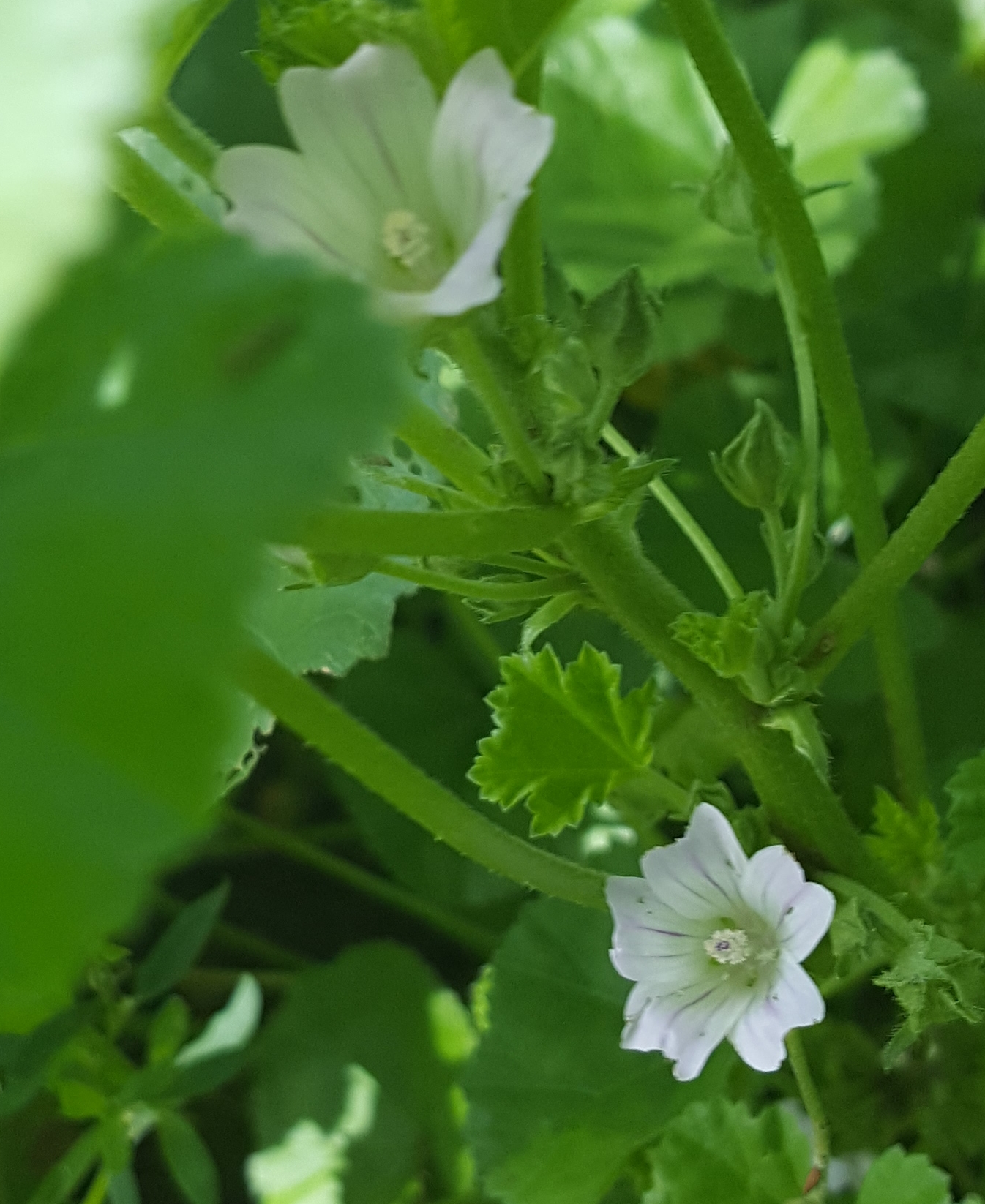
In the centre of all mallow flowers lies a pollen-loaded column of fused stamens. This surrounds the stigma, which rises above the column.
Flowering season: Mallows tend to have a long flowering season that starts during late spring and continues en massè throughout the summer.
Fruits: Mallows are known to freely seed. They produce round seed pods, known colloquially as ‘cheeses’, or botanically as schizocarps.
The cheeses are held close to the flower stem on short stalks. They soon follow after the first flowering.
They are crunchy, juicy little bites were once popularly munched by children on their way to and from school.
The favourite habitats of mallows:
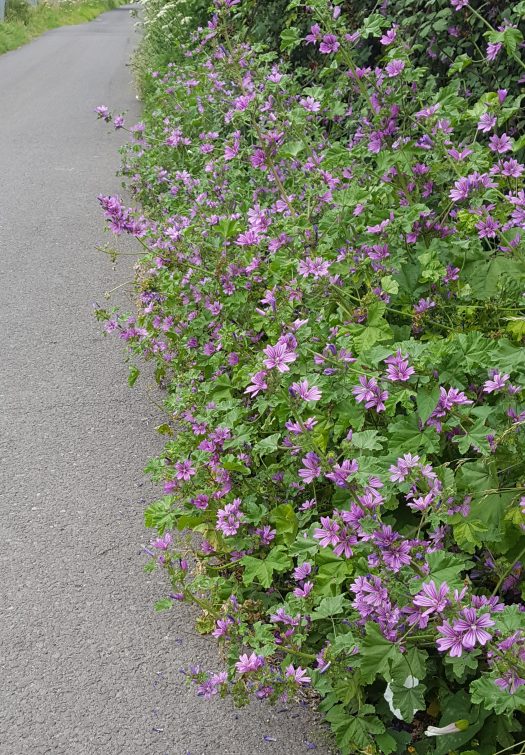
The common mallow loves a roadside where it can take a regular knock back by mowing. You will find mallow on most soils, from coastal to the more marginally upland habitats. In fact, most settings are adequate for this resilient plant. It loves waste-ground as well as grassland; gravel as much as coastal edges, and waysides as it likes hedges.
Parts used: Leaves, flowers, seed pods, roots.
Harvest: For the above ground parts. Leaves are best harvested n spring, taking advantage of the spurt of fresh new leaves.
The flowers can be picked as soon as you start to see them in late spring; and the seed pods are available from early summer. Roots can be harvested from leaf rosettes whenever large enough. If you want to learn more about harvesting our wild plants, be sure to read this article.
Medicinal and nutritional constituents: Vitamins A,B,C,E; inulin; mucilage; phenols; flavonoids; essential fatty acids; fibre; calcium; magnesium; zinc; selenium; potassium.
Traditional and contemporary uses of common mallow: As with many wild food plants, the common mallow has also had a long history of medicinal use.
Due to their high mucilage content, mallows make excellent soothing demulcent herbs, especially for cases of inflammation, either for the urinary, digestive or respiratory systems.
Pregnant women or new mothers may like to know that mallow leaves can provide useful amounts of Iron, as well as being quite high in zinc and most vitamins.
All of the Mallow family with exception of the cotton plant (Gossypium hirsutum), are reportedly edible. With their high mucilage content, the leaves can also usefully be taken as an emergency antidote to irritation or burning. This is useful to know if you ever accidentally eat any acrid plants from the buttercup family. This article on Britain’s poisonous plants will help you get to know all the plant hazards on these islands.
Creative cooks can substitute mallow for spinach in many dishes, including soups, salads, gnocchi and quiche. Try flash-frying larger mallow leaves for just one second in hot oil to make mallow popadoms! Mallow also makes a great addition to soups, where the mucilage helps to thicken them.
In Jewish culture, mallow has been been considered the ‘most important plant in local gather society’. Every spring mallow is gathered in the countryside. It’s common name in both Hebrew and Arabic, translates to ‘bread’.
During the war of 1948, when Jerusalem was under siege, mallow was an important famine crop, and one that is still celebrated on Independence day every year with a traditional dish made from mallow leaves.
Common mallow can be substituted for the family relative Corchorus olitorius aka ‘jutes mallow’, when making the Egyptian / Middle-eastern dish ‘Molokhia’. This traditional dish is usually served with chicken.
In China, mallow roots are a popular and common ingredient in making hearty, yet medicinally potent soups and broths. The inulin-rich tap roots of a number of different mallow species, including our common mallow, have been used.
The seed pods can substitute for most of the egg white if wanting to make mallow meringues.
Simply boil up the peeled seed pods using 3 parts water 1 part seed pods, and reduce the liquid by half. For every half cup of liquid add one egg white, ¼ t-spoon of cream of tartar, some vanilla and castor sugar, then whip it up until foamy and stiff, just like meringues.