Foraging for Guelder rose / Cramp bark. Viburnum opulus. Caprifoliaceae
The Guelder rose is another stunning member of the beautiful honeysuckle family. This deciduous, perennial shrub is native to Europe, North Africa and Northern Asia.
This shrub is found scattered among our hedges and country lanes up and down the land. You may already know that many other Viburnum plants are popular shrubs with gardeners, and are widely planted in amenity settings.
From my foraging walks, the guelder rose is not that well known, compared to other hedgerow species. With all the other blossoms appearing during May, it probably gets drowned in all the colourful ‘noise’ out there.
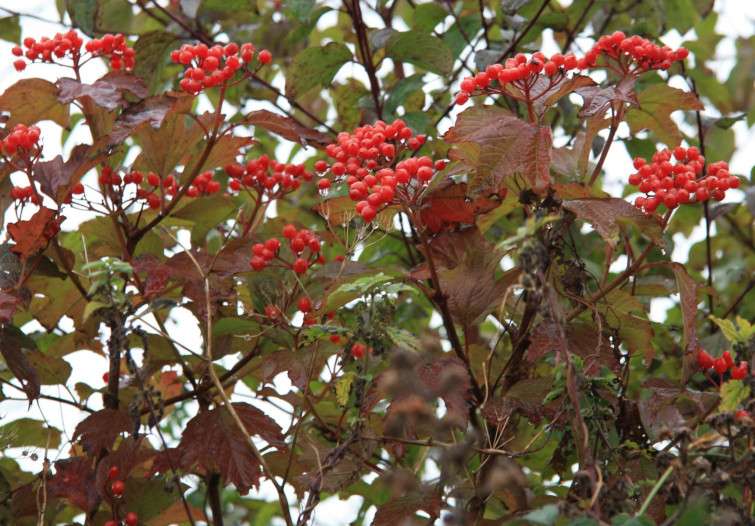
Later in the year, the berries increasingly will catch your attention, especially during those dull grey Autumn days. As you wander past hedgerows, splashes of scarlet stand out to the eye amongst the thinning, yellowing, autumn hedgerows.
What’s in a name?
Medicinal herbalists know the plant well as ‘cramp bark’, because of its medicinal attributes. It’s main common name stems from the province of Holland known as Gueldersland. This is where the shrub was first recorded as being cultivated.
The generic name Viburnum is the old Latin name for this shrub and the other 150-175 mainly shrubby species in the genus.
The specific name opulus refers to a type of maple, in allusion to the maple-like leaf shape of this species.
Because the Guelder rose displays similar growth characteristics to the elder, it was historically known as ‘red elder’ and ‘rose elder’.
Habitats to explore
Guelder rose is said to be well suited to chalkland. Closely related to the elder tree, this shrub is almost entirely absent in Scotland, yet can be found most everywhere in England. Check out the UK distribution map for guelder rose.
It delights in copses of Alnus (alder) and Salix (willow), as well as in a range of hedges, woodland edges, bridleways, and country lanes up to elevations of 400 metres.
It can easily grow up to 4 metres high on many stems. The plant wil flourish in full sun or partial shade and can tolerate most soils other than very wet ones.
When planting this species, the advice has always been to avoid extremely hot or dry, exposed, and cold areas.
How to identify Guelder rose
Remember its related to elder, so family diagnostic features are the same. The branches have grey twigs, somewhat angular in shape. These carry opposite pairs of buds and leaves, mainly terminating with double buds.
Their buds are scaly, and appear thin when viewed from one side, but reasonably broad and becoming tapered when viewed from the other.
Its twigs carry a similarity in colour and form to the elder, especially the opposite pairs of buds.
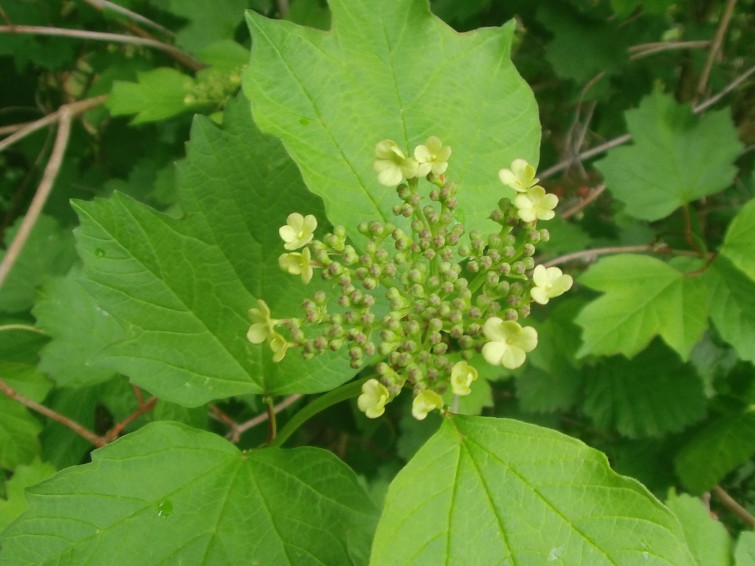
When looking close you will see that the leaves are somewhat akin to a maple. They are often broader than long, usually deeply-divided into 3-5 lobes, and with toothed margins.
The leaves are sometimes voraciously eaten to a lacy outline by the Viburnum leaf beetle (Pyrrhalta viburni). It is not unusual to find some plants decimated by this insect in certain areas.
This plant’s most noticeable features are the distinctive umbel-like inflorescence and subsequent clusters of scarlet berry fruits.
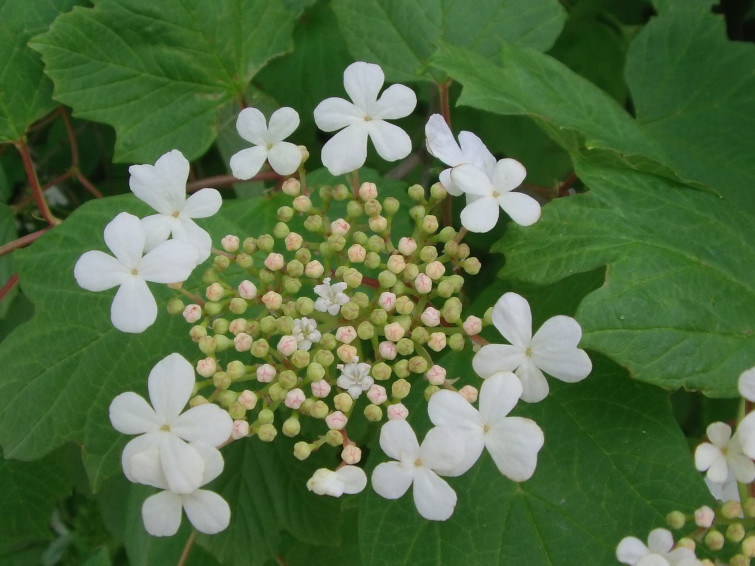
The almost flat-topped, dense corymb is typically around 11 cm wide and snow-white coloured. It will be found in our hedgerows from May-July, although with global heating, they are increasingly found out in the south earlier than the field guides state).
The flowers of Guelder rose are conspicuous in the way that they produce large (15-20 mm wide) sterile outer flowers, surrounding much smaller (6 mm wide) fertile flowers.
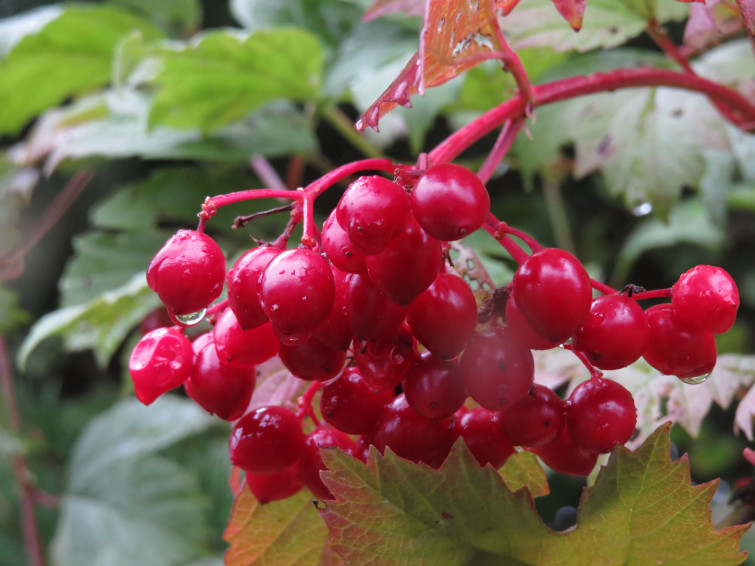
They eventually give rise to the shiny red fruits that ripen into drooping clusters, and are ready from September-October.
Parts used: Inner bark. Berries
Harvest: Bark from 3-5 year old branches in early spring before leaf break. Berries in autumn.
Key constituents: Salicin (which converts to salicylate in the body); isovalerianic acid; sesquiterpenes (viopudial, viburtinal); catechin tannins; coumarin (scopoletin); bitter principle (viburtine).
Learn more about the medicinal plants, constituents and actions in this in-depth article.
Actions: Anti-spasmodic, anti-inflammatory, nervine, tonic, astringent, diuretic.
Pharmacology and uses: As its name suggests, this plant has long been used to alleviate painful cramps and spasms.
The famed ‘cramp bark’ works by relieving and relaxing tense muscles, whether these are skeletal such as back muscles and limbs, or internal smooth muscles such as the intestines, airways, ovaries or uterus.
In North America, a closely related species, black haw (V.prunifolium), is often used interchangeably, although they have slightly different chemical constituents.
Certain indigenous North American Indian tribes such as the Meskwaki and the Penobscot reportedly used cramp bark for muscle swellings and mumps.
Cramp bark can also be taken internally as a decoction or applied topically. It has long been used to treat breathing difficulties in asthma as well as menstrual pains associated with excessive uterine contractions.
Some authors have noted it as being useful where miscarriage is threatened. Cramp bark is also helpful in cases of irritable bowel syndrome, colic, and the physical symptoms of nervous tension.
The molecule salicin, upon digestion, converts to salicylic acid. As a known anti-inflammatory, it will heal and support internal smooth muscles.
This plant also has value in treating cardio-vascular hypertension and is known to relieve constipation associated with tension. The anti-spasmodic action is known to be conferred in part by the substance valerianic acid.
In some cases of arthritis, where joint weakness and pain have forced muscles to contract until almost rigid, cramp bark can be used to bring remarkable relief.
This is because as the muscles relax, more blood can flow, metabolic waste products such as lactic acid can be removed and some degree of normal function can return.
Cramp bark can therefore be used in acute and chronic cases of muscle pains and cramps. It is also usefully used before embarking on any physical activity likely to bring pain.
The berries are not used medicinally. Some authors class them as poisonous whilst others mention them as edible. Tasted straight of the tree they are very bitter due to the substance viburtine.
The berries have been known to cause gastroenteritis when consumed raw. But cooking with the addition of sugar can make a nice enough preserve, but personally I prefer other fruit jams to this one.
Using the bark of Guelder rose is safe and effective for long and short term use, although maybe not if the patient is on anticoagulant medications. This is because the coumarins and salicylates are both known to thin the blood.
The plant has been reported to cause hypotension in large doses or even in average doses if taken by previously hypotensive individuals. Pregnant women ought to refrain from taking the bark of Guelder rose until they have consulted a qualified practitioner.
For tips on harvesting and other foraging hacks, take a look at my medicinal and edible wild plant harvesting guide. Happy foraging!