Foraging for coltsfoot – An ancient herbal medicine for the lungs
Tussilago farfara – Coltsfoot. Asteraceae family
We have gone foraging for coltsfoot for thousands of years. It’s a small herb with a big reputation, which is detailed below.
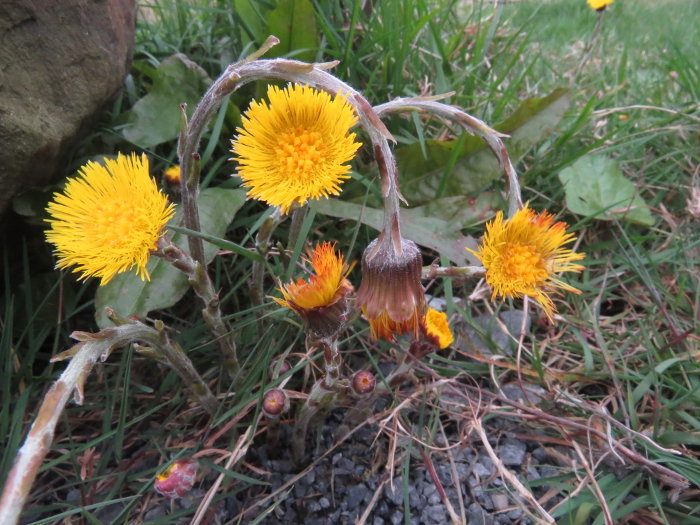
Coltsfoot is a small, creeping perennial herb, notable for its habit of producing beautiful yellow, dandelion-like flowers in late winter and early spring before its leaves appear.
As a result of this floral phenomenon, the ancient Latin name given to it by botanists of the renaissance period was Filius ante patrem, which means ‘the son before the father’.
We know from Roman times that this herb was one of our ‘go-to’ remedies for respiratory disorders.
Such was its prominence, if you were to walk into an apothecary in the 17th and 18th Century, you would recognise this flower immediately from the picture on the signage outside.
The ancient apothecary physicians used this flower as the emblem for their shops, and it is still used by many herbalists today.
What’s in a name?
This plant is one of 15 different species in the genus. Many scientific plant names contain clues as to a plant’s origins, or its favourite habitat, and sometimes to a plant’s main actions or uses.
The generic name Tussilago offers the hint towards its medicinal use. It has the same root word as tussive, relating to coughing.
It has been a popular anti-tussive (cough reflex inhibitor) herb for centuries and recent research is backing up some of the ancient claims.
The specific name farfara, is apparently derived from the ancient name for the white poplar tree (farfarus) whose leaf colour and form resembles coltsfoot somewhat.
Our ancestors obviously thought coltsfoot looked like the foot of an animal.
Coltsfoot botanical description
This is a hardy plant, native to Europe, West Asia, and North Africa. It re-emerges each year from a rootstock of stout, scaly, white (ish) rhizomes. These give rise firstly to its yellow flowers, before the long-stalked, somewhat hoof-shaped, sea-green leaves appear.
Leaves: The broadly kidney-shaped leaves will typically grow somewhere between 10-25 cm long. They have a few, small angular teeth on somewhat undulating margins.
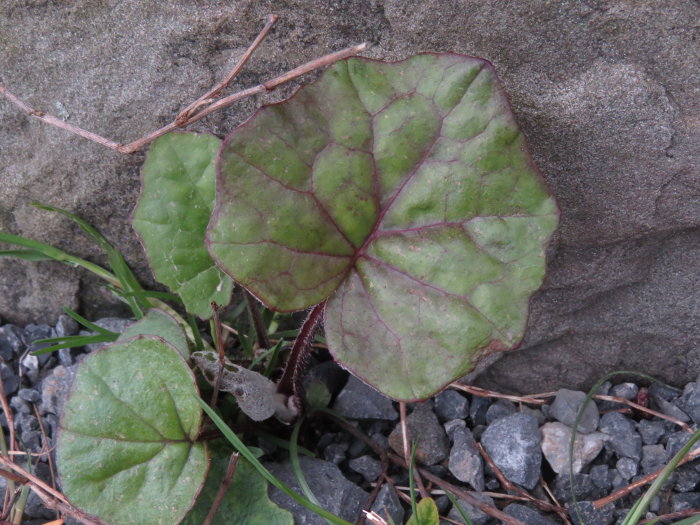 The leaf surface when young are covered with loose, white, woolly hairs, but those on the upper surface will fall off as the leaf quickly grows and expands.
The broad leaves have angled, sometimes pink-tinged, main veins, running away from the central vein, akin to its relative burdock. They are thicker than many other plant leaves and soft to the touch.
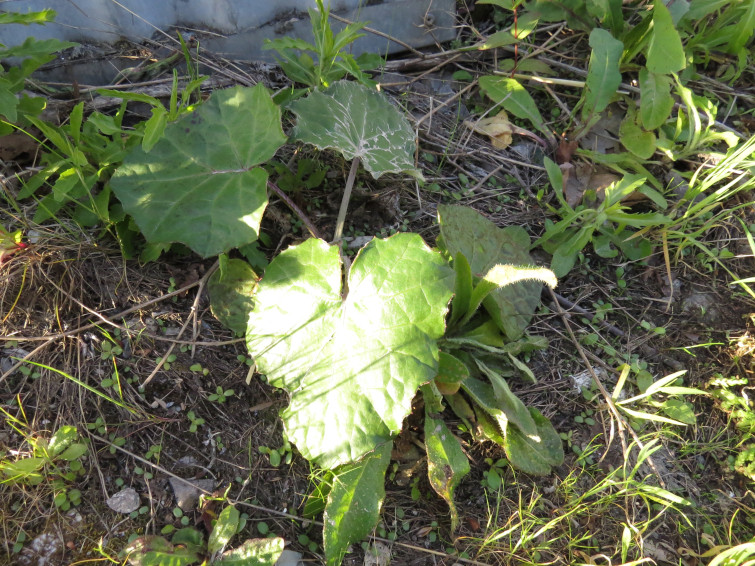
Petiole: Long, to approximately 20 cm. Channeled and initially covered in downy hairs.
Stems: This plant is unusal in that it produces separate stem organs from its rootstock for flowering, which have no leaves.
Flowers: Coltsfoot’s composite flowers are pretty similar in appearance to the dandelion at first glance, although the flower stems are quickly seen to be different.
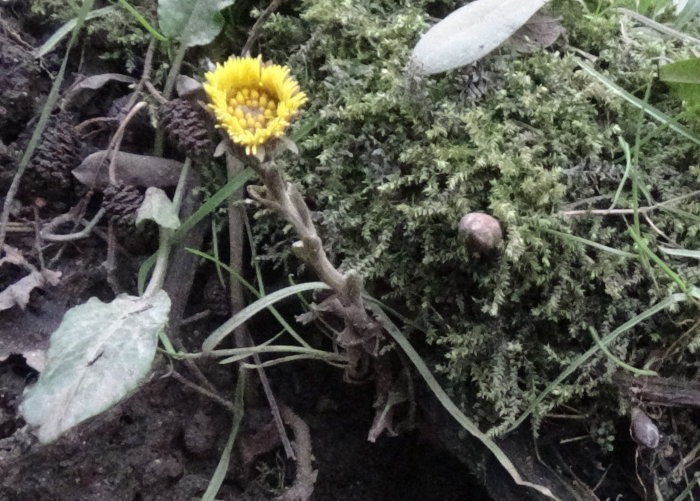
Coltsfoot’s terminal flowering stems are scaly and slightly woolly (unlike the dandelion), topped with striking yellow flower heads.
These striking blooms consist of yellow disc florets and yellow linear ray florets (unlike dandelion which has ray florets only).
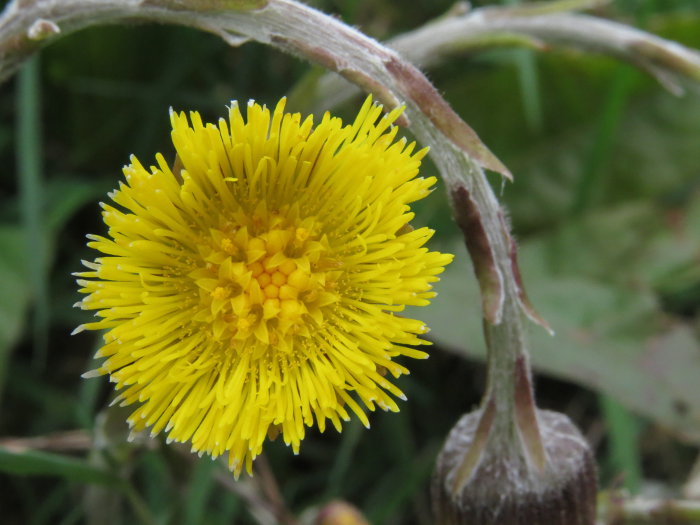
The flowers will generally grow to no more than 20-25 cm high, and always appear before the leaves have emerged. 
As with many of the daisy family plants, coltsfoot produces a spherical seed head of tiny fruits (achenes), attached to downy white, silky, pappus hairs.
Goldfinches were known to line their nests with these soft hairs, as were the Highland peoples of Scotland, who reportedly suffed mattresses and pillows with them.
Habitats to look in when foraging for coltsfoot
This plant used to grow abundantly throughout England. Yet it can still easily be found on a range of sites up to altitudes of 950 metres.
These include waste-grounds, along the sides of railway banks, on cliffs and dunes, and occasionally on roadsides. It grows as well in wet ground as in dry situations.
Coltsfoot loves life by the sea. On the Jurassic Coast in Dorset for example, and repeated on much of our coastline, this plant grows in reasonably large populations.
Nowadays however, with the ever increasing development in 21st century Britain, its abundance has been curtailed somewhat, especially in urban areas.
So, when foraging coltsfoot, you will find it still thrives in towns, in any place that remains a little wild, rough, and unkempt.
Coltsfoot Lookalikes
Be sure it is not the young leaves of Butterbur (Petasites officinalis, syn P.vulgaris syn P.hybridus), or the winter heliotrope (Petasites fragrans) you are collecting by mistake when you are foraging coltsfoot!
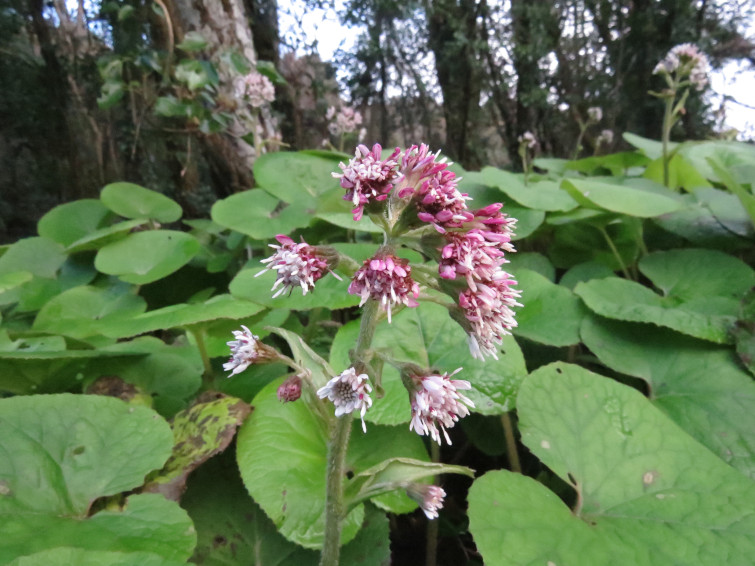 Both of the Petasites resemble coltsfoot in flowering habit and leaf shape, although butterbur is less likely to be mistaken when mature, because its leaves are so much larger than coltsfoot’s.
Both of the Petasites species have more rounded leaves, and without the slightly angled and toothed margins or the white downy fuzz. Butterbur can frequently be found dominating areas of canal and river banks.
Winter heliotrope will similarly be found in large carpeting expanses, be this at the edges of woodlands or hedgebanks, as well as other shady spots.
Parts used Leaves and flowers (the flowers were formerly much used, but not so today as you will shortly discover).
Harvest Leaves: when fully-grown. Flowers just before opening. Get up to speed on all my harvesting techniques and tips in this previous article.
Key constituents Flowers: mucilage; flavonoids (rutin, carotene); taraxanathin; pyrrolizidine alkaloids (senkirkine, senecionine, tussilagine). Leaves: mucilage; flavonols (quercetin, kaempferol and their glycosides); tannins; inulin; phytosterols (sitosterol, stigmasterol, taraxasterol); sesquiterpene (tussilagone); zinc.
Actions Expectorant, anti-tussive, demulcent, anti-catarrhal, anti-inflammatory. Discover more about medicinal plant constituents and actions in our overview of plant chemistry.
Pharmacology and uses Coltsfoot was formerly a prized pulmonary tonic and curative against emphysema, chronic bronchitis and whooping cough.
Culpepper mentions that “…the fresh leaves, or juice, or syrup thereof, is good for a bad, dry cough, or wheezing and shortness of breath”.
This is also true of other soft leaved plants, such as mallows (Malva spp) and mullein (Verbascum thapsus). It’s something worth remembering when out and about foraging…namely, that soft-to-the-touch leaves, usually mean a soft and demulcent medicinal action when taken internally.
Previously, this meant that many people smoked the flowers to help with coughs. The ancients of Greece and Rome were known to advises this, including Dioscorides, Galen and Pliny.
We now know that this method is not the best way forward, although you can still find coltsfoot in a number of herbal ‘tobacco’ blends.
Just like its relative elecampagne (Inula helenium), the roots and flowers of coltsfoot have been used to make a cough sweet.
Boiled in honey or sugar syrup, a type of ‘rock’ made with coltsfoot was once a popular remedy to alleviate coughs and asthma, which was especially useful to people who almost unfailingly were to sit in dusty churches for a few hours, at least once a week.
The overall anti-inflammatory action of coltsfoot is reportedly similar to the pharmaceutical drug indometacin.
The water-soluble polysaccharides are partly responsible for the anti-inflammatory action, as they are in a number of other species in the daisy family.
The trace element zinc, reportedly found in reasonabaly high amounts in coltsfoot, also adds to the anti inflammatory action.
The alkaloid tussilagine has been demonstrated as an effective cardiovascular and respiratory stimulant.
However, as with a number of plants containing the pyrrolizidine alkaloids, liver toxicity from chronic low exposure has been demonstrated in tests, albeit mainly on rats.
Further to this, pregnant women are known to pass on toxic pyrrolizidine compounds to their unborn child, resulting in at least one reported case of fatal, hepatic veno-occlusive disease.
This death was of a newborn infant whose mother had regularly taken cups of herbal tea containing coltsfoot and a Senecio species (a genus also known to contain pyrrolizidine alkaloids).
It is now believed the budding flowers of coltsfoot contain the highest concentrations of these compounds, so current advice from pharmacologists is usually that only the leaves should now be used in a tea, and not for prolonged use.
Coltsfoot has been shown to be anti-bacterial against bacteria including Staphylococcus aureus, Proteus spp and Psuedomonas aeruginosa.
It is also a mild diuretic and has been used to treat cystitis. There are no documented adverse drug reactions recorded for coltsfoot.
People have been foraging for coltsfoot to add to the pot for millennia. Coltsfoot leaves are reported in many ethnobotanical studies as being widely used as a vegetable.
The downy leaves can be simmered and blended with onion and potato into a thick soup, or the leaves can be steamed like spinach, then served with a knob of butter.
Some authors have said the leaves have a liquorice flavour. I do detect a sweetness in coltsfoot leaves, but liquorice is pushing the description somewhat. Well, to my smokers palate at least.
Other notes
Coltsfoot has been classed as an invasive plant not suitable for garden cultivation by the RHS.
You, like me, may think that invasiveness and rapid colonising of bare soil is a valuable asset in the medicinal herb gardener’s fight against weeds.
If I had a medium-large medicine garden, then this plant, along with other effective ground-covering medicinal species, such as ground ivy (Glechoma hederaceae), would be a most welcome and valued addition, boosting my medicine cabinet.
Lots more information on foraging wild plants and mushrooms are soon to be available on our monthly foraging guides.
For all of you new to foraging, you might want to hop over and take a look at the introductory article on starting out foraging. While you’re here, you can also get to know Britain’s poisonous and toxic plants.
New plant species posts in our A-Z weeders digest are coming soon! Happy foraging!