Discover how you can get a great night’s sleep from foraging wild lettuce!
Wild Lettuce (Lactuca virosa) and Prickly Lettuce Lactuca serriola) Asteraceae
Foraging for wild lettuce can help you get a good night’s rest. For various sleep -related problems, our two main wild lettuce species are some of the most helpful remedies you can find in Britain.
This article reveals some of the science behind why foraging wild lettuce can help your sleep, and therefore your health.
The wild lettuce plants are also some of the easiest herbs to find if you are living in town. When you are foraging wild lettuce in larger urban areas, you will often see both.
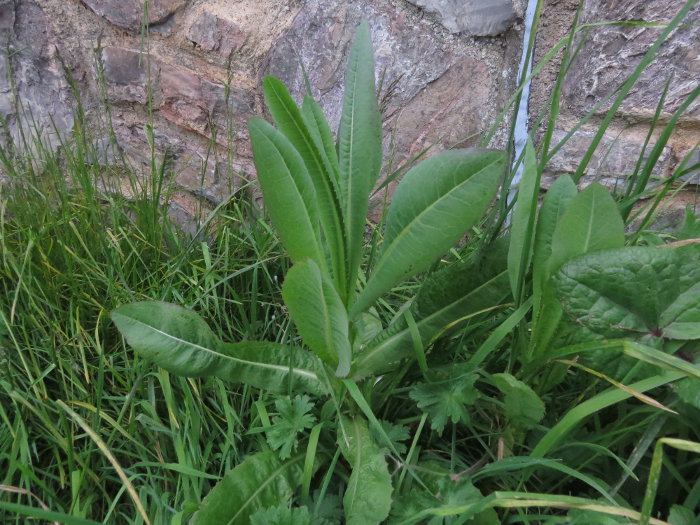
The major difference between the two species under discussion here is the leaf shape. Both plants can be used, but it’s good to know the differences.
What’s in a name?
Our wild lettuce plants are the ancestors of the common garden lettuces (Lactuca sativa).
There are around 100 species in the genus. We have two main Lactuca species in the wild here in Britain.
The generic name Lactuca comes from the Latin word lac – meaning milk. All lettuces produce lots of milky white latex when cut.
The species name virosa, is an interesting one, as it is a Latin word for poisonous. This name is given to a few very poisonous organisms such as Circuta virosa (cowbane) and Amanita virosa (destroying angel).
This I can understand, because these are deadly poisonous, whereas the wild lettuce is, well, it will put you to sleep, but no more than that. Maybe the extremely bitter latex suggested toxicity to our ancestors.
The species name serriola could refer to the serrations on the leaf and the way they line up. It’s common name ‘prickly lettuce’ explains itself.
Identifying wild lettuce herbs
Leaves: 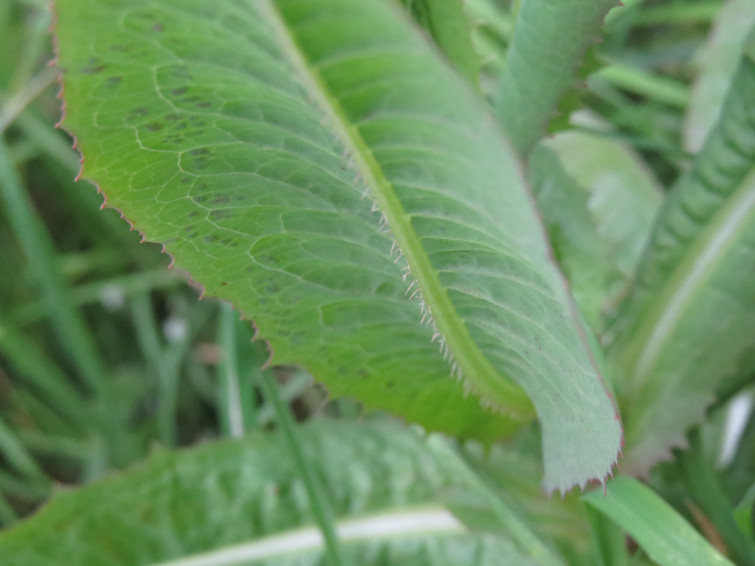
The main feature to look for when identifying wild lettuce is the single line of prickles running along the underside of the leaf.
Lactuca virosa has sessile, oblong-lanceolate shaped, and waxy grey-green coloured leaves.
The prickly lettuce (L.serriola) has pinnately-lobed leaves, deeply cut to the middle flange of the leaf on either side of the midrib.
The leaves of both species are usually found with undulating margins and can grow to 25 cm long.
Often, the leaves are found standing quite erect in their rosette, although as the plant prepares for flowering, they are found clasping the flowering stem, resulting in an almost arrow-like base to the leaf.
Petioles: Short to sessile. Stem leaves have clasping basal leaves.
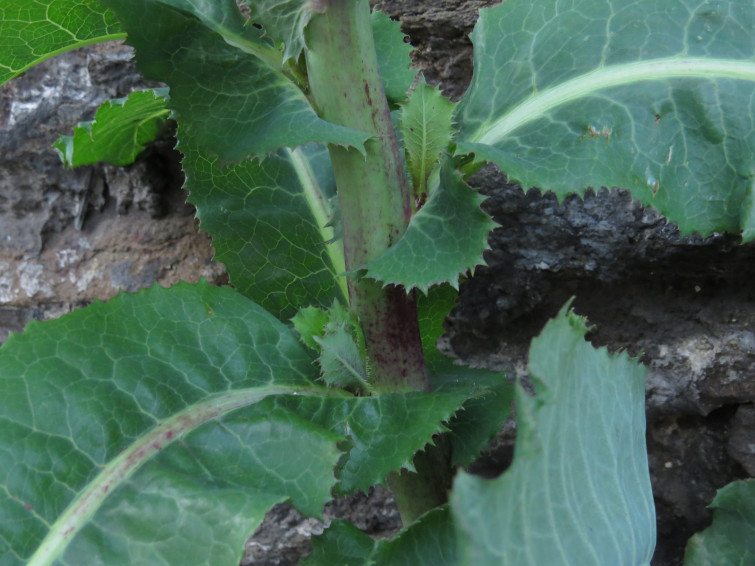
Stems: By mid-summer, this gives rise to its many-branched flowering stems. The stems are round and hollow (as are many herbaceous biennials and perennials).
The stems are typically found with purple-spotting. Stem leaves are alternately-spaced.
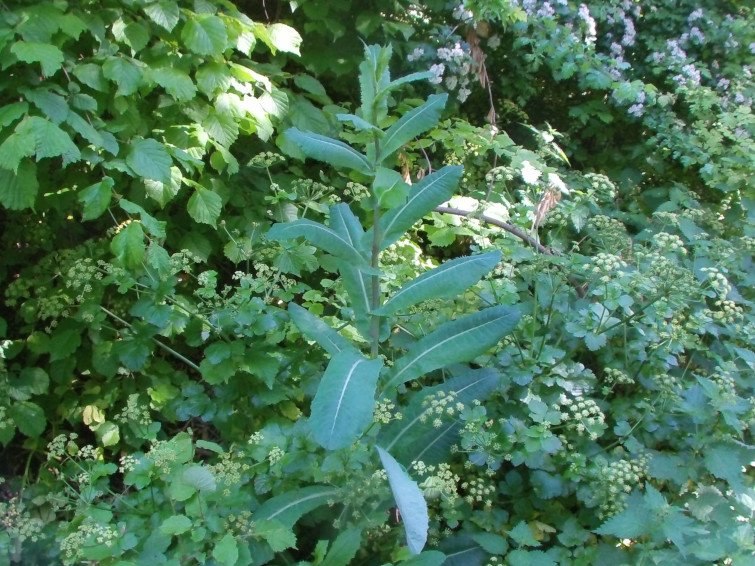
Flowers: The inflorescence is borne on the branched upper portion of the flowering stem.
They are composite flowers, and individually about 11-13 mm wide, with 7-12 yellow ray florets rising from a narrow involucre (8-12 mm long). In flower, the plant can reach heights of up to 200 cm.
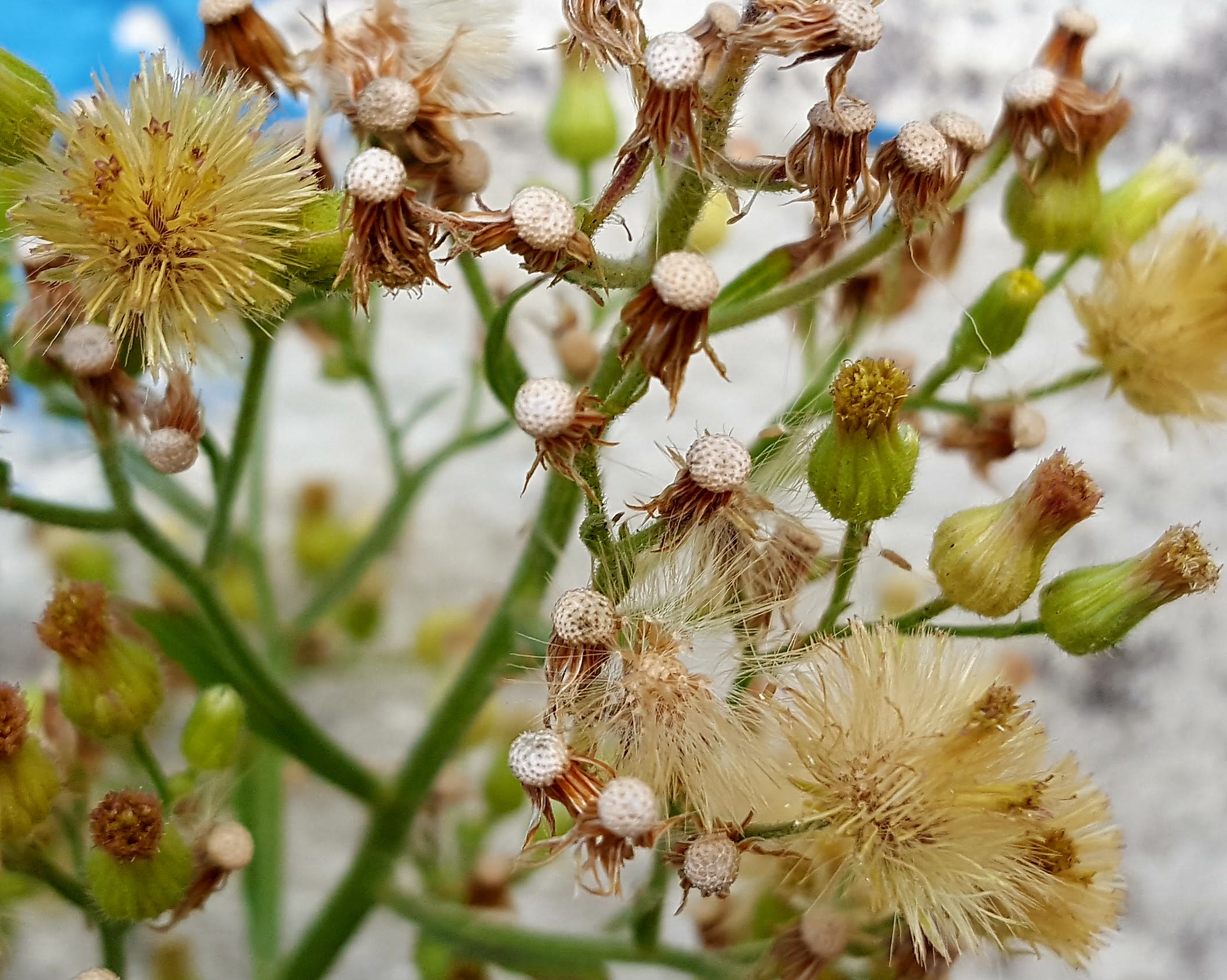
Flowering season: The flowers are on show from July onwards and are superseded by a white, hairy pappus, which spreads the tiny seeds far and wide on the wind.
Habitats to look in when foraging wild lettuce
Foraging wild lettuce is easy in the urban environment. Here, they get an easy foothold into any part of the urban jungle.
A quick look at these two distribution maps of Lactuca virosa and Lactuca serriola will show how widespread the plants are and if they are found in your area.
Take a look around in the spring and summer and you will see the wild lettuce appearing in many places.
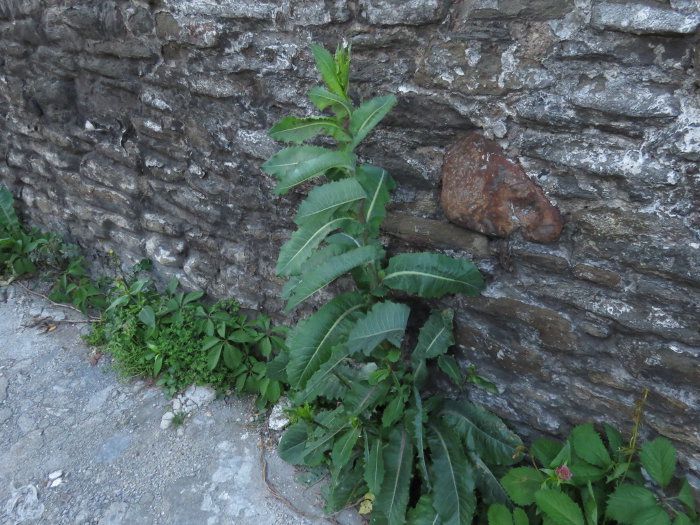
It loves growing out of the bases of walls, pavement cracks or crevices, kerbstones, road-sides, waste-ground and disturbed soils.
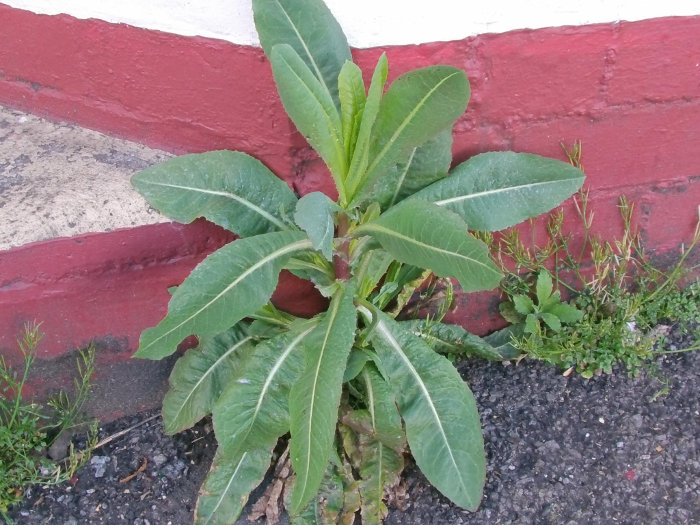
This seems to point to the conditions of its origins, believed to be Asia, where it would be most happy in the sun and on poorer, free-draining soils.
Parts used: Leaves, flower-buds, latex.
Harvest: Best just before the flowers open. Active constituents are in higher concentrations at this time, in comparison to material from younger plants. Learn more tips, tricks, and techniques in this harvesting wild plants article.
Key constituents: Sesquiterpene lactones known collectively as ‘lacturcarium’ (including lactupicrin and lactucerin); also contains the coumarin glucoside (aesculin); flavonoids (including apigenin, luteolin, quercetin and glycosides); proteins; sugars; resins; alkaloids.
Actions: Anti-tussive, sedative, relaxant, bitter.
Pharmacology and uses: Wild lettuces are best known for their relaxant and sedative actions.
Wild lettuce was one of a number of plants formerly used in a well-known anaesthetic recipe, employed before surgery during the middle ages (12th – 15th centuries).
An alcoholic extract of wild lettuce will show sedative properties, causing a reduction in motor activity and behaviour.
However, the compound lactucarium does not pass readily through the blood-brain barrier, and it is thought the effects may arise from peripheral and visceral actions below the neck, rather than above it.
Lactucarium has been used successfully in the treatment of morphine addiction because it has similar, if milder, anodyne-sedative effects.
The compound lactucarium is a mixture of a number of substances and was also reportedly used to adulterate opium. This and its latex, gave rise to the nickname – ‘lettuce opium’. It does not contain opiate molecules (only found in Papaver species)
Discover lots more about medicinal plant constituents and their actions in this must-read article.
Wild lettuce has been used successfully for treating both nervous excitability and insomnia.
Scientific evidence regarding its abilities to assist with chronic and acute coughs are still thin on the ground.
Even though there is a lack of published scientific papers, I still think its effectiveness can also be measured through its repeated traditional use by herbalists for hundreds of years.
We need to always remember that science still doesn’t hold anything like all the answers.
Wild lettuce was in a number of cough remedies before full implementation of the E.U traditional herbal medicinal product directive 2004/24/E.C. although how many it appears in now, I’m unsure.
The fact that the plant is so easily found, means it’s really simple to go out foraging wild lettuce and make your own.
The sleep-inducing qualities of lettuce were immortalised in Beatrix potter’s children’s books starring Peter Rabbit.
In the tales, Peter’s mum used to give him lettuce to eat last thing at night, for its soporific qualities.
A number of herbal books will also testify to the gentle sleep-inducing powers of eating lettuce last thing at night.
The wild lettuce is a much stronger sedative than the cultivated varieties and can often be found in sleep-inducing herbal preparations, combined with hops, valerian, lime flowers, and passionflower.
Toxicity has generally been regarded as low, but there are cases of people who have eaten large quantities of wild lettuce, then presenting themselves to hospitals suffering from various manifestations of wild lettuce toxicity.
These included: a decreased level of consciousness, agitation, dry mucosa, mydriatic pupils (pupils dilating), urinary retention, and hypoactive bowel sounds.
As ever with plants from the daisy family, as ever there is a warning for people who suffer allergic reactions to other members of this large plant family.
More from our A-Z weeders digest coming soon! Happy foraging!