Learn how to identify red valerian with the UK’s most comprehensive forager’s plant identification guide.
The following article will hopefully enable you to quickly and confidently identify red valerian. At the same time it will help you know the differences between this herb and its related namesake, the medicinal valerian (Valeriana officinalis), for which it is often confused.
Beginner foragers are at this juncture, directed towards these handy guides to starting out foraging and harvesting wild plants. As well as the hundreds of wild edible and medicinal plants covered here, you are also strongly advised to get well acquainted with Britain’s poisonous plants, because to learn them helps to leave them alone!
This plant was reportedly first brought here during the 1590’s. It was first recorded in the wild by 1734. Red valerian is a plant that some love, and some hate, but, if social media is anything to go by, many still regularly mis-identify. That is surely down to to plain old misplaced assumptions, because it is quite a distinctive looking herb, especially in its preferred habitats.
What’s in a name?
The first part of the scientific name Centranthus is derived from the Greek words ‘kenton’ meaning spur, and ‘anthos’, the old Greek word for flower. The specific moniker ruber, means red.
It shares both a family and a common name with the medicinal herb valerian. This name, as readers of the corn salad article will already know, comes from the Latin word Valere, and translates as ‘to be healthy’. Red valerian shares no medicinal properties or actions.
Other common names you may see include ‘Foxes brush’ and ‘Jupiters beard’.
Botanical description
Some technical language is necessary here. New readers may wish to bookmark this helpful glossary for foragers.
Leaves: The leaf shape is generally elliptic. The leaves will be found as upward thrusting rosettes throughout the winter. This should help to raise a forager’s interest levels when you are out foraging in December or January. New leaves appear in March.
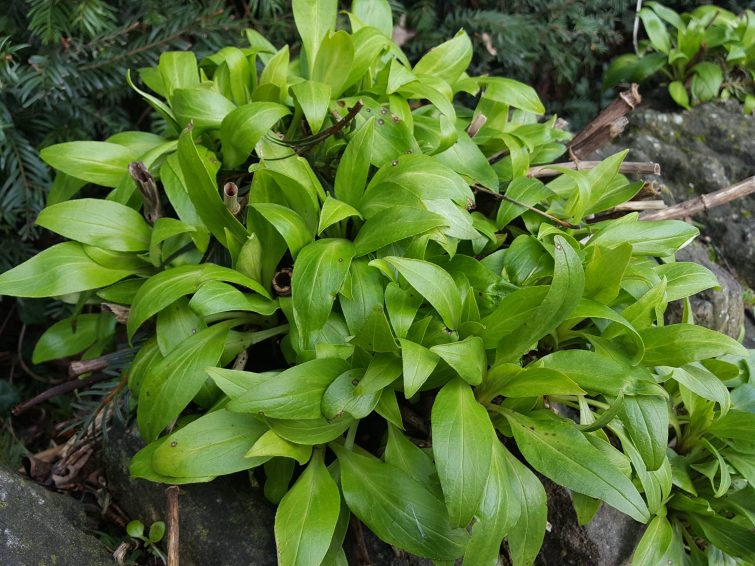
The simple, hairless and somewhat glossy-looking leaves, have a raised midrib below and a few whiteish veins above.
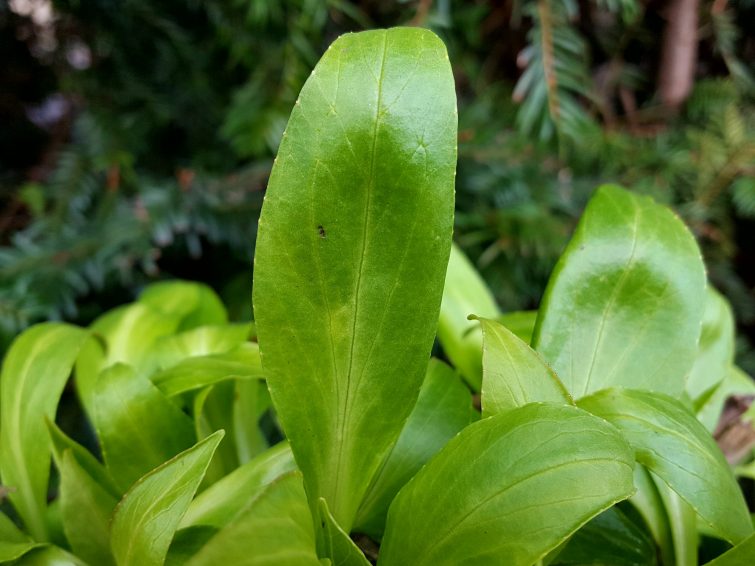
The leaf margins are minutely crenated with a series of white hydathodes visible with close inspection. Contrast these leaves with the large compound-pinnate leaves of the medicinal valerian.
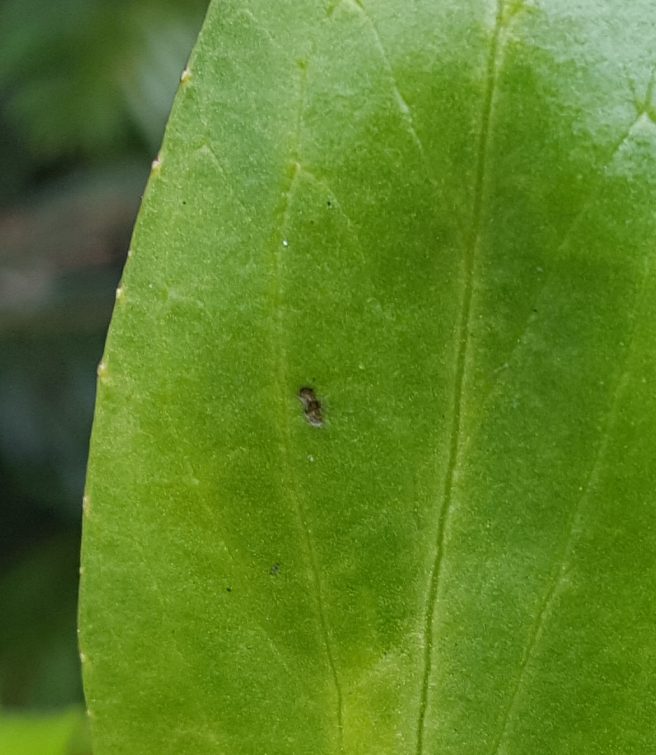
Petioles: Typically the small leaf stalks on basal leaves reach 5 cm or so. The oppositely-spaced stem leaves are smaller, and become sessile.
Roots: This plant has a winter-hardy, fibrous and rhizomous rootstock.
Stems: The flowering stems start to rise in late spring. They grow up to around 1 metre or so. They are typically round to weakly angled, and not swollen at the nodes. Eventually they become hollow and will snap audibly. Try it! During May the plant begins to put on an often spectacular display, especially when found en massé.
Flowers: Although most specimens have pink -red flowers, many will display brilliant white blooms. A darker magenta colour will also be found.
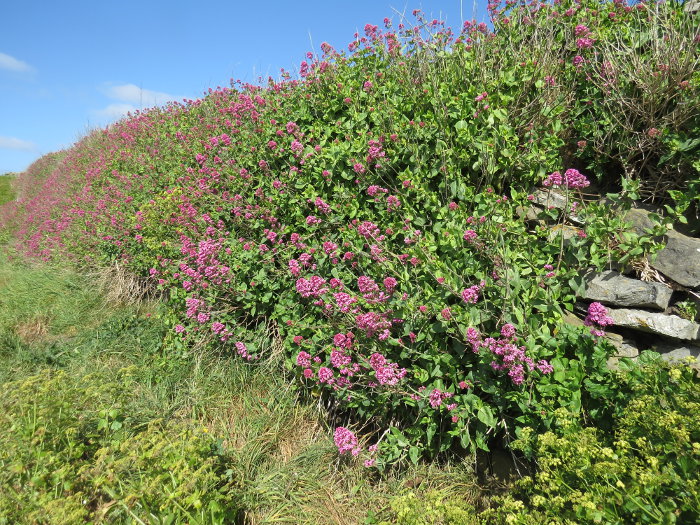
Flowering season: This plant will be in full bloom in our increasingly warmer climate from June. It then flowers all through the summer into late September and early October.
Fruits: The pollinated flowers produce numerous tear-drop shaped, ridged seeds, with short pappus hairs. The seeds are dispersed mainly on the wind.
Habitats: This plant thrives in Britain in habitats replicating its Mediterranean home. Absent in the higher parts of England, Wales and Scotland, you can find it in large numbers by the coast.
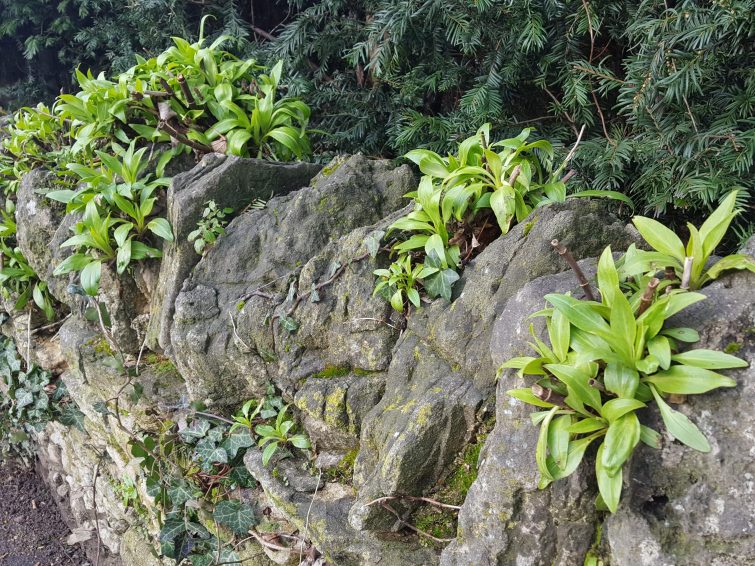
It also loves life on stone walls and old crumbling buildings, railway and road embankments, distubed ground and other free-draining lowland sites. The plant is absent on higher ground in England, Wales and Scotland.
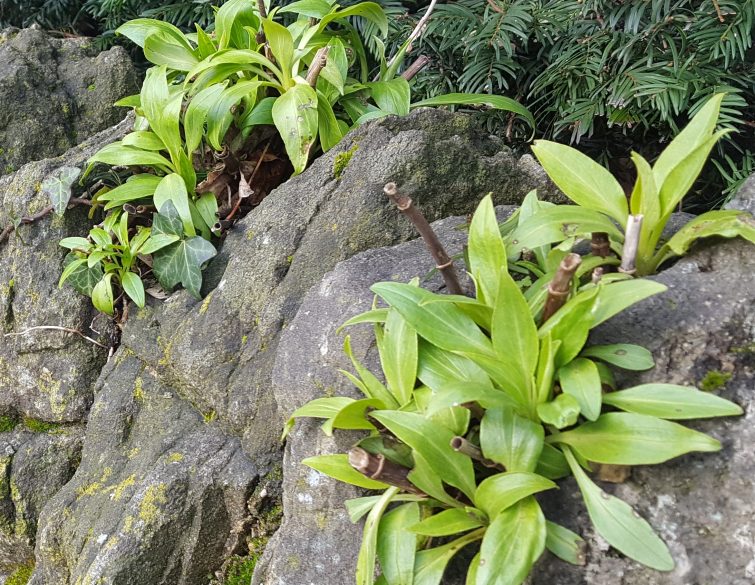
Parts used: Leaves, flowers and roots have all been used as food.
Harvesting: Leaves are best harvested in the winter months when they are not as bitter as they can get in the hotter months. Flowers can be picked as soon as they appear. Roots are best picked in the late autumn and winter months.
Edible uses: In its native range, this plant has a documented history of use as food. In Italy the leaves are used in salads or in a cooked dish of wild greens known as preboggion.
The young flowering stems are possibly worth experimenting with, as many pre-flowering stems are. The small flowers can also be added to salads. The roots have been documented as an edible, after cooking.
Other notes: As pretty as it is, this plant will quickly damage old stone walls. With the price of stonemasonry, this should be enough warning for homeowners to remove the plant from places other than the tops of walls.