- Foraging for Ribwort and greater plantain (Plantago lanceolata / P.major. Plantaginaceae
- How to identify ribwort and greater plantain
- Flowers
- Adaptable habit
- Habitats to look in? Everywhere!
- Britain’s three other common plantain herbs.
- Edible and medicinal uses of ribwort and greater plantain.
- Ribwort and greater plantain. First aid herbs at your feet.
- Eating plantain. Ideas on how to use plantain in the kitchen
- ‘Psyllium husk’.
Foraging for Ribwort and greater plantain (Plantago lanceolata / P.major. Plantaginaceae
It would take a book of its own to do justice to the many edible and medicinal uses of ribwort and greater plantain.
Much like the other common herbs covered here in these pages, such as shepherd’s purse and yarrow, humans have been foraging ribwort and greater plantain pretty much for ever.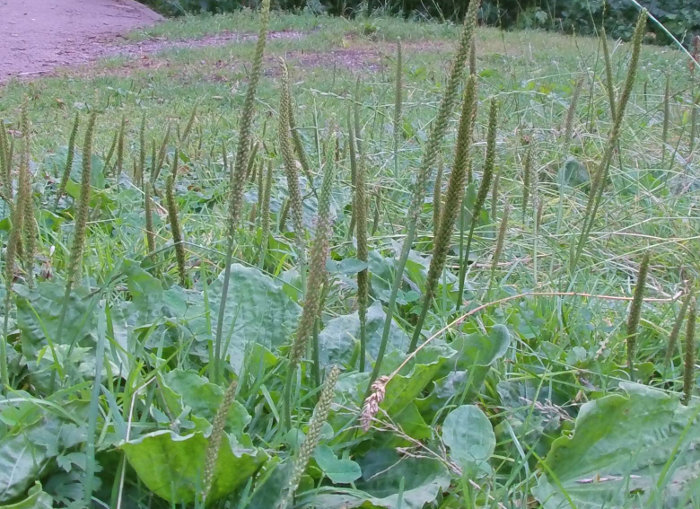
The genus Plantago contains two of our finest medicinal plants here in the UK as well as two other good edible species well worth knowing.
Aside from the two main plantains under study here, this article also takes a look at three others, hoary plantain (Plantago ovata) buckshorn plantain (P.coronopus), plus the sea plantain (P.maritima).
Worldwide, there are approximately 200 species of these mainly weedy and sometimes invasive plants in the genus Plantago.
Their generic name Plantago comes from the Latin Planta –soul of the foot.
The common water plantain (Alisma plantago-aquatica) is unrelated and a plant I plan to cover in a future article
Here in Britain, you will easily find at least four of the plantain tribe growing wild. Two of them are found in 99% of the country and are two of the most useful medicinal plants you can get your hands on. Two of them almost exclusively live and flourish by the coast and estuaries.
It is likely that you are already familiar with ribwort and greater plantain also known as ‘rats-tail’.
These two plants are extremely common herbaceous perennial herbs. They are never too far away from us in pretty much any country or urban setting.
It may be that our long and intimate relationship with the plantains, through more than a few turnings of the great celestial wheel, has ensured their large numbers and close proximity.
How to identify ribwort and greater plantain
Ribwort is a low-growing plant, with lanceolate leaves, approximately 15-25 cm long. Rats-tail plantain has much wider, broadly oval leaves with a noticeably wider and longer petiole.
Both plants grow in untidy rosettes and produce no leaves on the flowering stem. All species have distinctive white, raised veins on the undersides of the leaves. Stringy fibres are easily noticed when tearing the leaves.
Flowers
Flowering spikes of both species can reach up to around45 cm high. The stems, and the buds, are often being covered in fine silky hairs. Flowering stems can be deeply furrowed in appearance.

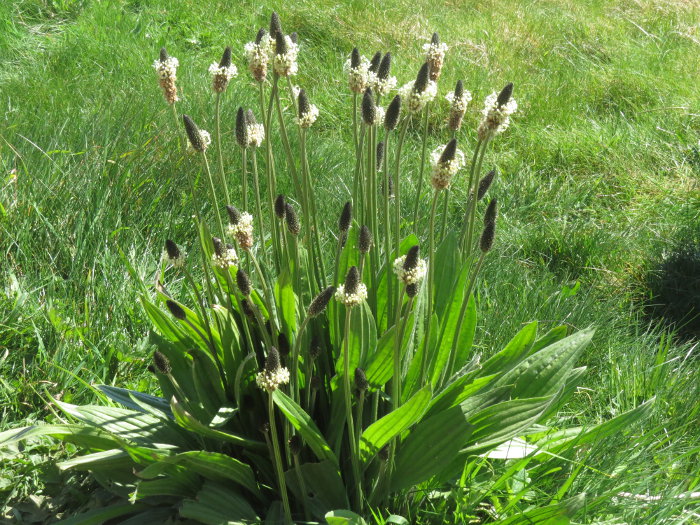 Greater plantain’s inflorescence is larger than ribwort’s, occupying a greater ratio of the whole stem. Whereas ribwort’s flowering stem is often larger in overall size yet with a much smaller, more delicate flower-head than greater plantain.
The flowers of both species are produced without the need for petals. Initially, ribwort’s green buds give rise to halos of pale creamy yellow anthers. Greater plantain produces purple-tinged stamens. The flowers eventually turn brown when seeds are ripe.
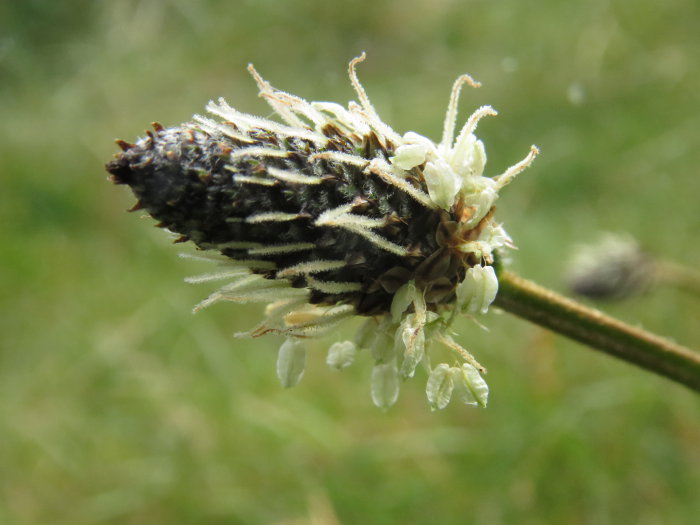
The field guides say both flower from April to August, and seeds ripen from June to September. I see them flowering in March regularly. The flowers are hermaphrodite and are pollinated by wind, flies and beetles.
Their seeds contain a water-retaining ‘gel’ made from mucilage, enabling them to germinate and grow in dry soils when other species cannot. If conditions are not favourable, the seed is long-lived and can sit in the soil for months or years waiting for the right conditions!
Adaptable habit
Ribwort and rats-tail are variable in their habit. They will adapt it to environmental factors, being erect in tall vegetation but prostrate under grazing pressure. They can establish by spreading through vegetative means, ribwort especially so, and often appear in dense patches.
Neither of these plants are exceptionally frost hardy, but in our milder winters of late, I’m seeing lots of ribwort persist through the darker months, especially round the Atlantic coast.
Habitats to look in? Everywhere!
Plantains can grow on most soils including alkaline and nutritionally poor soils up to altitudes of around 840 metres. They tolerate maritime exposure, establishing themselves in a wide range of conditions.
Ribwort plantain is often a significant component of flower-rich grasslands. Indeed, the plantain’s have been suggested as the most constant and widespread component of natural and semi-natural grassland in Britain.
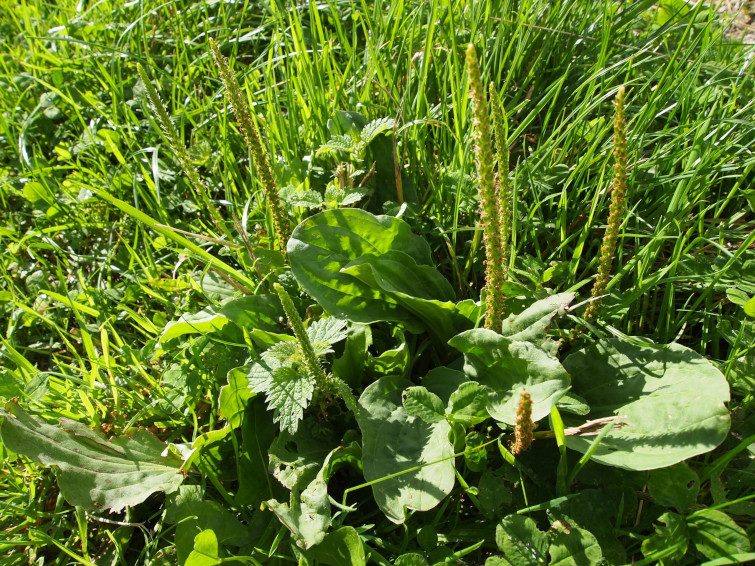
They are found in all but the most acid grassland, appearing in meadow communities, grazed pasture, lawns, sea cliffs, and sand dunes.
Although ribwort is frequently prominent in a grass sward, it is not dominant in the sense of excluding other species or limiting diversity (as shown by its constant presence in the most diverse grasslands).
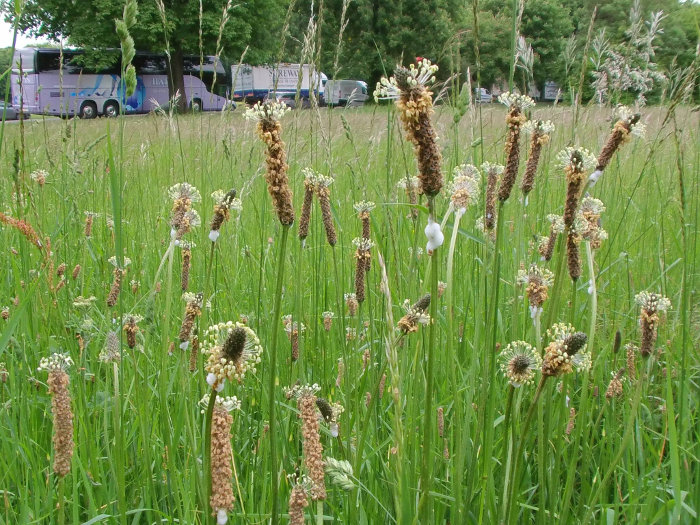
If you are not sure if the plantains are growing near you (they are!), then take a look at this map.
Britain’s three other common plantain herbs.
There are three other relatively common plantains. Two of these are very common at the coast.
Hoary plantain
Inland, If you keep your eyes well peeled in grassy areas you may stumble across the ‘hoary’ plantain (Plantago media). This plant has ovate-lanceolate leaves, sort of halfway between greater plantain and ribwort.
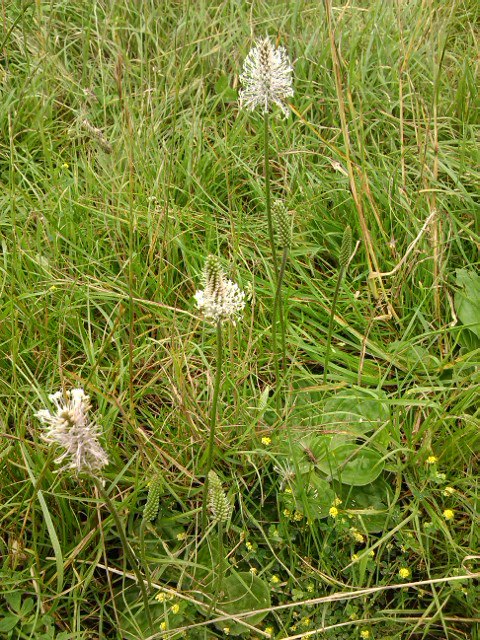 Leaves have five prominent ribs and flowers with purple-tinged stamens. I still confuse hoary plantain leaves with fat ribwort leaves from a glance.
Hoary plantain has to be the prettiest plantain of the lot to my eye, looking more similar in form to ribwort than the rats-tail, but with gorgeous mauve anthers.
It can often be found nearer the coast-line and can freely occur inland as well, but nowhere near as frequently as ribwort.
Hoary plantain is absent from most of Cornwall and Wales but can be found elsewhere under elevations of 520 metres. I’ve seen a few on the Downs near the Gorge in Bristol, another maritime climate and setting.
Buckshorn plantain
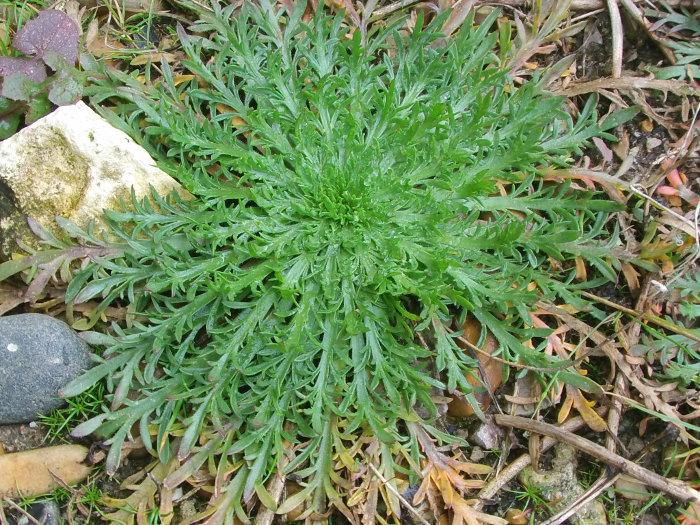
Down at the coast you can see buckshorn plantain. This plant has deeply divided, bi-pinnately-lobed leaves, with linear-lobed segments.
The leaf shape provides easy identification. Both its name and branched foliage give rise to an allusion of antlers. Its flower is relatively small, initially drooping and then producing a lovely little yellow display.
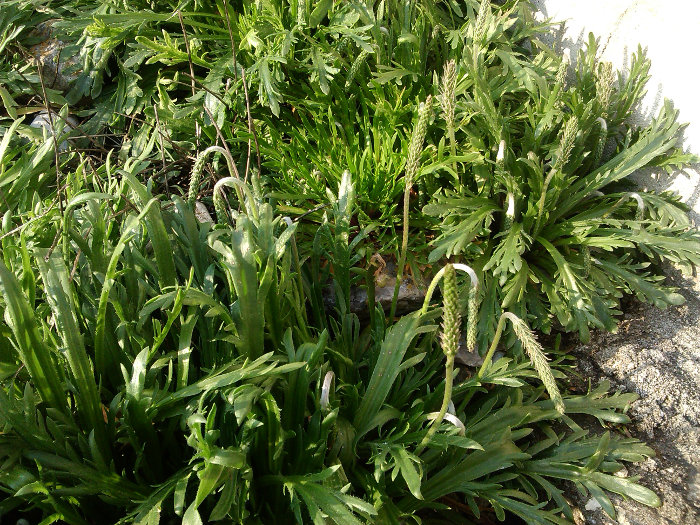
This distinctive-looking plant will occur in coastal towns and villages, on shingle beaches, or on sandy grassy edges and all manner of different cliffs. Keep an eye out for it in grasslands in cities that are technically coastal, such as Bristol and London.
This may have been the plantain that old texts refer to when mentioning plantain’s use as a ‘sallet’ herb.
Certainly, the other plantains mentioned are edible, but only the very youngest leaves are in any way enjoyable raw. Usually, our two common plantains here in Britain are often a little bit too bitter anyway, no matter their size, unless the younger specimens are used.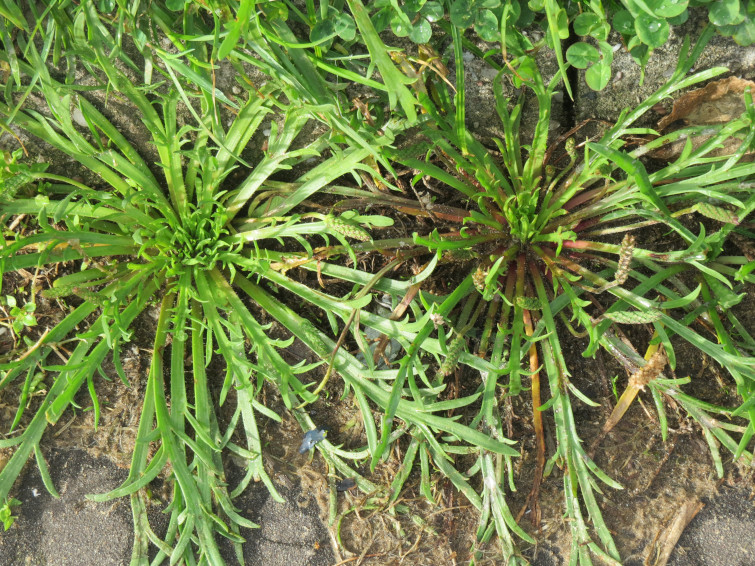
Buckshorn plantain is a coastal lowland species and can be found at altitudes of 340 metres although sometimes on salt-treated roads inland.
Sea plantain
Along the coastline and estuaries, you will come across the ‘sea plantain’ (Plantago maritima), which is another reasonably succulent wild salad or pottage herb.
As well as the drier areas of salt marsh, this plant enjoys shingle beaches, as well as sandy and rocky dunes and edges.
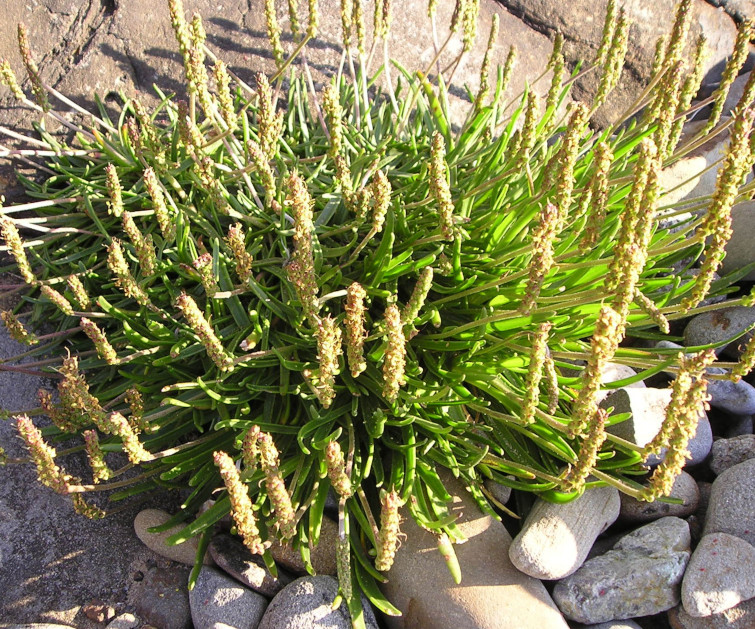 It primarily loves the coastal environment, because the numerous cliffs and estuaries offer many niche habitats for a range of tasty edible plants. Sea plantain will sometimes provide extensive coverage of leaves.
Sea plantain has narrower leaves than ribwort. It is a more succulent-looking leaf. On the back, you will see a singular, prominent, central mid-rib. The leaves are all attached to a woody crown. Its flowering stem and flowers are more similar to the rats-tail plantain.
Edible and medicinal uses of ribwort and greater plantain.
Parts used: Leaves. Pre-flowering buds, seed husk, seeds.
Harvest: Leaves, any time from spring to autumn.
Key constituents: Mucilage; glycosides (including aucubin); tannins; minerals (including silica, zinc and potassium).
Actions: Vulnerary, mildly anti-bacterial, bitter, anti-septic, astringent, demulcent, mildly expectorant, haemostatic, diuretic.
Pharmacology and uses: (Please refer to the glossary and the article on medicinal plant constituents and their actions for help with technical jargon)
The edible and medicinal uses of plantains are well documented. All of our well-known Western herbalists and herbal writers champion their virtues.
Both ribwort and greater plantain are known food plants of our Paleolithic ancestors. Remains have been found at various archeological sites. The Ethno-Archeologist Gordon Hillman showed how to make flatbreads with the seeds on the Ray Mears Wild food series a few years ago.

Both ribwort and greater plantain can be used to combat various debilitating ailments including catarrhal conditions. Rather than suppressing the symptoms, they enable the body to deal with the causes of excessive catarrh.
On mainland Europe, ribwort is widely applied against hay fever and allergic conditions, where the mucous membranes are dry and or hyper-sensitive. It is of great use in treating respiratory conditions.
Both medicinal plantains help to provide long term improvements in respiratory health. Herbalists recommended them for several respiratory ailments. These include bronchitis, nasal catarrh and sinusitis, as well as middle ear complaints.
Plantains are particularly effective in treating these conditions in children. Once again this is due to their mucilage content.
They act as calming, soothing expectorants. They help relax irritating coughs, especially where accompanied by a general tightness of the airways. Ribwort tea is a wholesome, satisfying, tonic of a tea.
John Parkinson (1567-1650) documented that either one of the plantains relieve “spitting of the blood” (one of the symptoms of tuberculosis, alongside irritation of the mucous membranes), and “for bloody or foul water by any ulcer in the kidney or bladder”.
Nicolas Culpeper (1616-1654) wrote that “plantains are special herbs for “staying all manner of the fluxes in man or woman”
And are “singularly good herbs for those that are troubled with consumption of the lungs, or coughs that come of heat“.
Culpeper also mentions plantain herbs as “a good wound herb, to heal fresh or old wounds or sores, either outward or inward”.
The aucubin present in the leaves is anti-bacterial and is known to increase uric acid excretion by the kidneys. The micro-nutrient silica is known to promote lung tissue repair and zinc aids general healing and natural defences.
The mucilage content provides a relaxing expectorant action, and combined with the tannin content, provides a local, soothing effect on the skin and gut lining
Ribwort and greater plantain. First aid herbs at your feet.
The plantain herbs are outstanding wound herbs. Like other traditionally used plants such as yarrow, plantain offer excellent first-aid, on the move.
No need for tears, plasters, first-aid-kits or nurses when these plants are so common. If you cut yourself when out foraging, either ribwort or greater plantain will likely be really near-by. Sorted!
To use in the wild, simply gather and chew a few of the leaves, then apply this ‘spit poultice’ to the afflicted area.
You will see that bleeding stops very quickly and broken flesh is rapidly ‘glued’ together due to the astringency of the tannins and demulcent mucilage components. The plantains are also mildly antiseptic, preventing infection.
The plantains can also be used against insect bites and stings. Once again simply scrunch the leaves until you get the juices flowing. Both the plantains are especially good for treating children suffering from these recurring afflictions.
Eating plantain. Ideas on how to use plantain in the kitchen
During a forage walk I hosted in Oxford, I met a Korean man who reminisced about eating the greater plantain leaves as a child at home. He mentioned that they cooked it as you would spinach, and said it was a commonly used vegetable in rural areas.
On his website, the esteemed forager Pascal Bauder demonstrates his method of cooking plantain that produces a seaweed-like texture.
Other plantain recipes utilise the earthy, mushroom-like flavour of leaves and flower buds. I like using plantain buds in May.
I can quickly gather enough to make a tapenade, mixing olive oil, lemon juice salt and pepper, either in a pestle and mortar or ‘Nutri-bullet’. Add more oil and or a splash of water to mix to a fluid paste consistency. Add to humus about half and half.
Try using sea plantain leaves in a pickle after blanching in boiling water for 30 seconds, or served as a lightly steamed sea vegetable served with pepper and a good squeeze of lemon juice.
Harvest specimens with leaves still attached to the base stem and cut them so the majority of them remain attached. Then try dunking in a spiced batter before frying and serving with a sweet chili and soy dip. The battered plantain looks like an octopus on the plate!
Buckshorn plantain has recently become an increasingly popular addition to commercial salad production in South West England. You may find it called ‘minutina’ or ‘erba stella’ in seed catalogues. Its succulent crunchy leaves are good if they have favourable conditions.
I have noticed that buckshorn can be almost hairless, or almost woolly. They can approximate succulence every now and then, complete with a salty tang, but are also liable to their fair share of stringy fibres, and sometimes taste bitter.
As ever, it is site-specific, so try the plant from numerous locations and times of year.
Plantains also offer us nutritious seeds. These can be added to meals as you might with linseeds, and ground into flour to make flatbreads. The seeds of Plantago lanceolata are nutty and just big enough to be bothered about.
‘Psyllium husk’.
Psyllium is the name given to husk from seed of either Plantago psyllium and P.indica and is freely available from many ethnic grocer shops as well as pharmacists.
This remedy has been used for millennia in Asia. People know it as ‘Asashwagole’ in North Africa and parts of Europe. If necessary, say in a survival situation, the seed and husk can be collected from our native plantains, but it will take you quite a while to harvest the product.
Parts used: Seeds
Key constituents: Muc-opolysaccharides within the mucilage (approx 15% total weight); proteins; fatty acids (linoleic, oleic, palmitic, stearic); sterols; tannins.
Actions: Demulcent, bulk-forming laxative.
If requiring a bulk laxative, there are typically just two main herbal choices that stand out; psyllium or the endangered slippery elm.
In both cases, the resultant effects are due to the high concentration of mucilaginous, polysaccharide substances.
Herbal pharmacologists advise the soaking of plantain husk in warm water for several hours before using. This is probably due to the nature of long-chain mucilage sugar units requiring time to be fully ‘loosened’ from the action of water.
Some studies have shown that fecal matter can be substantially increased by psyllium. For people with constipation, increases in the frequency of defecation will (hopefully) occur.
Psyllium is indicated by herbalists for use following anorectal surgery and for the management of haemorrhoids and in cases of diarrhoea.
As a bulk laxative, there is a chance it will cause minor flatulence and temporary abdominal pains. Do not attempt to swallow psyllium husk dry, for it may obstruct the throat!
For more information on other plants in season now, simply visit our seasonal and monthly wild food guides.