Horseradish (Armoracia rusticana) brassicaceae family.
Learn how to find, identify, and use the quintessential Sunday dinner favourite -horseradish.
Horseradish is best known as the basis of the fiery condiment accompanying Sunday roast dinners every week here in Britain.
But it is another plant we do well to explore for its various tender young plant parts, as they develop over the year.
This is a long-lived perennial plant. When mature in the summer it can easily reach well over 1.5 m wide.
Horseradish was reportedly imported into Britain during the 16th century, specifically as a medicinal plant.
It is essentially a much stronger version of our traditional respiratory herb hedge mustard (Sisymbrium officinale), and is used in pretty much the same way.
The culinary use of horseradish didn’t kick off immediately, but by the 18th century, it was a cottage garden staple and replacing other native pungent brassicas in food.
Today the root or the classic sauce made from them is found on almost every supermarket and corner shop shelf.
Leaves: 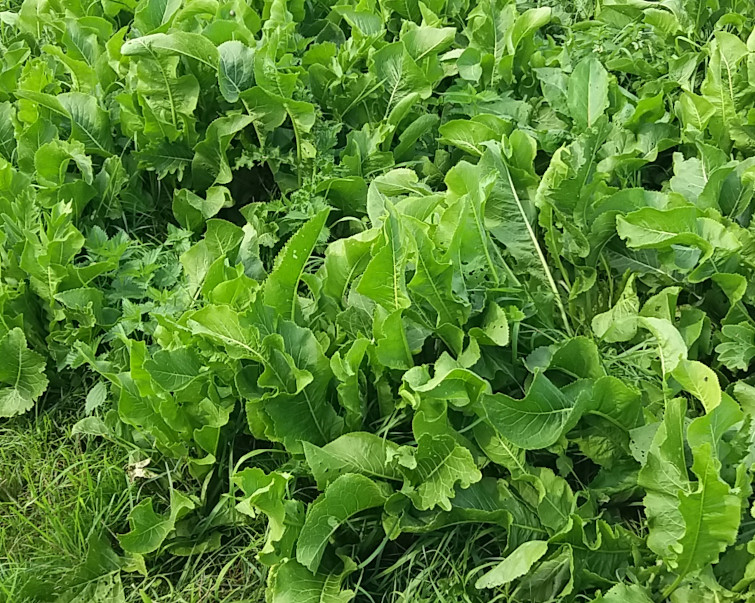 When crushed, they smell strongly of mustard. The shiny green leaves are very large, ovate-oblong shaped, and round at the base. The prominent midrib is white and helps distinguish this plant from docks.
The leaves are potentially confusable with our dock family plants, until you either closely look, or crush and smell them! Horseradish leaves will always try and reach up vertically.
The initial basal leaves appear in mid-spring, and can typically grow larger than 40 cm long. Leaves up to 60 cm long are not uncommon on well-established plants.
Leaf margins are crenate-serrate (See glossary) and they undulate. Later leaves and stems leaves are lobed, sometimes deeply and pinnately, especially at the base.
Petioles: Typically 25 c-30 cm long. Can be found slightly sheathing at the base. The petiole has a ‘v’-shaped channel running up it.
Roots: Large tap roots. these will develop over time into a woody crown with numerous new growing points.
Stems: These can rise to around 1.2 – 1.5 metres during flowering. The alternate spaced stem leaves refine in form, to a linear or elliptic shape.
Flowers: They are borne on terminal panicles. The Horseradish is a little temperamental. Some specimens do not flower every year, and some hardly ever. When they do, the small white flowers appear in the shape of a cross.
Flowering season: Look for the flowers from late June onwards.
Habit: Clump forming, upright, spreading.
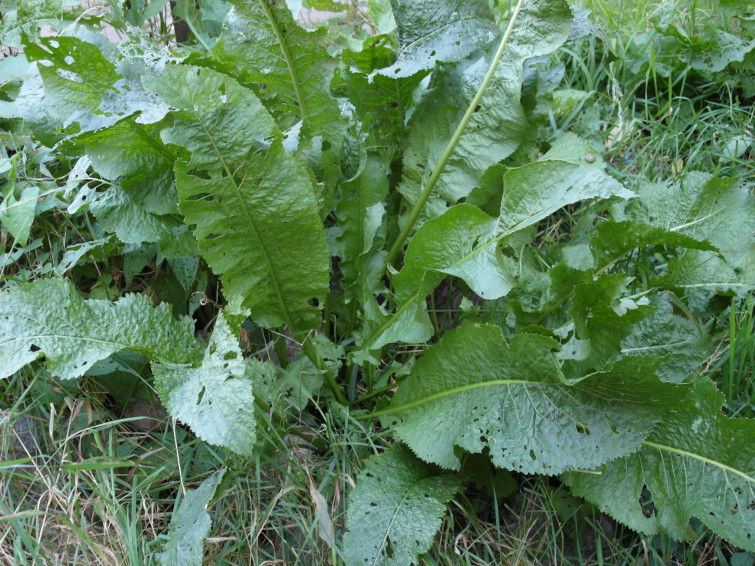
Habitats: Wasteground, scrub, coastal grassy sites, roadsides, and river banks in England and Wales borders. Absent from higher ground in Devon and Cornwall. Absent or rarer into Scotland.
Near me on the Somerset levels along the rhines, the plant is frequently occurring. 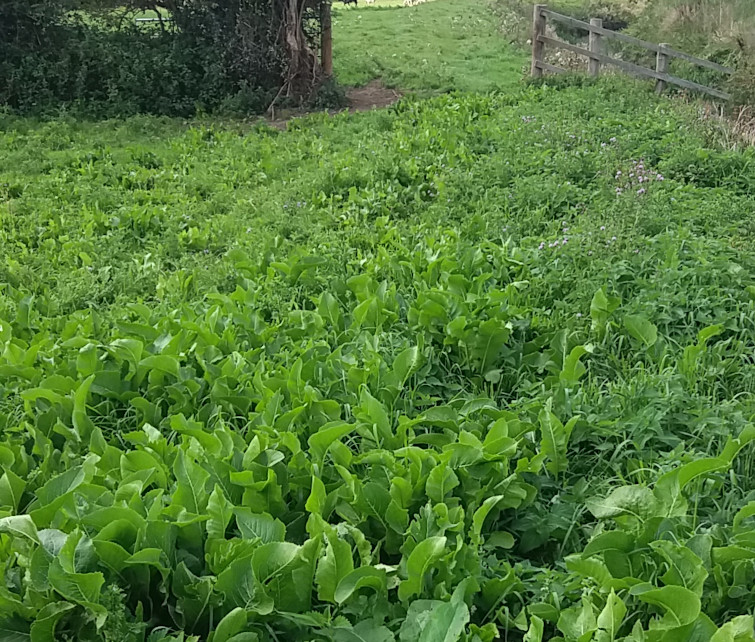
Harvesting: Different plant parts can be harvested throughout the year. The roots are best harvested in the Autumn.
The very young leaves can be used chopped in salads. Older leaves can be boiled like spinach.
Tender young flowering stems are sweet and pungent. Flowers can be added to salads. I know some chefs who like to extract the petiole sap for use in froths and jus to go with fish.
Other notes: One of only four species in the genus, horseradish was at one time commonly called red-cole (cole is an old term for brassica plants) These days, the plant is found in different craft gins, adding a lovely warm tone and to the spirit.
If you do not have horseradish on your land and would like some root ‘thongs’ for next spring, then contact me as I have plenty growing in my garden.
You can discover hundreds more plants in my continually updated ‘weeders digest’! Happy foraging!