Learn how to identify marshmallow – the original sticky fireside treat, perfect for Autumn bonfires!
Marshmallow (Althaea officinalis) Malvaceae
A few hundred years ago, this wild plant was being ruthlessly exploited. Gathered in large numbers from any available estuary, marshmallow was processed and sold around the world, for its gelatinous, sticky sweet roots.
The following video was taken on the banks of the Avon in urban Bristol a few years ago. The plant is just about to come into flower. You should be able to easily identify marshmallow from this video.
It’s the only specimen I have seen on the banks near the city centre, but I have yet to access much of it, because the majority of land next to the tidal Avon is difficult to reach.
The river Avon in Bristol is a steep-sided estuary with treacherous, shifting mudbanks. It meanders through the stunning Avon Gorge, reaching the Severn, just a few miles to the north west.
Leaves: Always well-creased when young. From 3-12 cm wide. Palmately-lobed, round-triangular shaped, and usually slightly 3-5 lobed leaves. Very soft to the touch. Irregularly toothed margins. Downy hairy.
There are usually stipules present at the base of the leaf, and these will often persist and not wither.
Petioles: Round, 1-4 cm long, occasionally slightly channeled above. Sometimes you will find it with a small hollow.
Stems: The mostly round stems are soft to the touch from downy hairs, and never woody. They typically reach anywhere from 60-130 cm high. Branched or not.
Roots: Tap-rooted. They are full of inulin, sugars, and mucilage.
Flowers: 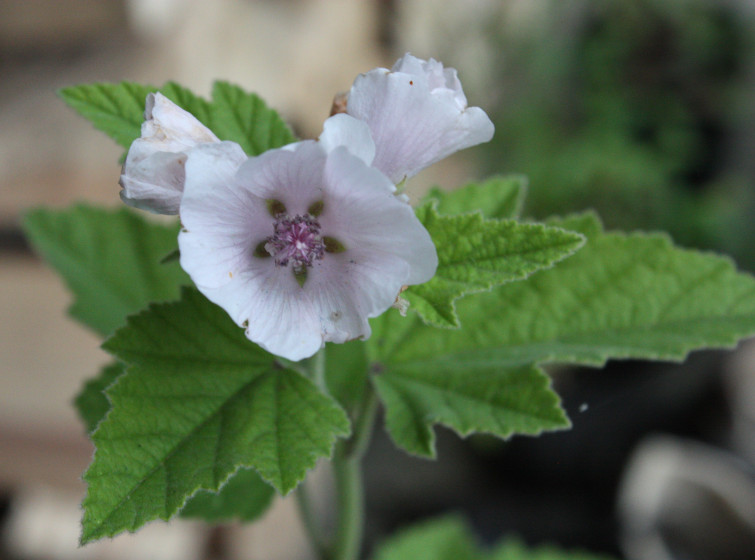
The flowers are quite large and a very pretty soft pink or lilac colour. Approximately 3-4 cm across. It has five petals that are usually free at the base, with five green sepals forming the calyx behind.
In the centre of the flower, just like in all the Malvaceae family, you will see a distinctive column-like structure. This produces fused stamens near the base, and a lobed stigma at the top.
Flowering season: From late June to early October, now that global heating has kicked right in.
Habitats: As this map shows, marshmallow is essentially a coastal plant. It mostly loves the brackish waters of estuaries, tributary ditches, and tidal rivers.
In some select areas, it can still be found thriving in the fascinating habitats where freshwater and seawater ecologies mix. The upper saltmarsh-cum-freshwater ecology has been decimated by us, so unsurprisingly, the plant is suffering quite a battle to even exist.
Severn Beach, East Anglia and areas on the South Coast of England are best places I know to have a good look at it
It is a popular garden plant, which germinates easily from seed, so the plant has escaped and naturalised in places it may otherwise not have.
Harvesting: (This plant is getting increasingly rare. Please do not harvest from the wild.)
The leaves are productive from April through into the summer before the flowers come. These can be enjoyed for most of the summer.
The roots are best in the autumn from established plants. Do not harvest roots from young, small plants.
Other notes: Again, because of its scarcity, please DO NOT take marshmallow from the wild. Simply enjoy its presence if you are lucky enough to meet it in the wild.
If anything, I think you should harvest or buy some seeds, then scatter or germinate marshmallow and grow the plant. It’s very easy to grow! If you are interested in learning more about our superb medicinal plants, then check out this article on medicinal plant constituents and actions.