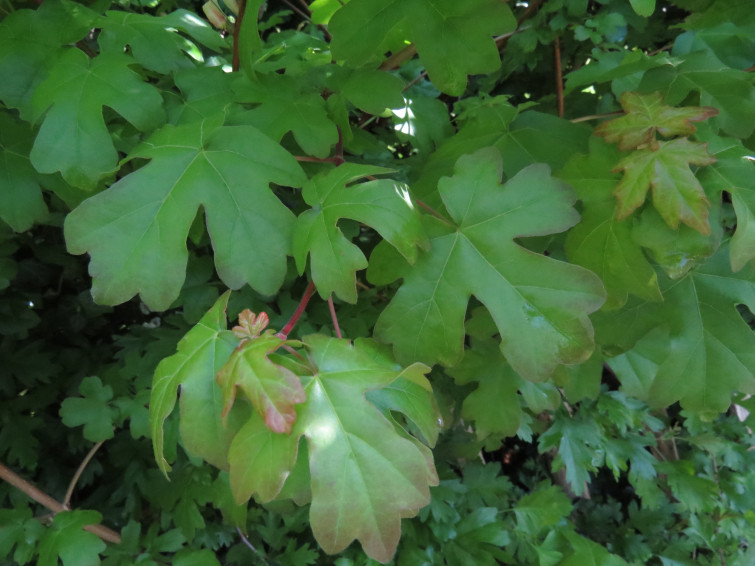
Foraging for Field maple. (Acer campestre) Aceraceae family
Learn how to identify field maple, Acer campestre with this short foragers guide.
Field maple is an extremely common deciduous tree that can reach heights of 15 metres and more. Although not as sugary as other maples, it is still worth experimenting with.
Leaves: Palmate to palmately-lobed. Typically they are 3-7 cm across. All of the 3-5 lobes are cut halfway down into the leaf. The leaf is hairy on the veins below.
Petiole: 1.5-8 cm long. On the field maple, the petiole is sparsely hairy.
Twigs: These are brown and stripy, with green lenticels. Sometimes with corky wings on the edges of the twig.
Buds: are approximately 5 mm. Reddish to brown or green. The buds are adpressed on the twig.
Bark: When mature, the bark develops very narrow fissures, that on well-aged specimens, begins to plate from the base of the trunk upwards.
Flowers: The insect-pollinated flowers are yellow, borne on a dangling raceme. The individually small flowers have five petals and numerous stamens in the centre.
They produce significant amounts of nectar, which bearing in mind their cousin, the sugar maple (Acer saccharum) isn’t that surprising.
Flowering season: From late April through May.
Fruits: Wind dispersed, winged Schizocarp fruits known as samara’s, similar to those on the sycamore. Two nuts are joined together forming the easily identifiable ‘propeller’.
Habitats: The plant can be found all over Britain, except on the higher ground. It is essentially a lowland plant that will be found in most places up to around 320 metres.
Field maple loves life at edges of woodland, in hedgerows and scrub. Also, widely planted in new hedges and amenity settings.
Harvesting: The sap can be tapped just like on other maples. It is in no way as prolific as silver birch for example, but will still yield some vitalising sap for making syrup.
The young flowers are best picked just as they are around half to two-thirds opened.
You can find numerous recipes online for battering and icing these flowers, whole. They are very sweet, even if using only a little icing.
Similarly, the young fruits of field maple are documented edible, with a few authors pointing to their use slow-cooked in the oven having been smeared in honey.
I have tried this and they are quite interesting. A chewy, toffee-like sweet bite.
Other Notes: Many Acer family plants are poisonous to horses. You can read more about medicinal plant constituents and actions in my in-depth article. If you would like a botanical survey carried out at your site please contact me here.
Discover some of my top foraging tips, tricks, and hacks here in this guide to starting out on your foraging adventures.