Scarlet pimpernel. (Anagallis arvensis) Primulaceae family. It’s not chickweed!
How to identify the chickweed lookalike Scarlet pimpernel.
If you have ever spent a few hours weeding around vegetable and field crops then you are likely to be already familiar with the Scarlet pimpernel. If you are a dedicated forager you need to know how to avoid it, as this plant is not for the pot.
I only know a very small number of the Primrose family that are documented as edible. The common primrose and the cowslip.
In amongst rows of vegetables, if allowed to, the Scarlet pimpenrnel will romp away because of its quick-growing, sprawling habit.
The BSBI online flora describes the plant as a winter annual, but I see this herb pop up whenever it can. It certainly enjoyed this summer just gone in my flowerbeds!
Before flowering, it can be confused with other plants, such as the close cousins, the blue pimpernel (See below), and the yellow pimpernel (Lysimachia nemorum).
It also has an initially strikingly similar appearance to chickweed, until its dainty red flowers appear. These will be spotted dotted around the ground from late spring.
When growing as a winter annual it can often form rosettes. Winter growth is slow when temperatures drop.
Leaves: Bright green, oval-elliptical with a distinctive crease in the middle. Usually found opposite in pairs, although whorls of three or four are not uncommon. The margins are entire.
Numerous records online point to saponins and various irritant compounds in the leaves being the reason for its inedibility.
Petioles: Sessile (you might want to check our A-Z glossary)
Stems: More or less square with angled edges. No single line of hairs on the stems, as are found on chickweed.
Stems are sometimes ascending and sometimes prostrate. The lower stem nodes can sometimes root, abling its rapid colonising of ground.
Flowers: 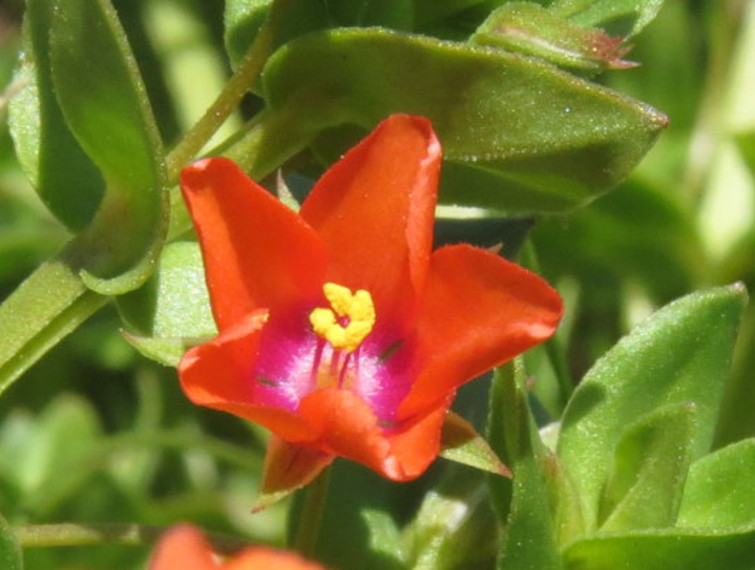
The flowers become more pretty the closer you look at them. They are mostly scarlet red, with purple shading at the centre of the flower.
Each flower has five petal lobes in the corolla tube. The calyx has five lobes, fused at the base. Five yellow-tipped stamens surround a small button like stigma.
Flowering season: Ephemeral herb, flowering when it can.
Habitats: A herb mostly of cultivation, and often found where the soil is disturbed. It will find various homes in the cracked urban environment. Always a lowland plant with a maximum altitude of up to 320 m.
The brilliant BSBI distribution maps show the areas in the UK where the plant was recently recorded
Other Notes: Not for eating as said earlier. Although it’s pretty, ultimately, if you are trying to grow crops, this is a right pain in the arse in the garden.
There is at least one subspecies worth knowing – the blue-flowered variant, called, you guessed it, the blue pimpernel (Anagallis arvensis ssp arvensis).
This plant is pretty much identical in every way except for the flower colour. I have seen it only a few times. Watch this space for photographs!