Guide to foraging lesser celandine (Ranunculus ficaria synonym Ficaria verna) Ranunculaceae (Buttercup) family
In Europe not so many years ago, it was common for country folk to go out foraging lesser celandine in the very early part of spring.
This article will show you how to confidently find, identify and use lesser celandine, or pilewort, as our imaginative ancestors also knew it.
For those of you new to foraging, you may also want to take a look at my guide to starting your foraging adventures.
Lesser celandine is said to have been William Wordsworth’s favourite flower. The Lakeland poet (1770 – 1850) paid homage to it in more than one poem…
“I have seen thee, high or low, thirty years or more; and yet t’was a face I did not know”.
Did he have piles and was in dire need for the plant? I think it’s likely, given his reported love of opium, and knowing what that particular plant can do to your digestive system! Read on to discover how the plant can cure piles.
What’s in a name?
Lesser celandine is one of about 700 species to have been placed in the large genus Ranunculus.
Due to the shape of the tubers and roots, the plant acquired one of its common names – pilewort. Lesser celandine shares part of its common name with an unrelated plant, greater celandine (Chelidonium majus).
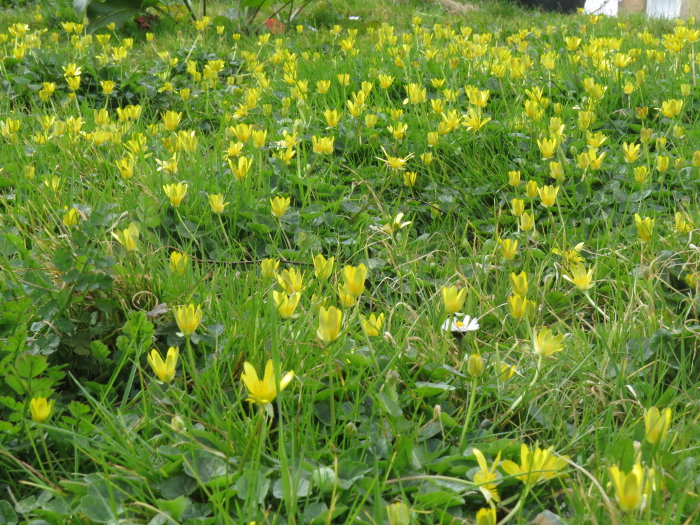
The word celandine is an old middle English word derived from the old French word ‘celidoine’. This was taken from the medieval Latin word celidonia, which itself came from the old Greek word ‘Khelidon’ – meaning ‘swallow’.
So, the flowering of the celandine plant was associated with the arrival of migrating swallows.
Its original generic name is derived from the Latin word rana – for frog, because this large genus of plants are often found in the same damp, wet, and marshy habitats as amphibians.
The plant’s specific name ficaria is derived from the Latin for fig-ficus, because its tubers were said to resemble bunches of figs!
Recently, the plant has had its scientific name changed to Ficaria verna, pointing to its ephemeral springtime growth.
The ancient Latin name given to lesser celandine before the present binomial system was ‘Ranunculus foliis cordatis angulatis petiolatis’ – or the ‘buttercup with cordate leaves and angled petioles’.
I think the older Latin classification for plants is a beautifully descriptive method, full of words we can recognise from our modern languages of English, French, Spanish, and Italian. Who said Latin was boring and pointless?
Lesser celandine botanical description
Leaves: 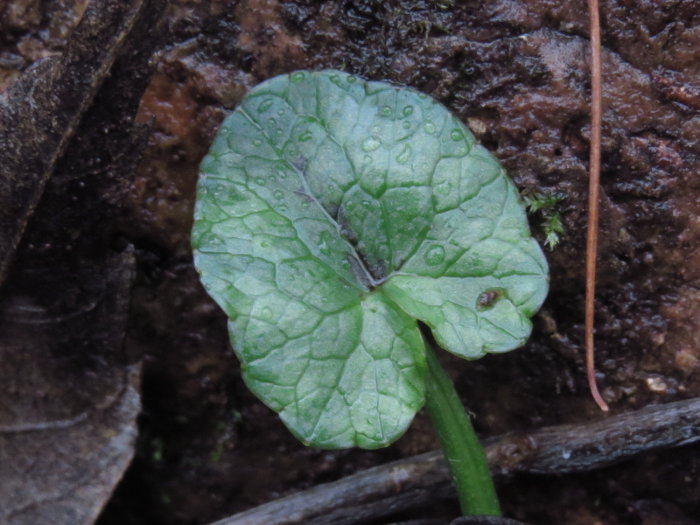
Lesser celandine leaves are cordate shaped. They are typically 4-6 cm wide, 6-10 cm longand usually produce a two-toned, mottled appearance.
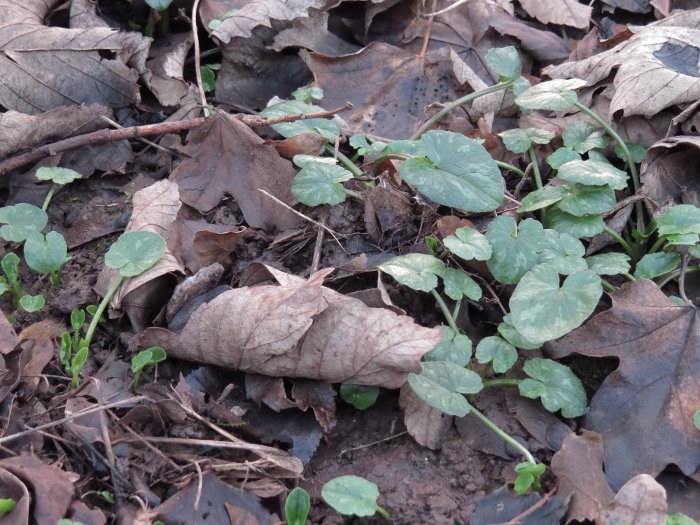
At least one variety or sub-species has carbohydrate-rich bulbils in the leaf axils. These are a surprise double harvesting bonus for the sharp-eyed when foraging lesser celandine!
The leaves are usually found with entire margins in the populations I’ve come across so far. However, certain sub-species (essentially regional variations) in various areas of the country, will be found with crenated and almost frilly margins.
The leaves can begin to appear in December in mild winters. Extensive carpets of leaves can be found in late winter/early spring.
Stipules: No stipules are present on the buttercup plants, which helps to distinguish them from say, rose family plants, which do have these small, leaf-like growths at the base of a stem or stalk.
Petioles: These are long and channelled. Anywhere from 3-10 cm in length.
Roots: The fibrous roots produce lots of spindle-shaped tubers, some 3-4 cm long. Lesser celandine also has rapidly creeping underground stems, enabling it to quickly form dense lush mats of growth.
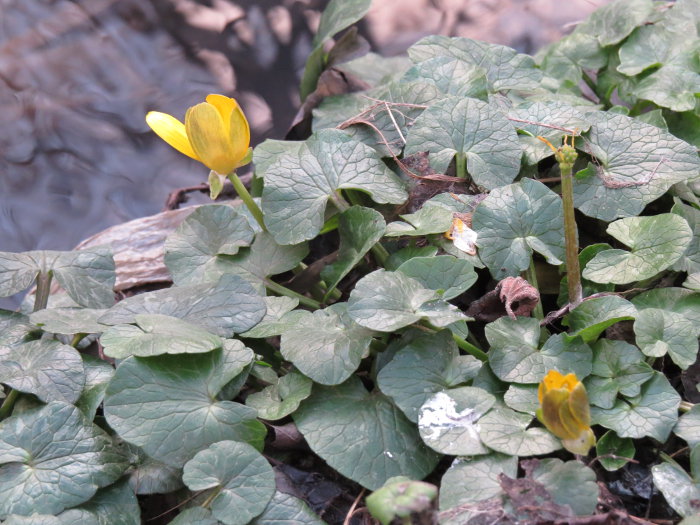
Stems: The flowers are terminal on unbranched flowering stems that reach up to 25 cm high.
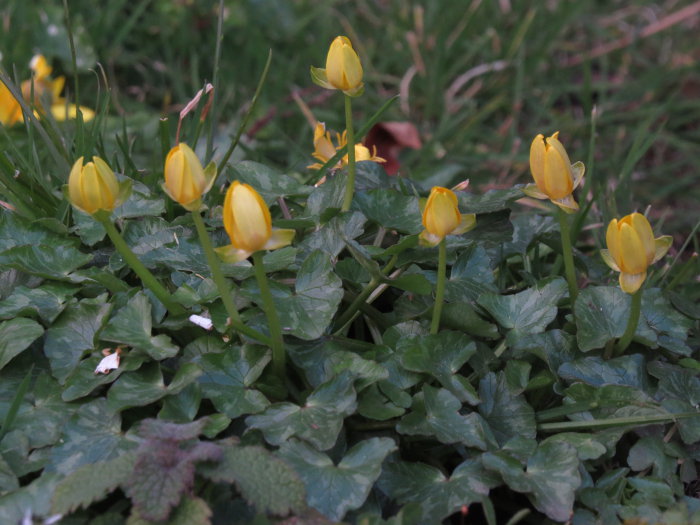
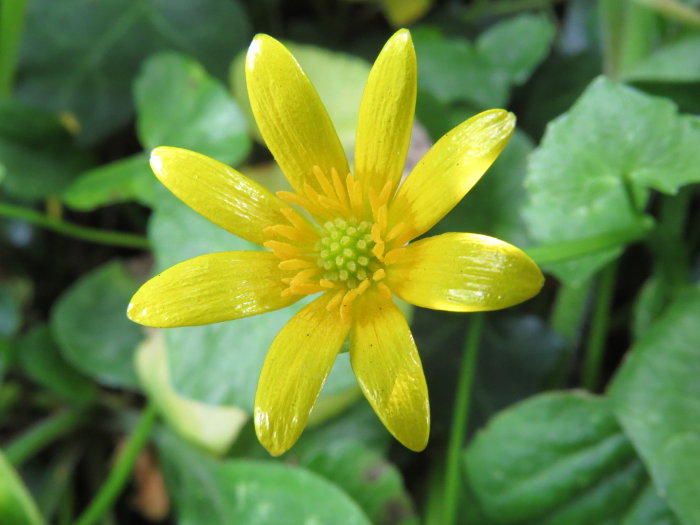
Flowers: Lovely glossy yellow flowers erupt among carpets of leaves. The flowers will close-up on rainy or dark windy days.
When opened, the flowers are between 2.5 – 4 cm wide. They have three sepals, and anywhere between eight-twelve petals, around 1-2 cm long.
The inner part of the petals and the stamens are coloured yellow-orange, giving the flowers a two-tone colour also.
Flowering season: Late February through March and April. Lesser celandine can bloom in large numbers in March.
Formerly known here in Britain as the ‘spring messenger’, you can spot this plant from a distance during early spring.
They are a glorious sight in dappled woodland light, more so if the bluebells and stitchwort are out joining it.
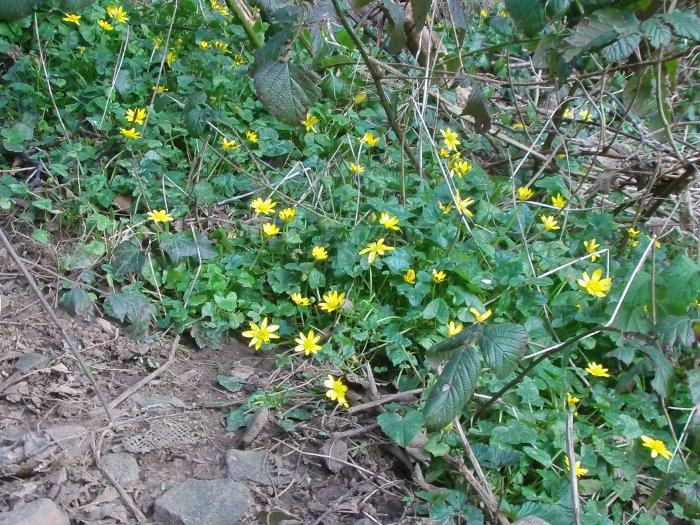
Habitats to look in when foraging lesser celandine.

Try any hedge-banks, verges, riversides, roadsides, and woodlands at altitudes up to 750 metres.
This natural woodland species finds a home in almost all parts of Britain and will be found in many urban settings as well. Foraging lesser celandine s a nationwide and simple affair.
Parts used: Roots, leaves.
Harvest: Leaves from January. Roots are best when plant is dormant from May-June onwards, or just emerging in December and January.
Numerous tips, tricks, and techniques to help you successfully forage wild plants can be found in my harvesting guide.
The fiddly-to-prepare tubers are for me, strictly survival food, or something I will maybe use as a garnish if I’m wanting an unusual talking point in the meal.
Key constituents: Lactones including anemonin; protoanemonin (not present in the dried product); triterpenoid glycosides; saponins; tannins; vitamin C.
Actions: Astringent. Slightly bitter.
For information on the different medicinal plant constituents and actions, head on over to my discussion on medicinal plant chemistry.
Pharmacology and Medicinal uses: This plant has traditionally been chiefly used as a medicine for haemorrhoids, for many hundreds of years.
It was specifically used for internal or prolapsed piles with or without haemorrhage. Lesser celandine is generally used by topical application as an ointment or as a suppository.
We know that our ancestors looked at the plant’s knobbly tubers and saw, with a sympathetic magic mindset, a resemblance to piles.
We then used this ‘signature’ of the plant to determine our course of action medically.
A system based on viewing the microcosm and macrocosm of ‘Gods creation’ and applying plant medicines based on a ‘doctrine of signatures’, soon took hold in the 15th and 16th centuries. Many ‘discoveries’ still hold true and apply today, and this plant is one such case.
I wish to discuss the relevance of plant signatures today, in a later article. No sniggering at the back. What are your views?

The fact that few clinical tests have been done with pilewort does not detract from its efficacy as demonstrated by long-standing traditional use.
Anti-haemorrhoidal activity has been documented for the saponin constituents. Its general astringency will also contribute to this effect.
Edible uses: The leaves are high in vitamin C. There is though a cautionary note when foraging lesser celandine:
You need to know that for absolute foraging safety, the leaves require cooking due to the presence of an irritant compound, protoanenomin, which is found in many buttercup family plants.
I would like to see any scientific studies regarding the build-up of this compound (first isolated from one of the Anenome species) in the leaves and roots.
Anecdotal evidence suggests that the leaves contain the highest amounts when the plant is in flower. Your individual tolerance will dictate exactly which course of action to take when eating this plant, as it does for all plants.
My experience of Protoanenomin is that concentrations do alter and that I am happy to eat lesser celandine leaves raw in a mixed dressed salad from when they first begin to re-emerge, and for a month or two, until most leaves are out and flowers appear.
If it’s a warm sunny March day, and the leaves are used as a trail nibble, lesser celandine will almost certainly irritate.
Remember here that sorrel is for thirst-quenching, mallow is for soothing, and lesser celandine needs dressing or cooking!
I do cook lesser celandine occasionally, as a ‘spinach’ green, but prefer foraging nettles as they begin to come through in the early spring.
For sure, eating raw will ensure the highest Vitamin C content in the leaves. The leaf’s previous importance to the Germanic people is evident in the fact that the German common name for this plant translates to ‘scurvy leaf’.
Did they eat it cooked? It isn’t difficult to see our ancestors gathering lots of leaves for the pottage broth.

I’ve been exploring lesser celandine tubers a little over the last few winters. Essentially doing a few time and motion studies as to how long it takes to harvest, prepare, and cook them.
The majority of tubers are small and present an extremely fiddly task in preparing to eat.
Frankly, they are a survival food for when the shit has really hit the fan! Other than that, you basically get scant reward for the time and energy spent on getting them to the table.
Look-a-like plants to know when foraging lesser celandine
Winter aconite (Eranthis hyemalis) can superficially look like lesser celandine and especially so at a distance.
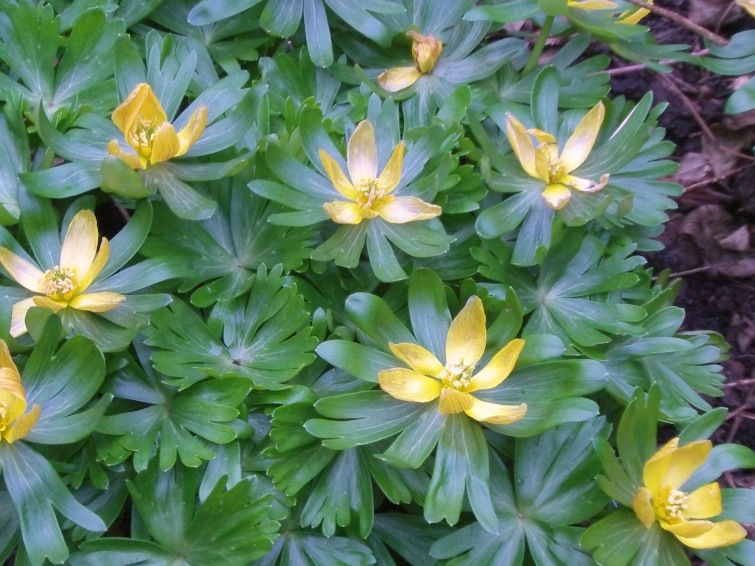

Although it’s not particularly frequent, winter aconite is a plant scattered in its distribution across mainly Southern and Eastern Britain.
This buttercup family plant has a similar flowering period, flower colour, size, and display, but the leaves are quite different to each other.

The winter aconite has what looks like a ruff of leaves under the flower. The leaves are deeply divided, more or less palmately-lobed. Winter aconite also producers small tubers, more round in shape than lesser celandine. The flowers are 20-30 mm across.
Winter aconite will happily grow in woodlands, by roadsides, in hedge-banks, and in parks and gardens.
Other notes:
The plant has evolved to complete its flowering cycle before the tree canopy is fully open, taking advantage of higher light levels found in February, March, and April.
By June it will have retreated to the underground until the very end of the year. Keep your eyes peeled in milder spots from December.
To the Small Celandine. William Wordsworth
“Pansies, lilies, kingcups, daisies,
Let them live upon their praises;
Long as there’s a sun that sets,
Primroses will have their glory;
Long as there are violets,
They will have a place in story:
There’s a flower that shall be mine,
‘Tis the little Celandine.
Eyes of some men travel far
For the finding of a star;
Up and down the heavens they go,
Men that keep a mighty rout!
I’m as great as they, I trow,
Since the day I found thee out,
Little Flower!–I’ll make a stir,
Like a sage astronomer.
Modest, yet withal an Elf
Bold, and lavish of thyself;
Since we needs must first have met
I have seen thee, high and low,
Thirty years or more, and yet
‘Twas a face I did not know;
Thou hast now, go where I may,
Fifty greetings in a day.
Ere a leaf is on a bush,
In the time before the thrush
Has a thought about her nest,
Thou wilt come with half a call,
Spreading out thy glossy breast
Like a careless Prodigal;
Telling tales about the sun,
When we’ve little warmth, or none.
Poets, vain men in their mood!
Travel with the multitude:
Never heed them; I aver
That they all are wanton wooers;
But the thrifty cottager,
Who stirs little out of doors,
Joys to spy thee near her home;
Spring is coming, Thou art come!
Comfort have thou of thy merit,
Kindly, unassuming Spirit!
Careless of thy neighbourhood,
Thou dost show thy pleasant face
On the moor, and in the wood,
In the lane;–there’s not a place,
Howsoever mean it be,
But ’tis good enough for thee.
Ill befall the yellow flowers,
Children of the flaring hours!
Buttercups, that will be seen,
Whether we will see or no;
Others, too, of lofty mien;
They have done as worldlings do,
Taken praise that should be thine,
Little, humble Celandine!
Prophet of delight and mirth,
Ill-requited upon earth;
Herald of a mighty band,
Of a joyous train ensuing,
Serving at my heart’s command,
Tasks that are no tasks renewing,
I will sing, as doth behove,
Hymns in praise of what I love!”
And The Lesser celandine…
“There is a Flower, the Lesser Celandine,
That shrinks, like many more, from cold and rain;
And, the first moment that the sun may shine,
Bright as the sun himself, ’tis out again!
When hailstones have been falling, swarm on swarm,
Or blasts the green field and the trees distressed,
Oft have I seen it muffled up from harm,
In close self-shelter, like a Thing at rest.
But lately, one rough day, this Flower I passed,
And recognized it, though an altered form,
Now standing forth an offering to the blast,
And buffeted at will by rain and storm.
I stopped, and said, with inly-muttered voice,
“It doth not love the shower, nor seek the cold:
This neither is its courage nor its choice,
But its necessity in being old.
“The sunshine may not cheer it, nor the dew;
It cannot help itself in its decay;
Stiff in its members, withered, changed of hue.”
And, in my spleen, I smiled that it was grey.
To be a Prodigal’s Favourite -then, worse truth,
A Miser’s Pensioner -behold our lot!
O Man, that from thy fair and shining youth
Age might but take the things Youth needed not!”
Happy foraging!