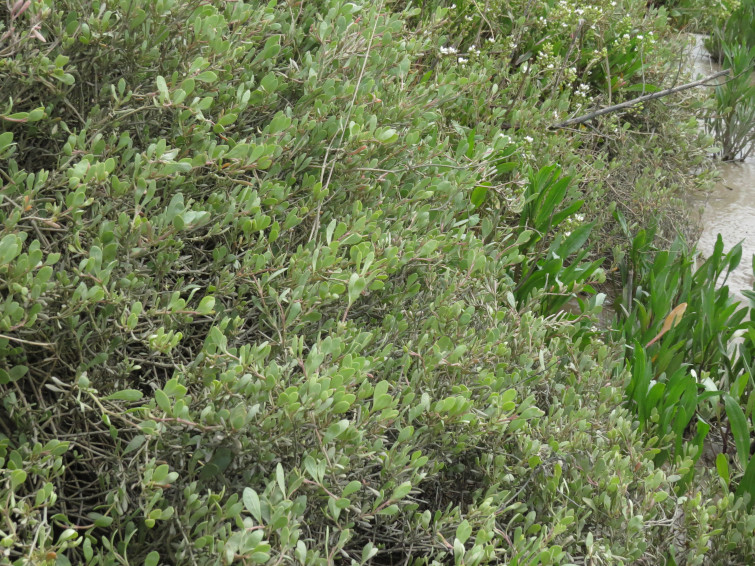
Foraging for sea purslane (Halimione portulacoides) Chenopodiaceae family
Learn all you need to know how to find, identify, and use the gourmet sea purslane!
When you go down on our salt marshes and estuaries, some plants like sea purslane are really easy to find.
This plant is a fantastic edible and one you really should get to know. It grows in huge numbers and can be seen from a distance, which means that when you find sea purslane, you’ve found it for life!

Estuaries and salt marshes are superb places for foragers to visit. The various coastal settings here in the UK are usually gloriously abundant habitats, providing gourmet foraging opportunities all year round.
A number of other well-known and much sought after wild plants can be harvested from our shorelines and estuaries.
These include sea aster, marsh samphire, sea beet and sea kale (although the latter has suffered a lot of over-picking, so I recommended you grow it if possible).
We are lucky here in Britain, because no matter where you live, you are never much more than 80 miles from the coast.
How to identify sea purslane?
This perennial plant belongs to the completely edible ‘beetroot’ family and cannot be confused with anything else..
Its relatives include the Andean grain – quinoa, fat hen / lambsquarters, good-king-henry / Lincolnshire spinach, red orache, samphire, Salsola, and the numerous varieties of cultivated beets and chards.
Sea purslane is an evergreen and available all year round. It has fleshy, grey/green elliptical leaves, which in the sunlight look silver. They grow on perennial woody stems. You will find dense carpets of sea purslane in its particular habitat niche.
The common name ‘purslane’ is bandied around a few plants, some of which are unrelated. Sea purslane is not related to any other purslane you will read about. The connection, I believe, is that they all have succulent, mostly oval-elliptical leaves. All are edible.
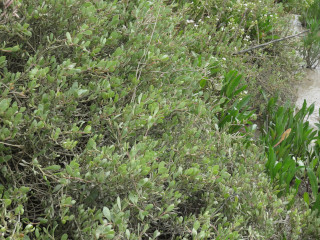
Sea purslane leaves grow in opposite pairs, with some branching from the leaf axils.
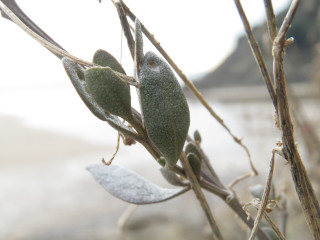
You may well notice a dusty coating on the leaves, especially at the growing tips and flowering tops, much like what you will find on numerous family relatives, and other unrelated plants.
This mealy appearance is due to tiny, single-cell thick bladder hairs, which possibly help to stave off the harsh maritime habitats.
The presence of bladder hairs are one of the key identifying characteristics for many members of this fantastic plant family. See, I told you plant i/d was easy!
In flower, sea purslane will typically reach around 50-80 cm high, unless being grazed by animals.
The branched, spiked inflorescence consists of little flowering clusters. Each flower has sepals but no petals, and grey-yellow . You can usually find it in flower anytime from June to September.
Habitats to find sea purslane
You may see sea purslane written about as a coastal plant. This is true but forgets to mention it’s actually a coastal specialist.
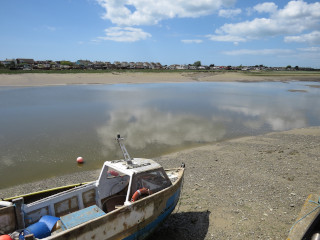
The areas of coastline that it grows in are almost exclusively our estuaries and salt marshes. Along the areas of rocky coastline, it finds it hard to get any sort of foothold.

The Gower, South Wales, is a great example. On the southern part of the peninsula, where its mostly cliffs, rocks, coves, and bays, you don’t find much.
Go a few miles north to the estuary salt marshes at Penclawdd and you will be amongst expansive stands of sea purslane.

For here, like every salt marsh, it especially loves the edges of tributary streams, pools and tidal river banks. in this niche habitat, sea-purslane has adapted to a regular, if brief, daily salty submergence.
So you will probably find the plant coated in estuary silt. This is not a plant you will be eating while you pick!
How sea purslane survives the salt marsh
It’s ecological niche and success is due to a couple of natty techniques to survive in what is otherwise an inhospitable setting for most plants.
Like other salt marsh specialists, it has developed large, air-filled root cells, enabling the free transport of oxygen around the roots.
Within other areas of the plant, notably in the leaves and stems, the cells have a higher internal concentration of salt than is found in the surrounding water, thereby enabling the absorption of water.
Harvesting sea purslane
As an evergreen, you can pick it whenever the fancy takes you. What more could a forager want, when many other plants have such a small window of harvesting opportunity!
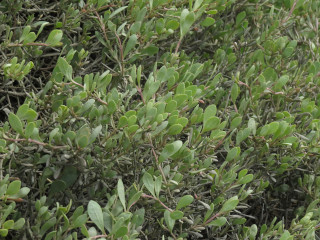 The leaves are at their best during the spring flush of new growth when its new stems are still tender.
Other than this time of year, the leaves will need to be fully plucked from the fibrous stem before cooking.
I have found that I need to use scissors or a sharp knife outside of the spring, because if you try and pinch the stems and leaves off at other times, it is likely that you will pull the woody stem away as well.
This isn’t nice for the plant as it damages the regenerative capabilities of the plant.
More harvesting tips for use on all our wild plants can be found on this guide here
Sea purslane in the kitchen
Sea purslane is increasingly popular with foragers and chefs. Its versatility in marrying up with fish or lamb dishes is one reason, while its salty flavour and succulent crunchy textures are others. If you like samphire, you will love this.
It can be simply served as a vegetable, either raw or lightly cooked for a minute or so, either by steaming or lightly sautéing in butter or oil. The salty flavour and fresh crunchy texture of sea purslane is loved by nearly everyone who tries it.
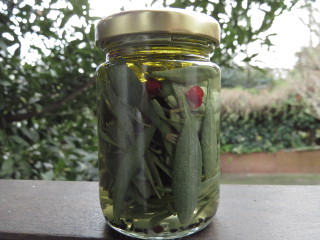
It is also a great vegetable to preserve, either by lacto-fermentation, or pickling in a subtly-spiced vinegar.
When fermenting, I tend to dry salt succulent material for a good few hours to draw out some moisture, and this guarantees to retain its bite.
When pickling in vinegar, I also dry salt initially, to ensure the crunchy texture. Use either the delicate flavours of white wine vinegar, or a slightly sweetened and spice-infused cider vinegar.
This wild food makes a superb accompaniment to fish and lamb dishes. Indeed, one of the reasons salt marsh lamb is so tasty comes from the fact that these animals graze on a number of salty tasting plants, including this one, lending a distinctive flavour throughout the cooked flesh.
Many recipes using sea purslane can now be found online, and its popularity in the kitchen increases, but I personally think that the less you do with it, the better it is. Used simply as a garnish, its silvery leaves offer a lovely distinctive counterpoint to the colours of numerous dishes.
If you fancy learning how to make hawthorn ketchup to accompany your steamed sea purslane, then check out this guide to foraging for hawthorn.
So if this has inspired you to get started foraging for gourmet foods, then read our beginners guide to foraging in the UK for lots of foraging hacks tips and tricks.