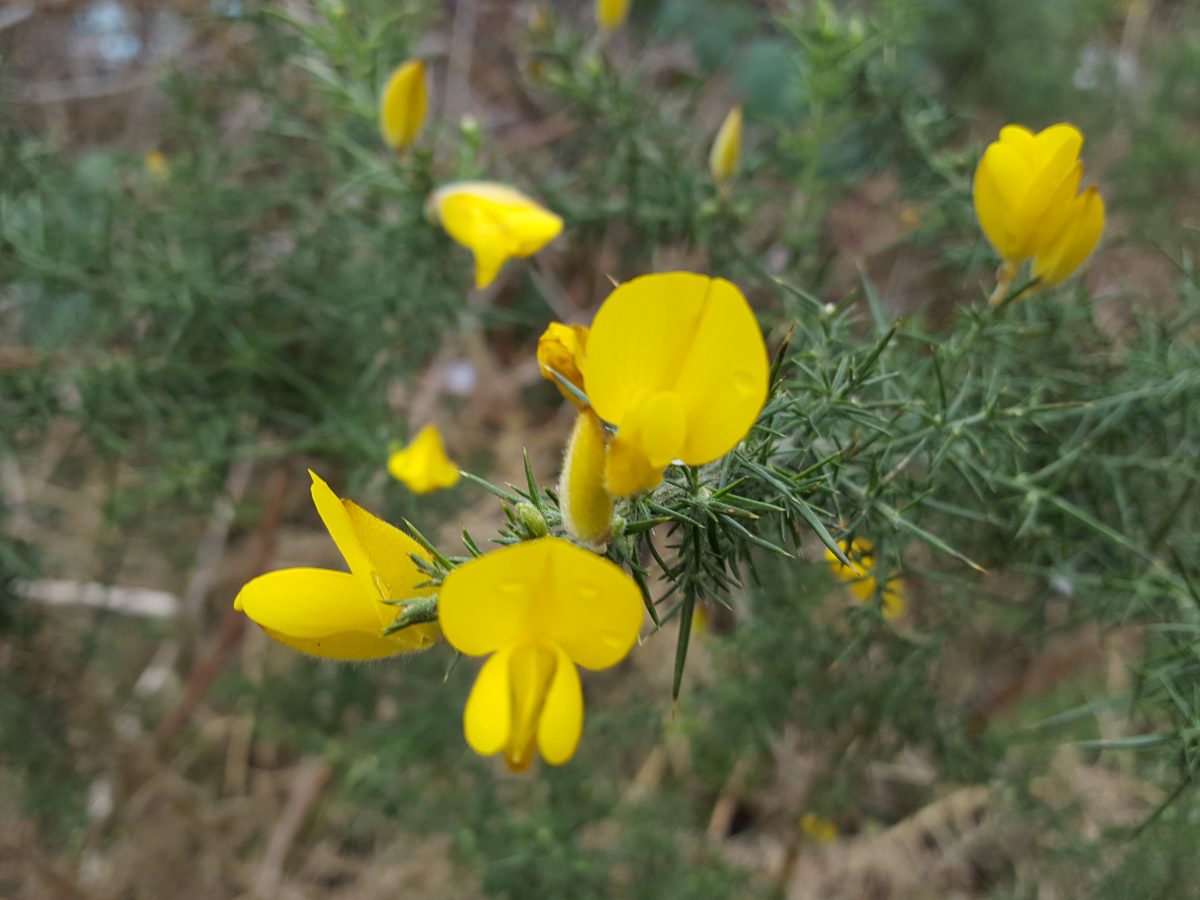
Discover quite literally how horrific it is to go foraging for gorse flowers in the UK!
For the more patient wild food afficianados, foraging for gorse flowers reaps a tasty, if occasionally painful reward.
This is another of Britain’s wild plants that many people know already. If so, you may only want to read the fascinating origins of the how gorse got its name, discussed presently.
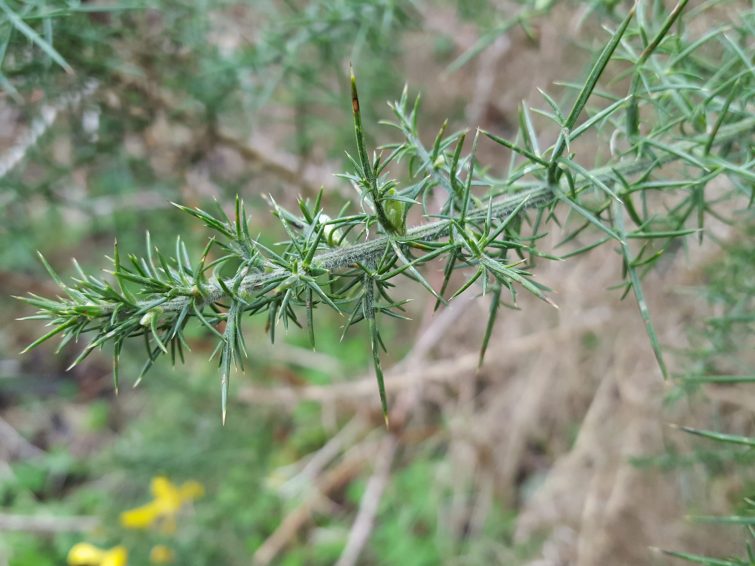
The botanical description is primarly designed for absolute beginner foragers, taking you through the key identification features, which in the long run will help you separate this plant from the dwarf gorse or the Western Gorse, if you fancy that sort of thing.
To help you, this more than useful foragers A-Z glossary is here to be your constant friend. For difficult words, just look them up!
What’s in a name?
The English common name Gorse is acknowledged by professional wordsmiths to have its roots in the archaic proto-Germanic language, where the plant was known by the name ‘Gorst‘. This old word came from the ancient language which eventually morphed into the current Dutch, German, and English languages.
The Old German word, as well as the old Saxon word for this plant, is ‘gersta’. In Germany, the cereal grain we know here as barley, is commonly called ‘gerste‘. This grass is identifiable from its long bristles on their flower heads.
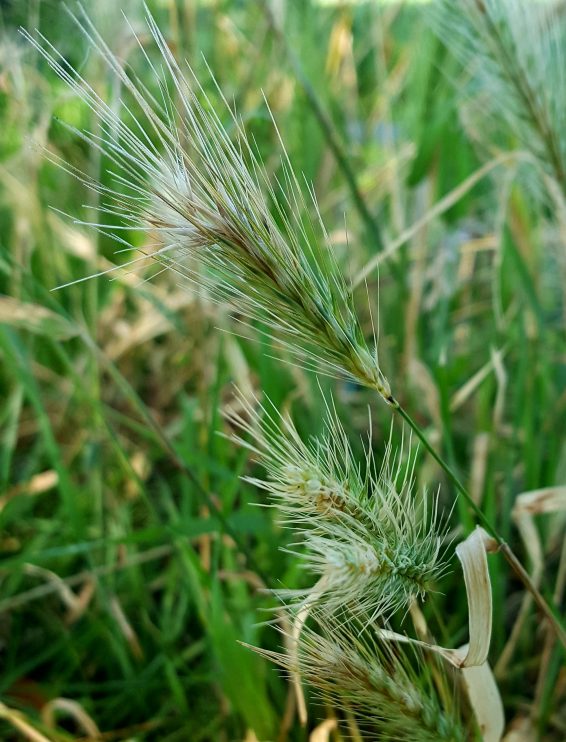
It further transpires that the original source word comes from even before the Germanic language. The word ‘gorst’ has its roots in an Indo-European word ‘ghers‘, which means ‘to bristle’. Incidentally the Germans now call gorse ‘Stechginster‘ and a gorse bush ‘Stechginsterstrauch‘.
Brilliantly, the word horror also has its roots in this ancient word ‘ghers‘, as does the scientific name for barley (Hordeum vulgare). That’s amusing to me because I imagine that most people in Britain would find the idea of picking a few hundred grams of gorse flowers absolutely horrific! They would literally be correct.
As the English language developed and changed, the plant name evolved into ‘Gors’, then finally turning into the word we have today, whenever it was our modern English was formatted.
The generic part of the scientific name – Ulex, was originally a Latin word, apparantly meaning a ‘shrub like rosemary’. Although I have also seen reference to the word ascribed to the Roman diarist Pliny, and being used to describe gold mining. The specific epithet europaeus tells us this is the common species that grows all over Europe.
Botanical description
Leaves: When first growing as a seedling, gorse has trifoliate leaves that soon change into spines. Johann Wolfgang von Goethe, mentions in his book “The metamorphosis of plants”, that if gorse is put in controlled conditions under glass with 100% humidity, it grows clover-like, trifoliate leaves.
Gorse’s numerous rigid spines are sturdy and wider at the base. Terminal spines are longer (25 – 30 mm) than the lateral ones (10 mm). All the spines have small (2mm) tips. You need to be constantly vigilant of the spines when foraging gorse flowers.
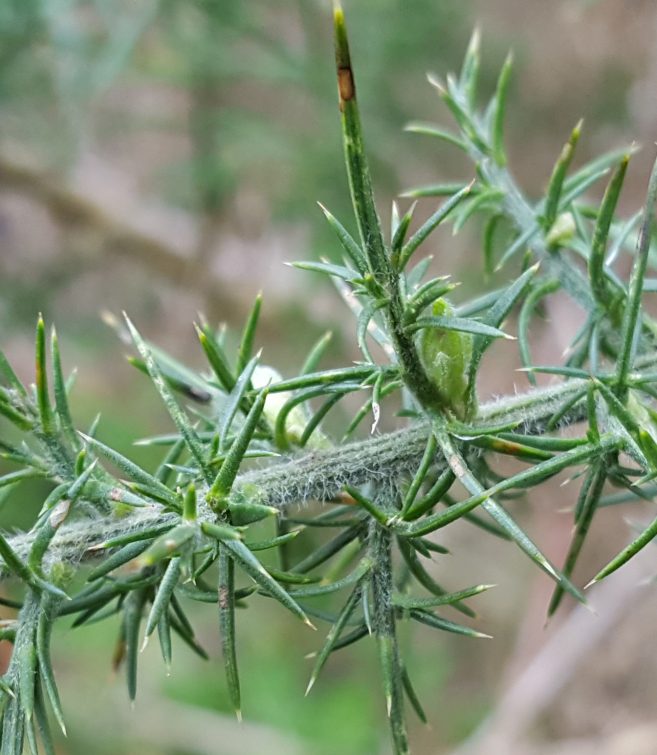
Petioles: No
Roots: This shrub initially develops a tap root but soon develops a large, matted, fibrous root system.
Stems: Irregular-shaped. From green, hairy, young first year twigs they they turn woody and light brown from the second year.
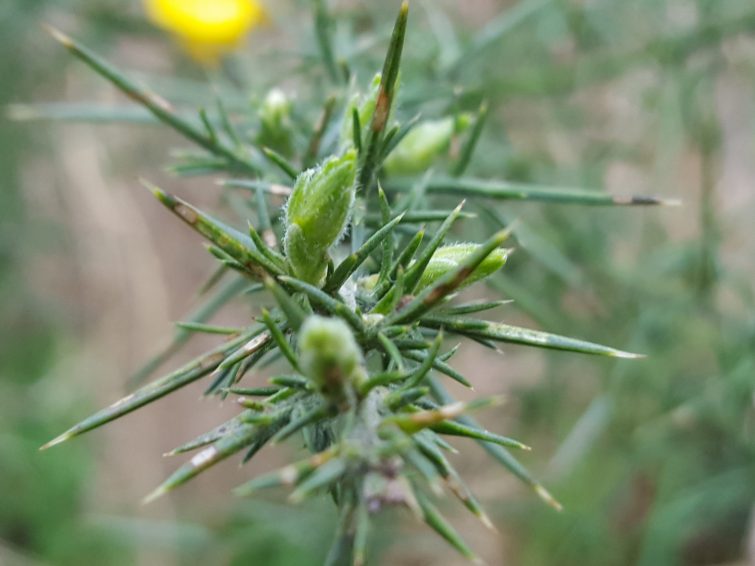
Bark: Light brown with wavy fissures.
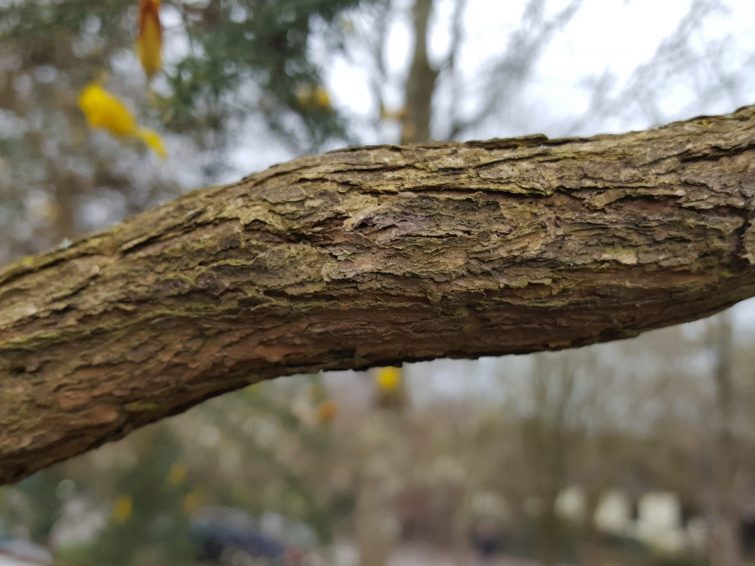
Flowers: From the oval green buds, emerge bright yellow flowers with the classic pea family shape and arrangement. These pretty and somehow beautifully exotically-scented flowers have a large ‘banner’ petal lobe, two winged lobes, and a ‘keel’, which consists of two petals fashioned together underneath.
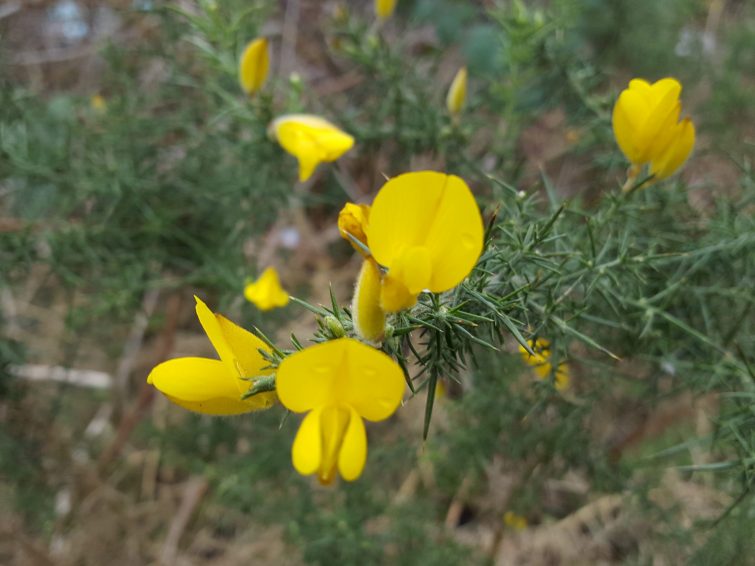
Flowering season: The old saying goes ‘that kissing is out of fashion when gorse is not in bloom’. This points to the fact that you can always see some gorse flowers during any month of the year. Its chief flowering period, depending on your location in the UK, will be from late March to May.
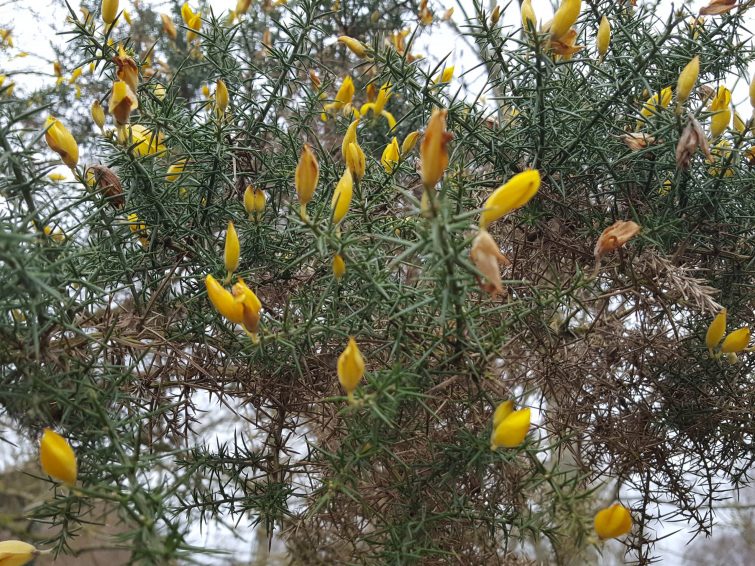
Fruits: The dead brown flowers persist for a long time, protecting a small, hairy, brown – purple pod. They are easily visible in the summer and autumn months. These eventually split open in hot weather to reveal two or three black seeds.
Habitats: It can thrive where many other plants cannot. Gorse loves rocky, sloping clifftops, sandy and slightly acid heathlands. It can also be found in woodland rides and clearances as well as on wastegrounds and alongside railway tracks. It is a lowland plant generally, but has been recorded at altitudes of 600 metres.
Parts used: Flowers for food; branches and stems for hot burning fires!
Edible uses: Wines, cordials, soft drinks and sugar syrups can all be made. Flowers can also be tossed into salads for a little pea- like flavour.
Other notes: A couple of other Gorse species, the dwarf gorse (U.minor ) and the Western Gorse (U. gallii) also grow in the UK, although moreso in the Western side of the country. These two species are much more low-growing and they come into flower at a different time.
I hope you found this article interesting. Remember that there are hundreds of medicinal and edible plants covered here, as well as Britain’s array of poisonous plants.
More plant species are coming soon!
Happy Foraging!