Learn how to identify green alkanet, know its lookalikes and discover its history and uses.
It is well worth getting to know how to identify green alkanet. Then you will also be able to confidently identify and harvest other similar-looking plants. This is because a study of green alkanet also requires a little study of its relatives, comfrey, borage, and forget-me-not’s.
Experienced foragers will already recognise this plant as one that we only really enjoy for its early spring show of flowers. Whereas beginner foragers will often ask… “is this plant borage, or forget me not’s, or comfrey?” This article can hopefully be used to answer the now yearly spring time social media barrage of questions and answers relating to sightings of this plant.
With its coarse hairiness, and the presence of bitter alkaloids (incluing traces of pyrollizidine alkaloids), many wild foodies already know that this plant is mostly off the menu. But that does not necessarily mean these plants are of no interest to us at all.
Green alkanet was reportedly first brought to Britain before 1700 and first recorded in the wild in 1724. It feels right at home here in many settings.
Before we look into the origins of the name, and its botanical description, I just want to remind all beginner foragers that there are hundreds of other plants to explore here, both written and photographed. These include an overview of the relatively small number of toxic and poisonous plants that reside here in Britain.
This site also provides you with a basket full of harvesting tips and tricks to help your foraging missions, and a glossary of terms to assist with any difficult botanical language.
For the more serious wannabe gastronomical botanists, there is my two-part, fast-track version of learning how to identify plants in a day, simply from the flower patterns they produce. Take your time to read and memorise the keywords in part 1 and part 2, because this will save you hundreds of hours of fruitless, back and forth searching through field guides, like I did when first getting to grips with plant I/D.
What’s in a name?
Unlike the previous plant covered here, Gorse, the green alkanet does not have a particularly interesting origin to its name.
The second part of its common name ‘alkanet’ derives from the old Arabic word for Henna, al hinna – alluding to the fact that there is a red coloured dye that can be obtained from the roots.
It must be noted however, that this is not the same red-coloured dye as is extracted from the roots of the related plant Alkanna tinctora. This particular herb is native to the Mediterranean region and is now widely known as the ‘dyers alkanet, or also simply just ‘alkanet’. Plants with the name ‘tinctoria’ and ‘tinctora’ are all pointing to their valued use in dyeing.
The generic part of the scientific name Pentaglottis comes from the old Greek language, and simply means five tongues. The word ‘penta’ equals five and ‘glottis’ refers to the tongue (although medically it’s the part of the throat where we find the vocal chords).
The specific epithet sempervirens is two cojoined Latin words that translate to ‘evergreen’ or ‘always alive’. True to its name, you can find this plant happily over-wintering here in Britain as large rosettes, looking a lot like borage, or comfrey.
Botanical description
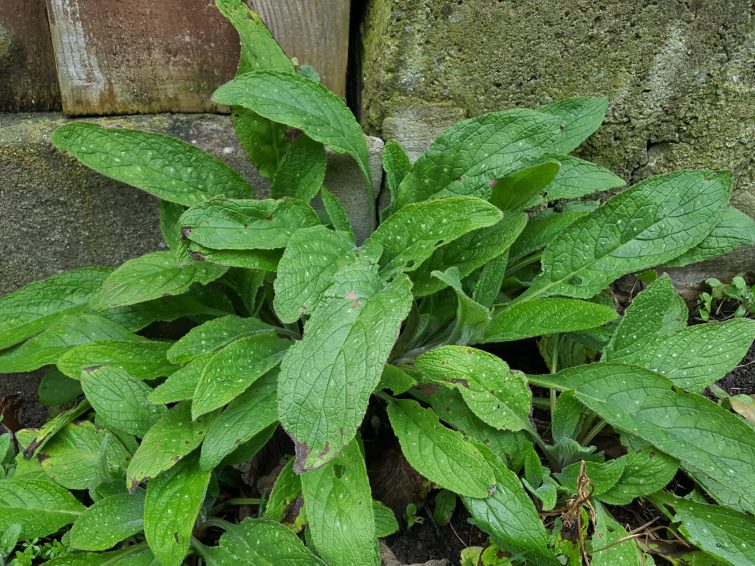
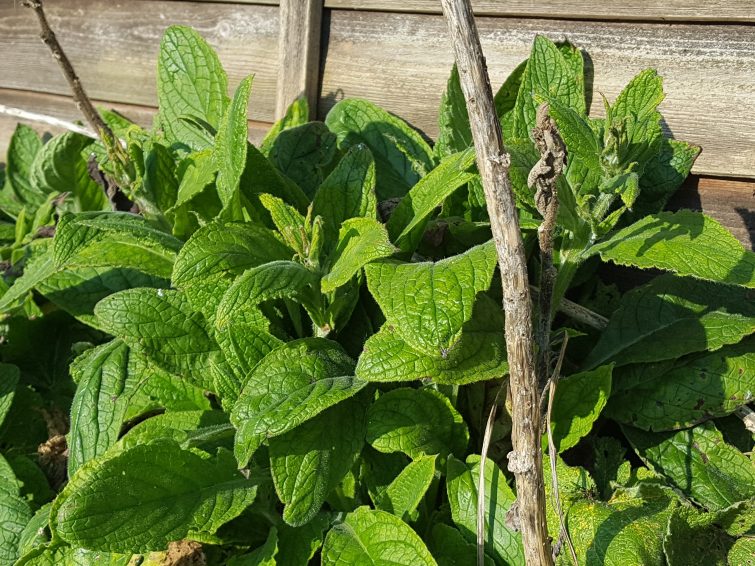
Leaves: This plant produces mostly basal leaves. These are characteristically ovate to lanceloate shaped, and always tapering towards a sort of wedge-shape at the base. Typically they reach around 15 cm – 25 cm long and 7 cm or so wide. The margins are mostly entire, but are occasionally found with a few very obscure and irregular teeth.
In comparison, forget-me-not’s have much smaller leaves; comfrey’s are more narrow; while borage has a wider, shorter leaf and it’s much more wrinkled in appearance.
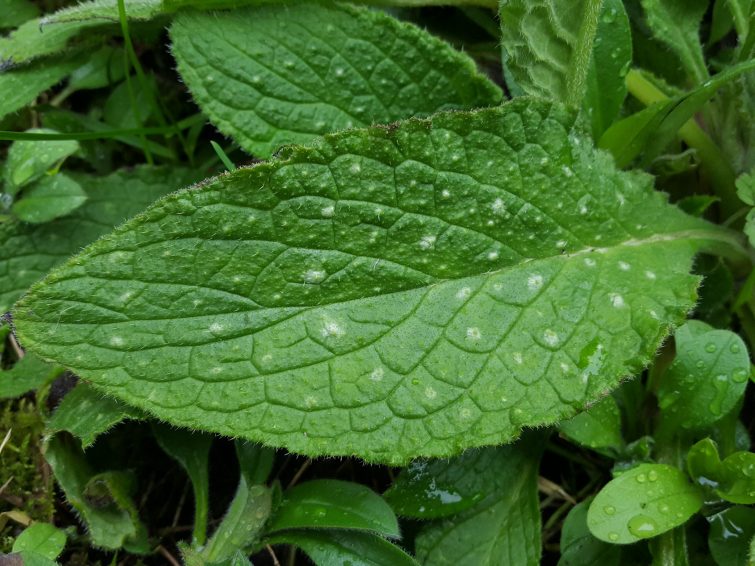
Green alkanet’s leaves are always noticeably bristly hairy. In common with other members of the family, these hairs can cause a rash on sensitive skin.
The leaves will mostly, but not always, show a number of raised white spots on the surface. None of its relatives discussed here have white spots. Green alkanet suffers from rust and many plant leaves will appear with small brown rust patches.
Petioles: These are always present except on the smallest stem leaves. Reaching up to 10 cm or so, the winged and channeled leaf-stalk is covered in bristly hairs.
Roots: Big, brittle taproots with black skin and yellow-orange inner flesh.
Stems: The green, hairy, angled stems can reach up to 1 metre high. They either grow on their own or with several others. Their branched stems appear from March.
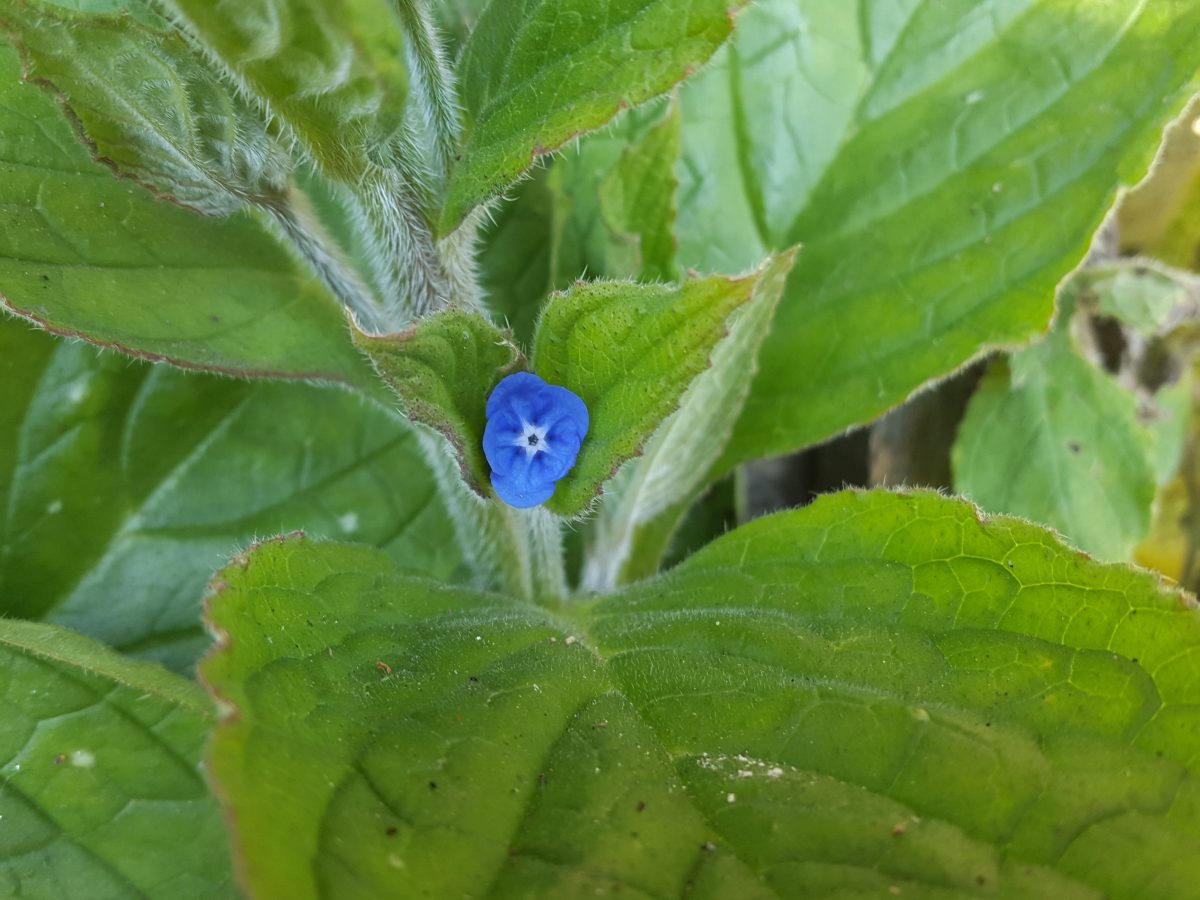
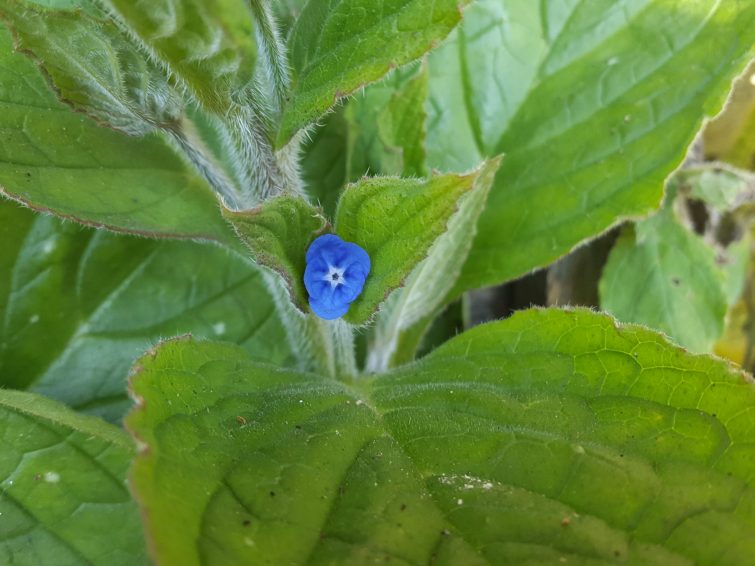
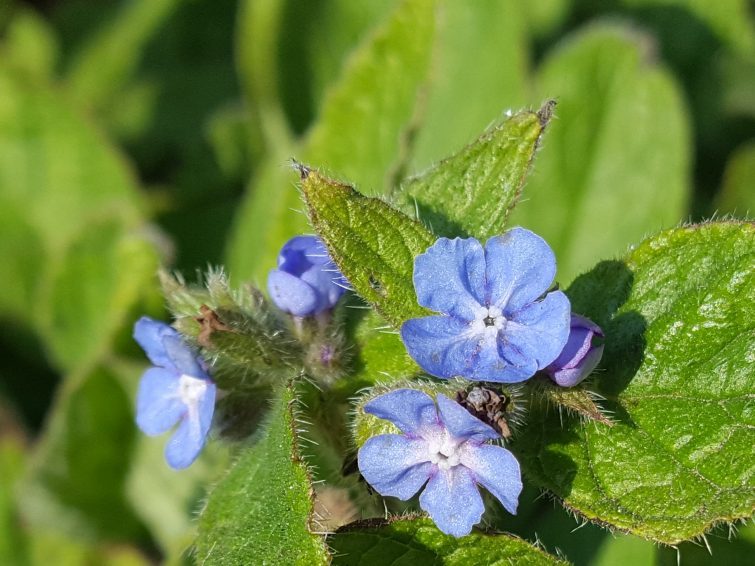
Flowers: Striking blue or blue-purple splashed flowers, with a white centre spot, that resemble large forget-me-not’s. They appear in leaf axils as well as in small clusters. (This inflorescence is botanically classed as a cyme). Five petal lobes are fused together and form a small corolla tube. Hidden from sight in the centre of the tube are the stamens and stigma.
Flowering season: Green alkanet will flower here in Britain from March through into early May. The earliest flowering plants are usually in sunny and protected urban spots.
Fruits: During the late spring and early summer, four slightly ridged nutlets will be found in each flower.
Habitats: Green alkanet has been bern described as an urban loving, street fighting bruiser! It appears on many types of soils throughout much of Britain, although only in lowland settings below 350 metres or so. It particularly likes wastegrounds, hedgerows, scrub, woodlands and riversides. This plant can be very invasive, and will spread quickly by its copious seed and by shards of root.
Parts used: The flowers can be used as garnish or plonked into ice cubes for cocktails and mocktails. The roots have a orange-red pigment that can be harvested for dyeing.
Harvesting: Flowers can be picked most of the spring, from March. Roots can be collected in the early autumn.
Medicinal uses: I have struggled to collect any medicinal information on this herb.
Other notes: This is a fantastic early season plant for certain bees, butterflies, moths and flies, who adore this plant, just like they adore its relative, borage. For gardeners, the leaves of green alkanet can be composted down to make a liquid plant feed, as you would comfrey.
More plant articles are coming soon. Happy foraging!