Foraging for sorrel and other docks. Hard to miss and easy to identify!
You don’t need to actively go foraging for sorrel to know the dock tribe of plants. Everyone knows the docks already. Who hasn’t rubbed a dock leaf on a nettle sting!?
The dock plants (Rumex species) are found all over Britain. Sorrel itself is found pretty much everywhere in the UK, from the seaside to the top of Ben Nevis.
.Just as easy to spot in towns as they are in the countryside, these plants are constant foraging companions. In fact you have probably seen sorrel in many grasslands when in flower, but just written it off as just another dock.
Rumex is a large genus within the rhubarb family -Polygonaceae. Around 200 species of annuals, biennials, and perennials are found throughout the world. All the Rumex are technically edible. only a few are worth eating, and are tasty refreshing salads.
In the British Isles, this plant family is one of the most common plant families you will encounter. It has a golden rule of foraging to share so read my post on the Polygonaceae family!
It also contains the edible and medicinal japanese knotweed (Fallopia japonica), the well known ‘grain’ buckwheat (Fagopyrum esculentum), and the integral ingredient in dock pudding, bistort (Bistorta officinalis)
The English common name ‘dock’ is derived from the old English word ‘docce’ – simply meaning ‘course large-leaved weed’. Hence, the unrelated burdock was known as ‘the coarse, large-leaved weed with burs’!
The edible and medicinal docks dealt with here are notable for their yellow tap-roots. This colour suggests the reason why docks were previously instinctively thought of as good for the liver, and for many bilious conditions.
Why go foraging for sorrel or other docks?
My favourite edible docks by far are the sorrels. I have found the common sorrel (Rumex acetosa) to be the most plentiful, whereas sheep’s sorrel (R.acetosella) is only locally common in some areas.
Sheep’s sorrel particularly enjoys life on acidic heaths, grasslands, and sand dunes. When out walking or foraging you will soon spot just how common sorrel is. If you haven’t tasted yet, you are in for a lovely surprise.
Kids seem to love the sorrels. The sour, ‘plum-skins’ taste is refreshing and unusual. It ticks lots of boxes that sweets can tick. Think of it as a gateway vegetable for any plant-averse children.
Identifying sorrel and other docks.
Leaves
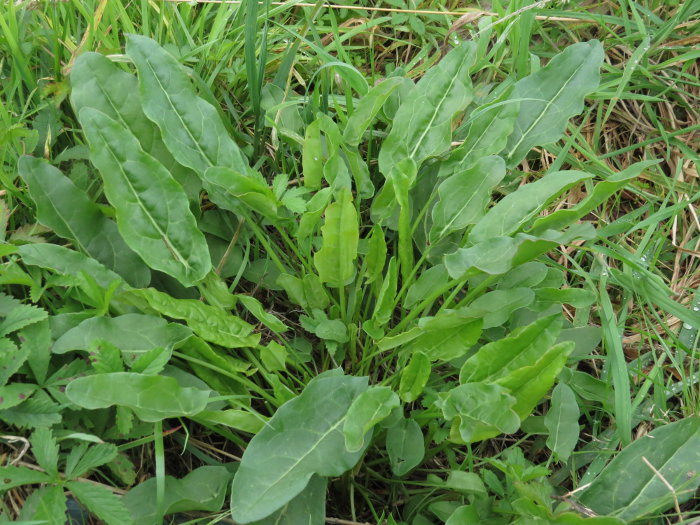
At a glance, the sorrels have noticably arrow-shaped leaves. Their leaves are smaller and more narrow than most other docks found here.
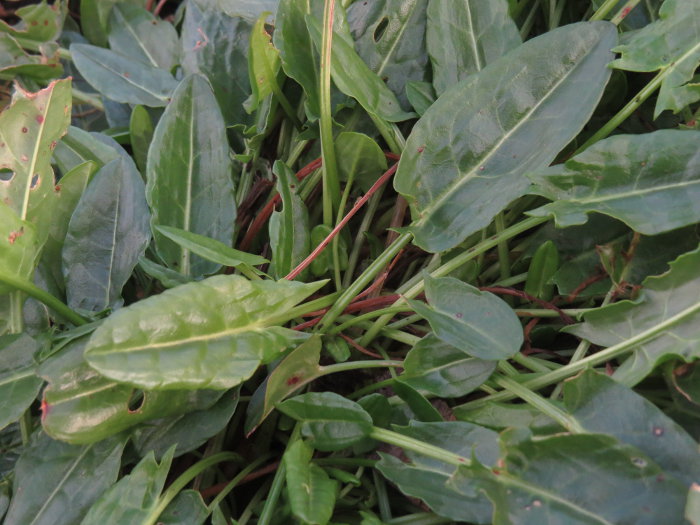
Common sorrel has downward-pointing basal lobes that always taper to a point. The prominent white mid-vein branches and (these two features separate the tasty sorrel from the dangerous lords and ladies – Arum maculatum).
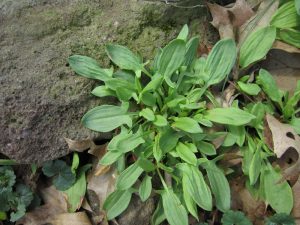
Sheep’s sorrel leaves are smaller, and identified by prominent side lobes at the base of the leaf.
Close inspection of Rumex plants show the leaf margins are entire. Some species have undulating leaves.
The curly dock (R.crispus) has oblong-lanceolate leaves with distinctly wavy or crispy margins.
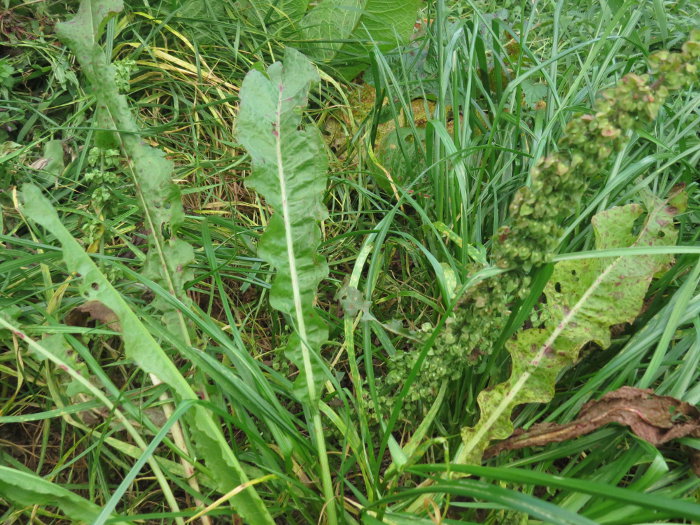
Its leaves are tapered inwards at the base. In general our docks have quite broad leaves on long petioles.
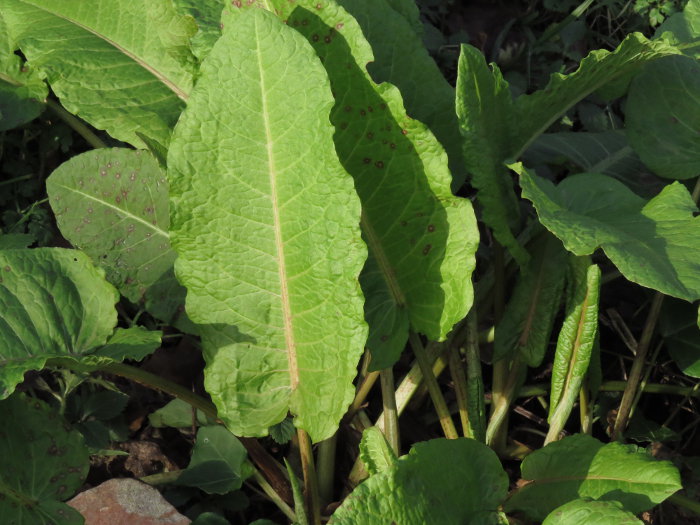
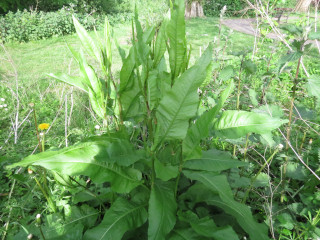
In the UK, the broad-leaved dock (R.obtusifolius) has the largest leaves. These are oval-oblong and display less of a wavy edge. They are typically cordate at their base.
The very young leaves of all docks may have a slight hint of oxalic acid like sorrel. I find the wood dock (R.sanguineus) to be a good salad when young and tender.
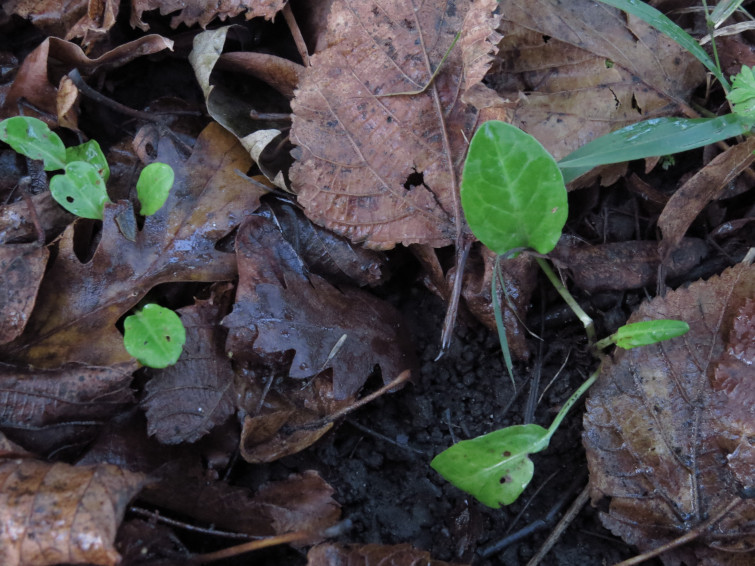
The wood dock and the great water dock are two other plants in the genus that I eat when out and about. Young wood dock leaves carry hints of oxalic acid, similar to sorrel, whilst older leaves quickly become bitter and tougher.
The great water dock (Rumex hydrolapathum) grows on very long leaf stalks. These are quite acidic and resemble a milder rhubarb.
This plant can grow in dense stands on mudflats and riverbanks, although I don’t commonly find it on our freshwater river systems. It can only handle bare ground.
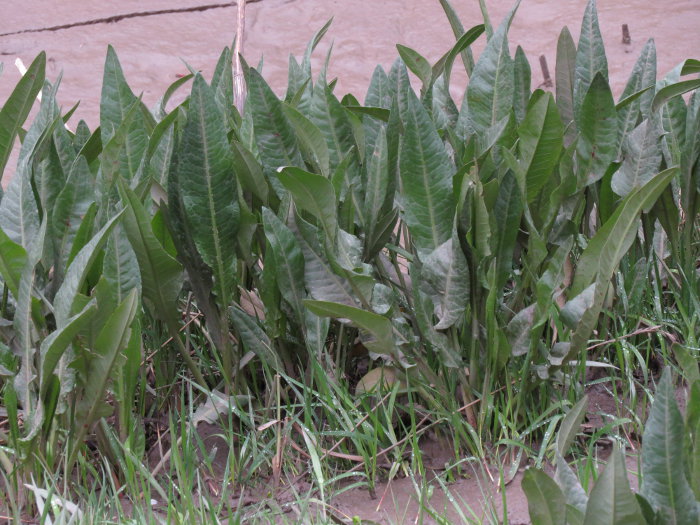
Stems that bend with papery knees
One of the key diagnostic features for the whole family will be found on the stems.
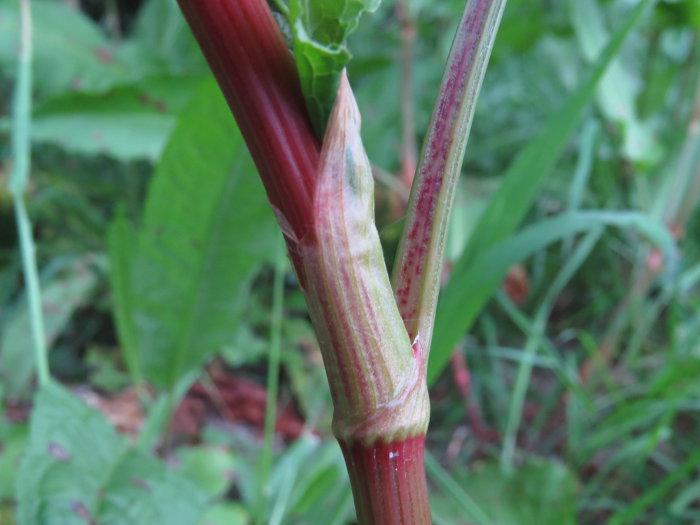
Here you will see a pronounced, angled joint. These are always initially covered in a papery sheath, or ocrea. You can see this family pattern repeating across all the various members of the family. As the plant grows the sheath will brown and wither.
The stem leaves of broad-leaved dock become narrow on the flowering stem. Often the stem leaves will have stipules at the base of the petioles.
All docks have a very similar-looking inflorescence. The flowering stems are green but can also carry a red-stripe. The broad leaved docks are occasionally found with completely red stems.
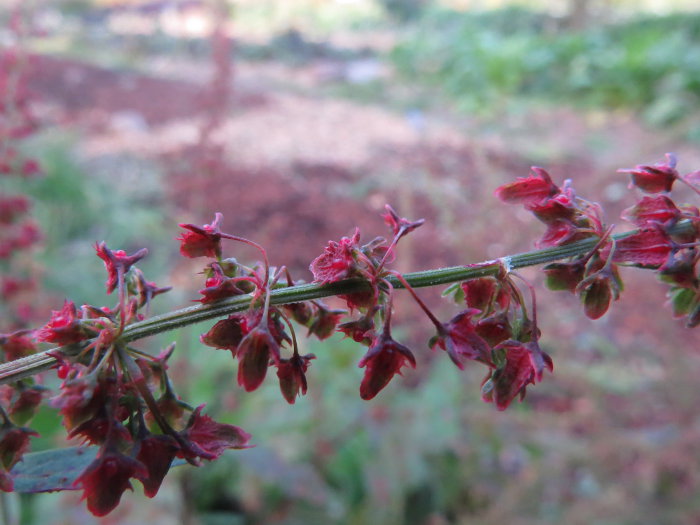
The stems are smooth, round, and fluted, with a solid, pithy core and few hairs, if any Dock flowering stems branch at acute angles towards the top.
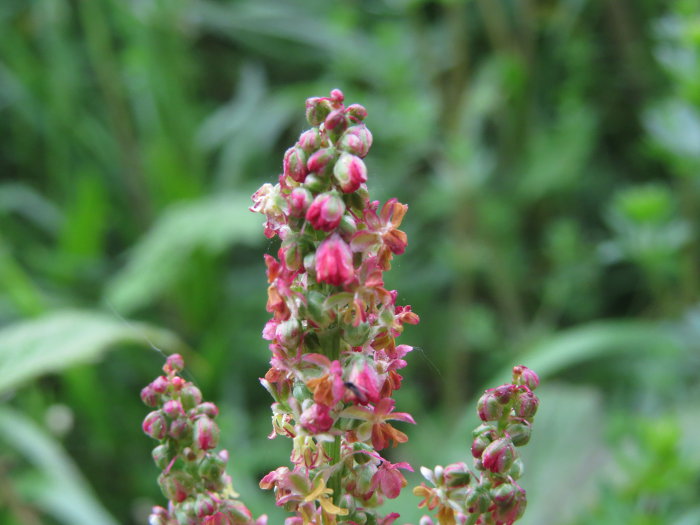
The flowers are individually small and don’t really catch the eye unless in close quarters. Although the reds and pinks you get from the stems on some species under dappled sunlight is quite striking. Other docks, like R.crispus are much more green-yellow to look at.
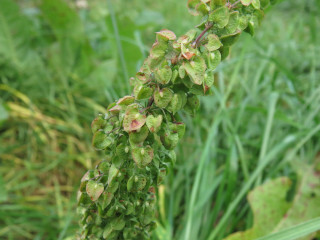
The flowers have six green, petal-like sepals. Three tiny outer ones, and three larger inner ones, surrounding the ovary. Typically 5-10 mm long, the flowers emerge from the upper leaf axils, growing on small stalks in dense whorled clusters, on branches 5-20 cm long.
Dock flowers are scentless, and often carry red ‘wart-like’ growths on the inner sepals. It is the size and shape of the sepals, plus the presence and shape of the ‘warts’ that helps distinguish between the numerous and similar-looking dock species.
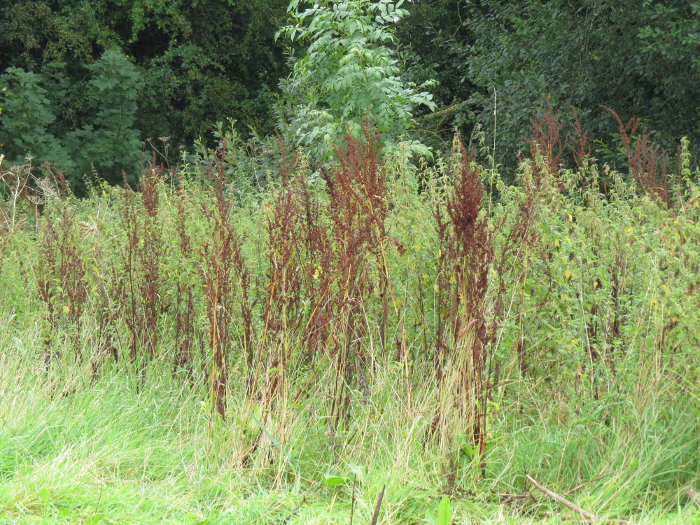
As dock seeds mature, they and the stems turn a rich brown colour. these stems will persist right through into late winter.
Habitats to find sorrel and other docks
In a word, everywhere!
The common sorrel shares nearly all its habitats with other docks. Look in fields, woodland clearances and woodland edges, hedgerows, coastal locations and wasteground in urban settings. You won’t need to look too long.
Foraging facts about sorrel and other docks.
Parts used: Root, leaves, stems, leaf stalks, and seeds. Learn how best to harvest medicinal and edible plants in this guide.
Harvest
Roots: early spring or autumn. Leaves: when small and young.
Key constituents
Tannins; flavonoids (including quercetin, lutin); anthraquinones (emodin, chrysophanol); phytosterols (beta-sitosterol, daucosterols); phenolic acids (isovanillic acid, p-hydroxycinnamic acid).
Actions
Astringent, anti-bacterial, cholagogue, alterative, tonic, aperient, anti-oxidant.
Pharmacology and uses
These plants are a somewhat recent addition to the European herbal pharmacopeia. However, they have been a mainstay in the repertoire of Native American indigenous people.
Via the tribes, North American physicians eventually brought these plants to the attention of western herbalists in the latter half of the 19th century. Previously the plant had enjoyed centuries of use.
The reported anti-bacterial action stems from phenolic acid components, whilst the flavonoids are known for antioxidant activity. Members of the Rumex genus are gentle laxatives or aperients.
It is likely that the small amounts of anthraquinones are responsible for this action as they are in rhubarb. In this overview of plant chemistry, you can read more about important medicinal plant constituents and actions.
The alterative herbs such as dock, act in a non-specific way on the digestive tract and liver. Through helping the liver remove toxins, alteratives are known as blood purifiers.
They are often employed to treat skin conditions such as psoriasis, boils, eczema, and for any conditions where skin eruptions and itching are prominent.
As a medicine, Sheep’s sorrel is becoming increasingly well known as one of the herbs in Essaic tea. Manufacturers of Essaic tea point to the use of sheep’s sorrel in fighting cancer, and aiding cellular regeneration.
Docks can generally help the digestive system by enabling the increase of gastric juices, including bile, and by encouraging bowel movement.
This is partly due to their bitterness. Culpeper mentioned that ‘bloodroot’ (as docks were often called), ‘purified the blood and strengthened the liver’. By detoxifying and toning, the liver becomes less congested and stronger. In days long gone, docks were also used to treat scurvy.
With a high concentration of iron, docks are helpful in treating anaemia. The root has been used as a poultice for this very reason.
The tannins and their astringent qualities mean internally irritated membranes will be soothed and protected. Externally the root will be useful in treating haemorrhoids.
Many people have heard of using docks for treating nettle stings, and the majority of them might agree that rubbing dock leaves on the stings was basically pointless.
That’s because it’s the gel from the new leaf shoots at the centre of the plant that help with stings and burns, not rubbing the leaf. I still prefer ground ivy for nettle stings, but finally I’m appreciating how docks work, thanks to Monica Wilde.
Research into the analgesic action of anthraquinones in Aloe vera, suggests it could be the same types of molecules present in the dock gel surrounding the emerging leaf shoots, that soothes the irritation from nettles. Read all about medicinal plant constituents and actions here.
Sorrel and other docks as food.
All plants of the Rumex genera have completely edible above-ground parts, though not many are tasty when eaten raw, like the sorrels.
The common sorrel has long been celebrated in France, where numerous recipes exist for sorrel soup and sauces.
The sour and tart flavour of sorrels makes it a superb accompaniment to fish dishes. Its distinctive sour flavour is due to oxalic acid.
The plant family as a whole are noted for higher-than-average oxalic acid content. People with kidney stones should avoid foods that are rich in oxalic acid. Sorrel or any dock should only be eaten occasionally for these reasons.

Saying this, I love collecting bunches of it when I’m making a wild winter salsa verde.
The sorrels, together with other aromatic herbs like ground ivy, wild celery, jack-by-the-hedge, various pungent Alliums, black mustard and watercress, are all available in our darkest months.
Sorrel and other docks are nutritious food plants, but the majority of them are too coarse for salads or tender ‘spinach’. In a survival situation, however, the docks will be one of the first going in the cooking pot.
The leaves contain a higher nutritional punch than spinach, containing roughly one third more iron. Docks have more fibre and Vitamin A than an equal amount of carrots.
The water dock will be found with leaves up to 1 m long and growing on 30 cm leaf stalks. When young these are worth using as a rhubarb replacement with a pronounced succulent crunch.
The blood-veined sorrel (Rumex sanguineus var sanguineus) has become a popular salad variety, and will occasionally be found growing naturalised in the UK.
This plant is essentially a red-veined version of the wood dock, and so doesn’t replace sorrel in any shape or form for flavour or texture.
Discover more of my foraging tips and hacks to fast track your success. If you want to know at a glance which plant and what plant parts are in season, then check out my other guides.
If you would like to practically learn the practical skills of the forager, then check out our beginners guide. Finally, keep an eye out for my one to one foraging mentoring. There’s no better time to start learning than today!