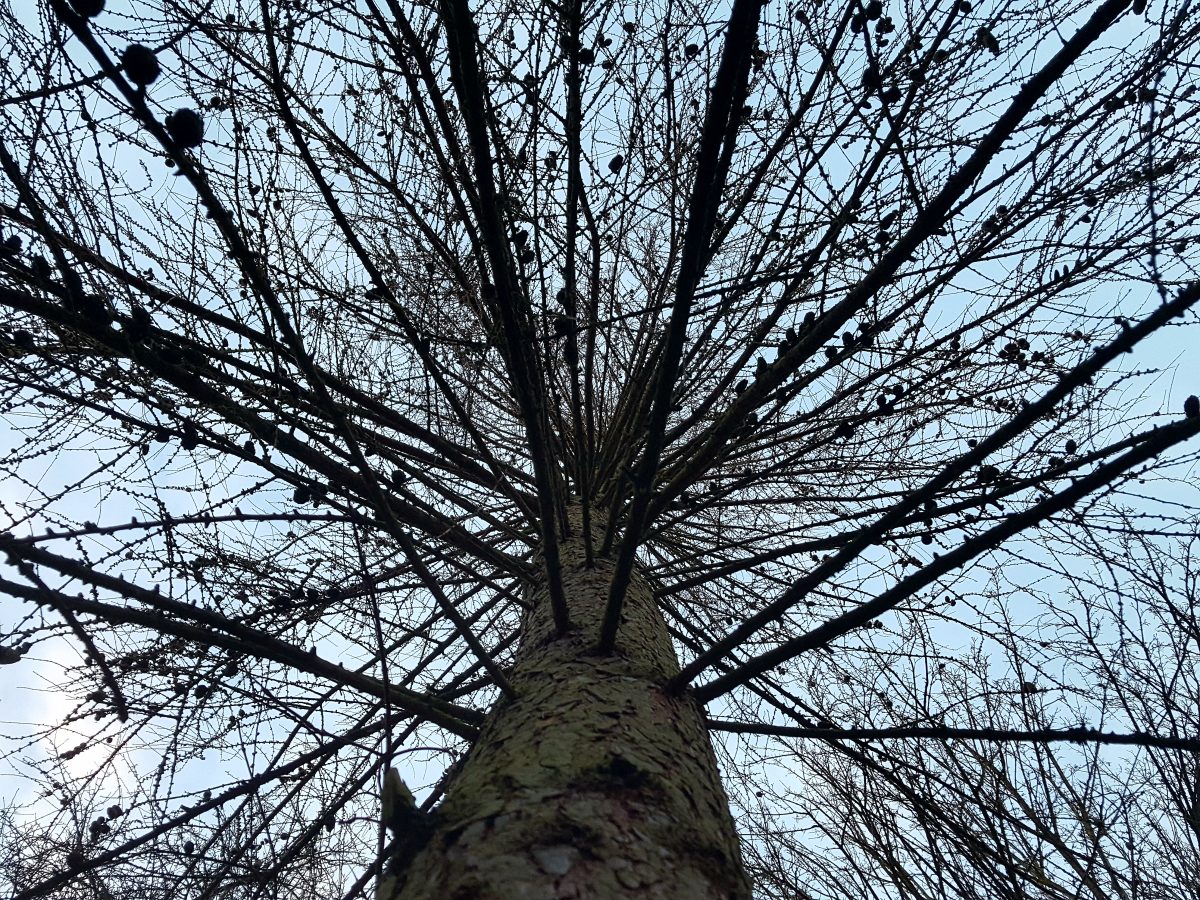
Bring some springtime zing into your life and go foraging for Larch leaves (Larix decidua, L.Kaempferi, and L. x marschlinsii) Pinaceae family
For me, one the best treats of spring are the zesty pine-lemon flavours we can get from foraging for Larch leaves and other conifer trees.
I couldn’t really care less that they are not native trees, because larches harmonize superbly with our mix of deciduous and evergreen species in the landscape, creating spectacular golden autumn displays.
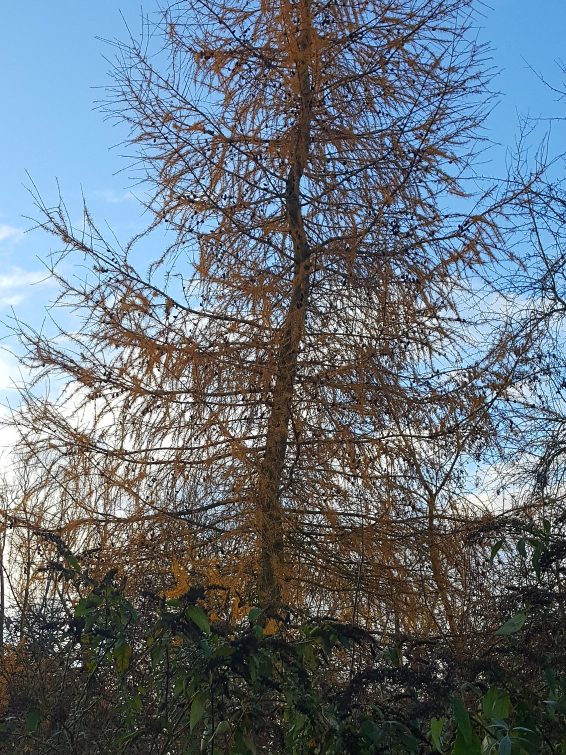
The European larch was reportedly first brought to Britain in the early 1600’s. The Japanese larch was subsequently brought here in the early 1800’s as a superior timber tree, due to increasing incidences of canker (a type of fungal infection) affecting the European larch.
The Japanese larch doesn’t suffer from canker as badly, and will therefore yield a better timber crop.
You can now find three larches in the UK. The third larch to naturalise in these islands was as a result of a cross between the European and Japanese larches.
The larches produce a superb spring and autumn show, and offer us foragers tasty reward from their fresh new foliage.
Both its purple and green cones, and its golden-yellow autumn leaf display can stop you in your tracks when you chance on one or more of these plants.
What’s in a name?
The English name larch can be traced back to the old Greek word ‘láros’, meaning pleasant. This word is almost certainly from where the Latin name Larix originates from.
The old German word ‘Larche’, and the old French name ‘Larice’ show more of the lingual roots.
Our common name is also similar to the Danish name ‘Lærke’ and the Dutch word ‘Lorken’, both derived from the old Latin name ‘Larix’ (also Laricis).
My etymology research suggests this word may have been co opted from an Alpine-Gaulish language.
The species name decidua refers quite obviously to its deciduous nature, which is quite unusual for the conifer-bearing ‘evergreen’ trees.
The species epithet kaempferi is in honour of the 17th century botanist Englebert Karmpfer. The hybrid was named after the late 18th century botanist, Carl Ulisses von Salis-Marschlins.
Botanical description
Leaves: Larches are notable for producing many needles from each shoot. Anywhere from 12 to 30 are found on the European larch (L.decidua)
Whereas a range of 15 to 40 needles can be seen on the Japanese larch (L.kaempferi), and between 40 to 50 needle leaves on the hybrid (L.marschlinsii) will be visible.
The leaves of the European larch are a vibrant bright green colour. They are typically around 5 – 7 cm long and 1 mm wide. Leaf midribs are raised below.
Petioles: The leaves of all three species are sessile, so petioles are not present, but you will see a short shoot or leaf ‘cushion’ from where the needle leaves arise. The shoots can be between 3 – 7 mm long.
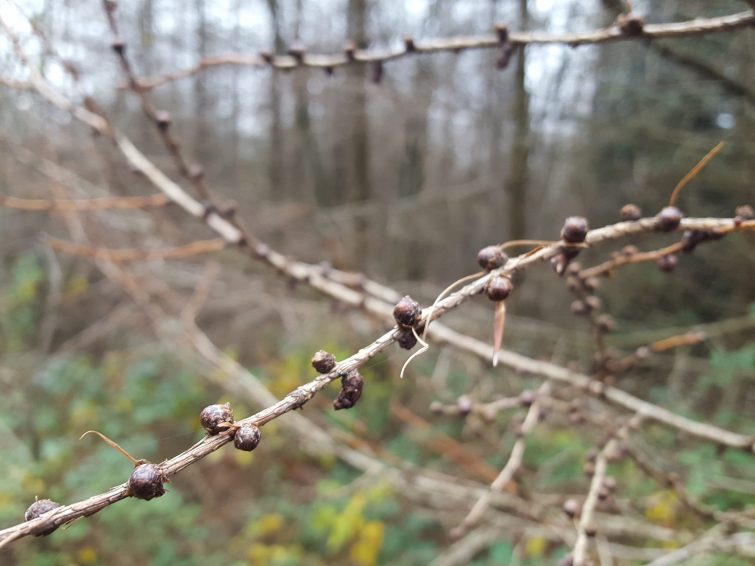
Buds: The ovoid-shaped, light-brown buds are approximately 4 mm long, 3 mm across and with numerous scales.
Twigs: The twigs and old cones easily gather algae, moss, and lichen on the living and dead twigs, so the actual tissue colour can be difficult to see.
The European larch has hay-coloured, hairless twigs, while the Japanese type has initially pruinose stems, that develop a reddish brown tinge. They are sometimes sparsely hairy to hairless.
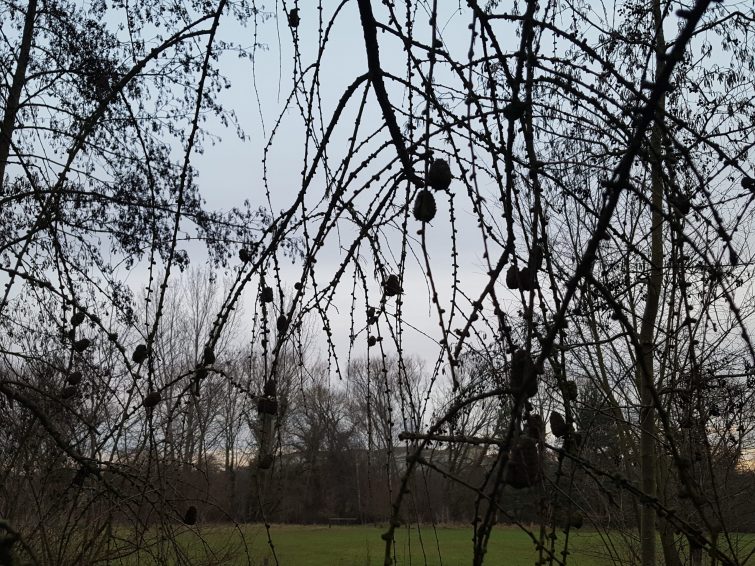
The hybrid larch has twigs somewhat pinkish-brown, and usually hairless.
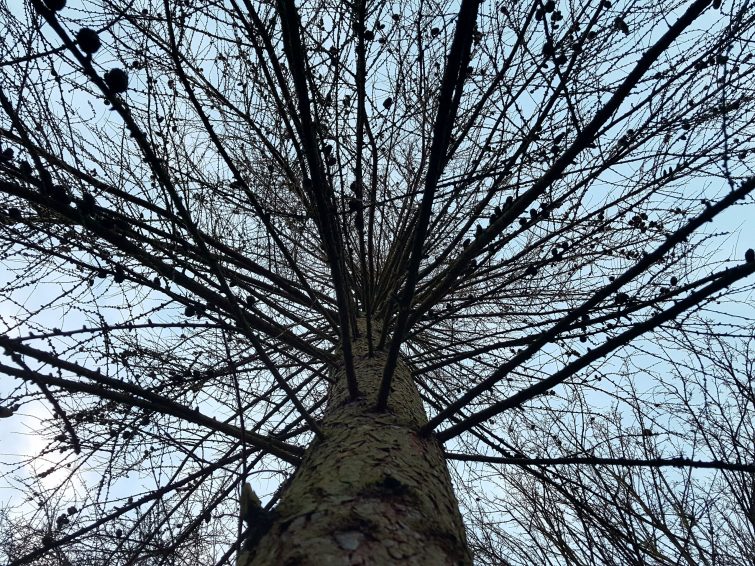
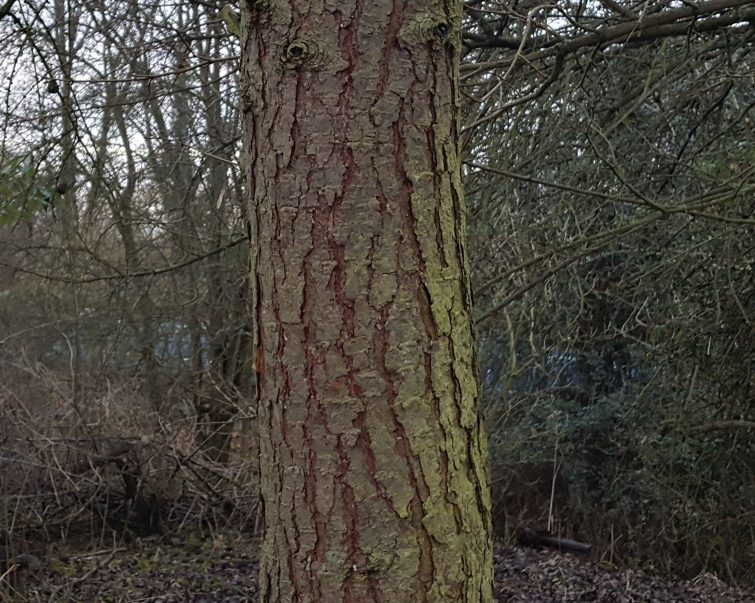
Bark: The bark takes on a pink to russet brown appearance from an early age, developing the narrow fissures as it matures. The bark can bulk up to a thickness of 10 cm on large specimens.
Habitats: The vast majority of larch trees in the UK are in plantations. You will also come across plants borne from parent’s plantations, or as amenity specimens in parks and gardens.
All three are naturalised in the wild across much of Britain, at a range of sites on various soils. All these sites will meet its requirements of being not to dry or too wet.
Flowering season: Depending on your location you can go see rhe flowers during April into May.
Flower colour: The European larch produces absolutely stunning purple-coloured female flowers. They are often sited close to the smaller, yellow, pollen-loaded male flowers.
Japanese larch produces creamy yellow flowers. The hybrid is the most boring-looking for me, with its yellow-green colour. These flowers are larger than the other two with broader cone scales.
The flowers eventually harden and turn grey-brown. When pollinated they produce tiny seeds inside their 6 – 7 cm long cones.
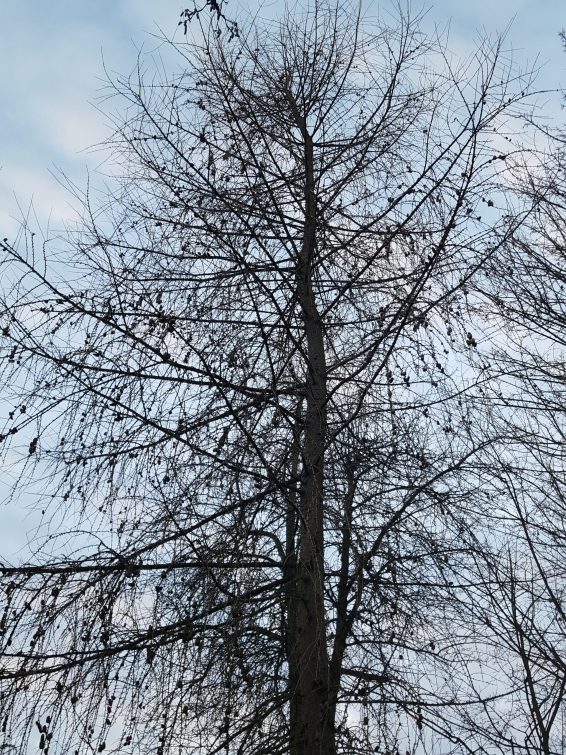
Fruits: Being gymnosperms, these plants produce ‘naked seeds’ without a fleshy or dry membrane to protect it from the outside world. The conifer plants are older in evolutionary terms than the rest of the flowering plants (angiosperms) found on Earth.
The larch produce copious amounts of seed which are a valuable source of food for birds.
Harvesting time: These are getting increasingly difficult to call due to global heating. In southern England you can generally go out foraging for larch leaves and their fresh, zingy flavour anytime from early May.
Other Notes. Chefs love playing with the aromatic needles. The young shoots and needles can be boiled and eaten. You can use the lemon-pine flavours in sauces, sorbet, ice cream, syrups, cordials, cakes and more! The leaves also make a very refreshing and vitamin C-loaded tea.
Like a number of trees, the inner cambium layer of bark can be collected and ground into a flour amendment.
If you look carefully in the summer and early autumn you may find edible fungi. There are a few edible mushrooms commonly called by the name ‘larch bolete’ you can find when out foraging.
Possibly the most common species is Suillus grevillei. This reddish brown-coloured fungus can be found growing in close quarters to the various species of larch.
Sadly, due to another type of fungus (Phytophthora ramorum) a.k.a ‘ramorum disease’, ‘larch tree disease’, and ‘larch sudden death’, the value of larch as a timber crop has crashed. This water mould is a notifiable disease. Essentially the plant is now worthless as a forestry crop in some areas.
More photos of the plants in spring and summer will appear here so remember to check back!